
债市修复

Search documents
方正富邦基金区德成:7月制造业PMI指数出炉 经济短期波动向好恢复基础仍在 利好债市修复
Zhong Guo Jing Ji Wang· 2025-07-31 08:53
Group 1 - The core viewpoint of the articles indicates that the manufacturing PMI in China for July 2025 is at 49.3%, a decrease of 0.4 percentage points from the previous month, suggesting a slight contraction in the manufacturing sector [1] - The PMI is a key indicator that reflects the economic conditions in the manufacturing sector, covering aspects such as production, orders, and inventory, and is considered a leading indicator for macroeconomic trends [1] - Large enterprises reported a PMI of 50.3%, down 0.9 percentage points; medium enterprises saw an increase to 49.5%, up 0.9 percentage points; while small enterprises reported a PMI of 46.4%, down 0.9 percentage points [1] Group 2 - Among the 13 sub-indices, several showed increases compared to the previous month, including the purchasing price index, factory price index, employment index, supplier delivery time index, and production activity expectation index, with increases ranging from 0.1 to 3.1 percentage points [1] - Conversely, indices such as production, new orders, new export orders, backlog orders, finished goods inventory, purchasing volume, and raw material inventory all declined, with decreases ranging from 0.3 to 0.8 percentage points [1] - Despite short-term economic fluctuations, the long-term outlook remains stable, supported by steady domestic demand and manageable declines in the business ecosystem [1]
固收事件点评报告:政治局会议后,债市或修复
ZHONGTAI SECURITIES· 2025-07-30 14:17
Report Industry Investment Rating No relevant content provided. Core View of the Report - The bond market may experience a short - term repair after the Politburo meeting. Three major concerns in the bond market have been alleviated, and the bond interest rate has started a repair trend. However, in the long - term, the probability of interest rates breaking through the low point is small, and the interest rate center may fluctuate upwards [4][5][9] Summary by Related Contents 1. Policy Content of the Politburo Meeting - The meeting set a "good" tone for the economy in the first half of the year, stating that the economy was stable with progress, and high - quality development achieved new results. In the second half of the year, economic work emphasizes "enhancing awareness of potential perils and adhering to a bottom - line mindset", and policy implementation may emphasize execution while reserving some flexibility [3][6] - Macro - policies should continue to exert force and increase strength in a timely manner. Fiscal policy should be more proactive, and monetary policy should be moderately loose. Policy tools should support key areas such as science and technology innovation, consumption, small and micro - enterprises, and foreign trade [3] - Science and technology innovation and boosting domestic demand are important policy measures. The meeting emphasized the leading role of science and technology innovation in new - quality productivity and placed more emphasis on consumption than investment in domestic demand [3] 2. Factors Affecting the Bond Market - Recently, the bond market has been weak, mainly suppressed by risk preference and inflation trading. The strengthening of the equity and commodity markets since June has suppressed bond market sentiment, and the "anti - involution" has raised inflation expectations [7] - Before the meeting, concerns in the bond market mainly included the possibility of excessive total - volume policies, real - estate policies, and the confirmation of "anti - involution" policies. After the meeting, these concerns were basically dispelled [4][5][7] 3. Analysis of the Bond Market's Future Trend - In the short - term, the bond market may repair. The meeting confirmed the economic achievements in the first half of the year, with a low probability of excessive total - volume policies. It did not directly mention real - estate policies, and the "anti - involution" statement was weakened, which may lead to a decline in inflation expectations. Additionally, moderately loose monetary policy also supports the bond market [4][5][10] - In the long - term, the probability of interest rates breaking through the low point is small, and the interest rate center may fluctuate upwards. It is recommended to focus on trading opportunities from oversold rebounds rather than heavy - position participation [9]
基金密集出手!
中国基金报· 2025-07-29 11:57
Core Viewpoint - The bond market has experienced significant adjustments since July, with a notable "seesaw" effect observed between the stock and bond markets, leading to large redemptions in bond funds and adjustments in net asset value precision [1][3]. Group 1: Market Performance - As of July 28, the average return of pure bond funds was -0.05%, with only 40% of products achieving positive returns [3]. - Nearly 40 bond funds have announced large redemptions since July, compared to 19 and 14 in June and May, respectively [3]. Group 2: Redemption and Adjustments - Major fund companies, including Guotai Junan, Huashang, and others, have raised the net asset value precision of their bond funds due to large redemptions [3]. - The adjustment in net asset value precision aims to protect the interests of fund holders from adverse effects caused by the precision of net asset value [3]. Group 3: Market Outlook - The bond market is expected to maintain a volatile pattern in the medium term, with a focus on short-term recovery opportunities [5][7]. - Factors such as the improvement of deflation expectations and the easing of US-China tariff frictions are expected to exert pressure on the bond market [6][7]. - The potential for a rebound in the bond market exists, driven by the recent central bank liquidity injections and the anticipated stabilization of the economic environment [4][8].


债市修复窗口有望逐步开启,30年国债ETF(511090)近5日“吸金”21.54亿元
Sou Hu Cai Jing· 2025-07-16 07:12
Group 1 - The 30-year Treasury ETF (511090) has seen a slight increase of 0.02%, with the latest price at 124.87 yuan, indicating active market trading with a turnover of 28.1% and a transaction volume of 5.057 billion yuan [1] - The latest scale of the 30-year Treasury ETF reached 18.008 billion yuan, marking a one-month high, with net inflows of 2.154 billion yuan over three out of the last five trading days [1] - The central bank conducted a reverse repurchase operation of 342.5 billion yuan and initiated a total scale of 1.4 trillion yuan for a buyout reverse repurchase operation, signaling stable liquidity and a potential recovery window for the bond market [1] Group 2 - The current DR001 rate is around 1.3%, while the one-year AAA interbank certificate of deposit yield remains above 1.6%, suggesting some investment appeal despite recent strong performance in the equity market [2] - The 30-year Treasury ETF closely tracks the China Bond 30-Year Treasury Index, which consists of publicly issued 30-year treasury bonds, serving as a benchmark for investment in this category [2]
央行加大投放进行时 资金面稳定助力债市修复
Shang Hai Zheng Quan Bao· 2025-07-15 18:26
Core Viewpoint - The People's Bank of China (PBOC) is actively managing liquidity through increased reverse repurchase operations, signaling a commitment to stabilize market expectations and credit conditions amid a peak in government bond issuance [1][2][3]. Group 1: PBOC Operations - On July 15, the PBOC conducted a reverse repurchase operation of 342.5 billion yuan with a fixed interest rate of 1.4%, resulting in a net injection of 173.5 billion yuan for the day [1]. - The PBOC also announced a total of 1.4 trillion yuan in buyout reverse repurchase operations, with 800 billion yuan for 3-month and 600 billion yuan for 6-month terms, indicating a proactive approach to liquidity management [1][2]. - The total amount of buyout reverse repos maturing in July is 1.2 trillion yuan, with a net injection of 200 billion yuan for the month, marking the second consecutive month of increased operations [1][2]. Group 2: Market Conditions - Analysts note that the current liquidity environment is under pressure due to a significant tax payment period and increased government bond issuance, with expected net financing exceeding 1 trillion yuan [3][4]. - The liquidity disturbances are manageable, with analysts suggesting that the impact of tax payments on liquidity is historically controllable, typically within a fluctuation range of ±2 basis points for representative rates [3][4]. - The overall market sentiment remains stable, with the PBOC's actions expected to maintain a steady interest rate environment, although the balance between liquidity disturbances and market expectations will be crucial for asset pricing [4]. Group 3: Bond Market Outlook - The bond market is anticipated to benefit from the PBOC's reverse repurchase operations, potentially leading to a recovery if liquidity remains stable or improves [5]. - As of July 15, the yields on 30-year and 10-year government bonds have decreased slightly, indicating a positive response to the PBOC's liquidity measures [5]. - Analysts recommend a strategy of increasing allocations to high-grade credit bonds as opportunities arise, while closely monitoring interest rate changes and policy actions [5].

基金密集出手!
Zhong Guo Ji Jin Bao· 2025-07-09 08:26
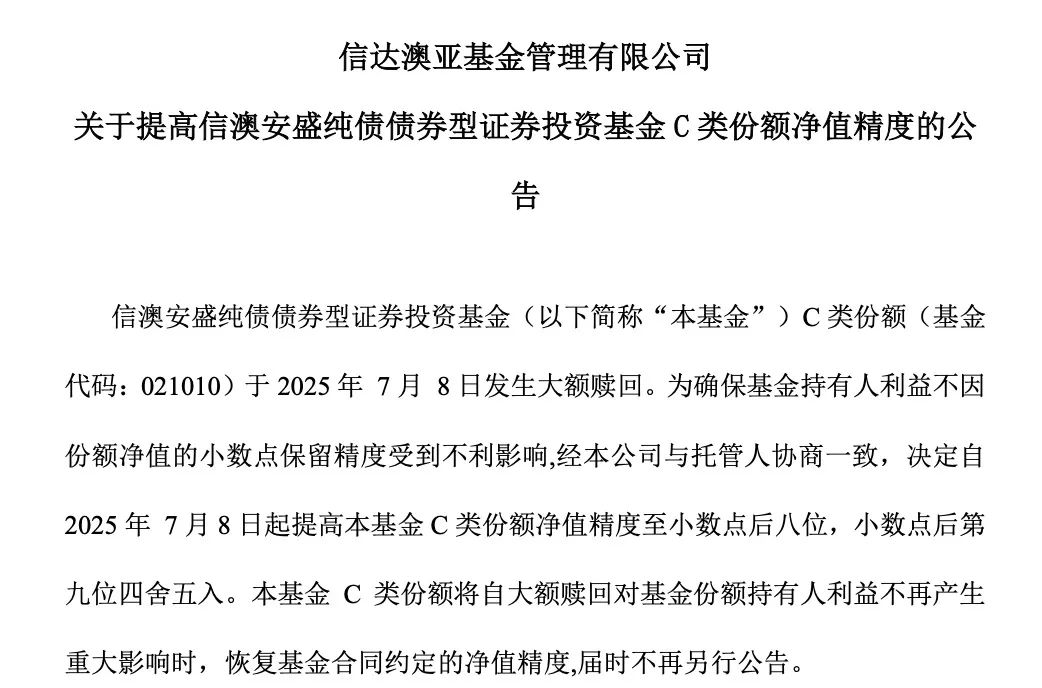
Core Viewpoint - Multiple fund companies are increasing the precision of their net asset values (NAV) in response to large redemptions, primarily affecting bond funds, to protect the interests of their investors [1][2][5]. Fund Adjustments - On July 9, Xinda Australia Fund announced an adjustment to the NAV precision of its Xin'ao Anshengli Pure Bond Fund due to a significant redemption on July 8, 2025, increasing the precision to eight decimal places [2]. - Similarly, Hui'an Fund announced on July 9 that its Hui'an Yutai Pure Bond Fund would also increase its NAV precision to eight decimal places following a large redemption on July 7, 2025 [5]. - Other fund companies, including Huashan, Guotai Junan Asset Management, and others, have also made similar announcements regarding NAV precision adjustments due to large redemptions occurring in early July [5]. Market Conditions - The bond market has transitioned from a bull market to a high-volatility phase, with cautious sentiment prevailing among fund companies [6]. - According to Yifangda Fund, liquidity issues in July are less severe than in June, and the recent stock market rally has improved market risk appetite, which may temporarily affect long-term bond rates [6]. - Jia Shi Fund anticipates that macroeconomic and liquidity conditions will remain favorable for both stock and bond investments, with expectations of continued monetary easing [6]. Future Outlook - Ping An Fund highlights potential risks in the bond market due to adjustments after significant gains, with limited upside in yield levels [7]. - Credit bond yields and spreads have fluctuated since the beginning of 2025, with expectations of continued downward movement in credit bond yields due to sustained liquidity [7].
基金密集出手!
中国基金报· 2025-07-09 08:15
Core Viewpoint - Multiple fund companies are increasing the precision of net asset values to address redemption issues, particularly in bond funds, as the bond market enters a recovery phase but remains cautious [2][6]. Group 1: Fund Adjustments - Several fund companies, including Xinda Australia Fund and Huian Fund, have announced adjustments to the net asset value precision of their funds due to significant redemptions, increasing precision to eight decimal places [4][5]. - Other companies such as Guotai Junan, Changcheng, and Jiashi have also made similar announcements regarding their bond funds in response to large redemptions [4][5]. Group 2: Bond Market Outlook - The bond market has transitioned from a bull market to a high-volatility phase due to factors like liquidity, tariff negotiations, and risk appetite, with a cautious sentiment prevailing [7]. - Companies like Yifangda Fund indicate that liquidity issues have lessened compared to June, and while short-term impacts from stock market strength may affect long-term bond yields, the overall trend is expected to be downward [7]. - The macroeconomic environment remains favorable for both stock and bond investments, with expectations of continued monetary easing and potential rate cuts to support market liquidity [7]. - Credit bonds are anticipated to see a decline in yields, with limited space for compression in short- to medium-term credit spreads, while long-term credit bonds may experience a similar trend [8].

资金宽松支撑债市,短期债市或迎修复,政金债券ETF(511520)昨日净流入超1.6亿,近10日净流入超18亿
Mei Ri Jing Ji Xin Wen· 2025-05-14 03:01
Group 1 - The core viewpoint of the article indicates that the bond market is experiencing a supportive environment due to a generally loose liquidity situation, despite a recent net withdrawal by the central bank [1] - The 30-year main contract for treasury futures rose by 0.13%, and the yield on the 30-year treasury bond decreased by nearly 2 basis points [1] - The upcoming reserve requirement ratio (RRR) cut on the 15th is expected to further support the bond market, with the 10-year treasury yield likely facing an adjustment ceiling around 1.7% [1] Group 2 - The recent inflow into the government bond ETF (511520) exceeded 1.8 billion, bringing its total scale to over 46.4 billion, making it the largest bond ETF in the market [1] - The government bond ETF has a duration of approximately 7.5 years, offering good liquidity and serving as a useful tool for bond market trading and allocation [1] - Related products include the government bond ETF (511520) and various classes of the Fortune China Bond 7-10 Year Policy Financial Bond ETF [1]
大金融观察系列之十一:保险减持银行资本债,怎么看?
HUAXI Securities· 2025-05-14 01:52
1. Report Industry Investment Rating No relevant information provided. 2. Core Viewpoints of the Report - Insurance institutions have been reducing their holdings of bank capital bonds since Q2 2024, and this behavior is not the decisive factor for the trend of bank capital bonds. Instead, fund and other trading - type institutions play a key role in determining the credit spread trend of bank capital bonds [1][3][49] - 4 - 5 - year large - bank capital bonds still have certain cost - effectiveness and can be bought during price adjustments, as there is potential for spread compression and they can provide good coupon income [5] 3. Summary According to the Table of Contents 3.1 Recent Reasons for Insurance's Net Selling of Bank Capital Bonds 3.1.1 Changes in Insurance Allocation Behavior Since Q2 2024 - From 2021 - 2023, insurance institutions significantly increased their holdings of bank capital bonds, with secondary - market net purchases of about 148.1 billion, 222.3 billion, and 396.5 billion yuan respectively. However, since Q2 2024, they have shifted to net selling, with quarterly net sales of 5 - 7.5 billion yuan from Q2 - Q4 2024. In 2025, they had a small net purchase of 1.12 billion yuan in Q1 and a net sale of 5.57 billion yuan in April [11] - Insurance institutions, as typical allocation - based investors, usually buy when prices are down and sell when prices are up. Generally, the scale of their daily net purchases of other types of bonds (mainly bank capital bonds) is positively correlated with the credit spread of 5Y AAA - second - tier capital bonds. But since Q4 2023, this correlation has been negative in some periods [12] - The reasons for continuous reduction and reverse operations may be: the decreasing yield of bank capital bonds in recent years, making their relative cost - effectiveness low; sufficient supply of local government bonds, leading insurance institutions to prefer them; and under the new accounting standards, insurance institutions are more cautious about bank capital bonds due to high valuation volatility [18][22][33] 3.1.2 Insurance's Reduction in April May Be Due to a Combination of Cost - effectiveness and Valuation Stability Considerations - Since March, insurance has had a weak willingness to allocate bank capital bonds, especially with continuous large - scale reductions since mid - to late March. However, the recovery of bank capital bonds was not strong, and it was abnormal to sell on the basis of cost - effectiveness alone [2][39] - In April, there were many uncertainties such as tariff, fundamentals, and policies. To avoid account valuation fluctuations, insurance reduced bank capital bonds and increased the allocation of interest - rate bonds and inter - bank certificates of deposit [2][40] - In April, the issuance scale of state - owned and joint - stock bank capital bonds increased significantly, and some insurance institutions may have "sold short - term bonds and bought long - term bonds" [43] 3.2 Insurance Allocation Behavior Does Not Determine the Trend of Bank Capital Bonds - The motives for insurance institutions to reduce bank capital bonds still exist: the spread center of long - term large - bank capital bonds is unlikely to rise systematically; local government bond supply is unlikely to shrink; and all insurance companies will implement new accounting standards in early 2026 [3][47] - The impact of insurance institutions' reduction on the bank capital bond market may be limited. Currently, their holding scale is small, and they usually adopt a passive allocation strategy of buying more when prices fall, which can play a "stabilizer" role but has little impact on the market trend. Fund and other trading - type institutions are the decisive factors for the credit spread trend of bank capital bonds [47][49] 3.3 4 - 5 - Year Large - Bank Capital Bonds Should Be Bought During Price Adjustments - There is no need to overly worry about insurance institutions' reduction of bank capital bonds. Their holding scale is limited, and they are not the main price - setters. In the medium - to long - term, the reduction in insurance demand and the rectification of bank wealth management's net - value smoothing methods will affect the spread center of bank capital bonds [53] - Comparing the credit spread quantiles of bank second - tier capital bonds in 2025 (January - April) and 2024, the spread centers of 1 - 3Y large - bank capital bonds and 1Y small - and medium - bank capital bonds are similar, while those of 4 - 5 - year large - bank capital bonds and medium - to long - term small - and medium - bank capital bonds have increased to varying degrees [54] - 4 - 5 - year large - bank capital bonds have cost - effectiveness. With the implementation of reserve requirement ratio cuts and interest rate cuts and the progress of Sino - US negotiations, fundamentals may become the focus of market speculation. Currently, with stable funding rates, compressing spreads may be a dominant strategy. As of May 13, 2025, the yield of 4 - 5 - year large - bank capital bonds is around 1.95%, and there is still about 8 - 16bp of spread compression space compared with the 1/4 quantile in 2024 [5][56]