消费者支出

Search documents
美联储青睐通胀指标回升 消费支出几近停滞
Zhi Tong Cai Jing· 2025-07-31 14:09
Core Inflation and Consumer Spending - The core Personal Consumption Expenditures (PCE) price index accelerated to a year-high in June, with a month-on-month increase of 0.3% and a year-on-year increase of 2.8%, indicating limited progress in inflation relief over the past year [1][4] - Consumer spending, adjusted for inflation, showed minimal recovery after a decline in May, reflecting a stagnant economic environment [1][5] Divergence in Economic Indicators - Economic data reveals a tug-of-war: while inflation is stagnating, concerns over Trump's tariff policies potentially raising prices are growing, alongside a weak labor market leading to reduced consumer spending [2][3] - The Federal Reserve maintained interest rates at its fifth consecutive meeting, with two members dissenting in favor of a 25 basis point cut, highlighting internal divisions regarding monetary policy [4] Consumer Behavior and Spending Trends - Consumer spending has shown the weakest growth since the pandemic, with June's recovery primarily driven by a rebound in non-durable goods, while durable goods purchases have declined for three consecutive months, marking the longest streak since 2021 [5] - The root of consumer weakness is attributed to a cooling labor market, with real disposable income remaining flat after a decline in May and wage growth nearly stagnant [9] Inflation Drivers and Future Outlook - June's price increases were mainly driven by home goods, sports equipment, and clothing, reflecting the impact of import tariffs on consumer prices [9] - Economists warn of potential upward pressure on inflation due to a new round of tariffs expected to be announced by Trump, alongside sustained high levels of key PCE components [9]

美国6月PCE略超预期,美联储降息时间表再添变数!
Jin Shi Shu Ju· 2025-07-31 12:59
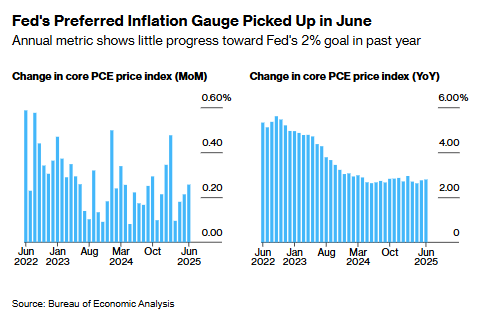
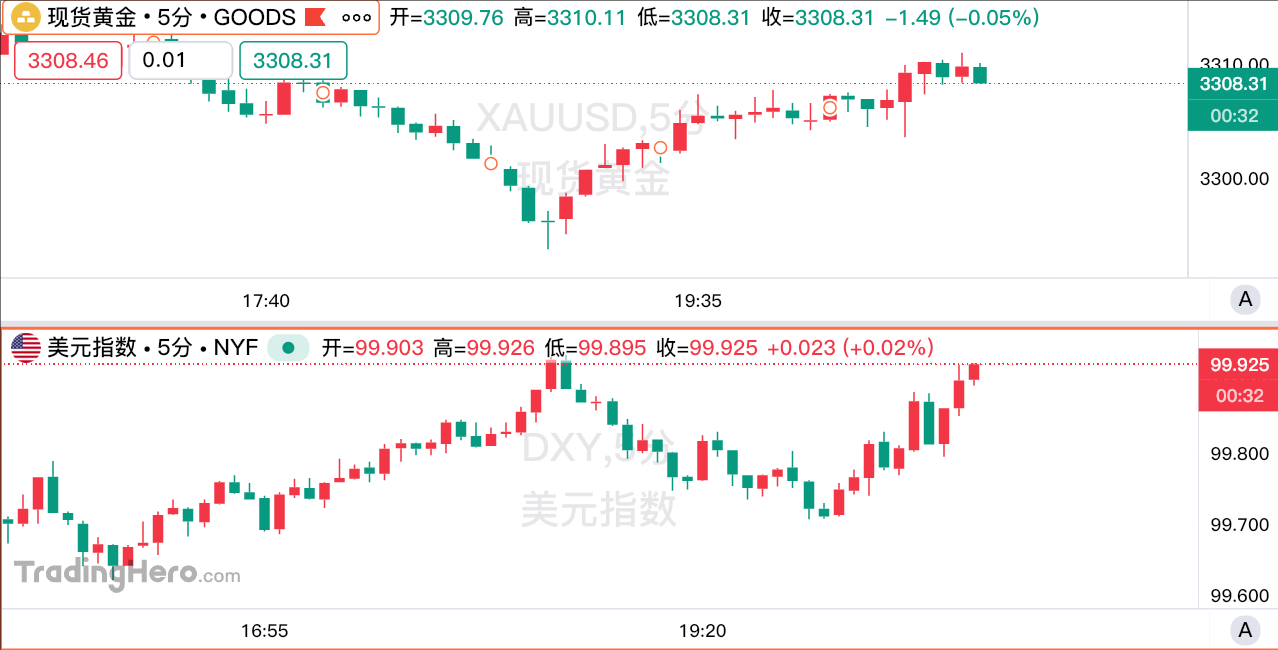
北京时间周四20:30,美国公布PCE数据,6月核心PCE物价指数年率录得2.8%,高于预期的2.70%,前值由2.70%修正为2.8%。6月核心PCE物价指数月率录 得0.3%,符合预期,高于前值的0.20%。 包含食品能源的整体PCE指数环比上升0.3%,同比上涨2.6%,分别高于市场预期的0.23%和2.5%。 数据还显示,个人消费支出价格指数环比上涨0.3%,将年率提升至2.6%,为2月份以来的最高水平。支出疲软的背后是劳动力市场降温。实际可支配收入在 5月份下降后持平,而工资和薪金几乎没有上涨。预计将于周五公布的7月就业报告将显示招聘持续放缓,失业率略有回升。储蓄率保持在4.5%。 美国系列数据公布后,现货黄金短线波动暂不大,美元指数短线小幅走高。 "美联储传声筒"Nick Timiraos表示,(6月)核心PCE通胀看起来开始恶化,并不比美联储去年开始降息时更好,从某些指标来看甚至更糟。6月份核心PCE 物价指数3个月年化率为2.6%(去年同期为2.3%)。按6个月年化计算,这一数字为3.2%(去年同期为3.3%)。 美国6月通胀数据略超预期,为美联储降息时间表再添变数。政策制定者此前强调,需要看 ...
美国6月PCE物价指数速评
news flash· 2025-07-31 12:45
Core Insights - The U.S. PCE price index for June increased by 2.6% year-on-year, marking the largest growth since December 2024, and exceeding the expected value of 2.5% and the previous value of 2.3% [1] - The core PCE price index for June rose by 2.8% year-on-year, the highest increase since February 2025, also surpassing both the expected and previous values of 2.7% [1] - Real personal consumption expenditures (PCE) in the U.S. grew by 0.1% month-on-month in June, aligning with expectations [1] Economic Indicators - The acceleration in inflation rates contrasts with minimal growth in consumer spending, highlighting a divergence among policymakers regarding the interest rate path [1]
美国关键通胀指标上升 而消费者支出近乎停滞
news flash· 2025-07-31 12:44
Core Insights - The core inflation indicator preferred by the Federal Reserve accelerated in June, marking one of the fastest increases this year, while consumer spending showed almost no growth, highlighting factors that create divergence among decision-makers regarding interest rate direction [1] Inflation Data - The core Personal Consumption Expenditures (PCE) price index, excluding food and energy, rose by 0.3% from May and increased by 2.8% year-on-year, indicating limited progress in curbing inflation over the past year [1] Consumer Spending - Inflation-adjusted consumer spending slightly rebounded in June after a decline in May, suggesting that economic pressures are causing Federal Reserve officials to have differing views on monetary policy direction [1] Economic Concerns - On one hand, the stagnation in inflation progress raises concerns among central bank officials about potential upward price pressures from tariffs imposed by President Trump. On the other hand, reduced consumer spending due to a weak labor market may lead to an overall economic slowdown [1]
美国消费数据回暖背后现隐忧!美国家庭可自由支配的服务支出已在缩减
Di Yi Cai Jing· 2025-07-21 11:00
Core Viewpoint - The article discusses the impact of tariff policies on consumer spending and inflation in the U.S., highlighting that while consumer confidence has shown signs of recovery, the long-term effects of tariffs are likely to lead to increased inflation pressure as pre-tariff inventories are depleted [1][8]. Group 1: Consumer Confidence and Spending - The University of Michigan's consumer confidence index rose to 61.8 in July, marking a 5-month high, but remains 16% lower than before the Trump administration [1]. - Retail sales in June increased by 0.6%, exceeding market expectations, while consumer spending on debit and credit cards grew by 7% and 4% respectively in Q2 compared to the previous year [4][5]. - Despite these positive indicators, Wells Fargo warns that consumer spending is not as robust as previously thought, with households reducing discretionary service spending [4][5]. Group 2: Discretionary Spending Trends - Discretionary service spending has shown a concerning decline, with a 0.3% drop noted in May, and a contribution of only 0.3 percentage points to GDP in the first quarter, the lowest since Q2 2020 [5][7]. - Consumers are increasingly opting for essential goods over discretionary items, as evidenced by shopping behavior during Amazon's Prime Day, where essential items were prioritized [6][7]. Group 3: Tariff Policy Effects - The effective tariff rate currently stands at 20.6%, the highest since 1910, yet inflation data does not reflect significant price increases due to tariffs [8][9]. - Key factors mitigating the impact of tariffs include declining energy prices and the Federal Reserve's tightening monetary policy, which has kept inflation in a downward trend [8][10]. - Import behavior has shifted, with a significant increase in imports prior to tariff implementation, leading to a stockpiling effect that has buffered immediate price impacts [8][9]. Group 4: Economic Outlook - The overall economic growth in the U.S. is expected to slow, with various economic indicators showing mixed performance and a general contraction trend [2][10]. - Low-income households are particularly vulnerable, as they are quickly exhausting pandemic savings and facing rising debt levels, which could lead to a significant impact on overall consumer spending [7][10].


美股震荡收平,市场淡化关税担忧
Wind万得· 2025-07-18 22:29
Core Viewpoint - The U.S. stock market showed stable performance with major indices entering a consolidation phase after consecutive gains, driven by strong economic data and corporate earnings, despite rising concerns over potential tariffs on EU goods [1][3]. Economic Data - The Michigan Consumer Sentiment Survey indicated a significant drop in short-term inflation expectations, with one-year inflation expectations falling from 5% in June to 4.4% in July, alleviating concerns about persistent inflation [2]. - The U.S. Department of Labor reported a decrease in initial jobless claims, signaling a healthy job market, following a period of increased claims earlier in the spring [6][7]. Corporate Earnings - Netflix reported second-quarter earnings that exceeded expectations but failed to excite the market, leading to a decline in its stock price due to high valuation concerns [4]. - American Express delivered strong earnings, indicating robust spending among high-end consumers, which supports the overall economy [5]. Market Sentiment - The S&P 500 and Nasdaq reached historical closing highs, bolstered by strong economic data and corporate earnings, while concerns over tariff policies temporarily eased consumer confidence worries [3][4]. - Despite the positive economic indicators, uncertainties remain regarding trade policies and the potential impact on market stability, particularly with the looming decision on tariffs against EU imports [4][7].

美国运通首席执行官:美国消费者支出持续稳定。
news flash· 2025-07-18 12:59
Group 1 - The core viewpoint is that American Express CEO indicates that consumer spending in the U.S. remains stable [1] Group 2 - The company highlights that despite economic uncertainties, consumer confidence is holding up, which supports ongoing spending [1] - American Express reports strong performance metrics, suggesting resilience in the consumer sector [1] - The CEO emphasizes the importance of adapting to changing consumer behaviors and preferences in the current market [1]

美股,再创新高!中概股大涨
证券时报· 2025-07-18 00:02
Core Points - The S&P 500 and Nasdaq indices reached new all-time highs driven by strong retail data and a decrease in initial jobless claims [1][4] - The Dow Jones Industrial Average rose by 0.52% to 44,484.49 points, while the Nasdaq increased by 0.75% to 20,885.65 points, and the S&P 500 gained 0.54% to 6,297.36 points [2] Economic Data - In June, U.S. retail sales increased by 0.6%, surpassing market expectations of 0.1%, reversing a 0.9% decline in May [4] - Core retail sales, excluding automobiles, gasoline, building materials, and food services, rose by 0.5%, up from a downwardly revised 0.2% in May, indicating a moderate slowdown in consumer spending [4] - Among 13 major retail categories, 10 experienced growth, with auto sales rebounding after two months of decline [4] - The Consumer Price Index (CPI) for June rose by 0.3% month-over-month and 2.7% year-over-year, aligning with market expectations [5] - Initial jobless claims fell for the fifth consecutive week to 221,000, the lowest level since mid-April, indicating resilience in the labor market [5] Cryptocurrency Legislation - The U.S. House of Representatives passed three significant cryptocurrency bills, including the "Genius Act," aimed at major regulatory reforms for cryptocurrencies [7] - The "Clarity Act," which establishes a broader regulatory framework for digital assets, was also passed and will be reviewed by the Senate [8] - President Trump is preparing to open alternative investments, including cryptocurrencies, to the $9 trillion U.S. retirement market, which could fundamentally change savings management for Americans [8] Oil Market - International oil prices rose due to positive U.S. economic data and ongoing geopolitical risks in the Middle East [10] - Light crude oil futures for August delivery increased by $1.16 to $67.54 per barrel, a rise of 1.75% [10] - Brent crude oil futures for September delivery rose by $1 to $69.52 per barrel, a gain of 1.46% [10]

美股小幅走高逼近历史新高 6月零售销售反弹缓解支出担忧
news flash· 2025-07-17 14:13
Core Viewpoint - The U.S. stock market experienced a slight increase, approaching historical highs, driven by a rebound in June retail sales that alleviated concerns about consumer spending [1] Group 1: Market Performance - The U.S. stock market is nearing historical highs, indicating positive investor sentiment [1] - June retail sales data showed a significant rebound, suggesting that consumer spending remains robust [1] Group 2: Economic Indicators - The strong retail sales figures indicate that the narrative of a "consumer demise" is greatly exaggerated, according to Northlight Asset Management's Chief Investment Officer [1] - Fund managers are contemplating what factors could lead the S&P 500 index to break out of its recent narrow trading range ahead of the Federal Reserve's interest rate decision [1]
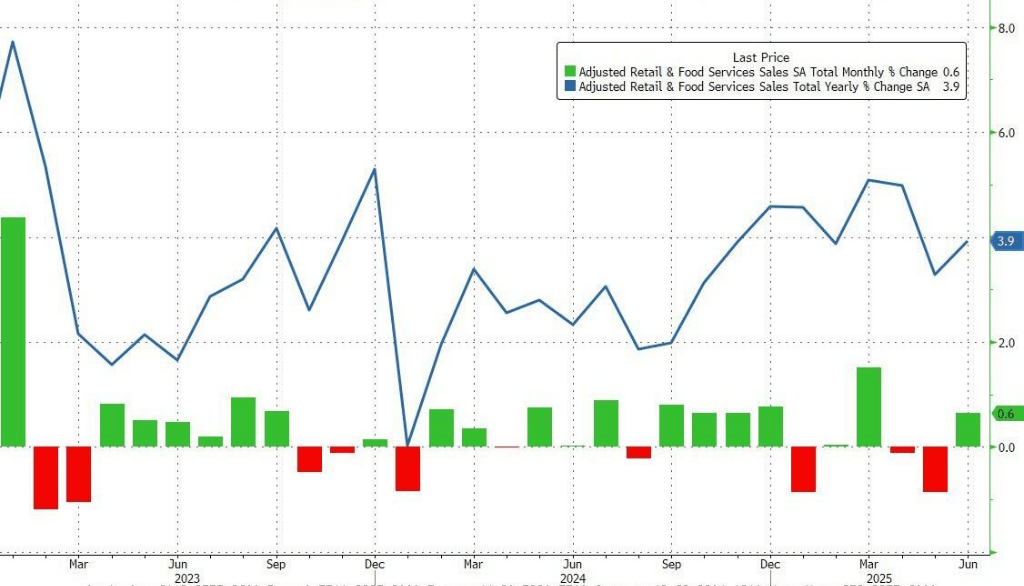
美国6月零售销售环比增长0.6%超预期,扭转此前两月跌势
Sou Hu Cai Jing· 2025-07-17 13:18
Core Viewpoint - Despite the impact of Trump's tariff policies, U.S. consumers continue to spend actively, with June retail sales showing a surprising rebound, alleviating concerns about consumer spending tightening [1][3]. Group 1: Retail Sales Performance - U.S. retail sales in June increased by 0.6% month-over-month, surpassing expectations of 0.1% and reversing a decline of 0.9% in the previous month [4]. - Excluding automobiles, retail sales rose by 0.5%, against an expected increase of 0.3% and a prior decrease of 0.2% [4]. - Retail sales excluding automobiles and gasoline also saw a 0.6% increase, exceeding the anticipated 0.3% [4]. Group 2: Consumer Spending Insights - In June, 10 out of 13 major retail categories experienced growth, with automotive sales rebounding after two months of decline, indicating strong consumer spending on key goods [3][6]. - The "control group" retail sales, which directly contribute to GDP calculations, also rose by 0.5% month-over-month, leading to a year-over-year growth of 4.0%, further confirming the resilience of consumer spending [6]. Group 3: Economic Context - The strong retail sales data contrasts with previous "soft data" surveys that reflected pessimistic sentiment, suggesting that actual consumer spending behavior is more positive and robust than perceived [7]. - Adjusting for inflation, the estimated "real" retail sales have shown year-over-year growth for nine consecutive months, indicating that U.S. consumers' purchasing power remains on an upward trend despite rising prices [11].