
移动支付

Search documents
恒生科技指数跌至年线附近 恒生科技ETF(513130)单日获近10亿份净申购
Xin Lang Cai Jing· 2025-12-17 07:51
Core Viewpoint - The Hong Kong technology sector is experiencing a pullback, with the Hang Seng Tech Index nearing its annual line, prompting increased market interest and inflow of funds into related assets [1][2] Group 1: Market Performance - The Hang Seng Tech ETF (513130) saw a net subscription of 990 million units on December 16, raising its total shares to 59.663 billion and its latest scale to 42.337 billion yuan [1] - The average daily trading volume of the Hang Seng Tech ETF since Q4 2025 has reached 5.468 billion yuan, indicating significant liquidity advantages [1] Group 2: Valuation and Investment Potential - The latest price-to-earnings (P/E) ratio of the Hang Seng Tech Index has dropped to 22.74, which is at a low percentile of 31.42% over the past five years [2] - Compared to major technology indices in A-shares and US markets, the Hang Seng Tech Index offers attractive valuation opportunities, with a P/E significantly lower than the Nasdaq's 41.09 and the Sci-Tech Innovation 50's 156.57 [2] Group 3: Fund Characteristics and Investor Interest - The Hang Seng Tech ETF (513130) is recognized as a preferred tool for investors looking to allocate to the Hong Kong technology sector, with over 220,000 account holders as of the mid-2025 report [2] - The ETF features advantages such as large scale, superior liquidity, and support for T+0 trading, with a low annual management fee of 0.2%, making it an appealing option for cost-effective investment in Hong Kong tech assets [2]
12月16日沪深两市强势个股与概念板块
2 1 Shi Ji Jing Ji Bao Dao· 2025-12-16 11:28
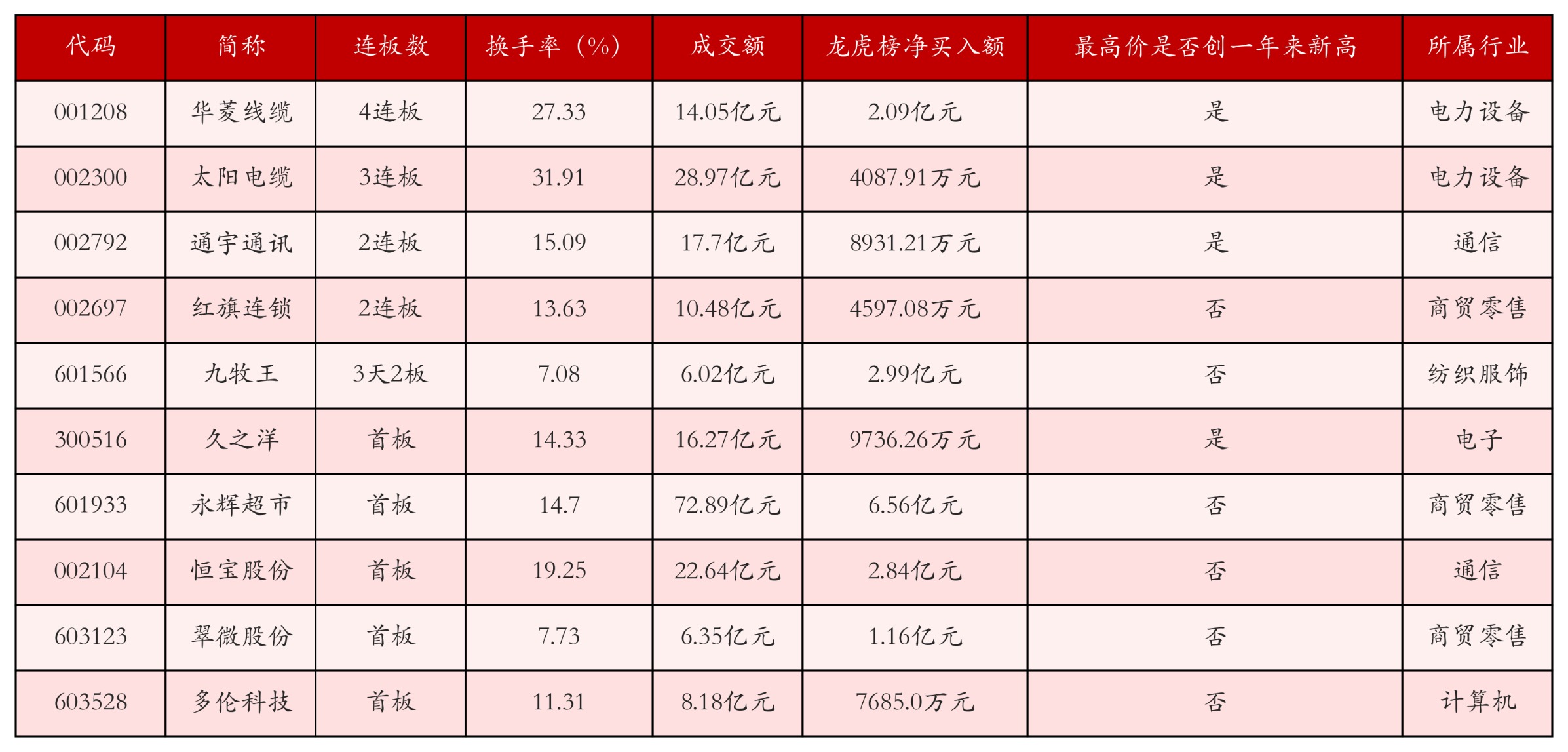
Strong Individual Stocks - As of December 16, the Shanghai Composite Index fell by 1.11% to 3824.81 points, the Shenzhen Component Index decreased by 1.51% to 12914.67 points, and the ChiNext Index dropped by 2.1% to 3071.76 points. A total of 44 stocks in the A-share market hit the daily limit up [1] - The top three strong stocks based on consecutive limit-up days and trading data are: Hualing Cable (001208) with 4 consecutive limit-ups, Sun Cable (002300) with 3 consecutive limit-ups, and Tongyu Communication (002792) with 2 consecutive limit-ups [1] - Detailed data for the top 10 strong stocks includes: - Hualing Cable (001208): 4 consecutive limit-ups, turnover rate of 27.33%, and a closing price of 14.0 - Sun Cable (002300): 3 consecutive limit-ups, turnover rate of 31.91%, and a closing price of 28.9 - Tongyu Communication (002792): 2 consecutive limit-ups, turnover rate of 15.09%, and a closing price of 17.7 [1] Strong Concept Sectors - The top three concept sectors with the highest gains are: Duty-Free Shops with a gain of 1.44%, Ride-Hailing with a gain of 0.89%, and Pre-made Dishes with a gain of 0.56% [2][3] - The detailed performance of the top 10 concept sectors includes: - Duty-Free Shops: +1.44% - Ride-Hailing: +0.89% - Pre-made Dishes: +0.56% - Digital Currency: +0.47% - Dairy Industry: +0.45% - Mobile Payment: +0.26% - ETC: +0.21% - China Shipbuilding System: +0.15% - Unmanned Retail: +0.02% - Unmanned Driving: -0.03% [3]


万联晨会-20251215
Wanlian Securities· 2025-12-15 00:52
Core Viewpoints - The A-share market saw collective gains last Friday, with the Shanghai Composite Index rising by 0.41%, the Shenzhen Component Index by 0.84%, and the ChiNext Index by 0.97%. The total trading volume in the Shanghai and Shenzhen markets reached 20,920.64 billion yuan [1][7] - In terms of industry performance, non-ferrous metals, electronics, and power equipment led the gains, while retail, comprehensive, and building materials sectors lagged behind. Concept sectors such as smart grids, the Internet of Things, and mobile payments showed significant increases, whereas horse racing, newly listed tech stocks, and duty-free shop concepts experienced declines [1][7] Important News - The Ministry of Commerce, the People's Bank of China, and the Financial Regulatory Bureau issued a notice to strengthen the collaboration between commerce and finance to boost consumption. The notice includes 11 specific measures aimed at enhancing financial support in key consumption areas, promoting personal consumption loans, and encouraging the issuance of consumption vouchers by merchants and platforms [2][8] Research Highlights - The Central Economic Work Conference held on December 11, 2025, analyzed the current economic situation and systematically deployed economic work for 2026. The policy focuses on both demand and supply, acknowledging the coexistence of favorable and unfavorable external factors. The emphasis is on continuously expanding domestic demand and optimizing supply, with expectations for a gradual adjustment in key industry capacities [9][10] - Fiscal policy is expected to remain proactive, with a fiscal deficit rate likely to stay around 4%. The focus will be on optimizing the structure of fiscal expenditures and addressing local government financial difficulties [10][11] - Monetary policy will be adjusted flexibly in response to economic changes, aiming to support stable economic growth and reasonable price recovery. Structural tools are expected to be enhanced, with a focus on supporting small and medium-sized financial institutions [11][12] - The role of domestic demand is set to strengthen, with more policies anticipated to promote the construction of a large domestic market. This includes plans to increase urban and rural residents' income, which will help boost consumer confidence and sustainable consumption growth [11][12]
连马云都想不通,为啥越来越多老百姓选择微信支付,放弃支付宝?
Sou Hu Cai Jing· 2025-12-08 11:00
Core Insights - The evolution of mobile payment in China has seen a shift from Alipay to WeChat Pay, with WeChat becoming the preferred choice for many users due to its convenience and integration with social interactions [1][3][10] Group 1: User Preferences - The competition in mobile payments is driven by user habits rather than technology, with WeChat Pay winning due to its ease of use and social integration [3][12] - Alipay is viewed as a professional financial tool, while WeChat is perceived as a part of daily life, leading to different user demographics [7][19] Group 2: Market Share and Demographics - As of Q1 2025, WeChat Pay's market share has surpassed 60%, particularly in lower-tier markets where access to WeChat is more prevalent than Alipay [10][19] - Alipay remains popular among urban and e-commerce users, while WeChat dominates in offline consumption and small transactions [8][19] Group 3: Functional Differences - WeChat Pay simplifies payment processes by embedding them within social interactions, such as group payments and red envelopes, transforming payments into social rituals [14][15] - Alipay excels in areas like cross-border payments, government services, and e-commerce, maintaining a stronghold in high-value transactions [17][19] Group 4: Conclusion on Competition - The competition between Alipay and WeChat is not about one replacing the other but rather about their distinct market positions and user needs [19]


马斯克采访时再提微信,感叹中国用户靠一个App搞定生活,西方十年都学不来
Sou Hu Cai Jing· 2025-12-06 04:26
Core Viewpoint - Elon Musk is striving to transform his X platform into a comprehensive application akin to China's WeChat, highlighting the cultural and regulatory challenges he faces in the Western market [1][4]. Group 1: Cultural and Psychological Barriers - The Western perception of social and financial services as separate domains creates a psychological barrier for users, making them resistant to integrating these functions on a single platform [4]. - A significant majority of Americans express distrust towards how tech companies handle personal data, with over 80% concerned about potential misuse of their information [4]. Group 2: Existing Financial Infrastructure - The entrenched credit card system in the West, which has developed over more than fifty years, provides a robust financial ecosystem that includes consumer protections and rewards, making it difficult for new payment methods to gain traction [5]. - The convenience of credit cards, combined with their extensive benefits, poses a challenge for mobile payment solutions to prove their superiority [7]. Group 3: Regulatory Challenges - Increasing regulatory scrutiny in the West, particularly through measures like the EU's Digital Markets Act (DMA), poses a significant risk for Musk's plans to bundle services on the X platform, as it could lead to antitrust issues [9]. - The regulatory environment emphasizes preventing market dominance and ecosystem bundling, contrasting sharply with the integrated model of WeChat [9]. Group 4: Comparative Ecosystem Analysis - WeChat's success stems from its ability to evolve in a less developed service environment, rapidly integrating social and financial services into a single platform [11]. - The fragmented nature of the Western digital ecosystem, where various industries operate independently, offers users more choices but results in a less cohesive experience [11]. - The complex network of over 6 million developers and 50 million creators within WeChat's ecosystem forms a strong competitive advantage that is difficult to replicate [13].


财经价值观:银行机构ATM机五年减少25万多台 未来ATM机会消失吗?如何推动银行网点生态变革?
Yang Guang Wang· 2025-12-06 00:09
Group 1 - The core issue discussed is the decline of ATM machines in China, with a reported decrease of approximately 14,800 units in Q3 2023, bringing the total to 760,900, marking a continuous decline over several quarters [1] - Five years ago, there were over 1 million ATMs in China, indicating a reduction of more than 250,000 machines since then, attributed largely to the rise of mobile payment systems [1] - The increasing volume and value of electronic payment transactions in China have made mobile payments the preferred method for consumers, leading to decreased usage of ATMs [1] Group 2 - Despite the decline, ATMs are unlikely to disappear completely, as they still serve essential functions for certain demographics, particularly the elderly and in rural areas where cash transactions remain important [2] - The banking industry is undergoing a digital transformation, with traditional ATMs being replaced by advanced devices that offer a wider range of services, including financial management and government payment options [2] - Future banking locations may evolve to integrate various functions beyond transactions, such as financial education and community services, reflecting a shift in the role of bank branches [2] Group 3 - Future smart ATMs may incorporate advanced features such as voice interaction, allowing users to perform tasks like bill inquiries and financial analysis, showcasing the potential for integrating AI technology [3] - The challenge for banks will be to maintain efficiency in financial services while ensuring a personal touch, emphasizing the need for thoughtful innovation in the digital age [3]
天阳科技跌2.00%,成交额6664.15万元,主力资金净流出781.19万元
Xin Lang Zheng Quan· 2025-12-03 02:29
Core Viewpoint - Tianyang Technology's stock has experienced fluctuations, with a year-to-date increase of 21.53% but a recent decline in the last 5, 20, and 60 trading days [1][2] Group 1: Stock Performance - As of December 3, Tianyang Technology's stock price is 19.08 CNY per share, with a market capitalization of 9.313 billion CNY [1] - The stock has seen a net outflow of 7.8119 million CNY in principal funds, with significant selling pressure in large orders [1] - The company has appeared on the "Dragon and Tiger List" three times this year, with the most recent net purchase of 231 million CNY on June 16 [1] Group 2: Financial Performance - For the period from January to September 2025, Tianyang Technology reported revenue of 1.516 billion CNY, a year-on-year increase of 8.11%, while net profit attributable to shareholders decreased by 32.25% to 57.7671 million CNY [2] - The company's main business revenue composition includes 69.43% from technology development, 28.56% from technology services, 1.40% from consulting services, and 0.47% from system integration [1] Group 3: Shareholder Information - As of September 30, 2025, the number of shareholders is 49,500, a decrease of 24.01%, while the average circulating shares per person increased by 36.27% to 8,526 shares [2] - The company has distributed a total of 110 million CNY in dividends since its A-share listing, with 42.7816 million CNY distributed in the last three years [3] - Among the top ten circulating shareholders, Huabao Zhongzheng Financial Technology Theme ETF holds 6.4686 million shares, an increase of 3.2689 million shares compared to the previous period [3]
拉卡拉跌2.03%,成交额1.69亿元,主力资金净流出1234.46万元
Xin Lang Cai Jing· 2025-12-02 06:35
Core Viewpoint - Lakala's stock price has experienced fluctuations, with a year-to-date increase of 25.32% but a recent decline over various trading periods, indicating potential volatility in the market [1][2]. Company Overview - Lakala Payment Co., Ltd. is based in Haidian District, Beijing, and was established on January 6, 2005, with its IPO on April 25, 2019. The company primarily provides acquiring services for small and micro enterprises and personal payment services, with 100% of its revenue derived from payment services [1]. Financial Performance - For the period from January to September 2025, Lakala reported a revenue of 4.07 billion yuan, a year-on-year decrease of 7.33%, and a net profit attributable to shareholders of 339 million yuan, down 33.90% compared to the previous year [2]. - Since its A-share listing, Lakala has distributed a total of 2.615 billion yuan in dividends, with 1.035 billion yuan paid out in the last three years [3]. Shareholder Information - As of September 30, 2025, Lakala had 104,400 shareholders, a decrease of 26.11% from the previous period, with an average of 7,038 circulating shares per shareholder, an increase of 35.37% [2]. - The top ten circulating shareholders include notable entities such as Huabao Zhongzheng Financial Technology Theme ETF and Hong Kong Central Clearing Limited, with changes in their holdings indicating shifts in institutional interest [3].

东方财富跌2.04%,成交额31.25亿元,主力资金净流出5.55亿元
Xin Lang Zheng Quan· 2025-12-02 03:35
Core Viewpoint - Dongfang Caifu's stock price has experienced a decline of 12.19% year-to-date, with significant drops in recent trading periods, indicating potential challenges in market performance and investor sentiment [1]. Financial Performance - For the period from January to September 2025, Dongfang Caifu reported a revenue of 11.589 billion yuan, representing a year-on-year growth of 58.67%. The net profit attributable to shareholders was 9.097 billion yuan, reflecting a year-on-year increase of 50.57% [2]. - Cumulatively, the company has distributed 4.818 billion yuan in dividends since its A-share listing, with 2.504 billion yuan distributed over the past three years [3]. Shareholder Structure - As of September 30, 2025, the number of shareholders for Dongfang Caifu was 1.0139 million, a decrease of 8.84% from the previous period. The average number of circulating shares per shareholder increased by 9.70% to 13,193 shares [2]. - The top circulating shareholders include Hong Kong Central Clearing Limited, holding 540 million shares (an increase of 55.5162 million shares), and Guotai Junan CSI All-Share Securities Company ETF, holding 327 million shares (an increase of 132 million shares) [3].

复旦微电涨2.04%,成交额1.02亿元,主力资金净流入1197.58万元
Xin Lang Cai Jing· 2025-12-01 02:01
Group 1 - The core viewpoint of the news is that Fudan Microelectronics has shown a significant increase in stock price and trading activity, indicating positive market sentiment [1] - As of December 1, Fudan Microelectronics' stock price rose by 2.04% to 58.97 CNY per share, with a total market capitalization of 48.44 billion CNY [1] - The company has experienced a year-to-date stock price increase of 53.93%, although it has seen a decline of 7.34% over the past 20 days [1] Group 2 - Fudan Microelectronics, established on July 10, 1998, primarily engages in integrated circuit (IC) related businesses, operating through two segments: design and sales of ICs, and IC testing services [2] - The company's revenue composition includes 37.04% from FPGA and other products, 23.92% from non-volatile memory, 21.35% from security and identification chips, 13.46% from smart meter chips, and 4.15% from IC testing services [2] - The company is classified under the electronic-semiconductor-digital chip design industry and is involved in concepts such as mobile payment, RISC, biometrics, sensors, and artificial intelligence [2] Group 3 - As of September 30, the number of shareholders for Fudan Microelectronics increased by 26.42% to 27,500, while the average circulating shares per person decreased by 20.91% to 19,562 shares [3] - For the period from January to September 2025, the company reported a revenue of 3.024 billion CNY, reflecting a year-on-year growth of 12.70%, while the net profit attributable to shareholders decreased by 22.69% to 330 million CNY [3] Group 4 - Since its A-share listing, Fudan Microelectronics has distributed a total of 311 million CNY in dividends, with 258 million CNY distributed over the past three years [4] - Among the top ten circulating shareholders as of September 30, 2025, notable changes include a decrease in holdings by the largest shareholder, while other institutional investors have increased their stakes [4]
