
美元信用弱化

Search documents
黄金股ETF涨近2%,黄金ETF华夏涨1.2%,录14连吸金
Sou Hu Cai Jing· 2025-11-19 05:43
Core Viewpoint - Gold prices experienced a rebound after a recent decline, driven by geopolitical tensions, weakening dollar credit, and central bank gold purchases, despite uncertainties surrounding the Federal Reserve's interest rate decisions [1] Group 1: Market Performance - Gold prices fell below $4,000 but rebounded, with gold stocks ETF rising nearly 2% and the Hua Xia Gold ETF increasing by 1.2% [1] - COMEX gold saw a four-day decline, totaling a 3.4% drop, before a V-shaped reversal occurred, with spot gold and New York futures both surpassing $4,080 [1] - The recent market correction was attributed to overbought conditions and tightening liquidity, with COMEX gold experiencing a 6% decline from October 21 to November 18 [1] Group 2: Future Projections - Goldman Sachs set a gold price target of $4,440 for Q1 2026, while Morgan Stanley predicts a rise to $4,500 by mid-2026 [1] - Despite uncertainties regarding the Federal Reserve's December rate cut, the initiation of a rate-cutting cycle remains unchanged, and market liquidity is expected to improve with the U.S. government reopening and the cessation of balance sheet reduction on December 1 [1] Group 3: Investment Trends - There was a significant net inflow into gold ETFs, with a net inflow of 1.777 billion yuan into the SGE gold 9999 tracking ETF, and the Hua Xia Gold ETF seeing a net inflow of 138 million yuan over 14 consecutive trading days, totaling 824 million yuan [1] - The Hua Xia Gold ETF (518850) has a low comprehensive fee rate of 0.2% and allows T+0 trading, while the gold stock ETF (159562) also has a 0.2% fee and focuses on gold and copper stocks [2]
黄金四连跌后反弹!费率最低的黄金股ETF涨近2%,黄金ETF华夏涨1.2%,录得“14连吸金”
Sou Hu Cai Jing· 2025-11-19 03:24
Core Viewpoint - Gold prices rebounded after a decline, driven by geopolitical tensions, weakening dollar credit, and central bank gold purchases, despite recent market corrections [1] Group 1: Market Performance - Gold prices fell below $4000 but rebounded, with COMEX gold experiencing a four-day decline totaling 3.4% before a V-shaped recovery, surpassing $4080 [1] - The SPDR Gold Shares ETF saw a nearly 2% increase, while the Huaxia Gold ETF rose by 1.2% [1] - The Huaxia Gold ETF (518850) has seen a net inflow of 1.38 billion yuan over 14 consecutive trading days, totaling 8.24 billion yuan since the price peak on October 21 [1] Group 2: Future Projections - Goldman Sachs set a gold price target of $4440 for Q1 2026, while Morgan Stanley predicts a rise to $4500 by mid-2026 [1] - The Federal Reserve's anticipated interest rate cuts and the reopening of the U.S. government are expected to improve market liquidity [1] Group 3: Investment Products - The Huaxia Gold ETF (518850) is noted for its low comprehensive fee rate of 0.2% and allows T+0 trading [2] - The Gold Stock ETF (159562), which tracks SSH gold stocks, has a similar fee structure and focuses on gold and copper stocks [2]
美联储降息分歧加剧,金价延续走低,黄金ETF华夏(518850)跌0.74%
2 1 Shi Ji Jing Ji Bao Dao· 2025-11-18 03:17
Core Viewpoint - The divergence in interest rate decisions among Federal Reserve officials is impacting gold prices, leading to a decline in COMEX gold futures and related ETFs [1] Group 1: Gold Market Performance - COMEX gold futures opened lower and are currently trading around $4028 per ounce, reflecting a downward trend [1] - Gold ETF 华夏 (518850) has seen a net inflow of 686 million yuan over the past 13 trading days, despite a 0.74% drop today [1] - Other related ETFs, such as 黄金股 ETF (159562) and 有色金属 ETF 基金 (516650), have also experienced declines of 1.2% and 1.56% respectively [1] Group 2: Federal Reserve Insights - There is increasing disagreement among Federal Reserve officials regarding interest rate decisions, with at least three officials expected to oppose maintaining the current rates in the upcoming December meeting [1] - If the Federal Reserve were to cut rates by 25 basis points, the opposition could also reach at least three votes [1] Group 3: Market Analysis and Future Outlook - Longcheng Futures indicates that the recent pullback in gold prices follows a period of strong performance, driven by signals of a weak U.S. economy and expectations of Federal Reserve easing [1] - Following the end of the U.S. government shutdown, market expectations for rate cuts have decreased, contributing to the recent decline in gold prices [1] - In the short term, gold prices may continue to fluctuate within a range, while medium to long-term support remains from risks of economic recession, fiscal expansion, and weakening dollar credibility [1]


黄金、白银期货品种周报-20251117
Chang Cheng Qi Huo· 2025-11-17 02:11
1. Report Industry Investment Rating No relevant content provided. 2. Core Views of the Report - The overall trend of Shanghai Gold futures is in an upward channel, possibly at the end of the trend. The short - term gold price may fluctuate within a range, while the medium - and long - term is supported by economic recession risks, fiscal expansion, and weakening US dollar credit. For Shanghai Silver futures, the overall trend is in a strong upward phase, also possibly at the end of the trend. The short - term may consolidate within a range, and the medium - and long - term upward trend remains unchanged under the support of macro - easing, supply - demand gap, and weakening US dollar credit. It is recommended to adopt a wait - and - see approach for both gold and silver futures [7][30]. 3. Summary by Directory Gold Futures 01. Mid - term Market Analysis - Mid - term trend: The overall trend of Shanghai Gold futures is in an upward channel, currently possibly at the end of the trend [7]. - Trend judgment logic: Last week, the gold price showed a pattern of "strengthening in oscillation and then回调". The core logic was driven by the resonance of "signals of weak US economy" and "expectations of Fed easing", along with factors such as the weakening US dollar and central bank gold purchases. The Friday回调 was due to high - level profit - taking pressure. In the future, the short - term gold price may fluctuate within a range, and the medium - and long - term is supported by economic recession risks, fiscal expansion, and weakening US dollar credit. Attention should be paid to the re - issuance of US economic data and Fed policy trends [7]. - Mid - term strategy: It is recommended to wait and see [8]. 02. Variety Trading Strategy - Last week's strategy review: The Shanghai Gold main contract 2512 was expected to fluctuate between 900 - 940 yuan/gram in the short term, with the upper pressure level at 930 - 940 yuan/gram and the lower support level at 900 - 910 yuan/gram. It was recommended to wait and see [10]. - This week's strategy recommendation: The Shanghai Gold contract 2602 will consolidate in a short - term oscillation. The upper pressure level is 960 - 970 yuan/gram, and the lower support level is 900 - 910 yuan/gram. It is recommended to wait and see [11]. 03. Relevant Data Situation - The report presents data on the price trends of Shanghai Gold and COMEX gold, SPDR Gold ETF holdings, COMEX gold inventory, US 10 - year Treasury yield, US dollar index, US dollar against offshore RMB, gold - silver ratio, Shanghai Gold basis, and gold internal - external price difference [18][20][22]. Silver Futures 01. Mid - term Market Analysis - Mid - term trend: The overall trend of Shanghai Silver futures is in a strong upward phase, currently at the end of the trend [30]. - Trend judgment logic: Last week, the silver price showed a pattern of "rising in oscillation and then回调 at a high level", reaching a record high of 12,600 yuan/kg. The core driving logic was the resonance of the strengthened expectations of Fed easing (ending QT and interest - rate cut expectations) and the structural shortage of spot goods, along with the surge in investment demand (increase in ETF holdings) and the resilience of industrial demand (recovery in photovoltaic and Indian imports). The Friday回调 was mainly due to high - level profit - taking and technical resistance, and the continuous decline in open interest indicated cautious market sentiment. In the future, the short - term may consolidate within a range, and the medium - and long - term upward trend remains unchanged under the support of macro - easing, supply - demand gap, and weakening US dollar credit [30]. - Mid - term strategy: It is recommended to wait and see [30]. 02. Variety Trading Strategy - Last week's strategy review: The silver main contract 2512 was expected to oscillate and consolidate, with attention paid to the range of 11,000 - 12,000 yuan/kg. The upper resistance level was 11,800 - 12,000 yuan/kg, and the lower support level was 11,000 - 11,200 yuan/kg. Short - term grid trading was recommended [33]. - This week's strategy recommendation: The silver contract 2602 will consolidate in a short - term oscillation. The upper pressure level is 12,000 - 12,600 yuan/kg, and the lower support level is 10,900 - 11,500 yuan/kg. It is recommended to wait and see [34]. 03. Relevant Data Situation - The report presents data on the price trends of Shanghai Silver and COMEX silver, SLV Silver ETF holdings, COMEX silver inventory, Shanghai Silver basis, and silver internal - external price difference [41][43][46].
贵金属日报2025-10-29:贵金属-20251029
Wu Kuang Qi Huo· 2025-10-29 02:02
1. Report Industry Investment Rating - Not provided in the report 2. Core View of the Report - After a significant upward trend, the prices of gold and silver have notably corrected. However, considering the three main fundamental drivers of overseas geopolitical risks, the weakening of the US dollar's credit, and the start of the Federal Reserve's interest - rate cut cycle, the current price decline is more of a "correction within an upward trend" rather than a "trend reversal." Therefore, it is recommended to maintain a long - position mindset and allocate long positions in precious metals on dips. The reference operating range for the main contract of Shanghai gold is 880 - 966 yuan/gram, and for the main contract of Shanghai silver is 10937 - 11690 yuan/kilogram [2] 3. Summary by Relevant Content Market Quotes - Shanghai gold dropped 1.18% to 905.06 yuan/gram, and Shanghai silver rose 0.49% to 11180.00 yuan/kilogram. COMEX gold was reported at 3954.10 US dollars/ounce, and COMEX silver at 47.04 US dollars/ounce. The yield of the 10 - year US Treasury bond was 3.99%, and the US dollar index was 98.74. The Federal Reserve will hold an October interest - rate meeting early tomorrow. Amid the current easing of US inflation data and the lack of labor - market data, the market has almost fully priced in a 25 - basis - point interest - rate cut by the Fed in this meeting [1] Central Bank Gold Reserves - The former governor of the Philippine central bank stated that the central bank's gold reserves were excessive, accounting for 13% of its total central - bank reserves. He also mentioned that the central bank was debating whether to increase gold holdings or take profit. After the news was announced, the gold price dropped significantly, and the international silver price was weak. The views of the Philippine central bank do not represent the general trend of central - bank gold purchases. The global central - bank gold - buying is aimed at hedging against the US - dollar credit. The South Korean central - bank officials said they would consider increasing gold holdings from a long - term perspective, and before that, South Korea's central - bank gold reserves had remained unchanged for 12 consecutive years [2] Key Data of Gold and Silver - For gold on October 28, 2025, compared with the previous day: COMEX gold's closing price (active contract) decreased by 0.72% to 3968.10 US dollars/ounce, trading volume increased by 1.94% to 33.06 million lots, and open interest increased by 2.43% to 52.88 million lots; LBMA gold's closing price decreased by 0.56% to 3948.50 US dollars/ounce; SHFE gold's closing price (active contract) decreased by 3.51% to 901.38 yuan/gram, trading volume increased by 24.38% to 64.34 million lots, and open interest decreased by 1.72% to 34.94 million lots; the closing price of AuT + D decreased by 3.61% to 896.69 yuan/gram, trading volume increased by 21.58% to 67.74 tons, and open interest increased by 0.36% to 258.77 tons - For silver on October 28, 2025, compared with the previous day: COMEX silver's closing price (active contract) increased by 0.66% to 47.14 US dollars/ounce, open interest increased by 1.75% to 16.58 million lots; LBMA silver's closing price decreased by 1.95% to 46.44 US dollars/ounce; SHFE silver's closing price (active contract) decreased by 3.03% to 11049.00 yuan/kilogram, trading volume increased by 35.58% to 176.07 million lots, and open interest decreased by 2.69% to 70.24 million lots; the closing price of AgT + D decreased by 3.08% to 10996.00 yuan/kilogram, trading volume increased by 17.10% to 765.42 tons, and open interest increased by 0.19% to 3717.77 tons [5]
冠通期货11月宏观经济月度报告-20251027
Guan Tong Qi Huo· 2025-10-27 11:04
Report Summary 1. Report Industry Investment Rating The provided content does not mention the report industry investment rating. 2. Core Views of the Report - In October, capital markets experienced increased volatility, with risk assets generally rising after an initial decline. Overseas, geopolitical events and policy uncertainties influenced market trends, while in China, economic data weakened in Q3, leading to strengthened policy support [4][63]. - The significant correction in gold prices from historical highs can be attributed to factors such as the easing of geopolitical risks, the rebound of the US dollar, and technical adjustments. However, the long - term drivers for gold prices remain strong [5][8]. - The IMF raised its global economic growth forecast for 2025 but emphasized the fragility of the global economy and the need for structural reforms [34][36]. - In China, CPI and PPI both showed narrowing declines, indicating potential for monetary easing policies. Exports in September exceeded expectations, but the real estate sector continued to drag down the economy [40][50][59]. 3. Summary by Relevant Catalogs Global Capital Market Performance - **Overseas**: Trump's tariff increase on China, the US government shutdown, and the Fed's interest - rate cut expectations affected market sentiment. Risk assets generally rose, but gold and silver prices corrected significantly, and non - US currencies depreciated [4][63]. - **Domestic**: The domestic futures market showed a differentiated pattern, with stocks, bonds, and commodities having mixed performances. The stock market experienced a technical correction, and the bond market showed a seesaw effect with the stock market [4][69]. Gold Price Analysis - **Reasons for the Correction**: The decline in gold prices was due to the easing of geopolitical risks, the rebound of the US dollar, and technical overbought conditions, which triggered large - scale profit - taking and programmed selling [5][8]. - **Historical Comparison**: The 5.31% decline in London spot gold on October 21, 2025, ranked seventh among the top ten single - day declines since 2000 [9]. - **Long - term Outlook**: The long - term drivers for gold prices, including the weakening of the US dollar's credit, the strengthening of interest - rate cut expectations, the "scar effect" on asset allocation, and investment demand, remain intact [21][24]. Global Economic Outlook - **Growth Forecast**: The IMF raised the global economic growth forecast for 2025 to 3.2% but warned of continued weakness, high public debt, and trade policy uncertainties [34][36]. - **Regional Performance**: Asia is expected to remain the main engine of global growth. AI is estimated to boost global economic growth by 0.1% - 0.8% annually [36]. China's Economic Indicators - **CPI and PPI**: In September, China's CPI was - 0.3% year - on - year, and PPI was - 2.3% year - on - year. Both showed narrowing declines, but CPI was still affected by factors such as low pork and oil prices and high - base effects [41][43]. - **Exports**: In September, China's exports reached $3285.7 billion, a year - on - year increase of 8.3%, exceeding expectations [50]. - **GDP**: In the first three quarters of 2025, China's GDP was 1015036 billion yuan, a year - on - year increase of 5.2% at constant prices [58]. - **Real Estate**: From January to September, national real estate development investment decreased by 13.9% year - on - year, with significant declines in various real - estate - related indicators [59]. Market Trends - **Commodities**: The CRB and Nanhua commodity indices showed different trends. Historically, the Nanhua commodity index has a slightly higher probability of rising in November [75]. - **Stock Market**: In October, the stock market experienced a technical correction, with value stocks outperforming growth stocks. The price - to - earnings ratios of major stock indices were under pressure, and the equity risk premium rebounded [79]. - **Global Economy**: Global economic sentiment weakened, with both the manufacturing and service sectors showing a decline. Inflation in major economies rebounded, and central banks' monetary policies diverged [86][94][97]. - **China's Economy**: China's manufacturing PMI continued to improve in September, while M2 growth declined, M1 growth increased, and the credit cycle showed signs of starting [106][111]. - **External Demand**: China's export growth showed resilience, but there were still concerns about external demand. Import and export price indices declined, and the export profit margin widened negatively [123]. - **Internal Demand**: Real - estate investment continued to decline, and consumption growth slowed down, with travel data dropping after the summer vacation [124][131]. - **Inflation**: China's CPI remained negative, and PPI decline slowed down. The macro - profit margin (CPI - PPI) decreased [134]. - **Mid - level Industries**: Steel prices fluctuated downward, oil prices dropped with increased inventory, copper prices rose with inventory reduction, and coking coal prices continued to rebound [141].
贵金属日报2025-10-27:贵金属-20251027
Wu Kuang Qi Huo· 2025-10-27 03:13
1. Report Industry Investment Rating No relevant content provided. 2. Core View of the Report - The recent correction in precious metal prices is mainly due to the expectation of a temporary easing of overseas risk events and an over - bought correction in trading, rather than a reversal of the trading logic. The price decline is more of a "correction in the upward trend" than a "trend reversal" based on geopolitical risks, weakening US dollar credit, and the start of the Fed's interest - rate cut cycle. It is recommended to maintain a long - position strategy, focusing on the upcoming Fed interest - rate meeting and considering buying on dips. [2][4] 3. Summary by Related Catalogs 3.1 Market Quotes - On October 27, 2025, Shanghai gold futures (SHFE) fell 0.48% to 941.34 yuan/gram, and Shanghai silver futures fell 0.25% to 11,419.00 yuan/kilogram. COMEX gold was reported at 4,126.90 US dollars/ounce, and COMEX silver was reported at 48.41 US dollars/ounce. The US 10 - year Treasury yield was 4.02%, and the US dollar index was 98.94. [2] - From August 22 to October 17, the price of the COMEX gold main contract rose by 26.21%, and the price of the COMEX silver main contract rose by 31.23%. On October 21, COMEX gold prices dropped by 5.07%, and COMEX silver prices dropped by 6.27%. [2] 3.2 Factors Affecting Prices - Overseas risk events: Media reports of a potential peace plan to end the Russia - Ukraine conflict led to a short - term drop in precious metal prices. However, the situation has not been completely reversed as Trump and the White House stated there are no plans for a meeting between the US and Russian presidents. [2] - US inflation data and Fed policy expectations: US September CPI data was lower than expected, boosting expectations of the Fed's loose monetary policy. Due to the government shutdown in October, inflation data may not be released in November. The market has almost fully priced in two 25 - basis - point interest rate cuts in the next two Fed meetings. [3] 3.3 Strategy Suggestions - Maintain a long - position strategy. Focus on the Fed's interest - rate meeting on Thursday (market expects a 25 - basis - point rate cut), and pay attention to Powell's statement on the balance - sheet. It is recommended to buy on dips. The reference trading range for the SHFE gold main contract is 923 - 982 yuan/gram, and for the SHFE silver main contract is 11,082 - 12,023 yuan/kilogram. [4] 3.4 Data Summary - **Gold**: On October 24, 2025, compared with the previous day, COMEX gold's closing price (active contract) decreased by 0.39% to 4,126.90 US dollars/ounce, trading volume increased by 10.19% to 29.20 million lots, and open interest increased by 2.43% to 52.88 million lots. SHFE gold's closing price (active contract) decreased by 0.44% to 938.10 yuan/gram, trading volume decreased by 33.87% to 49.95 million lots, and open interest decreased by 1.28% to 35.59 million lots. [7] - **Silver**: On October 24, 2025, compared with the previous day, COMEX silver's closing price (active contract) decreased by 0.49% to 48.41 US dollars/ounce, open interest increased by 1.75% to 16.58 million lots. SHFE silver's closing price (active contract) decreased by 1.18% to 11,332.00 yuan/kilogram, trading volume decreased by 5.55% to 147.59 million lots, and open interest decreased by 1.97% to 73.99 million lots. [7]
贵金属周报:美国通胀数据低于预期,价格将得到支撑-20251025
Wu Kuang Qi Huo· 2025-10-25 14:14
1. Report Industry Investment Rating - Not provided in the given content 2. Core View of the Report - The decline in precious metal prices is more of a "correction in an uptrend" rather than a "trend reversal" based on geopolitical risks, weakening US dollar credit, and the start of the Fed's interest - rate cut cycle. Maintain a long - term bullish view and focus on the Fed's interest - rate meeting next Thursday. Suggest allocating long positions on dips, with the reference range for the SHFE gold main contract at 923 - 982 yuan/gram and for the SHFE silver main contract at 11082 - 12023 yuan/kilogram [11] 3. Summary by Directory 3.1. Weekly Assessment and Market Outlook - **Weekly Market Review**: Gold and silver prices declined this week. As of Friday's daytime close, SHFE gold fell 6.17% to 938.10 yuan/gram, SHFE silver fell 7.49% to 11332.00 yuan/kilogram, COMEX gold fell 3.30% to 4126.90 US dollars/ounce, and COMEX silver fell 4.38% to 48.41 US dollars/ounce. The 10 - year US Treasury yield was 4.02%, and the US dollar index rose 0.39% to 98.94 [11] - **Reasons for the Correction**: The main reasons were the expected easing of overseas risk events and over - bought corrections in trading, not a reversal in the trading logic. News of a potential end to the Russia - Ukraine conflict led to a short - term decline in precious metal prices, but the risk events have not been completely reversed [11] - **US Economic Data**: The US September CPI data was lower than expected, boosting expectations of the Fed's loose monetary policy. There may be a lack of inflation data in the future, and the market has almost fully priced in two 25 - basis - point interest rate cuts in the next two Fed meetings [11] 3.2. Market Review - **Price Movements**: Gold and silver prices declined this week. SHFE gold and silver, as well as COMEX gold and silver, all recorded drops [30] - **Open Interest**: This week, the total open interest of SHFE gold decreased by 1.28% to 355,900 lots, while the total open interest of COMEX gold as of the latest report period increased by 2.43% to 528,800 lots. The total open interest of SHFE silver decreased slightly by 1.97% to 739,900 lots, and the total open interest of COMEX silver as of the latest report period increased by 1.75% to 165,800 lots [32][34] - **Managed Fund Net Positions**: As of the September 23 report period, the net positions of COMEX gold and silver managed funds increased. The net position of COMEX gold managed funds rose by 1578 lots to 160,500 lots, and that of COMEX silver managed funds rose by 1293 lots to 37,000 lots [36] - **ETF Holdings**: As of October 24, the total holdings of gold ETFs within the Reuters statistical scope were 2332.14 tons, and the total holdings of overseas silver ETFs were 28165.84 tons [39] 3.3. Interest Rates and Liquidity - **US Treasury Yields**: Analyzed the spreads between 10 - year and 2 - year US Treasury bonds and short - term Treasury yields [49] - **Interest Rates and Inflation Expectations**: Presented the US federal funds rate, overnight reverse repurchase rate, 10 - year nominal and real interest rates, and inflation expectations [52] - **Fed's Balance Sheet**: The Fed's total assets decreased by 6921 million US dollars this week. There were changes in various items on both the asset and liability sides [54] 3.4. Macroeconomic Data - **US CPI & PCE**: The US September CPI and core CPI were lower than expected and previous values. The CPI同比 was 3%, lower than the expected 3.1% and the previous value of 2.9%, and the core CPI同比 was 3%, lower than the expected and previous value of 3.1% [61] - **US Employment**: Due to the US government shutdown, the latest weekly unemployment data was missing [64] - **US PMI & PPI**: The US September ISM manufacturing PMI was 49.1, higher than the expected 49 and the previous value of 48.7. The ISM non - manufacturing PMI was 50, lower than the expected 51.7 and the previous value of 52 [67] - **US New Housing Data**: In August, the annualized number of new housing sales was 800,000, significantly higher than the previous value of 664,000. The annualized number of building permits was 1.33 million, and the annualized number of new housing starts was 1.307 million [70] 3.5. Precious Metal Spreads - **Gold Basis**: Analyzed the spread between gold TD and SHFE gold [73] - **Silver Basis**: Analyzed the spread between silver TD and SHFE silver [76] - **Domestic - Foreign Spreads**: Analyzed the domestic - foreign spreads of gold and silver [79] 3.6. Precious Metal Inventories - **Silver Inventories**: Presented the silver inventories of Shanghai Gold Exchange, Shanghai Futures Exchange, COMEX, and LBMA [86][89] - **Gold Inventories**: Presented the gold inventories of COMEX and LBMA [91]
黄金年内连创新高后迎调整,现在还能上车吗?
Sou Hu Cai Jing· 2025-10-23 14:23
Core Viewpoint - The gold market in 2025 is experiencing a remarkable surge, with London gold prices rising over 56% year-to-date, reaching new highs, but a recent sharp decline has raised questions about the sustainability of this trend [1][3][10]. Price Movement and Market Dynamics - As of October 22, 2025, the London gold price started at $2,650 per ounce and peaked at $4,381.48, with a year-to-date increase of 56.55% and an annualized return of 70.93% [3]. - On October 21, 2025, gold prices experienced a significant drop of 6.3%, attributed to easing geopolitical tensions and profit-taking by investors [1][3]. Institutional Outlook - Despite short-term fluctuations, institutions maintain a long-term optimistic outlook, with Goldman Sachs raising its 2026 gold price forecast from $4,300 to $4,900 per ounce [4]. Key Drivers of Gold Price Increase 1. **Central Bank Purchases**: Central banks, particularly in emerging markets, have been accumulating gold, with a net purchase of 1,037.4 tons in 2023, representing 21.2% of total demand, and this trend is expected to continue [7]. 2. **U.S. Federal Reserve Policy Shift**: Expectations of a shift in Federal Reserve policy, including a potential 100 basis point rate cut by mid-2026, are expected to lower the opportunity cost of holding gold, making it more attractive to investors [8]. 3. **Safe-Haven and Inflation Hedge Demand**: Geopolitical risks and inflation concerns have reinforced gold's dual role as a safe-haven asset and an inflation hedge, leading to robust demand [9]. Short-Term Adjustments - The recent price correction is viewed as a technical adjustment rather than a fundamental shift, providing a potential buying opportunity for long-term investors [10][11]. - Historical trends indicate that a 5%-10% correction is common during a strong upward trend, suggesting that the current pullback may be a consolidation phase [12]. Investment Strategy for Ordinary Investors - Ordinary investors are advised to view gold as a risk management tool rather than a short-term speculative asset, focusing on long-term allocation [15]. - Gold ETFs, such as the South China Gold ETF (code: 159834), are recommended for their convenience and lower costs compared to physical gold or futures [16][17]. - A systematic investment approach, such as dollar-cost averaging or incremental buying during price dips, is suggested to mitigate risks associated with market volatility [18]. Conclusion - The gold market's fundamentals remain strong despite recent price adjustments, with key drivers like central bank purchases and geopolitical tensions still in play. Investors are encouraged to focus on long-term strategies and utilize accessible investment vehicles like gold ETFs to capitalize on the ongoing market dynamics [19].
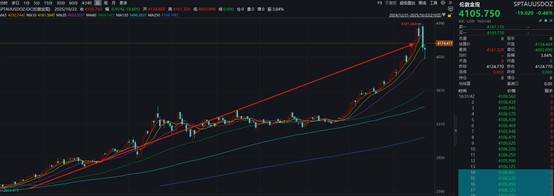
与14年前相比,这轮黄金牛市有何相似之处?
Di Yi Cai Jing· 2025-10-22 12:43
Core Viewpoint - The recent decline in gold prices and mining stocks has raised questions about the end of the current gold bull market, but industry experts believe that short-term fluctuations do not indicate a long-term trend reversal [1][2]. Group 1: Market Trends - Gold prices rose over 30% from late August to October 20, 2025, reaching nearly $4,382 per ounce, marking a 170% increase over the past two years [1]. - Historical comparisons show that in 2011, gold also surged approximately 30% in two months, driven by the European debt crisis, before hitting a peak of $1,921 per ounce [1][2]. Group 2: Factors Influencing Gold Prices - The current gold bull market shares similarities with the 2011 bull market, including drivers such as geopolitical tensions, inflation threats, and significant increases in gold holdings by central banks [2][3]. - Recent volatility in gold prices is attributed to potential resolutions in geopolitical conflicts, such as the Russia-Ukraine situation, and the easing of U.S. trade tensions, alongside technical corrections due to prior rapid price increases [2][3]. Group 3: Long-term Outlook - Despite short-term fluctuations, the core logic supporting the current gold bull market remains intact, with expectations for gold prices to continue reaching new highs in the medium to long term [2][3]. - The current market dynamics are influenced by the weakening of the dollar's credit amid high global debt levels, alongside central banks' monetary easing policies aimed at countering economic downturns [3].