量子计算

Search documents
深圳星际量子科技有限公司成立,注册资本1000万人民币
Sou Hu Cai Jing· 2025-12-04 22:39
天眼查显示,近日,深圳星际量子科技有限公司成立,法定代表人为李承军,注册资本1000万人民币, 由深圳禾苗通信科技有限公司全资持股。 序号股东名称持股比例1深圳禾苗通信科技有限公司100% 经营范围含一般经营项目是:量子计算技术服务;智能机器人的研发;智能机器人销售;工业机器人制 造;工业机器人销售;工业机器人安装、维修;服务消费机器人制造;服务消费机器人销售;特殊作业 机器人制造;工业设计服务;虚拟现实设备制造;可穿戴智能设备销售;可穿戴智能设备制造;人工智 能理论与算法软件开发;人工智能应用软件开发;人工智能基础软件开发;信息系统集成服务;软件开 发;人工智能硬件销售;人工智能通用应用系统;人工智能行业应用系统集成服务;智能控制系统集 成;工业自动控制系统装置销售;工业自动控制系统装置制造;工业控制计算机及系统制造;工业控制 计算机及系统销售;数据处理和存储支持服务;信息技术咨询服务;货物进出口;技术进出口。(除依 法须经批准的项目外,凭营业执照依法自主开展经营活动),许可经营项目是:无 企业名称深圳星际量子科技有限公司法定代表人李承军注册资本1000万人民币国标行业制造业>计算 机、通信和其他电子设备制 ...
外卖大战烧钱千亿元:没有赢家的“内卷”
Zheng Quan Shi Bao· 2025-12-04 17:42
Core Insights - The fierce competition among Meituan, Alibaba, and JD Group in the food delivery sector has resulted in a combined loss of nearly 80 billion yuan in the third quarter, highlighting the high cost of the subsidy war [1] - Despite the apparent short-term benefits for consumers, the platforms are facing a challenging situation of simultaneous growth and losses, with significant financial implications [1] Financial Performance - Meituan reported its largest loss since going public, while Alibaba's operating profit plummeted by 85%, and JD's net profit was halved [1] - The three companies invested hundreds of billions in subsidies and marketing to capture market share but failed to achieve sustainable profit growth [1] Market Dynamics - The competition has accelerated user mindset formation and consumption habits, expanding instant retail from food to a broader range of categories [1] - JD's food delivery efforts helped it surpass 700 million annual active users, while Alibaba's initiatives through Taobao Flash and Hema Fresh contributed to business growth [1] Operational Efficiency - Intense competition has forced platforms to optimize operational efficiency and service systems, with Meituan maintaining a lead in high-ticket orders and Alibaba focusing on fulfillment efficiency and user experience [1] - These changes signify a necessary transition from extensive expansion to refined operations within the industry [1] Strategic Reflection - The ongoing investment in food delivery contrasts with global tech giants like Google and Microsoft, which are focusing on AI and cloud computing, indicating a strategic lag in China's tech industry [2] - While Chinese tech giants have made some advancements in AI, their investments in foundational technologies and global breakthroughs remain insufficient compared to their spending in local delivery services [2] Future Challenges - The temporary "ceasefire" in the food delivery war signals a return to rationality, but the real challenge lies in whether Chinese tech companies can convert this rationality into sustained investment in hard technology and frontier innovation [2] - The significance of the food delivery battle should extend beyond market share redistribution to a collective reflection on development models, urging companies to move beyond "traffic competition" to a "technology-driven" approach [2]


亚马逊云科技首席执行官 Matt Garman:亚马逊云业务年增220亿美元,增量超半数《财富》500强企业全年收入
Xin Lang Cai Jing· 2025-12-04 11:47
Core Insights - Amazon Web Services (AWS) has grown into a $132 billion business, with a year-over-year growth rate accelerating to 20%, adding $22 billion in the past year alone, surpassing the annual revenue of more than half of the Fortune 500 companies [1][1][1] Business Growth - AWS's Amazon S3 continues to grow, with the number of stored objects exceeding 500 trillion and data volume reaching hundreds of exabytes, processing over 200 million requests daily [1][1][1] - In the past year, AWS added 3.8 gigawatts of data center capacity, ranking first globally, and has the largest private network in the world, which grew by 50% in the last 12 months, laying over 9 million kilometers of terrestrial and submarine fiber optic cables [1][1][1] AI and Quantum Computing Developments - AWS's Amazon Bedrock now provides AI inference capabilities to over 100,000 enterprises globally, and the AgentCore SDK has been downloaded over 2 million times since its release [1][1][1] - The company introduced Ocelot, its first quantum computing chip prototype, which has reduced the cost of quantum error correction by over 90% [1][1][1] Infrastructure and Network - AWS boasts the largest and most widely deployed AI cloud infrastructure globally, with a network of data centers covering 38 regions and 120 availability zones, with plans to add three more regions [1][1][1]

吴华强、叶甜春等学者当选IEEE Fellow
半导体芯闻· 2025-12-04 10:09
Core Insights - The 2026 IEEE Fellow selection list has been announced, recognizing 347 scholars for their outstanding contributions in engineering and technology fields, with over 70 from mainland China and Hong Kong, marking a new high for Chinese representation [1] Group 1: IEEE Fellow Recognition - IEEE Fellow is the highest membership honor awarded by the IEEE, recognizing significant breakthroughs in research, technology leadership, or exceptional engineering contributions [1] - The selection process is rigorous, with an acceptance rate of less than 0.1% of the total membership [1] Group 2: Areas of Contribution - The newly elected fellows' research spans critical fields such as artificial intelligence, integrated circuits, wireless communication, quantum computing, biomedical engineering, renewable energy, and cybersecurity [1] - Their work has not only achieved theoretical breakthroughs but also has had a profound practical impact on industry upgrades and solving major engineering challenges [1] Group 3: Key Technologies - Several elected fellows played core roles in tackling "bottleneck" technologies, including high-performance computing architectures, next-generation mobile communication standards, high-end chip design, and intelligent sensing systems [1]

黄仁勋专访:未来十年AI将重塑全球能源与知识格局,核反应堆成关键解药
3 6 Ke· 2025-12-04 09:05
Group 1: Company History and Challenges - Nvidia was founded in 1993 with the goal of "creating new computing ways" and initially partnered with Sega to develop game console chips, which provided the initial funding for the company [1] - The company faced a major crisis in mid-1995 when it chose the wrong technology paths in texture mapping, graphics modeling, and architecture design, putting it in a dire situation [2] - Nvidia managed to survive by convincing Sega to convert a remaining contract payment of $5 million into an investment, which helped keep the company afloat [3] - When funds were running out, Nvidia acquired inventory from a bankrupt company to complete chip development, ultimately leading to significant success and rapid growth [4] - Nvidia differentiated itself in the 3D graphics field by hardcoding core requirements into chips and focusing on a single application scenario, allowing it to stand out among competitors [5] Group 2: Entry into AI and Technological Innovations - Nvidia entered the AI field in 2012 when a team used Nvidia GPUs to train a neural network, which sparked the modern AI revolution [6] - The first DGX-1 supercomputer was developed with significant investment, and although it initially received no orders, it later became a key product for AI applications [8] - Nvidia's GPUs, designed for gaming, provided the necessary parallel processing power that became foundational for deep learning and AI applications [9] - The introduction of CUDA technology, despite initial skepticism, ultimately transformed the AI landscape and significantly increased Nvidia's market value [10] Group 3: AI Development and Future Predictions - The company believes that AI development will be gradual rather than sudden, with a focus on safety and responsible use of increased computational power [10] - In the next decade, AI energy consumption is expected to become negligible due to advancements in computing performance, which has improved by 100,000 times over the past decade [15][17] - Nvidia predicts that small nuclear reactors will emerge in the next six to seven years to address energy needs for AI development [16] - The company asserts that AI will not eliminate jobs but will replace specific tasks, leading to the creation of new roles and a reduction in the technology gap [19][20] - Historical evidence suggests that AI tools, like ChatGPT, will democratize technology access, allowing more people to benefit from advancements without needing extensive technical knowledge [20]

2026年值得期待的十大技术应用都有啥?
Huan Qiu Wang Zi Xun· 2025-12-04 06:38
Core Insights - The article highlights the rapid advancements in technology expected by 2026, including emotional AI, wearable health devices, renewable energy innovations, and more, which are set to transform daily life and work environments [1]. Group 1: Emotional AI and Personalization - Emotional AI assistants are evolving beyond traditional voice assistants like Siri and Alexa, becoming capable of understanding human emotions through tone and expression, thus providing personalized support [2]. - These AI systems are increasingly being integrated into mental health support and personal development, marking a significant shift in the role of technology in daily life [2]. Group 2: Wearable Health Technology - Next-generation wearable devices are anticipated to monitor vital health metrics in real-time, shifting healthcare from reactive to proactive approaches [3]. - Innovations such as smart skin patches and AI watches are expected to provide early warnings for health risks, contributing to personalized health management [3]. Group 3: Renewable Energy Innovations - New night-time solar panels that capture infrared radiation are expected to overcome previous limitations of solar energy, enabling continuous power supply even in darkness [4]. - Advances in lithium-sulfur and solid-state battery technologies are projected to enhance energy storage, significantly improving electric vehicle performance and promoting sustainable transportation [4]. Group 4: Brain-Computer Interfaces - Brain-computer interface technology is moving from medical applications to everyday use, allowing users to control devices through thought, which could revolutionize rehabilitation and enhance daily life [6]. - This technology is expected to play a role in various fields, including prosthetics and augmented reality [6]. Group 5: Space Economy - The space economy is poised for growth, with reduced costs for suborbital flights and the emergence of zero-gravity hotels, indicating a new era of space exploration and commercial opportunities [7]. - Companies are exploring asteroid mining, suggesting a potential new frontier for resource acquisition [7]. Group 6: AI in Education - AI-driven personalized education is set to replace standardized teaching methods, adapting to individual learning styles and enhancing engagement for both children and adults [8]. - This transformation in education is expected to significantly impact workforce adaptability in response to industry changes [8]. Group 7: Quantum Computing - Quantum computing is anticipated to become practical by 2026, potentially solving complex problems beyond the capabilities of classical computers [9]. - Applications in pharmaceuticals and supply chain optimization could drastically reduce costs and timeframes in various industries [9]. Group 8: Smart Cities - The integration of AI and IoT technologies is expected to create smarter cities, improving traffic management, waste collection, and security systems [10]. - These advancements aim to enhance urban living by making cities cleaner, safer, and more efficient [10]. Group 9: Robotics - Robotics technology is expected to permeate everyday life, with applications in kitchens, construction, and elder care, making robots an integral part of daily routines [11]. - The decreasing costs and advancements in AI are driving this trend, leading to widespread adoption of robotic solutions [11]. Group 10: Bioprinting - The bioprinting field is projected to experience significant advancements, enabling the creation of disease models and personalized medical treatments [12]. - This technology could revolutionize organ transplantation and food production, addressing future challenges in healthcare and food security [12].
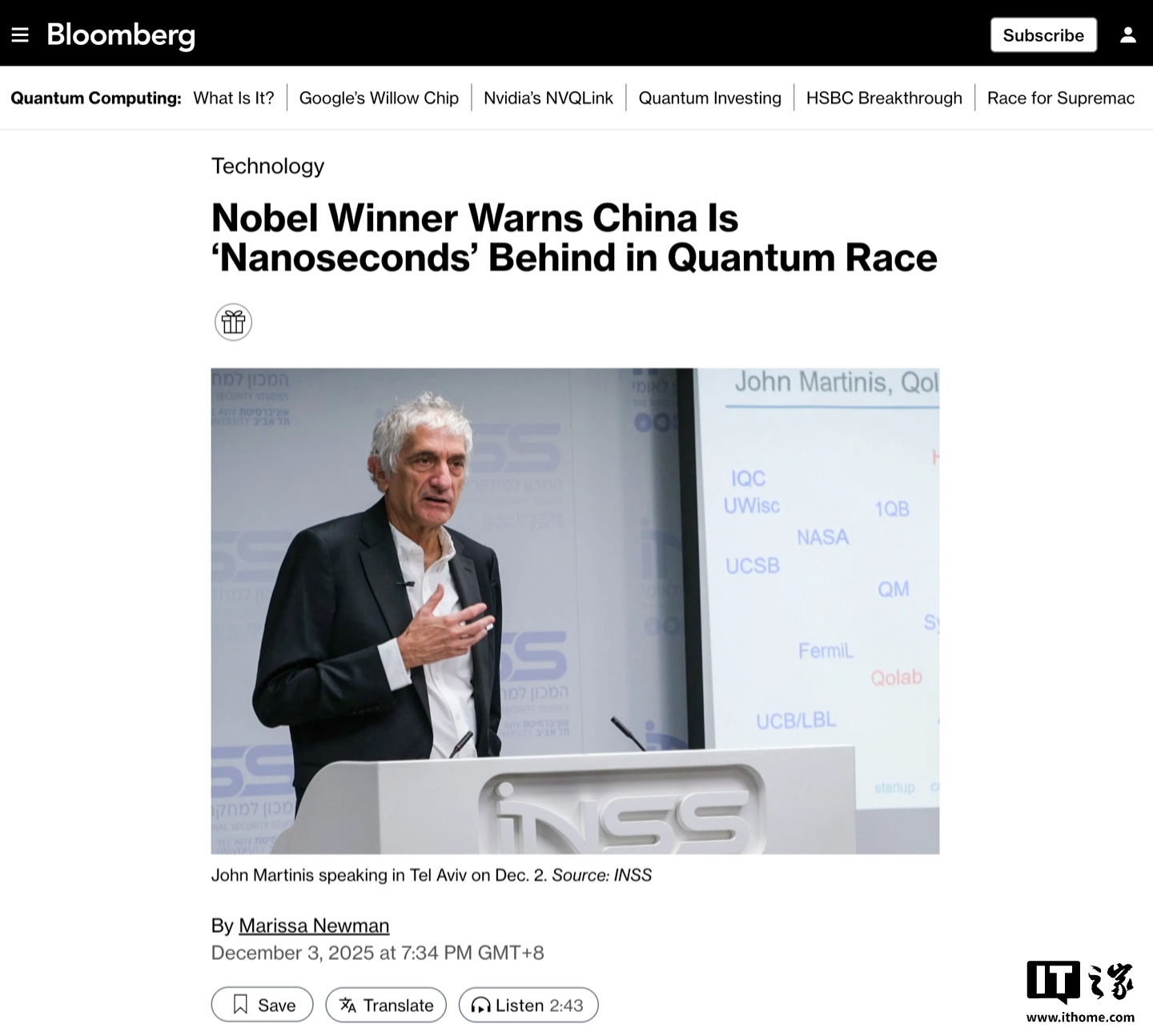
2025 诺贝尔物理学奖得主马蒂尼斯:中国在量子竞赛中仅落后美国“几纳秒”
Xin Lang Cai Jing· 2025-12-04 01:48
Core Viewpoint - John Martinis, one of the Nobel Prize winners in Physics this year, warns that China's rapid advancement in quantum computing is significantly narrowing the technological gap with the United States [1][8]. Group 1: Competitive Landscape - The competition in quantum computing is intensifying among the US, Europe, and China, with Martinis stating that practical quantum computers are still 5 to 10 years away from realization [4][11]. - Quantum computing is considered a strategic technology that could surpass traditional computing capabilities, potentially enabling the decryption of military communications and attacks on critical infrastructure [4][11]. Group 2: Technological Progress - Martinis, who previously worked on quantum hardware development at Google, noted that when Google announced achieving "quantum supremacy" in 2019, it was believed that China was about three years behind [4][11]. - However, Martinis pointed out that China has rapidly caught up, with the current lead of the US being only a few nanoseconds [4][11]. - Chinese research teams have a clear grasp of technological trends, often producing results with similar capabilities within months of key advancements announced by the West [4][11]. Group 3: Quantum Computing Fundamentals - Quantum computers utilize quantum bits (qubits) that can exist in both 0 and 1 states simultaneously, leading to an exponential increase in information processing capabilities compared to traditional computers [7][11].
2026年值得期待的十大技术应用
Ke Ji Ri Bao· 2025-12-04 00:55
Core Insights - The article highlights the rapid advancements in technology expected by 2026, including emotional AI, wearable health devices, renewable energy innovations, and more, which are set to transform daily life and work environments. Group 1: Emotional AI - The next generation of emotional AI assistants is surpassing traditional ones like Siri and Alexa by understanding human emotions through tone, expression, and wording, providing personalized relaxation recommendations and enhancing customer care [2] - Emotional AI is becoming a partner in daily life, playing a significant role in mental health support and personal growth [2] Group 2: Wearable Devices - By 2026, wearable devices are expected to evolve into "life guardians," with smart skin patches monitoring hydration, stress hormones, and nutrition levels, while AI watches can predict heart disease risks days in advance [3] - These innovations are shifting healthcare from reactive treatment to proactive prevention [3] Group 3: Renewable Energy - New night-time solar panels will capture infrared radiation, allowing for continuous power supply even in darkness, while advancements in lithium-sulfur and solid-state battery technologies will enhance energy storage for electric vehicles [4] - 2026 may mark a historical turning point for the decline of fossil fuels as the dominant energy source [5] Group 4: Brain-Computer Interfaces - Brain-computer interface technology is moving from medical applications to everyday use, enabling paralyzed patients to control devices with their thoughts and enhancing work efficiency through instant data retrieval [6] - By 2026, these interfaces will be integrated into daily life, impacting prosthetics, rehabilitation, and augmented reality experiences [6] Group 5: Space Economy - The space economy is set to flourish, with suborbital flight prices dropping below $100,000 and companies developing zero-gravity hotels, indicating a new era of space exploration and commercialization [7] Group 6: AI in Education - AI-driven personalized education is emerging, adapting courses to individual learning styles and helping adults with career transitions, fundamentally reshaping educational approaches [9] Group 7: Quantum Computing - Quantum computing is expected to solve complex problems beyond the capabilities of classical computers, significantly reducing drug development timelines and optimizing supply chains [10] Group 8: Smart Cities - Cities will become smarter by 2026, with AI traffic systems alleviating congestion, IoT-enabled waste management, and predictive security systems enhancing urban living [11] Group 9: Robotics - Robotics will become ubiquitous in households and various work environments, with cooking robots, construction robots, and personal care robots transforming daily tasks [12][13] Group 10: Bioprinting - The bioprinting field is anticipated to achieve significant advancements, enabling the creation of disease models, personalized medicine, and potentially addressing organ donation shortages [14]
2025中国经济回眸:巩固稳的基础 激发进的动能
Jing Ji Ri Bao· 2025-12-04 00:39
Economic Overview - China's GDP is expected to reach 140 trillion yuan in 2025, solidifying its position as the world's second-largest economy [1] - The economy has shown resilience despite external uncertainties, with a GDP growth of 5.2% year-on-year in the first three quarters, an increase of 0.4 percentage points from the previous year [2] - The urban unemployment rate in October was 5.1%, a decrease of 0.1 percentage points from the previous month, while the Consumer Price Index (CPI) rose by 0.2% year-on-year, indicating overall price stability [2] Investment and Infrastructure - A significant investment of nearly 73 billion yuan has been initiated for the Qinghai Hainan Clean Energy Transmission Base project, marking the establishment of a third green energy corridor [2] - The manufacturing sector remains robust, with the added value of equipment manufacturing accounting for over 35% of the total industrial output [8] Policy and Economic Stability - The Chinese government has implemented a series of policies aimed at stabilizing employment, businesses, and market expectations, which have shown positive effects on economic performance [3] - Major financial institutions, including Goldman Sachs and Deutsche Bank, have raised their growth forecasts for China's economy, reflecting confidence in its stability [3] Innovation and Technology - The quantum computing industry is gradually taking shape, with significant advancements showcased at the 2025 Quantum Technology and Industry Conference [4][5] - The introduction of new high-speed real-time oscilloscopes and the world's largest skin-stretching machine highlights China's progress in key manufacturing technologies [8] Consumer Market and Domestic Demand - A new implementation plan aims to enhance the adaptability of consumer goods supply and demand, targeting the formation of three trillion-level consumption sectors and ten hundred-billion-level consumption hotspots [9] - The focus on domestic circulation has been strengthened, with policies aimed at reducing logistics costs and promoting a unified national market [9] Foreign Investment and Global Confidence - Foreign investments continue to flow into China, with significant projects launched by companies like Danfoss and Medtronic, indicating strong confidence in China's economic prospects [13] - The eighth China International Import Expo reported a transaction intention of 83.49 billion USD, a 4.4% increase from the previous year, showcasing China's growing importance on the global stage [13]
“我们可能只领先中国几纳秒,这是真正的竞赛”
Guan Cha Zhe Wang· 2025-12-03 23:42
Core Insights - The global competition in quantum computing is intensifying, with China rapidly closing the gap with the United States, potentially leading to a situation where the U.S. may only be ahead by "a few nanoseconds" [1][2] - John Martinis, a prominent figure in quantum computing, emphasizes the competitiveness of China's advancements in the field, indicating that Western researchers are concerned about the genuine race between the two nations [1][2] Investment and Strategic Focus - The U.S. government, while currently focused on artificial intelligence, is beginning to shift its attention towards the challenges posed by quantum computing [2] - China has strategically prioritized quantum technology development since the "13th Five-Year Plan" (2016-2020) and has included it in the "14th Five-Year Plan" (2021-2025) as one of the seven key areas for technological advancement [5] Technological Advancements - China's latest generation of optical quantum computer, Jiuzhang 4, has achieved control over 3,050 photons, significantly outperforming traditional computers in specific tasks [5] - The potential applications of quantum computing span various fields, including medicine, finance, artificial intelligence, and military, with implications for existing encryption systems [4] Funding and Investment Disparities - China leads the world in public funding for quantum technology, with an investment of $15.3 billion, which is eight times that of the U.S. government's investment of $1.9 billion and double that of the European Union's total investment of $7.2 billion [5] - A report by LexisNexis suggests that China could surpass the U.S. in quantum computing patents as early as 2027, indicating a significant shift in technological capabilities [5][6] Future Outlook - Experts predict that Chinese research institutions will play a crucial role in the development of quantum technologies in the coming years, similar to the technological transformations seen in the electric vehicle sector [6]