
国产替代

Search documents
成本趋稳叠加内外需同步改善,化学纤维行业迎来基本面持续向好,政策赋能产业升级,龙头企业有望受益
Xin Lang Cai Jing· 2026-02-11 10:16
Group 1 - Huafeng Chemical (002064) is a global leader in the spandex industry, with strong technical advantages in differentiated spandex and early investments in bio-based and recycled spandex, benefiting from the growing demand for green fibers [2][34] - Tongkun Co., Ltd. (601233) is a domestic leader in the polyester filament industry, with strong technical and capacity advantages in differentiated and high-end products, and is expected to benefit from the recovery of downstream textile demand and policies promoting recycled fibers [3][35] - New Fengming (603225) is a core player in the polyester filament industry, with a strong position in differentiated and high-end products, and is well-positioned to benefit from the recovery of textile demand and the promotion of recycled fibers [4][36] Group 2 - Shuangxin Environmental Protection (001369) is a core enterprise in the PVA industry, with strong technical and capacity advantages, and is expanding into biodegradable and bio-based materials, expected to benefit from the growing demand for biodegradable materials [5][38] - Tianfulong (603406) is a core player in the polyester industrial yarn industry, with strong technical advantages and is expanding into high-performance and recycled industrial yarns, expected to benefit from the growth in automotive and industrial fabric demand [6][39] - Wanwei High-tech (600063) is a leading company in the PVA industry, with strong technical advantages and is expanding into biodegradable materials, expected to benefit from the growing demand for biodegradable materials [7][40] Group 3 - Xinxiang Chemical Fiber (000949) is a core enterprise in the viscose staple fiber industry, with strong technical advantages and is expanding into recycled viscose and bio-based viscose, expected to benefit from the recovery of textile demand [8][41] - Taihe New Materials (002254) is a leader in the aramid industry, with strong technical advantages and is expanding into high-performance and bio-based aramid, expected to benefit from the growth in high-end fields [9][42] - Jilin Chemical Fiber (000420) is a core player in the viscose staple fiber industry, with strong technical advantages and is expanding into high-performance carbon fiber, expected to benefit from the growth in aerospace and new energy sectors [10][44] Group 4 - Sanfangxiang (600370) is a core enterprise in the PTA industry, with strong technical advantages and is expanding into recycled PTA and bio-based PTA, expected to benefit from the recovery of textile demand [11][45] - Shenma Co., Ltd. (600810) is a leader in the nylon 66 industry, with strong technical advantages and is expanding into high-performance and recycled nylon, expected to benefit from the growth in automotive and industrial fabric demand [12][46] - Hailide (002206) is a leader in the polyester industrial yarn industry, with strong technical advantages and is expanding into high-performance and recycled industrial yarns, expected to benefit from the growth in automotive and industrial fabric demand [13][47] Group 5 - Youfu Co., Ltd. (002427) is a core player in the polyester industrial yarn industry, with strong technical advantages and is expanding into high-performance and recycled industrial yarns, expected to benefit from the growth in automotive and industrial fabric demand [14][48] - Huaxi Co., Ltd. (000936) is a core enterprise in the polyester staple fiber industry, with strong technical advantages and is expanding into recycled and bio-based polyester, expected to benefit from the recovery of textile demand [15][49] - Baolidi (300905) is a leader in the chemical fiber color masterbatch industry, with strong technical advantages and is expanding into biodegradable color masterbatches, expected to benefit from the green transformation of the chemical fiber industry [16][51] Group 6 - Nanjing Chemical Fiber (600889) is a core player in the viscose staple fiber industry, with strong technical advantages and is expanding into recycled viscose and bio-based viscose, expected to benefit from the recovery of textile demand [17][52] - Haiyang Technology (603382) is a core enterprise in the polyester industrial yarn industry, with strong technical advantages and is expanding into high-performance and recycled industrial yarns, expected to benefit from the growth in automotive and industrial fabric demand [18][53]


2026开年ETF融资风向:中证500领跑,卫星与半导体受捧
市值风云· 2026-02-11 10:12
Core Viewpoint - The market in 2026 is experiencing a shift, with leveraged funds becoming a focal point as they indicate strong bullish sentiment towards specific sectors [3][4]. Financing Overview: Aggressive and Defensive Dynamics - The operations of leveraged investors this year show a strong offensive style and structural differentiation, with significant net purchases in both mid-cap stocks and hard technology sectors [4][6]. - The top 20 net purchases include the CSI 500 ETF with a net buy of 6.31 billion, reflecting high expectations for valuation recovery and earnings elasticity in mid-cap stocks [5][6]. Net Purchase Side: Key Trends - The satellite internet and commercial aerospace sectors are experiencing a collective surge, with three ETFs in the top 20 for net purchases, indicating a strong market interest in this emerging field [12]. - The semiconductor equipment ETF shows a significant increase in net purchases, reinforcing the narrative of domestic substitution as a strong pillar in the A-share market [12]. - The Hong Kong technology sector is seeing increased buying despite a decline, suggesting a belief in the long-term value of these assets [13][14]. Net Sale Side: Profit-Taking and Cross-Border ETF Retreat - The net sales list reflects a tactical retreat, particularly in the STAR Market ETFs, where significant profit-taking is observed despite positive performance [17][18]. - The Hong Kong Securities ETF leads in net sales, indicating a cautious approach to cross-border investments amid external market pressures [18]. Market Dynamics and Policy Influence - The market is transitioning from a focus on core assets to sectors supported by industrial logic, with the CSI 500 index gaining favor as a sign of recognition for mid-cap blue-chip earnings elasticity [19]. - Policy direction plays a crucial role in fund flows, with significant investments in satellite and semiconductor sectors reflecting government support for new productive forces [19].

心脉医疗肿瘤介入新品获批,股价近期表现相对稳健
Jing Ji Guan Cha Wang· 2026-02-11 09:24
Core Viewpoint - The company has received regulatory approval for its first embolic product in the tumor intervention field, which is expected to enhance its product pipeline, although actual sales impact remains uncertain until production licenses are obtained [1] Recent Events - A national centralized procurement for 316 commonly used drugs, including those for anti-tumor treatments, has been initiated, with a selection rate of 93%. This may exert price pressure on the pharmaceutical industry, and the company should be aware of the risks associated with high-value consumables procurement expansion [2] Stock Performance - The company's stock price fluctuated between a high of 100.00 yuan and a low of 97.60 yuan over the past week, with a total price change of 1.21% and a volatility of 2.46% [3] Capital Movement - There was a net outflow of 197.72 million yuan in main funds on February 5, with a significant single purchase accounting for 6.03%. The total trading volume over the past week was 619 million yuan, indicating active turnover, while the medical device sector saw a slight decline of 0.48% [4] Financial Report Analysis - For the first three quarters of 2025, the company reported revenue of 1.015 billion yuan, a year-on-year increase of 4.66%, while net profit decreased by 22.46% to 429 million yuan. The gross margin stood at 70.4%, with a significant revenue increase of 64.68% in the third quarter, although net profit was impacted by product price adjustments [5] Financial Condition - The company has a debt ratio of 15.85% and maintains a stable cash flow, with overseas business revenue accounting for 18% of total income in the first three quarters, expected to grow over 60% for the year [6] Institutional Viewpoints - Analysts suggest that while short-term profitability may be under pressure, the company is likely to benefit from innovative product iterations, accelerated overseas expansion, and domestic substitution trends in the medium to long term, with a target price of 122.06 yuan. However, caution is advised regarding procurement policies and potential underperformance in R&D [7]

仪器信息网春节放假通知(红包封面领取中)
仪器信息网· 2026-02-11 09:01
Core Viewpoint - The article emphasizes the resilience and innovation of the Chinese scientific instrument industry in the face of global challenges, highlighting the importance of domestic products and AI integration for future growth [2]. Group 1: Industry Challenges and Responses - The year 2025 was marked by significant challenges, including intensified geopolitical tensions, U.S. export bans on high-end instruments, and tariff wars, which tested the stability of global supply chains [2]. - The scientific instrument industry underwent a comprehensive "stress test" during this period, prompting a shift towards domestic product standards and accelerated AI integration [2]. Group 2: Innovation and Market Transformation - The article notes breakthroughs in the first sets of domestically produced equipment and the reshaping of market standards through advancements in biobreeding and new pharmacopoeias [2]. - The expansion of the "national team" in scientific instruments and the deepening of state-owned enterprise empowerment are highlighted as key factors in fostering innovation and collaboration within the industry [2]. Group 3: Future Outlook - The industry is portrayed as seeking certainty through self-reliance and open cooperation, aiming to create a new landscape of independence and strength amidst challenges [2]. - The article concludes with a positive outlook for the future of the Chinese scientific instrument industry, wishing success and progress to all professionals in the field [4].

当VC开始”团购”项目:揭秘2025年最拥挤的13轮融资,谁在为高估值买单?
Xi Niu Cai Jing· 2026-02-11 07:34
Core Insights - In 2025, China's primary market is witnessing a unique "queueing" phenomenon where numerous hard tech companies attract multiple investment institutions in single rounds of financing, with a focus on collaboration rather than competition among investors [1][2] Group 1: Investment Trends - A total of 13 projects in 2025 had over 15 investors in a single round, covering strategic sectors such as AI chips, commercial aerospace, robotics, semiconductors, and biomedicine [1][2] - Notable companies include Mu Xi Co., Ltd. (C round, nearly 50 investors), Qingwei Intelligent (C round, 24 investors), and the Hainan Commercial Aerospace Innovation Center (angel round, nearly 30 investors) [2] Group 2: Mu Xi Co., Ltd. Case Study - Mu Xi Co., Ltd., a leading domestic GPU company, completed a record financing round in February 2025, raising over 7.2 billion yuan with nearly 50 investment institutions participating [3][4] - The investor lineup included state-owned capital, market-oriented funds, and industrial capital, indicating a strong collective bet on the domestic AI computing power sector [4][5] - The stock debuted on the Sci-Tech Innovation Board at 104.66 yuan per share, skyrocketing to 829.90 yuan on the first day, marking a 692.95% increase and a market cap exceeding 330 billion yuan [6] Group 3: Hainan Commercial Aerospace Innovation Center - The Hainan Commercial Aerospace Innovation Center was established in July 2025 with nearly 30 industry chain companies participating, marking a precedent for competitors to collaboratively build an innovation platform [7][10] - This model aims to leverage Hainan's advantages in low-latitude launches and tax policies while establishing a technology standard alliance to avoid redundant construction [9][10] Group 4: Qingwei Intelligent Case Study - Qingwei Intelligent, a leader in reconfigurable chips, completed a 2 billion yuan C round financing in December 2025, with 24 institutions participating, setting a record for the AI chip sector [11][12] - The investment was characterized by a mix of state-owned and market-oriented institutions, with a focus on the unique advantages of Qingwei's reconfigurable computing architecture [13] Group 5: Structural Changes in Investment Landscape - The phenomenon of multiple investors in single rounds reflects structural changes in the primary market, driven by a scarcity of viable projects in high-tech sectors and a shared risk mechanism among investors [14][15] - The increasing role of state-owned capital in hard tech investments is evident, with local state-owned platforms and industrial guidance funds significantly boosting the number of investors in single rounds [14] - The speculative mindset fueled by the success of Mu Xi's IPO has led to a trend where institutions are eager to participate in the last financing rounds before public offerings, despite high valuations [15]
微创机器人-B:中国手术机器人领军者,“让天下没有难做的手术”-20260211
Huaan Securities· 2026-02-11 07:25
Investment Rating - The investment rating for the company is "Buy" [1][10]. Core Insights - The surgical robot industry has a broad prospect with high clinical value, driven by both industry and policy [4][5]. - The domestic industry is at a pivotal moment, with increasing approval of domestic surgical robots and a growing number of local brands [4][5][6]. - The company is a leading player in the domestic surgical robot market, with a rich product portfolio and positive clinical feedback [7][8]. Summary by Sections Company Overview - The company, Shanghai MicroPort Medical Robotics, focuses on the design, development, and commercialization of surgical robots, aiming to assist surgeons in complex surgeries [17]. - Established in 2014, the company has developed a platform for innovation and industrialization in surgical robots, with multiple products approved for clinical use [18][20]. Market Potential - The global surgical robot market is expected to grow significantly, with a projected market size of $21.2 billion by 2024, reflecting a compound annual growth rate (CAGR) of 22.4% from $7.7 billion in 2019 [42]. - The laparoscopic surgical robot segment is the largest, accounting for over 50% of the total market [42]. Product Portfolio - The company has a diverse range of products, including the TUMAI laparoscopic surgical robot series and the Honghu orthopedic surgical robot series, with a total of seven commercialized products [8][20]. - The TUMAI series has been recognized in over 40 countries and regions, achieving significant sales and installations [8]. Financial Projections - Revenue is expected to reach RMB 569 million, RMB 896 million, and RMB 1.308 billion in 2025, 2026, and 2027, respectively, with year-on-year growth rates of 121%, 57%, and 46% [9][12]. - The company is projected to narrow its losses significantly, with a forecasted net profit of RMB 530 million by 2027 [9][12]. Competitive Landscape - The domestic market is seeing an increase in competition, with 11 local brands now approved for surgical robots, indicating a shift towards domestic alternatives to established international brands [5][53]. - The company maintains a competitive edge through its advanced technology and product offerings, which are well-received in both domestic and international markets [6][8].
尾气处理催化剂行业市场运行态势:环保法规趋严,规模达242.06亿元
Xin Lang Cai Jing· 2026-02-11 07:00
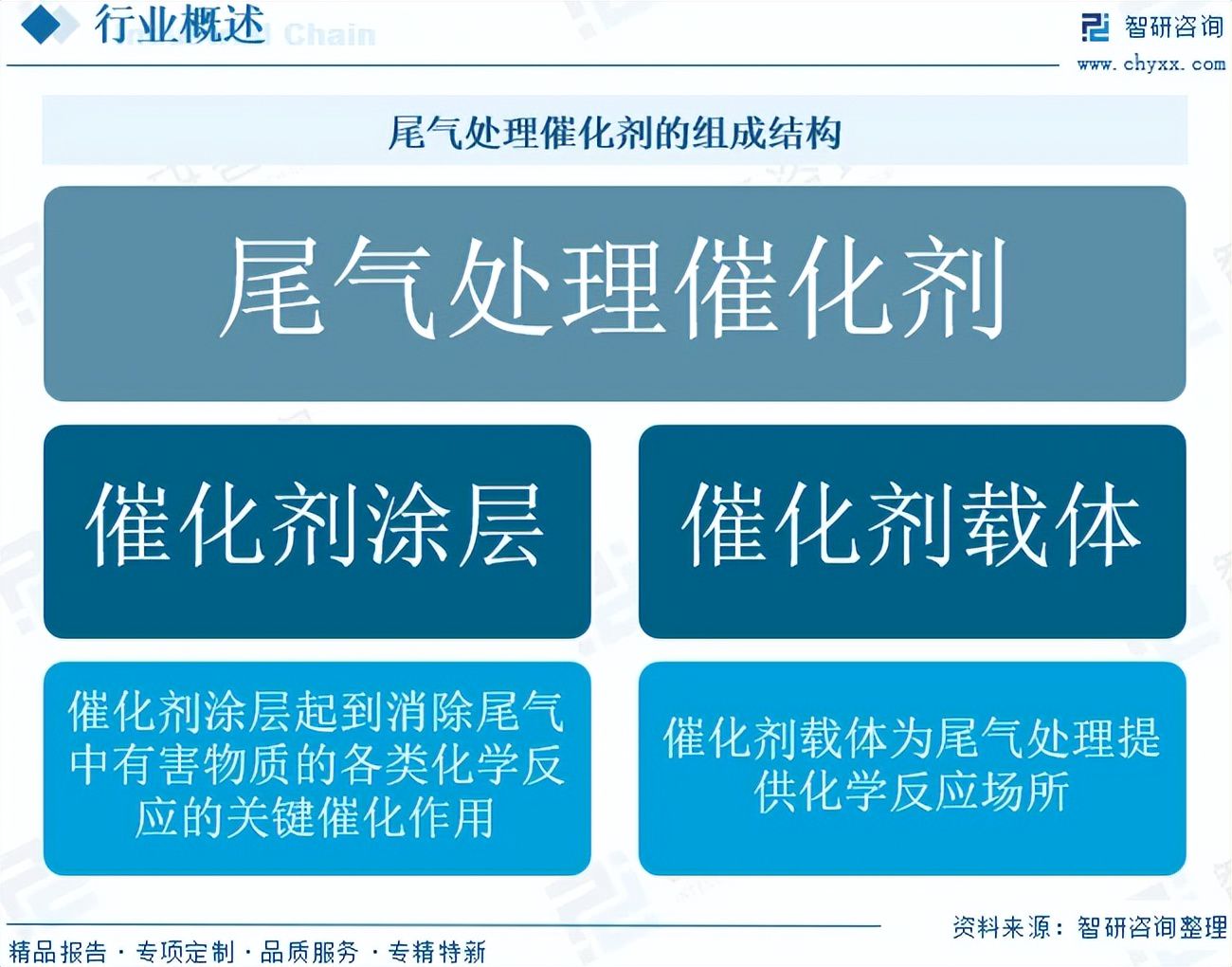
Core Insights - The Chinese exhaust catalyst market has been dominated by foreign giants like BASF, Johnson Matthey, and Umicore due to high technical barriers and its primary application in vehicle exhaust treatment [1][11][27] - The introduction of the National VI emission standards has marked a significant upgrade in China's emission regulations, making them among the strictest globally, and has led to a narrowing technology gap between domestic and foreign catalyst manufacturers [1][11][27] - The market for exhaust treatment catalysts in China is projected to grow from CNY 14.702 billion in 2017 to CNY 22.999 billion by 2024, with a compound annual growth rate (CAGR) of 6.6% [1][12][28] - Future growth is expected to be driven by the upcoming "National VII" standards, the rise of new energy vehicles, and stricter regulations on non-road machinery emissions [1][12][28] Industry Overview - Exhaust treatment catalysts are chemical agents used to convert harmful substances in internal combustion engine exhaust into less harmful or harmless substances, thereby reducing pollution and protecting the environment [2][18] - The catalyst consists of a coating that facilitates chemical reactions to eliminate harmful substances and a carrier that provides a reaction site, typically made from ceramic or metal [3][19] Industry Chain - The upstream of the exhaust catalyst industry chain includes raw materials and equipment such as precious metals, rare earth elements, and chemical raw materials [8][24] - The midstream involves the production and manufacturing of exhaust treatment catalysts, while the downstream includes applications in vehicles and industrial engines [8][24] Market Demand and Trends - The demand for exhaust treatment catalysts is increasing due to the continuous improvement of environmental regulations and rising automotive emission standards [1][12][28] - The automotive industry is the primary application area for exhaust catalysts, which are essential for meeting stringent emission regulations and ensuring cleaner, low-carbon vehicle operation [10][26] - China's automotive production is expected to rise from 26.082 million units in 2021 to 34.531 million units by 2025, contributing to stable demand for exhaust treatment catalysts [10][26]
存储大厂华邦电表示本季度内存价格预计将飙升90%至95%,高“设备”含量的科创半导体ETF(588170)近1月日均成交10.87亿元
Xin Lang Cai Jing· 2026-02-11 06:47
Group 1 - The Shanghai Stock Exchange Sci-Tech Innovation Board Semiconductor Materials and Equipment Theme Index (950125) decreased by 0.85% as of February 11, 2026, with mixed performance among constituent stocks [1] - The China Securities Semiconductor Materials and Equipment Theme Index (931743) also fell by 0.87%, with Guangli Micro leading gains at 8.99% and Kema Technology experiencing the largest decline at 6.86% [1] - The Sci-Tech Semiconductor ETF (588170) reported a trading volume of 3.92 billion yuan with a turnover rate of 4.81%, while the Semiconductor Equipment ETF Huaxia (562590) had a trading volume of 885.57 million yuan and a turnover rate of 3.23% [1] Group 2 - The Sci-Tech Semiconductor ETF saw a net inflow of 117 million yuan, accumulating a total of 50.67 million yuan over the last five trading days, while the Semiconductor Equipment ETF Huaxia had a net inflow of 3.83 million yuan over the last 22 trading days [2] - According to a report from Winbond Electronics, the DRAM shortage is expected to persist, with memory prices projected to surge by 90% to 95% this quarter, and similar price increases anticipated for the next quarter [2] - China Securities predicts a significant rise in storage product prices in the first quarter of 2026, with a continued upward trend expected throughout the year due to limited new supply and strong demand [2] Group 3 - The Sci-Tech Semiconductor ETF (588170) tracks the Shanghai Stock Exchange Sci-Tech Innovation Board Semiconductor Materials and Equipment Theme Index, focusing on semiconductor equipment (60%) and materials (25%) [3] - The Semiconductor Equipment ETF Huaxia (562590) emphasizes semiconductor equipment (63%) and materials (24%), targeting the upstream semiconductor sector [3] - The semiconductor equipment and materials industry is crucial for domestic substitution, benefiting from low domestic replacement rates and high potential for growth driven by the AI revolution and technological advancements [3]
“一块布”卡住AI供应链
财联社· 2026-02-11 06:09
Core Viewpoint - The electronic fabric industry is experiencing a price surge due to supply-demand imbalances, with significant price increases reported across various products in the supply chain [2][5]. Group 1: Price Trends and Market Dynamics - The price of electronic fabric has seen a notable increase, with prices rising from 4.15 yuan/meter at the end of September 2025 to 4.75 yuan/meter currently, reflecting a series of price hikes in October, December, and January 2026, each ranging from 0.15 to 0.25 yuan/meter [2][5]. - Major companies in the electronic fabric sector, such as Honghe Technology and International Composites, have reported significant stock price increases, with several reaching historical highs [3][4]. Group 2: Company Performance and Projections - Honghe Technology expects a net profit of 193 million to 226 million yuan for the fiscal year 2025, representing a year-on-year increase of 745% to 889% [4]. - International Composites anticipates a turnaround with a projected net profit of 260 million to 350 million yuan for 2025, indicating a return to profitability [4]. Group 3: Demand Drivers and Competitive Landscape - The rapid growth in AI demand is driving an increase in the market demand for electronic-grade glass fiber fabric, leading to both production and sales growth [5]. - The supply of LowCTE electronic fabric is constrained, with major supplier Nitto Denko holding over 90% of the global market share, and new production capacity not expected until 2027, which will only increase supply by 20% [5][6]. Group 4: Future Outlook - Analysts predict that the current price increase in electronic fabric will continue, with expectations of a new price increase cycle starting in 2026 due to ongoing supply constraints and recovering demand [6]. - The high-end electronic fabric market, particularly for LowDK and LCTE products, is expected to remain tight, further driving price increases and benefiting domestic manufacturers [6].



ai推动先进封装成长-国产替代迎来新机遇
2026-02-11 05:58
Summary of Conference Call Records Industry Overview - The advanced packaging industry is experiencing significant growth driven by the surge in AI computing power demand, particularly through technologies like CoWoS. It is expected that 2026 will mark the beginning of a new era for domestic advanced packaging demand, with the global advanced packaging market projected to exceed $79.4 billion by 2030 [1][2][4]. Key Companies and Market Dynamics - TSMC is facing a long-term shortage in CoWoS advanced packaging capacity, leading to some capacity overflow to companies like ASE and Amkor, which has positively impacted their stock prices [1][2]. - Domestic companies such as Shenghe Jingwei and Changdian Technology have made breakthroughs in key technologies and have completed customer validation [1][3]. - Shenghe Jingwei is recognized as the leader in the domestic CoWoS advanced packaging sector, with a projected compound annual growth rate (CAGR) in revenue ranking among the top ten globally from 2022 to 2024 [1][8]. Technological Advancements - The mainstream solutions are evolving from CoWoS S to CoWoS L, which retains the advantages of silicon while offering greater flexibility and scalability, indicating a future trend in advanced packaging [1][4]. - Companies like Huawei Ascend, Cambricon, and Haiguang are making progress in inference and training scenarios, contributing to the domestic AI computing landscape [6]. Financial Performance - Shenghe Jingwei reported a revenue of 3.178 billion yuan and a net profit of 435 million yuan in the first half of 2025, with a utilization rate of 63%. The net profit is expected to continue growing as supply chain improvements occur [9][10]. - The traditional packaging market in China holds over 20% market share, while advanced packaging is viewed as a critical opportunity for domestic companies to leapfrog competitors [7]. Market Trends and Pricing - The global advanced packaging market is expected to reach approximately $46 billion in 2024, with a year-on-year growth of 19%. The recent increase in traditional packaging prices by about 10% is anticipated to enhance the gross margins of related companies [2][11]. Recommendations - It is advised to focus on companies such as Changdian Technology, Tongfu Microelectronics, Yongxin Electronics, and Jingtai Electronics, which possess strong competitiveness in both traditional and advanced packaging sectors and are likely to benefit from the overall industry development trends [12].