绿色低碳转型

Search documents
中国汽车市场一周行业信息快报——2025年12月第2期
Zhong Guo Zhi Liang Xin Wen Wang· 2025-12-08 08:58
Group 1: National Standards Implementation - The implementation of national standards for dynamic monitoring and early warning of new energy vehicle safety performance, as well as remote service and management systems, began on December 1 [1][2] - The standards aim to enhance data monitoring on safety platforms and establish a new safety management model for new energy vehicles [1] Group 2: November Sales Data - Multiple automotive companies reported their November sales figures, with China FAW selling 306,000 vehicles and producing 312,000 [5] - Changan Automobile's sales reached 283,000 units, a year-on-year increase of 2.3% [5] - BYD's sales slightly declined, while Hongmeng Zhixing saw an 89.61% year-on-year increase in new car deliveries [5] - Other companies like NIO and Li Auto reported significant year-on-year growth, while Li Auto experienced a continuous decline for six months [5] Group 3: Government Initiatives - The Ministry of Industry and Information Technology encouraged leading companies in lithium batteries and new energy vehicles to expand internationally and invest in green energy projects [6] - The ministry emphasized the importance of international cooperation in green technology and standards [6] Group 4: Automotive Repair Industry - The China Automotive Maintenance Industry Association announced the initiation of a credit evaluation system for automotive repair enterprises to enhance integrity and market order [7][9] Group 5: New Standards and Initiatives - The new national standard GB17675-2025 for steering systems will replace the previous standard starting July 1, 2026, focusing on the safety of new technologies [9] - Geely Auto Group declared December as "Geely Safety Month" and will open a global safety center on December 12 [9][10] Group 6: New Product Launches - ZF announced the mass delivery of the Indi coaxial reducer, which significantly improves efficiency while saving space and weight [11] - The National Lithium Battery Material and Product Quality Inspection and Testing Center passed a national acceptance check, equipped with advanced testing facilities [12][14] - Scania's first locally manufactured Super trucks were officially launched from its production base in Jiangsu, with a total investment of 2 billion euros [16]





经济日报︱绿色低碳转型取得历史性成就
国家能源局· 2025-12-08 04:37
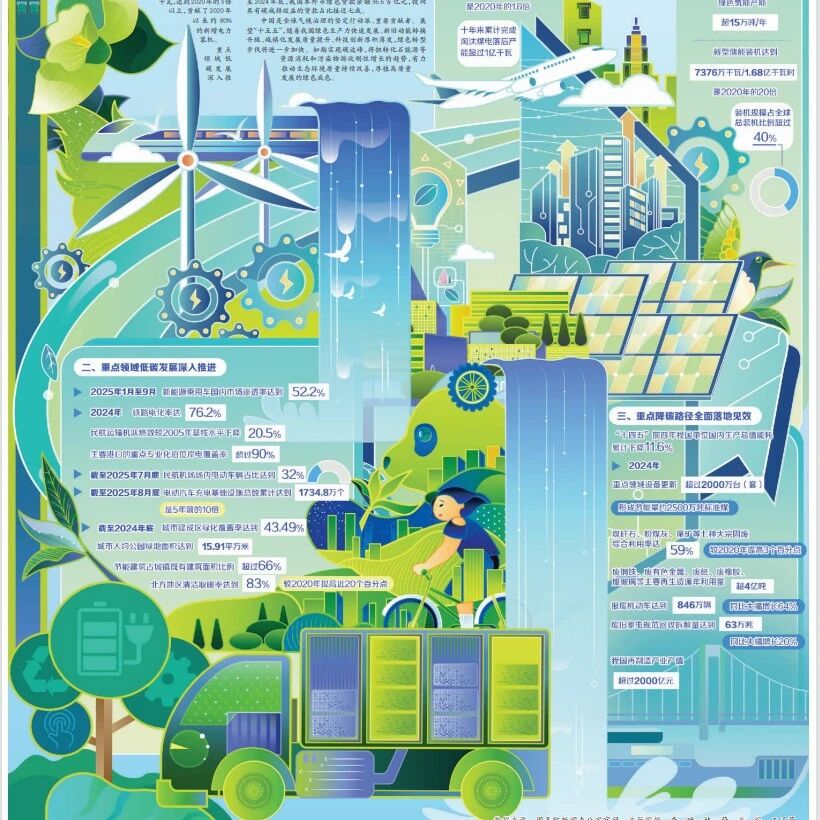
非化石能源消费比重由2020年的16.0%增至2024年的19.8%;2025年1月至9月,新能源乘用车国内市场渗透率达到 52.2%;"十四五"前四年我国单位国内生产总值能耗累计下降11.6%……作出碳达峰碳中和重大宣示五年来,面对复杂多 变的国内外形势,在党中央坚强领导下,我国牢固树立和践行绿水青山就是金山银山的理念,采取有力行动、付出艰苦努 力,推动绿色低碳转型取得历史性成就。 能源绿色低碳转型取得显著成效。中国立足基本国情和发展阶段,在保障能源安全的前提下,大力实施可再生能源替代, 推进新型能源体系和新型电力系统建设,为实现"双碳"目标提供有力支撑。截至2025年8月底,风电、光伏发电装机规模 突破16.9亿千瓦,达到2020年的3倍以上,贡献了2020年以来约80%的新增电力装机。 数据来源 国务院新闻办公室官网 ( 转 自 《 经 济 日 报 》 ) 国家能源局 国家能源局微信公众号是国家能源局新闻宣传、信息公开、服务群众的重要平台。 · 公开 政务信息 · 发布 行业动态 ·提供 公众服务 重点领域低碳发展深入推进。工业、交通、建筑、居民生活是产生碳排放的重要领域,对实现碳达峰碳中和具有重要影 ...
经济大省挑大梁 | 由大到强 山东十万亿经济体量的高质量发展跃迁
Zhong Guo Xin Wen Wang· 2025-12-08 02:18
Economic Growth and Transformation - Shandong Province's GDP is projected to exceed 10 trillion yuan by 2025, showcasing its role as a major economic province with a focus on stable growth, transformation, and overall benefits [1] - The province is enhancing its manufacturing sector through "chain thinking," implementing over 12,000 technological transformation projects valued at over 5 million yuan each, revitalizing traditional industries [1][2] Manufacturing and Innovation - Shandong has established itself as a leader in manufacturing, with 235 national-level "single champion" enterprises exporting products to over 190 countries, including notable companies like Jinan Second Machine Tool and Yantai Wanhua Chemical [2] - The province is advancing in green transformation, achieving a 14.5% reduction in energy consumption per unit of GDP over three years, while maintaining an average economic growth rate of 5.2% [2] Agricultural Development and Digital Transformation - Shandong is leveraging digital technology to reshape agriculture, with innovations like AI-powered harvesting robots and agricultural drones enhancing productivity [3] - The province's agricultural exports have maintained the highest national value for over 20 years, with a total export value of 121.74 billion yuan in the first three quarters of 2025, accounting for 22.8% of the national total [3] Technological Innovation and Collaboration - Shandong's innovation landscape is characterized by collaborative platforms and open ecosystems, with significant achievements in smart manufacturing recognized at the 2025 World Intelligent Manufacturing Conference [4] - Companies like Shandong Xinhua Medical Equipment and Inspur are making strides in high-end markets, with certifications and operational advancements in AI and medical technology [4][5] Overall Development Strategy - Shandong's development strategy focuses on upgrading manufacturing, promoting rural revitalization, and stimulating technological innovation, reflecting its commitment to being a leading economic province [5]
中共山东省委关于制定山东省国民经济和社会发展第十五个五年规划的建议
Bei Jing Ri Bao Ke Hu Duan· 2025-12-08 00:15
Core Viewpoint - The "15th Five-Year Plan" period is crucial for Shandong Province to establish itself as a modern socialist strong province, building on the achievements of the "14th Five-Year Plan" and addressing new challenges in the evolving international and domestic landscape [2][4][5]. Group 1: Achievements and Progress - During the "14th Five-Year Plan" period, Shandong achieved significant economic growth, with GDP surpassing 10 trillion yuan, and major economic indicators outpacing national averages [2][3]. - The province has made strides in modernizing its industrial system, enhancing technological innovation, and maintaining its position as a leader in agriculture and manufacturing [2][3][4]. - Social welfare has improved, with a focus on public service enhancements and a steady increase in residents' disposable income [2][3][4]. Group 2: Historical Context and Future Direction - The "15th Five-Year Plan" is positioned as a decisive phase for Shandong to solidify its role in national modernization and economic growth, aiming for a strong economy and improved living standards by 2035 [4][5]. - The plan emphasizes the importance of deepening reforms, implementing the Yellow River strategy, and fostering a high-level open economy [4][5][6]. Group 3: Challenges and Opportunities - Shandong faces a complex international environment with rising geopolitical tensions and economic uncertainties, but it also possesses strong foundational advantages such as a large market and robust industrial capabilities [5][6]. - The province aims to leverage its strengths in innovation and infrastructure to navigate these challenges and enhance its economic resilience [5][6][7]. Group 4: Economic and Social Development Goals - The guiding principles for the "15th Five-Year Plan" include prioritizing high-quality development, deepening reforms, and ensuring effective governance while focusing on the needs of the people [7][8]. - Key objectives include enhancing economic strength, technological capabilities, and social welfare, with a commitment to sustainable development and ecological protection [8][9][10]. Group 5: Industrial and Technological Advancements - Shandong plans to focus on building a modern industrial system, emphasizing smart, green, and integrated development across various sectors [12][13]. - The province aims to foster emerging industries and enhance the resilience of its supply chains, ensuring a robust foundation for future growth [14][15][16]. Group 6: Infrastructure and Investment - Investment in infrastructure is a priority, with plans to enhance transportation networks and digital infrastructure to support economic activities [22][23][24]. - The province seeks to attract both domestic and foreign investments, promoting a favorable business environment and facilitating cross-border trade [32][33].
能源企业高质量发展锚定科技创新
Jing Ji Ri Bao· 2025-12-08 00:04
聚焦绿色转型,夯实高质量发展的绿色根基。科技赋能绿色转型是能源企业的核心使命。能源企业 需将科技创新作为绿色低碳转型的核心驱动力,重点突破二氧化碳捕集利用、可再生能源高效利用等清 洁低碳技术,发展综合能源服务与能源梯级利用模式。推动数字技术与能源技术深度融合,加快建设智 慧油田、智能电网等新型能源基础设施,全面提升能源系统效率与智能化水平。建立绿色技术创新体 系,完善评估、交易与转化机制,将绿色发展理念融入科技创新全过程,让绿色成为能源企业高质量发 展的鲜明底色。 科技创新赋能能源企业高质量发展,是一篇需要久久为功的大文章。能源企业既要锚定战略方向、 深耕技术攻关,也要深化机制改革、坚持开放合作,更要聚焦绿色转型、践行使命担当,以高水平科技 自立自强为建设能源强国、推进中国式现代化注入强劲动力。 (本文来源:经济日报 作者:中国石油集团经济技术研究院副院长 罗良才) 深化机制改革,激活内生创新活力。机制创新是激发科技创新动能的关键抓手。能源企业需勇于打 破体制机制障碍,构建充满活力的创新生态。积极践行新型举国体制,联合高校、科研院所及上下游企 业组建跨领域创新联合体,集中力量攻克关键共性技术。建立研发投入稳定 ...
绿色低碳转型取得历史性成就
Jing Ji Ri Bao· 2025-12-07 21:50
Group 1 - The proportion of non-fossil energy consumption increased from 16.0% in 2020 to 19.8% in 2024, with the domestic market penetration rate of new energy passenger vehicles reaching 52.2% from January to September 2025 [1] - By the end of August 2025, the installed capacity of wind and solar power exceeded 1.69 billion kilowatts, more than three times that of 2020, contributing approximately 80% of the new power installations since 2020 [1] - The energy green and low-carbon transition has achieved significant results, with a cumulative decline of 11.6% in energy consumption per unit of GDP during the first four years of the 14th Five-Year Plan [1][2] Group 2 - Key sectors such as industry, transportation, construction, and residential life are major contributors to carbon emissions, and China is integrating carbon peak and carbon neutrality into its overall economic and social development [2] - China has established the world's largest clean steel production system and has maintained the highest production and sales of new energy vehicles globally for ten consecutive years, making the green low-carbon industry a new engine for economic growth [2] - By the end of 2024, the balance of green loans in both domestic and foreign currencies is expected to reach 36.6 trillion yuan, with nearly 70% of loans directed towards carbon reduction benefits [2] Group 3 - China is a steadfast actor and important contributor to global climate governance, with expectations for accelerated green transformation in the 15th Five-Year Plan [3] - The realization of carbon peak is anticipated to reverse the trend of rigid growth in fossil energy consumption and pollutant emissions, significantly improving ecological environment quality [3]
马士基高管建言上海国际航运中心建设:打造“航运数据枢纽”“航运科技硅谷”
Xin Hua Cai Jing· 2025-12-07 14:11
韩岩滨认为,在此背景下,上海在巩固规模优势的同时,应向效率与创新双轮驱动转型,从政策对标迈 向制度创新引领,以更加开放、包容、国际化、市场化的制度环境构建核心竞争力,可以从五方面行 动:一是强化政策创新与网络效应。 通过扩大沿海捎带政策试点和应用范围,形成高效稳定的制度网 络,释放政策红利,提升国际服务竞争力,支持区域性全渠道履约中心、国际物流中心和新兴业务发 展,打造更加灵活、开放、市场化的制度环境。 二是推动数智化升级,打造全球航运数据枢纽。 在现有绿色港口走廊基础上,探索建设绿色数字走 廊,加强与洛杉矶、鹿特丹、新加坡等港口的数据合作,建立统一数据标准,实现船期优化、航速降 低、码头效率提升及班轮碳排放减少,推动全球航运绿色发展。 新华财经上海12月7日电(葛佳明)12月7日,上海加快"五个中心"建设研讨会在沪举行,来自中外政产 学研各环节的资深专家共商上海经济社会高质量发展面临的新机遇和新挑战,为"五个中心"形成合力建 言献策。 马士基码头公司中国区总裁韩岩滨发表了题为"上海国际航运中心的发展机遇"的演讲,围绕全球航运格 局变化、上海国际航运中心建设机遇及后续行动建议进行了阐述。在韩岩滨看来,上海具备 ...
政策+法规双驱动,环境监测新蓝海
GOLDEN SUN SECURITIES· 2025-12-07 12:25
Investment Rating - The report maintains a "Buy" rating for key companies in the environmental sector, including Huicheng Environmental, Gaoneng Environment, and Hongcheng Environment [6]. Core Insights - The environmental monitoring and air pollution control sectors are expected to benefit from new policies and regulations aimed at enhancing air quality management and performance evaluation [17][18]. - The report highlights the importance of the ecological environment department's new guidelines for air quality performance grading, which will create a favorable environment for companies involved in air pollution control and environmental monitoring [17]. - The report emphasizes the potential for growth in the environmental sector due to low macroeconomic interest rates, recommending companies with strong cash flow and high dividend yields [2][29]. Summary by Sections Policy and Regulation - The ecological environment department has issued guidelines to strengthen air quality performance grading, establishing a four-tier evaluation system (A, B, C, D) to promote green and low-carbon transformation in key industries [10][17]. - The newly enacted Shanxi Province Environmental Protection Regulations aim to prevent and reduce pollution, which will positively impact the environmental monitoring sector [18]. Market Performance - The environmental sector has underperformed compared to the broader market, with a decline of 1.45% against a 0.37% increase in the Shanghai Composite Index [32]. - Key stocks in the environmental sector showed varied performance, with China Tianying leading gains at 9.07% while Yishida faced a significant drop of 14.39% [32]. Key Companies - Huicheng Environmental is recognized for its strong growth potential, particularly in hazardous waste management and innovative recycling projects [31]. - Gaoneng Environment is positioned as a leading environmental system service provider, focusing on solid waste and hazardous waste resource utilization [31]. - Hongcheng Environment is noted for its consistent dividend payouts and robust growth in environmental services [31].


汽车行业周报(20251201-20251207):板块触底有望提前,关注26年beta反弹机会-20251207
Huachuang Securities· 2025-12-07 12:07
证 券 研 究 报 告 汽车行业周报(20251201-20251207) 行业研究 汽车 2025 年 12 月 07 日 推荐(维持) 板块触底有望提前,关注 26 年 beta 反弹机会 华创证券研究所 | 证券分析师:张程航 | 证券分析师:夏凉 | 证券分析师:李昊岚 | 联系人:张睿希 | | --- | --- | --- | --- | | 电话:021-20572543 | 电话:021-20572532 | 邮箱:lihaolan@hcyjs.com | 邮箱:zhangruixi@hcyjs.com | | 邮箱:zhangchenghang@hcyjs.com | 邮箱:xialiang@hcyjs.com | 执业编号:S0360524010003 | | | 执业编号:S0360519070003 | 执业编号:S0360522030001 | | | 本周我们更新了明年年度策略,相较于前几年,2026 年确实市场一致预期相对较高,我 们观点简言之:1)销量展望没那么悲观,所以会有 beta 反弹机会;2)整车投资依然以 个股为主,零部件以新产业为主。 4Q 汽车基本面低于预期,这 ...


39页|2025年化肥行业低碳发展系列研究报告-中国化肥减量增效十年之路
Sou Hu Cai Jing· 2025-12-07 02:43
Core Viewpoint - The Chinese fertilizer industry has achieved significant reduction and efficiency improvements over the past decade, becoming a key example of sustainable agricultural transformation globally. Since the launch of the "Zero Growth Action for Fertilizer Use" in 2015, the national fertilizer application has decreased for nine consecutive years, from 60.23 million tons to 49.88 million tons, a reduction of 17.2% [1][13][35]. Group 1: Industry Transformation and Achievements - The fertilizer application rate for the three major grain crops has increased from 35% to 42.6%, indicating more scientific and precise fertilization methods [1][13]. - The total grain production in China has remained stable at over 1.3 trillion jin since 2015, with a projected first-time increase to over 1.4 trillion jin in 2024, further ensuring food security [1][13]. - The actions taken have cumulatively avoided approximately 126 million tons of fertilizer application from 2015 to 2024 [1][35]. Group 2: Policy and Market Mechanisms - The transformation of the fertilizer industry is a result of multiple policies and market mechanisms working in synergy, involving technological innovation, management optimization, and production structure adjustments [1][12]. - The "dual carbon" goals of the state are driving the fertilizer industry towards a green and low-carbon direction, facing complex challenges in balancing food security, environmental protection, and economic benefits [1][12]. Group 3: Global Context and Future Outlook - The process reflects not only domestic agricultural modernization but also provides reference value for global agricultural sustainable development [2]. - The fertilizer industry must explore more efficient and environmentally friendly development paths to support the dual goals of food security and ecological protection [2].