
量化投资

Search documents
量化数据揭秘:机构震仓的3个信号
Sou Hu Cai Jing· 2025-10-15 07:40
Core Insights - The article reflects on the volatility of the stock market, particularly during the "slow bull fast adjustment" phase in Q2 2025, highlighting the challenges faced by investors during this period [1][2][3] Market Behavior - The market experienced a slow upward trend followed by rapid corrections, exemplified by a significant drop in the Shanghai Composite Index due to geopolitical tensions, which was quickly reversed [2][3] - Investors were often caught off guard by sudden market movements, leading to panic selling and missed opportunities for gains [3][5] Investment Strategies - A quantitative method for identifying institutional shakeouts was discovered, which helped in understanding market fluctuations better [5][7] - Key indicators include the "dominant momentum" represented by colored bars reflecting different trading behaviors and "institutional inventory" indicating the activity level of large funds [7] Current Market Context - The recent surge in gold and silver prices is attributed to expectations of Federal Reserve interest rate cuts, U.S. political instability, and geopolitical conflicts, but caution is advised against solely relying on news-driven trading [9][11] - Successful investors utilize quantitative thinking to assess market movements, focusing on the nature of the capital driving these fluctuations rather than just price changes [11][12]


打卡一家业绩亮眼的量化私募,严控风险,力争稳定超额收益
私募排排网· 2025-10-15 00:00
本文首发于公众号"私募排排网"。 (点击↑↑ 上图查看详情 ) 编 者按 私募排排网数据显示,截至2025年8月底,管理规模在20亿以下的私募管理人有7200余家,占比超90%,是私募行业数量庞大的中坚力量。私募排 排网推出 「打卡100家小而美私募」 栏目,聚焦管理规模适中、策略特色鲜明的优质私募基金管理人。通过深度解析其投资方法论、风控体系及能力 圈建设,为投资者提供差异化的视角与洞察。本期打卡—— 久期量和 。 Part.1 公司概况 上海久期量和投资有限公司(以下简称"久期量和"或"公司")成立于2015年12月,2016年5月6日在中国证券投资基金业协会备案,登记编号为 P1031301,现为基金业协会普通会员,拥有投资顾问资质。 公司专注于量化投资领域,建立了各类以对冲和套利为核心的量化解决方案。公司团队拥有计算机、数学工程、金融等复合型专业背景,成员均来 自国内知名的大型银行、外资银行、证券公司等金融机构,具有深厚的学术背景和丰富的资产管理经验。 Part.2 核心团队 目前,公司总人数26人,投研团队18人,核心团队毕业于北大、清华、人大、港大、中科大、伦敦政治经济学院(LSE)、多伦多大学等 ...

日本政坛地震!华尔街巨鳄却在悄悄布局
Sou Hu Cai Jing· 2025-10-14 14:13
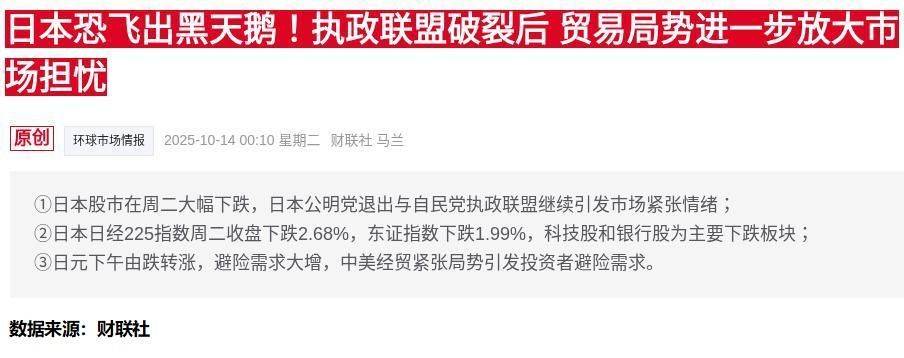
Group 1 - The sudden political shift in Japan, with the Komeito party exiting the ruling coalition with the Liberal Democratic Party (LDP), has created significant market uncertainty, leading to a 2.68% drop in the Nikkei 225 index and a 1.99% decline in the TOPIX index [1][3] - Despite the market panic, certain sectors showed unusual activity in "institutional inventory" data, indicating potential investment opportunities during times of fear [3][6] - The breakdown of the ruling coalition may allow opposition parties to form a large alliance, impacting the political future of LDP President Sanna Takashi [3] Group 2 - The current market environment is characterized by structural and differentiated trends, necessitating careful selection of investment directions [4] - Investors should focus on understanding how institutional investors are positioning themselves, as this can provide insights into potential market movements [4][6] - The "institutional inventory" data reflects the level of institutional participation, with active inventory suggesting strong institutional interest in certain stocks [6][8] Group 3 - The example of "Jinling Sports" illustrates how stock performance can be linked to external events, such as the start of a popular sports league, highlighting the importance of timely information [8] - The political crisis in Japan, while creating uncertainty, also presents opportunities as certain sectors show active capital inflows according to "institutional inventory" data [8] - Quantitative data analysis is emphasized as a valuable tool for investors to discern real capital flows and identify genuine opportunities amidst market volatility [8]
这只“量化”基金,连亏5年...
Sou Hu Cai Jing· 2025-10-14 10:25
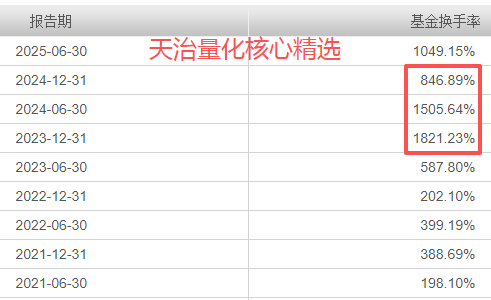
Core Viewpoint - The "Tian Zhi Quantitative Core Selection" fund has experienced significant losses, with a reported decline of 13.39% this year, marking a trend of consecutive annual losses over the past four years, each exceeding double digits [5][27]. Fund Performance - The fund's turnover rate has been exceptionally high, reaching over 1000% since August 2023, indicating frequent trading of its top holdings [14]. - The fund's net asset value has fluctuated significantly, with a reported net asset change rate of 374.38% as of June 30, 2025, despite the overall decline in performance [8]. Fund Management - The fund has undergone management changes, with five different fund managers, each contributing to poor performance rankings [19]. - The previous manager, Xu Jiahan, is noted for making high-risk investments, leading to substantial losses during his tenure [11][23]. Investment Strategy - The fund's investment strategy has been criticized for chasing high-performing stocks, particularly during periods of market volatility, which has exacerbated losses [16][27]. - The current manager, Li Shen, has shifted the fund's focus towards value stocks, particularly in the financial and public utility sectors, but has struggled to capitalize on market rebounds [25][27]. Market Context - The fund's performance is set against a backdrop of broader market trends, with significant fluctuations in growth and value sectors, impacting overall investment strategies [30][34]. - Despite the fund's poor performance, there has been an influx of retail investor interest, leading to an increase in the fund's C share scale from 2 million to 7 million [28].


这波百亿大战,量化凭什么赢?
雪球· 2025-10-14 09:09
Core Viewpoint - The private equity industry in China has seen a significant shift, with quantitative funds now surpassing subjective funds in number among the hundred billion-level private equity firms, marking a pivotal change in the investment landscape [2][6]. Group 1: Market Environment Changes - The market has transitioned from a "wild" era characterized by slow information dissemination and significant mispricing to a more civilized and efficient environment [8][15]. - In the past, the market was dominated by retail investors, leading to prolonged deviations of stock prices from their intrinsic values [10][12]. - The current market environment, influenced by technological advancements and macroeconomic changes, presents greater challenges for subjective fund managers, as mispricing opportunities have become shorter and more complex [17][20]. Group 2: Investment Products and Tools - The availability of investment products and tools has evolved from scarcity to abundance, with the introduction of stock index futures in 2010 marking a turning point for quantitative strategies [26][27]. - The diversification of trading products has led to the emergence of various innovative quantitative strategies, providing more profit opportunities [29][31]. Group 3: Technological Advancements - Technological progress has played a crucial role in the rise of quantitative strategies, with the volume of data available for analysis significantly exceeding that of subjective approaches [33][35]. - Quantitative strategies benefit from faster execution and continuous improvements in computational power, enhancing their effectiveness compared to subjective strategies [37][39]. - The distinction between subjective and quantitative investment lies in their methodologies, with subjective investment relying on individual insight and quantitative investment relying on data and algorithms [39].

震荡市不想躺平又怕回撤?博时资本红利增强策略&波动增利策略:一边收息一边薅波动
私募排排网· 2025-10-14 09:04
Core Viewpoint - In the current volatile capital market, asset management institutions must maintain stability and long-term growth, with Bosera Capital exemplifying this through its multi-asset strategy and over 2.24 trillion yuan in managed assets [2][3]. Group 1: Company Overview - Bosera Capital was established in February 2013 with a registered capital of 850 million yuan and is a subsidiary of Bosera Fund, which is primarily controlled by China Merchants Securities [8][6]. - The company has issued over 1,500 products and has a cumulative management scale exceeding 2.24 trillion yuan [2]. - Bosera Capital shares a risk control system with its parent company, ensuring comprehensive risk monitoring and compliance management [10]. Group 2: Investment Strategy - The investment strategy framework of Bosera Capital includes various strategies such as fixed income, fixed income plus, quantitative stock selection, quantitative derivatives, ETF rotation, volatility enhancement, and overseas thematic FOF strategies [3][12]. - The investment strategies are designed to complement those of the parent company, providing differentiated products [12]. Group 3: Volatility Enhancement Strategy - The volatility enhancement strategy aims to capture market fluctuations and enhance returns through non-linear grid trading and futures pricing [15]. - The flagship product, "Bosera Rongxiang Enhanced Income No. 1," is tailored for volatile markets and aims to achieve excess returns while controlling drawdowns [15]. - The strategy's returns are derived from four main sources: volatility profits, basis spread profits, index returns, and cash returns [16]. Group 4: Performance and Risk Management - Historical performance shows that the volatility enhancement strategy has achieved positive returns for nine consecutive years from 2016 to 2024, with annualized returns significantly outperforming the CSI 500 index during downturns [22][24]. - The strategy has demonstrated strong risk control, with maximum drawdowns significantly lower than the CSI 500 index during adverse market conditions [24]. Group 5: Dividend Enhancement Strategy - The fixed income plus quantitative dividend enhancement strategy focuses on high-dividend, low-volatility stocks while maintaining a significant allocation to bonds [34]. - The strategy benefits from favorable policies encouraging cash dividends and stock buybacks, enhancing the selection of potential investment targets [37]. - The strategy employs a rigorous selection process to ensure sustainable high dividends and robust company fundamentals [39][40]. Group 6: AI Integration - Bosera Capital aims to integrate AI technology into various aspects of its strategies, including factor development, return prediction, and model optimization [43]. - The use of AI is expected to enhance the efficiency of investment research and decision-making processes [43].

权益因子观察周报第125期:上周估值因子表现较好,本年中证2000指数增强策略超额收益为23.32%-20251014
GUOTAI HAITONG SECURITIES· 2025-10-14 08:53
Group 1 - The core viewpoint of the report indicates that valuation factors performed well last week, with the year-to-date excess return of the CSI 2000 index enhancement strategy reaching 23.32% [1] - The report tracks the performance of public index enhancement funds for major broad-based indices, including the CSI 300, CSI 500, CSI 1000, and CSI 2000, providing weekly updates for investor reference [8][9] - The report highlights the top-performing public index enhancement funds for the year, with specific excess returns noted for each fund across different indices [10][16][21][26] Group 2 - The report details the performance of public enhancement funds for the CSI 300 index, noting that the top five funds have year-to-date returns ranging from 24.89% to 32.31%, with corresponding excess returns [10][12] - For the CSI 500 index, the top five funds achieved year-to-date returns between 36.56% and 41.67%, with excess returns noted for each fund [16][19] - The CSI 1000 index enhancement funds also showed strong performance, with the top five funds reporting year-to-date returns from 42.53% to 44.54% [21][24] - The CSI 2000 index enhancement funds had year-to-date returns ranging from 38% to 46.5%, with significant excess returns for the leading funds [26][31] Group 3 - The report analyzes the performance of various factors used in quantitative stock selection models, emphasizing the importance of valuation, profitability, growth, corporate governance, and volume factors [33] - It discusses the methodology for neutralizing factors, particularly the treatment of market capitalization and industry effects, to better reflect the investment logic and stock selection effectiveness [33][34] - The report provides insights into the performance of single factors, highlighting the best and worst performing factors across different stock pools for the past week and year [35][36]
AI模型做指数增强,他的“代表作”业绩很亮眼
Zhong Guo Zheng Quan Bao· 2025-10-14 08:37
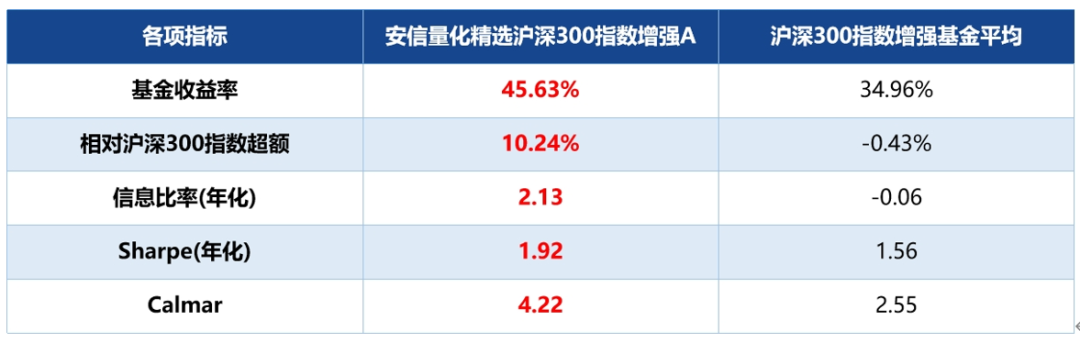
Core Insights - The article highlights the significant growth of index funds, particularly index-enhanced funds, which combine the discipline and diversification of index funds with active management to seek excess returns (Alpha) [1] - Despite the overall decline in excess returns for many index-enhanced products due to increased market efficiency and homogenization of quantitative strategies, the manager Shi Rongsheng from Anxin Fund has achieved consistent and stable excess returns through a unique "AI + machine learning" quantitative framework [1][2] Group 1: Performance Metrics - As of August 24, 2023, the Anxin Quantitative Selected CSI 300 Index Enhanced Fund has achieved a cumulative return of 36.53%, outperforming the CSI 300 by 14.89%, with a one-year cumulative return of 45.63%, exceeding the CSI 300 by 10.24% [2][3] - The fund's performance metrics, including information ratio (annualized) of 2.13, Sharpe ratio (annualized) of 1.92, and Calmar ratio of 4.22, significantly surpass the average levels of CSI 300 index-enhanced funds [3][5] Group 2: Investment Strategy - Shi Rongsheng's investment strategy has evolved from traditional multi-factor models to a focus on machine learning, allowing for more effective capture of complex relationships between returns and factors, thus overcoming the limitations of traditional factor-driven approaches [8][14] - The application of AI and machine learning in quantitative investment enables the identification of mathematical relationships between various factors and stock performance, enhancing the efficiency of discovering complex patterns that traditional methods may miss [7][8] Group 3: Future Prospects - Building on the success of the CSI 300 index-enhanced fund, Shi Rongsheng is set to manage a new product, the Anxin ChiNext Index Enhanced Fund, which targets growth-oriented innovative enterprises in strategic emerging industries [9] - The ChiNext Index has shown significant long-term performance, with a cumulative return of 189.01% since its inception, indicating a strong potential for future investment opportunities [12]
82%权益基金发行,散户该如何避免踩坑?
Sou Hu Cai Jing· 2025-10-13 21:21
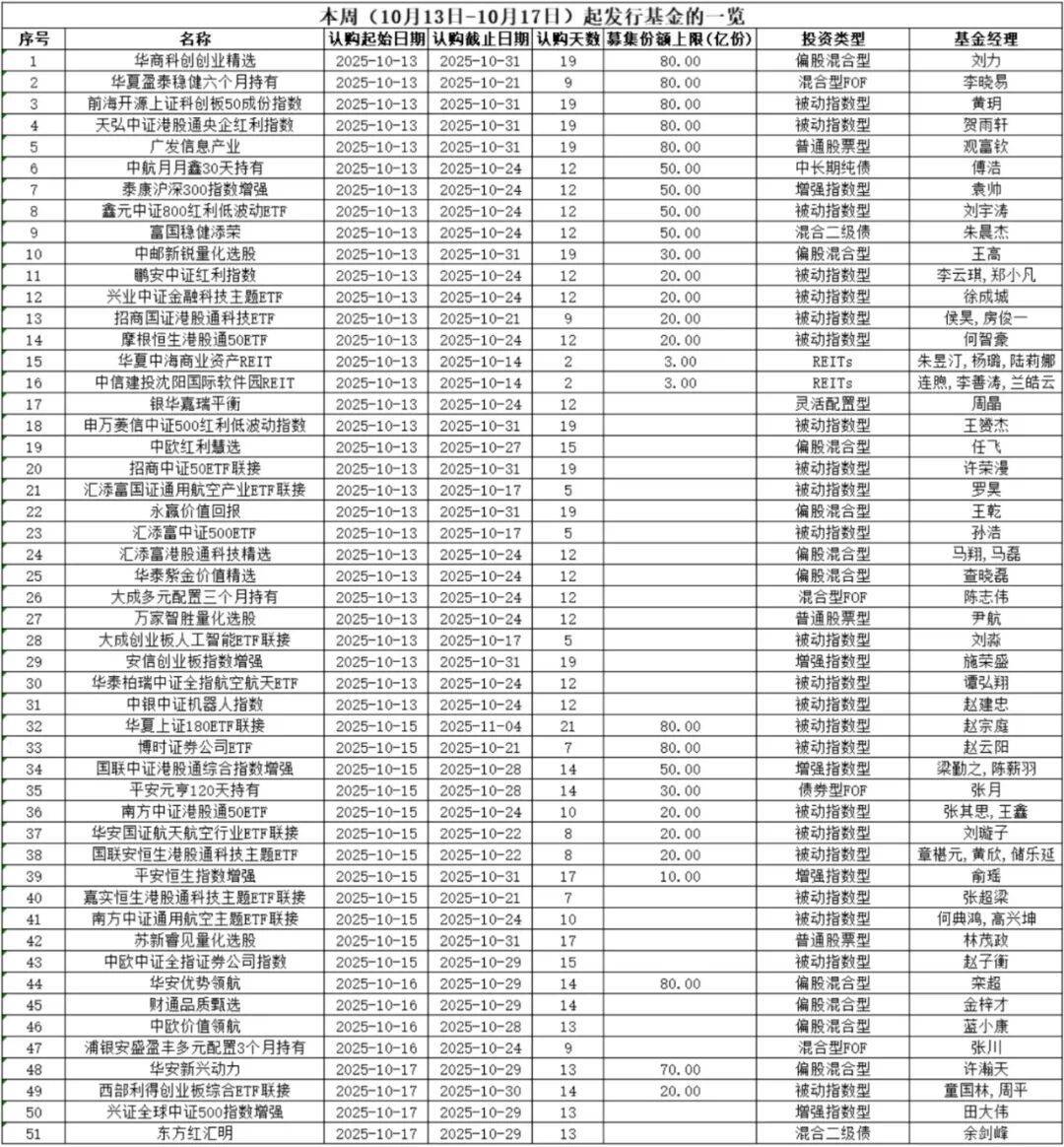
Core Insights - The recent surge in new fund issuances, with 51 new funds launched and 82% being equity products, signals a potential market recovery, but underlying patterns suggest caution [1][11][12] Fund Issuance Overview - A total of 51 new funds were launched in the first trading week after the National Day holiday, with 31 funds starting their fundraising on the same day [1] - Equity products accounted for 82% of the new fund offerings, indicating a strong interest in this asset class [1][11] Market Behavior and Trends - Historical parallels are drawn to the 2007 bull market, where similar patterns of fund issuance were observed, suggesting that current enthusiasm may not be sustainable [1][12] - The market has seen a strong recovery since April, with the banking sector rising over 12% and micro-cap stocks increasing by 35% [3] Investment Strategies and Risks - The current earnings season is highlighted as a critical period where stock performance becomes closely tied to earnings reports, but this can also lead to misleading market movements [5][6] - The concept of "fake drops" and "real declines" is introduced, emphasizing the need for investors to be wary of market manipulations that can mislead retail investors [5][6] Data-Driven Investment Approach - The importance of using quantitative data to analyze market trends and fund performance is stressed, as it can reveal underlying truths that are not apparent through traditional analysis [11][12] - Investors are advised to remain calm amidst market excitement and focus on data-driven decision-making rather than emotional reactions [12][13]
194%收益神话下:谁在悄悄撤退?
Sou Hu Cai Jing· 2025-10-13 17:24
Core Insights - The article highlights the impressive annualized return of 194.49% from Yongying Technology, while cautioning about the underlying risks that may be overlooked due to the allure of such high returns [1] - The current AI hype is compared to the "Internet Plus" boom in 2015, suggesting that the market may be at a critical juncture with both speculative trading and institutional repositioning occurring simultaneously [3][5] - The article emphasizes the importance of understanding market dynamics beyond surface-level trends, advocating for a deeper analysis of quantitative data and investment strategies [5][9] Market Dynamics - The intertwining of "speculative trading" and "institutional repositioning" is noted as a frequent occurrence in the third quarter, coinciding with the adjustment of 42 doubling funds [5] - The article suggests that while many investors are captivated by technology stocks, there is a need to recognize the potential of energy-related investments, as indicated by the unusual movements in uranium stocks during a market downturn [5] - The research on rare earth elements by Morgan Stanley is mentioned, highlighting the often-overlooked components in the electric vehicle supply chain, such as neodymium-iron-boron magnets, which are crucial for connecting technology narratives with resource logic [7] Investment Strategies - The article advocates for a strategy of identifying low-entry opportunities following institutional repositioning, likening it to finding hidden culinary gems in a bustling city [9] - It compares the market to a symphony, where different sectors play distinct roles, emphasizing the need for a holistic understanding of market rhythms rather than focusing on individual stocks [9] - The article concludes that successful fund managers are more adept at decoding market behavior than merely timing the market, suggesting that the true advantage lies in recognizing moments of consensus among investors [9]
