
新型城镇化

Search documents
探索独具特色的融合新路
Jing Ji Ri Bao· 2025-07-22 22:09
Core Viewpoint - Chongqing is implementing a new urbanization strategy focused on people, aiming to promote coordinated development between urban and rural areas, and exploring a unique path for urban-rural integration during the "14th Five-Year Plan" period [1] Group 1: Urbanization and Rural Revitalization - The integration of new urbanization and comprehensive rural revitalization is essential for promoting urban-rural integration, with a focus on large cities supporting rural areas [1] - Chongqing is enhancing urbanization through district and county towns, creating a collaborative development pattern among large, medium, and small cities, and promoting rural revitalization demonstration zones [1] Group 2: Development of Rural Specialty Industries - Strengthening rural specialty industries is a key path for urban-rural integration, leveraging local resources and promoting the integration of primary, secondary, and tertiary industries [2] - Chongqing is developing unique industries such as hot pot ingredients and ecological tourism, enhancing brands like "Three Gorges Citrus" and "Wushan Crisp Li" to solidify the foundation for urban-rural integration [2] Group 3: Infrastructure and Public Services - Integrated planning of urban and rural infrastructure and public services is crucial for supporting urban-rural integration, improving farmers' quality of life, and promoting rural economic development [2] - Chongqing is addressing rural infrastructure gaps and constructing a modern infrastructure system to enhance connectivity and living conditions in rural areas [2] Group 4: Reforming Urban-Rural Integration Mechanisms - Reforming the mechanisms for urban-rural integration is vital for achieving common prosperity, focusing on policies that support the urbanization of agricultural transfer populations and land system reforms [3] - Chongqing is enhancing policies for public services and increasing the proportion of land transfer income used for rural development, aiming to inject vitality into urban-rural integration [3] Group 5: Long-term Strategy for Rural Revitalization - Comprehensive rural revitalization is a long-term systemic project, with Chongqing planning to optimize land use and resource allocation while strengthening county-level specialty industries [3]
我们的美丽城市 我们的宜居家园(产经观察)
Ren Min Ri Bao· 2025-07-22 21:44
Group 1 - The central urban work conference proposed the goal of building a modern people's city, emphasizing six aspects: innovation, livability, beauty, resilience, civilization, and intelligence [1] - Since the 18th National Congress of the Communist Party, significant achievements have been made in urban development, including improvements in new urbanization levels, urban governance, livability, cultural heritage protection, and ecological quality [1] Group 2 - In Suzhou, the youth apartment project provides affordable housing for new citizens, featuring amenities like a basketball court, shared laundry, and community activities, enhancing the living experience for young residents [2][3][4] - The project was transformed from a commercial housing project into a rental housing initiative to meet the housing needs of young professionals in the area [2][3] Group 3 - The rental apartments offer diverse layouts, fully equipped with smart management systems, and are priced 30% lower than the surrounding market rates, making them accessible for new citizens and young people [3] - The occupancy rate of Suzhou's rental housing has reached approximately 83.5%, with plans to add over 11,000 new units this year [4] Group 4 - In Beijing's Changping District, a new residential project emphasizes high-quality living spaces with features like high ceilings, smart home systems, and soundproofing materials, reflecting the demand for better housing [5][6][7] - The project aims to enhance living quality by integrating good design, materials, and services, aligning with the city's initiative to meet residents' needs for high-quality housing [7] Group 5 - In Jiangxi's Jiujiang City, the community has undergone significant improvements, transforming outdated facilities into a complete community that meets daily needs within a 15-minute walk [9][10][11] - The community's renovation involved extensive resident engagement to identify needs and repurpose existing spaces for new services like childcare and dining [11][12] Group 6 - Chengdu has developed over 600 pocket parks, enhancing urban green spaces and providing accessible recreational areas for residents, contributing to improved urban living conditions [15][16]
黄茅峡水库正式开工!广东防洪体系补上“关键拼图”
Nan Fang Du Shi Bao· 2025-07-22 15:16
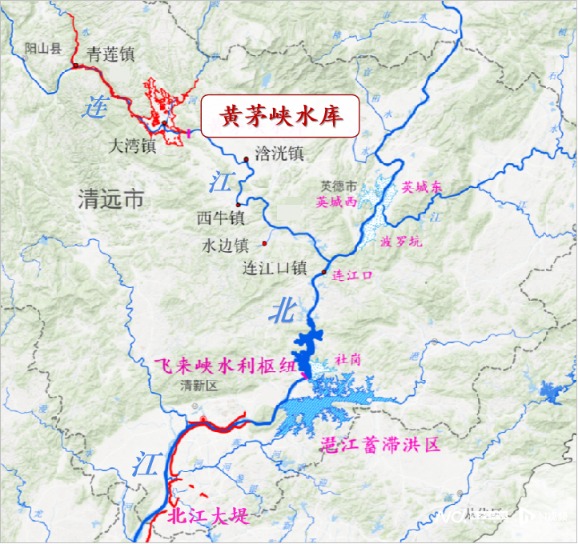
Core Viewpoint - The construction of the Huangmaoxia Reservoir in Guangdong marks a significant step in enhancing the flood control system along the Beijiang River, contributing to regional development and water safety [1][6]. Group 1: Project Overview - The Huangmaoxia Reservoir, located 6 kilometers downstream from Dawan Town in Yingde City, has a total capacity of 562 million cubic meters and is classified as a Class II large-scale project [2]. - The reservoir serves multiple purposes, primarily focusing on flood control while also supporting navigation, irrigation, and power generation, making it a comprehensive public welfare project [2][6]. Group 2: Flood Control and Navigation - Once completed, the reservoir will significantly improve the flood control system for the middle and lower reaches of the Beijiang River, alleviating flood pressure in cities like Guangzhou, Foshan, and Qingyuan [6]. - The project will also establish a Class IV navigation channel, enhancing the shipping capacity for 500-ton vessels and improving logistics efficiency in the region [6]. Group 3: Renewable Energy and Agriculture - The reservoir is expected to generate over 100 million kilowatt-hours of green electricity annually, contributing to the optimization of the regional energy structure [6]. - It will enhance irrigation supply reliability for the Yingde irrigation area, supporting agricultural water needs and promoting rural revitalization [6]. Group 4: Innovative Construction and Ecological Protection - The project integrates new urbanization and rural revitalization, combining hard investments with soft construction to create a high-quality water conservancy project [7]. - Innovative techniques, such as land elevation, will reduce land acquisition costs and promote large-scale farming, protecting arable land while lowering investment pressures [7][9]. Group 5: Community Development and Financing - The project aims to improve the living environment in rural areas, enhance commercial areas, and develop green living demonstration points, benefiting local communities [11]. - Innovative financing models, including the use of real estate investment trusts (REITs), will attract social capital and ensure reliable funding for the project [12].

7月22日午间涨停分析
news flash· 2025-07-22 03:50
Market Overview - A total of 78 stocks hit the daily limit up, with 54 stocks achieving consecutive limit ups, and 10 stocks failed to close at the limit, resulting in a limit-up rate of 89% (excluding ST and delisted stocks) [1] - The focus stock, Aowei New Materials, achieved a record of 10 consecutive limit ups, setting a new record for "20cm" stocks in A-shares [1] - Infrastructure-related stocks continued to perform well, with Liugang Co. achieving 10 limit ups in 16 days and Sifang New Materials achieving 7 limit ups in 12 days [1] Key Stocks and Their Performance - Aowei New Materials: 10 consecutive limit ups, 20.00% increase [24] - Liugang Co.: 10 limit ups in 16 days, 9.94% increase [26] - Sifang New Materials: 7 limit ups in 12 days, 10.02% increase [26] - Beihua Co.: 4 consecutive limit ups, 10.02% increase [14] - Meibang Co.: 4 consecutive limit ups, 10.00% increase [14] Sector Performance - The "Super Hydropower" sector saw significant activity, with multiple stocks achieving limit ups due to the announcement of a 1.2 trillion yuan investment in hydropower projects [5][9] - The "Shield Machine" sector also performed well, with several stocks hitting limit ups, attributed to the same investment announcement [6][7] - The "Water Conservancy" sector showed strong performance, with stocks like Sanhe Pipe Pile and Hanjian Heshan achieving limit ups [8] Investment Themes - The announcement of the 1.2 trillion yuan investment in hydropower projects is driving interest and investment in related sectors, including construction, materials, and machinery [5][9][15] - Geopolitical tensions are expected to boost the valuation of domestic defense and military companies, as noted by analysts [13]



新型城镇化概念涨3.46%,主力资金净流入这些股
Zheng Quan Shi Bao Wang· 2025-07-21 09:43
Group 1 - The new urbanization concept index rose by 3.46%, ranking 10th among concept sectors, with 180 stocks increasing in value [1][2] - Notable gainers included Zhuhai Design, Dahongli, and Guanlong Energy, which reached a 20% limit up, while Chongqing Construction and Meili Ecology also hit the limit up [1] - The top gainers in the new urbanization sector were Zhonghua Rock Soil, Qinglong Pipeline, and Leizhi Group, with increases of 25.19%, 13.32%, and 11.71% respectively [1][2] Group 2 - The new urbanization sector saw a net inflow of 1.219 billion yuan from major funds, with 108 stocks receiving net inflows [2][3] - Zhonghua Rock Soil led the net inflow with 195 million yuan, followed by Qinglong Pipeline and China Railway with 182 million yuan and 122 million yuan respectively [2][3] - The net inflow ratio for *ST Zhengping, Zhonghua Rock Soil, and Sanhe Pipeline was 68.96%, 44.30%, and 31.02% respectively, indicating strong investor interest [3] Group 3 - The new urbanization sector's trading volume was characterized by significant turnover rates, with stocks like Qinglong Pipeline and Zhonghua Rock Soil showing turnover rates of 22.33% and 6.01% respectively [3][4] - Stocks such as Meili Ecology and Chongqing Construction also demonstrated strong performance with turnover rates of 9.64% and 3.13% respectively [4][5] - The overall market sentiment for the new urbanization sector appears positive, as indicated by the substantial trading activity and net inflows [2][3]



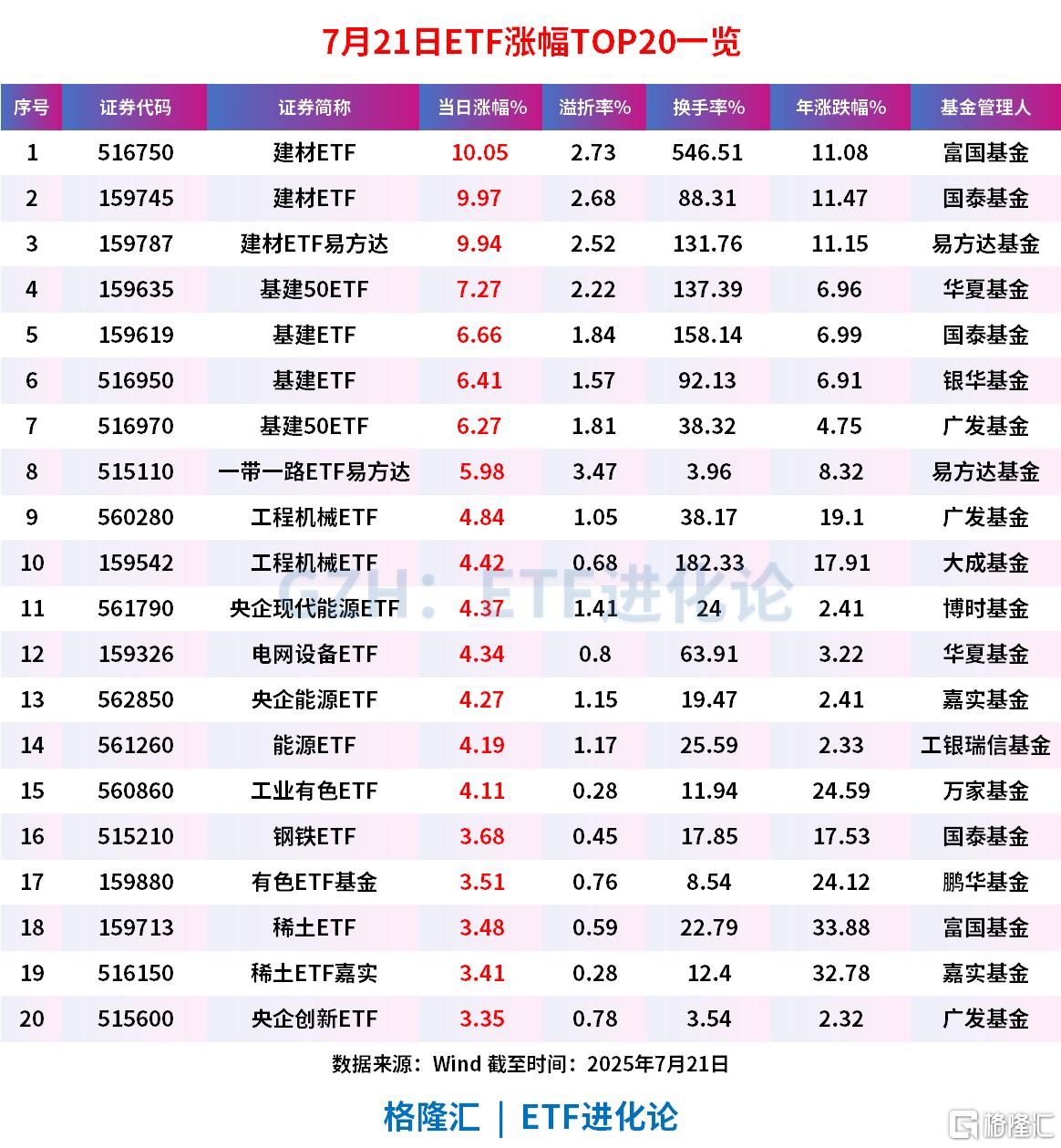
1.2万亿超级工程引爆上下游!建材ETF易方达、建材ETF涨停,换手率最高飙到500%!
Ge Long Hui· 2025-07-21 09:43
Group 1 - The core message of the news is the significant market reaction following the commencement of the Yarlung Tsangpo River downstream hydropower project, leading to a surge in various sectors, particularly in water conservancy and hydropower [1] - The construction of the Yarlung Tsangpo River project has a total investment of 1.2 trillion yuan, with an expected cement demand of 20 to 30 million tons during the construction phase, translating to an annual average demand of 1 to 1.5 million tons [5][10] - The construction project has positively impacted related ETFs, with notable increases in the building materials and infrastructure sectors, reflecting strong investor enthusiasm [1][5] Group 2 - The building materials ETF saw significant gains, with the top-performing ETFs including the Guotai Fund Building Materials ETF and the E Fund Building Materials ETF, both reaching near their daily limit [1][3] - The trading volume for the Guotai Building Materials ETF reached an extraordinary turnover rate of 546.51%, indicating high investor interest [1][3] - The top ten weighted stocks in the building materials index include Conch Cement, Beixin Building Materials, and Dongfang Yuhong, which are expected to benefit from the increased demand due to the hydropower project [5][6] Group 3 - The construction of the hydropower project is anticipated to boost China's GDP growth by 0.23 percentage points in the first year, highlighting its macroeconomic significance [10] - The industry is experiencing a shift towards healthier competition, moving away from "involution" and focusing on technological innovation and quality [10] - The overall supply-demand dynamics in the building materials sector are expected to improve, with the industry currently at a low valuation and positioning for potential recovery [10]
中国镇当时丨中国镇域经济新格局:“千亿镇”领跑 “单打冠军”崛起
Zhong Guo Xin Wen Wang· 2025-07-21 09:43
Core Insights - The article emphasizes the importance of township economy in China's high-quality economic development, highlighting its role as a fundamental unit of the national economy [2][3] Group 1: Township Economy Overview - There are over 20,000 townships in China, with 6 towns achieving a GDP of over 100 billion yuan and nearly 20 towns reaching 50 billion yuan [1] - The development of township economies is closely linked to their proximity to major cities, allowing them to leverage industrial upgrades and spatial layout opportunities [1][3] Group 2: Key Functions of Township Economy - Township economies serve as a crucial vehicle for new urbanization, providing low-cost urbanization pathways for rural populations [2] - They promote rapid development in surrounding rural areas across economic, social, cultural, and ecological dimensions, supporting the rural revitalization strategy [2] - The development of township economies enhances economic connections between urban and rural areas, facilitating the flow of people and resources [2] Group 3: Pathways to Economic Growth - The emergence of towns with a GDP of over 100 billion yuan reflects the expansion of city and county economies into township economies [3] - Successful towns have capitalized on their advantageous locations and have engaged in industrial growth through investment attraction and self-development [3][4] Group 4: Future Development Strategies - Towns are encouraged to focus on niche markets and specialized industries to become "single champions" rather than attempting to cover all sectors [5] - The article suggests that towns should adapt to new market demands and leverage their unique resources to create competitive advantages [5][6] Group 5: Evaluation and Policy Recommendations - The assessment of township development should include metrics beyond GDP, such as per capita income, living standards, and ecological quality [6] - Future policies should support differentiated development based on local resources and characteristics, ensuring a balanced approach to production, living, and ecological functions [6]
新型城镇化在推进中国式现代化中的双重职责
Si Chuan Ri Bao· 2025-07-20 22:22
已经确立了推进城乡融合发展的战略部署,并提出建立健全城乡融合发展体制机制和政策体系的 一系列重大举措。城乡融合的根本走向是实现城乡平等,而现实的实施路径和本质要求则是在城 乡联动的过程中强化以城带乡、以工补农、以企助村,这要在以下方面进一步着力:其一,实行 公共资源城乡公平均衡配置。统筹生产、生活、生态和安全的需要,一体制定城乡经济社会发展 规划,一体建设道路、电力、通信、供水、数字等基础设施,一体打造良好的公共服务体系和财 政、金融等政策支持环境。要特别强调的是,推动城乡基本公共服务均等化,是增进农民福祉、 实现乡村振兴的关键性举措。近年来,我国农村地区围绕文化教育、医疗卫生、养老托幼等实施 了一系列公共服务设施建设,但基本公共服务不健全、欠均衡、少规划等问题依然存在。推动城 乡基本公共服务均等化,要克难而进,在明确目标任务的基础上,着力建立健全有利于城乡基本 公共服务普惠共享的体制机制,打造城乡一体、覆盖全民、均衡配置的教育、医疗、文化、科 技、社会保险、社会救助等基本公共服务体系。其二,着力推动农村人口进一步向城镇转移。减 少农村人口,不仅有利于增加城镇发展能量,也有利于提高农民收入和消费水平,为农村改 ...
深刻把握、主动适应形势变化——深入贯彻落实中央城市工作会议精神述评之二
Xin Hua She· 2025-07-18 08:57
Core Insights - China's urbanization is transitioning from a rapid growth phase to a stable development phase, focusing on quality improvement and efficiency enhancement in urban development [1][2] - The recent Central Urban Work Conference highlighted the need for a new approach to urban modernization that aligns with the current historical context and challenges [1][2] Urbanization Trends - Urbanization rate increased from 53.1% in 2012 to 67% in 2024, with urban population rising from 720 million to 940 million [2] - 19 urban agglomerations now accommodate 75% of the national population and contribute approximately 85% of the GDP [2] - The urban rail transit operational mileage has reached nearly 11,000 kilometers [2] Development Strategies - Emphasis on "five transformations" and "five enhancements" to adapt to changing urban development needs [4][7] - The focus is shifting from mere quantity of urbanization to the quality of urban living, addressing diverse public demands and urban shortcomings [2][4] Urban Planning and Quality Improvement - The new urbanization strategy prioritizes human-centered development, aiming to enhance the quality of life for residents [5] - Key initiatives include optimizing urban functional structures and spatial layouts, and improving resource utilization [6][7] Key Tasks and Goals - The conference outlined a clear framework for urban development, focusing on optimizing modern urban systems and building vibrant, livable, green, resilient, and smart cities [8][9] - Emphasis on regional coordination and collaborative development among cities to enhance overall urban competitiveness [8][9]
【A 股市场大势研判】市场全天低开高走,创业板指领涨
Dongguan Securities· 2025-07-18 03:31
Market Overview - The market opened low and closed high, with the ChiNext Index leading the gains [4] - Major indices showed positive performance, with the Shanghai Composite Index up by 0.37%, Shenzhen Component Index up by 1.43%, and ChiNext Index up by 1.75% [2][4] - Over 3,500 stocks in the market rose, indicating a broad-based rally [4] Sector Performance - The top-performing sectors included Defense and Military (+2.74%), Communication (+2.41%), Electronics (+2.18%), Biomedicine (+1.77%), and Comprehensive (+1.42%) [3] - Conversely, the worst-performing sectors were Banking (-0.42%), Transportation (-0.39%), Environmental Protection (-0.26%), Public Utilities (-0.24%), and Construction Decoration (-0.19%) [3] Concept Index Highlights - The leading concept indices were Co-packaged Optics (CPO) (+3.34%), PCB Concept (+3.07%), AI Mobile (+3.01%), AI PC (+3.01%), and Recombinant Protein (+2.92%) [3] - The lagging concept indices included Gold Concept (-0.13%), Control Shares (-0.12%), Cement Concept (-0.06%), Solid Waste Treatment (-0.03%), and New Urbanization (-0.03%) [3] Future Outlook - The market is expected to continue its upward trend, with a focus on sectors such as Machinery Equipment, Consumer Goods, TMT (Technology, Media, and Telecommunications), and Financials [6] - The upcoming political bureau meeting and the Federal Reserve's interest rate decision are key events to watch [6] - The overall economic performance remains resilient, with a GDP growth of 5.3% year-on-year in the first half of the year [6] Investment Opportunities - The robotics sector is highlighted as a key area of growth, driven by advancements in AI and automation [5] - The innovative drug sector remains strong, with recent government policies favoring the procurement of established drugs while excluding innovative drugs from centralized purchasing [5] - Chinese biotech companies are seen as undervalued compared to their U.S. counterparts, presenting potential investment opportunities [5]