资产配置

Search documents
公募ETF多元化时代在路上
Guo Ji Jin Rong Bao· 2025-12-27 03:56
Core Insights - The market recognition of index investment has significantly increased this year, with public ETFs experiencing substantial growth in both product quantity and scale, driven by heightened market attention and innovation from fund companies [1] Group 1: Market Trends - The ETF market is witnessing structural differentiation, particularly highlighted by the explosive growth of bond ETFs, which saw a net inflow of 418.9 billion yuan from April 15 to December 15, 2025, indicating a strong underlying demand [3] - The current market is characterized by a preference for technology growth styles, with industry and thematic ETFs expanding rapidly while broad-based ETFs are experiencing net outflows [3] Group 2: Competitive Landscape - The ETF market is becoming increasingly competitive, with numerous companies filing for similar products, leading to a saturation of ETF offerings [5] - Fund companies are focusing on quality competition, enhancing liquidity for smaller products and innovating service offerings to provide comprehensive support for investors [5] Group 3: Future Innovations - The diversification of ETF products is expected to increase, catering to various investor needs, including those focused on emerging industries and specific investment strategies [7] - Potential future innovations in ETFs may include leveraging new industries or themes, expanding into emerging markets, and introducing leveraged, inverse, or actively managed ETFs [8]
一线城市高端住宅持续热销
2 1 Shi Ji Jing Ji Bao Dao· 2025-12-26 23:43
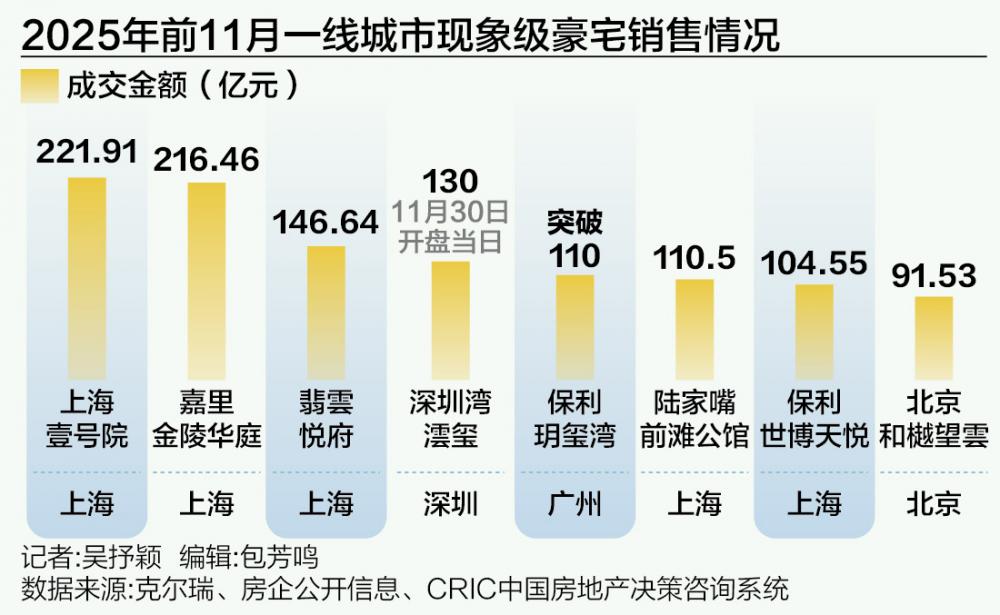
Core Viewpoint - Despite the overall adjustment in the real estate market, the high-end residential market has emerged with an independent trend in 2025, driven by significant sales in major cities like Shanghai, Guangzhou, Shenzhen, and Beijing [1][9]. Sales Performance - In the first 11 months of this year, Shanghai's high-end residential sales reached 221.91 billion yuan, while Shanghai Kerry Jinling Huating recorded 216.46 billion yuan. Guangzhou's Poly Yuexi Bay achieved over 10.6 billion yuan in a single day, and Shenzhen Bay Luanxi set a new record with 13 billion yuan in a single day [1][9]. - Nationally, the total sales of new residential properties fell by 11.1% year-on-year to 7.51 trillion yuan, yet high-end residential properties maintained a robust trading volume [3][12]. Buyer Demographics - Buyers of high-end properties include entrepreneurs, celebrities, and foreign nationals, with local buyers in Shanghai accounting for approximately 28.6% and buyers from Jiangsu and Zhejiang provinces making up 30% [4][13]. - Notably, a family client purchased six units at Guangzhou's Poly Yuexi Bay for a total of 500 million yuan [4][13]. Market Dynamics - The demand structure in the real estate market is shifting from "first-time buyers" to "improvement-driven" buyers, with high-net-worth individuals focusing on property value retention and improvement functions [4][13]. - New high-end projects are designed with lower density and higher greenery, enhancing living experiences compared to existing properties, thus accelerating the sales of luxury homes [5][13]. Supply Trends - The land market is increasingly concentrated in core areas, which is expected to boost the supply of high-end residential properties. For instance, a land parcel in Shanghai was sold for 4.465 billion yuan, setting a new record for the area [7][14]. - Continuous emergence of high-priced land will lead to an increase in high-end residential supply, with cities offering more quality land parcels in prime locations [15]. Future Outlook - The high-end residential market is anticipated to remain active, but there are concerns about the ability to absorb the increased supply. Recent data indicates a rational adjustment in transaction volumes and prices for second-hand high-end properties [8][15]. - The market is expected to support new high-quality projects that meet improvement needs, but the disparity in product quality between new and older projects may increase, leading to potential challenges in sales for some older developments [8][15].

“固收+”基金总规模超2.4万亿元 较年初增超50%
Zheng Quan Ri Bao· 2025-12-26 17:17
Core Insights - The "Fixed Income Plus" (固收+) funds have experienced rapid growth in 2023, with total assets reaching 2.48 trillion yuan by December 26, marking a 51.22% increase from the beginning of the year [2][3] - The significant growth in the "Fixed Income Plus" sector is attributed to multiple factors, including increased investor demand for stable returns amid declining interest rates and market volatility [3][4] Group 1: Growth of "Fixed Income Plus" Funds - The total scale of "Fixed Income Plus" funds has grown from 1.64 trillion yuan at the start of the year to 2.48 trillion yuan, reflecting a growth rate of over 50% [2] - The secondary bond fund category has nearly doubled in size, increasing from 692.03 billion yuan to 1.37 trillion yuan, a growth of over 98% [2] - The primary bond fund category grew from 700.05 billion yuan to 841.85 billion yuan, with a growth rate exceeding 20% [2] Group 2: Factors Driving Growth - Investor demand for products with predictable returns has surged due to a declining interest rate environment and increased volatility in equity markets [3] - The transition of bank wealth management products to net value has led traditional investment funds to seek stable and less volatile alternatives, positioning "Fixed Income Plus" funds as a key option [3] - Public fund institutions are actively developing "Fixed Income Plus" product lines, catering to various risk tolerances and effectively meeting diverse investment needs [3] Group 3: Strategies of Public Fund Institutions - Different public fund institutions are employing varied strategies in the "Fixed Income Plus" space, focusing on asset allocation adjustments based on market conditions [4] - The investment goals of "Fixed Income Plus" products are diverse, requiring a balance between long-term and short-term objectives [5] - Long-term goals focus on asset appreciation and returns, relying on in-depth research of corporate fundamentals and industry trends [5]
马云预言成真?未来3年,把存款换成这4个资产,或能衣食无忧!
Sou Hu Cai Jing· 2025-12-26 16:29
Core Viewpoint - The article discusses the declining trend of bank deposit interest rates and suggests alternative asset classes for individuals to consider for financial security, while debunking a false claim about Jack Ma's predictions regarding these assets. Group 1: Current Trends in Bank Deposits - Bank deposit interest rates are currently on a downward trend, with a specific example showing a decrease from 3.25% to 1.75% for a three-year deposit, resulting in a reduction of annual interest income by 1,500 yuan for a deposit of 100,000 yuan [3][10]. Group 2: Suggested Asset Classes - The article proposes four asset classes to consider instead of traditional bank deposits: 1. **Investing in Skills**: Emphasizes the importance of acquiring skills to enhance employability and income potential, especially in a challenging job market [5]. 2. **Investing in Health**: Highlights the growing trend of individuals prioritizing health investments, such as gym memberships and regular health check-ups, to ensure long-term well-being [7]. 3. **Learning Financial Management**: Recommends that individuals invest time in learning financial and investment knowledge to protect and grow their assets in a low-interest environment [10]. 4. **Investing in Dividend Stocks**: Suggests reallocating funds into dividend-paying stocks, particularly in the banking sector, where average dividend yields range from 4% to 5%, surpassing current deposit rates [12].
“百亿”规模黄金ETF扩容 机构把脉后市行情
Xin Lang Cai Jing· 2025-12-26 15:32
Core Viewpoint - The demand for gold ETFs has significantly increased in 2023, driven by rising gold prices and a growing interest in gold as a safe-haven asset amid global macroeconomic uncertainties [1][5]. Group 1: Gold Price Trends - International gold prices have recently entered a continuous upward trend, with spot gold reaching nearly $4,490 per ounce on December 23, surpassing the previous high of $4,381 per ounce at the end of October [2]. - The Shanghai Gold Exchange's spot gold price also hit a record high of 1,014 yuan per gram, while the main futures contract reached 1,018 yuan per gram [2]. Group 2: Growth of Gold ETFs - The total market size of gold ETFs tracking SGE Gold 9999 reached 221.59 billion yuan, with a year-on-year growth of over 200%, while those tracking the Shanghai Gold Index reached 22.44 billion yuan, growing over 500% [2][3]. - Six gold ETFs have surpassed 10 billion yuan in management scale, with the leading product from Huaan Fund reaching 94.61 billion yuan, approaching the 100 billion yuan mark [3]. Group 3: Institutional Insights - Institutions believe that the value of gold as an investment will continue to rise due to ongoing global macroeconomic uncertainties and diverse asset allocation needs [5][6]. - UBS forecasts that gold prices could reach $4,500 per ounce by June 2026, supported by factors such as central bank demand and a potential decline in interest rates [6]. Group 4: Market Dynamics and Future Outlook - Analysts suggest that gold may experience a "wide fluctuation and buy on dips" pattern in the short term, supported by lower real interest rates and a weakening dollar [7]. - The current economic indicators, including high core inflation and rising unemployment rates, provide a basis for the Federal Reserve to consider interest rate cuts, which could further support gold prices [7].
年终奖怎么投资?多家银行放出专属理财“大招”
Guo Ji Jin Rong Bao· 2025-12-26 15:25
Group 1 - The core viewpoint of the articles highlights that banks are launching "year-end bonus wealth management" plans to cater to the needs of employees receiving year-end bonuses, focusing on stable and low-risk investment products [1][2][3] - Several banks, including Postal Savings Bank, China Construction Bank, and Bank of Communications, are offering "one-stop" wealth management solutions that include deposits, investments, and insurance products [1][2] - The recommended investment products are primarily low-risk (PR1) or medium-low risk (PR2), with a focus on meeting customer needs and enhancing customer loyalty in a competitive market [2][3] Group 2 - This year, banks are incorporating various insurance products into their year-end wealth management plans, with some banks prioritizing conservative and stable insurance options alongside traditional investment products [3][4] - The overall trend in year-end wealth management plans is towards low volatility and stability, with higher risk products being less common [4] - Experts suggest that investors should analyze their financial situation, risk tolerance, and future funding needs to create a tailored investment plan that balances risk and return [4][5] Group 3 - For short-term funds, it is recommended to choose highly liquid cash management products, while medium-term funds can be allocated to low-risk fixed income products [5] - Long-term investments may include rights-based financial products, with diversification through funds being encouraged to achieve long-term return goals [5][6] - The global economic uncertainty is expected to persist, and the wealth management market is projected to continue expanding, necessitating investor education on asset allocation and investment strategies [6]



黄金现在还能买吗?专家解读→
Xin Lang Cai Jing· 2025-12-26 14:36
Group 1 - The core viewpoint of the articles emphasizes the increasing volatility of gold prices, particularly as they are expected to remain high in 2025, influenced by various factors including geopolitical tensions and monetary policy [1][2][3] - The recent rise in international gold prices has led to a significant increase in gold jewelry prices, with some brands exceeding 1400 yuan per gram for pure gold [1] - Central banks around the world are continuing to purchase gold, which is expected to strengthen supply and demand dynamics, potentially driving prices higher [1][2] Group 2 - The World Gold Council's report highlights that geopolitical and economic uncertainties, along with a weakening dollar, are key drivers of the current gold price surge [2] - The Shanghai Gold Exchange has issued a notice to enhance market risk control due to the recent volatility in precious metal prices, urging members to improve risk awareness and maintain market stability [2] - Looking ahead to 2026, the gold market is anticipated to enter a new phase characterized by a dynamic balance of multiple forces, with ongoing geopolitical uncertainties and structural demand from investors and central banks likely to support gold prices [3]

“百亿”成交频现,一线城市高端住宅持续热销
2 1 Shi Ji Jing Ji Bao Dao· 2025-12-26 13:40
Core Viewpoint - Despite the overall adjustment in the real estate market, the high-end residential market has emerged with independent trends in 2025, driven by significant sales in major cities and a shift in buyer demographics towards high-net-worth individuals seeking investment properties [1][2]. Group 1: Market Performance - In the first 11 months of this year, the sales of new residential properties nationwide reached 7.51 trillion yuan, a year-on-year decrease of 11.1%, while high-end residential properties maintained a certain level of transaction volume [2]. - Notable high-end residential projects in first-tier cities include Shanghai's Yihua Courtyard with sales of 22.191 billion yuan and Shenzhen's Bay Luanxi with a single-day sales record of 13 billion yuan [1][2]. - The high-end residential market in Shanghai is particularly robust, with over 3,402 units sold at prices above 20 million yuan, totaling 139.2 billion yuan [2]. Group 2: Buyer Demographics - Buyers of high-end residential properties include entrepreneurs, celebrities, and foreign nationals, with local buyers in Shanghai accounting for approximately 28.6% and buyers from Jiangsu and Zhejiang provinces making up 30% [3]. - In Guangzhou, high-end buyers include tech company founders, with one family reportedly purchasing six units for a total of 500 million yuan [3]. Group 3: Supply Dynamics - The supply of high-end residential properties is increasing due to a concentration of land sales in core urban areas, which is expected to continue driving supply growth [6]. - Recent land sales in Shanghai and Shenzhen have set new records for land prices, indicating a trend towards higher-end developments [6]. - The government is encouraging residential development towards low-density and high-quality projects, enhancing the living experience and driving demand for high-end properties [4]. Group 4: Market Outlook - The high-end residential market is expected to remain active, with a rational return in transaction volumes anticipated as more properties enter the secondary market [1][7]. - While the demand for high-end properties remains strong, there is caution regarding the ability of the market to absorb increased supply, with some experts suggesting a potential for price stabilization [7].
64套千万豪宅1日售罄,爆卖40亿,什么信号?
Xin Lang Cai Jing· 2025-12-26 13:27
Core Viewpoint - Despite the overall adjustment in the real estate market, the high-end residential market has shown independent momentum in 2025, with significant sales figures reported in major cities [1][10]. Group 1: Sales Performance - In the first 11 months of this year, Shanghai's high-end residential projects, such as Shanghai Yihua Courtyard and Kerry Jinling Huating, recorded sales of 221.91 billion yuan and 216.46 billion yuan respectively [1][10]. - Guangzhou's Poly Yuexi Bay achieved a single-day sales record of over 10.6 billion yuan upon opening in November, while Shenzhen Bay Luanxi set a new national record with 13 billion yuan in single-day sales [1][10]. - The total sales of high-end residential properties priced over 20 million yuan in Shanghai reached 139.2 billion yuan from 3,402 units sold, leading the first-tier cities [12]. Group 2: Market Dynamics - The high-end residential market's robust performance is attributed to a shift in land supply towards core areas, increasing the availability of desirable properties [1][10]. - High-end residential properties are viewed as strong financial assets, attracting buyers not only for self-use but also for investment purposes [1][10]. - The market anticipates a rational return in transaction volumes as more high-end properties enter the secondary market, which may define the market trend in 2026 [1][10]. Group 3: Buyer Profile - Buyers of high-end properties include entrepreneurs, celebrities, and foreign nationals, with local buyers making up approximately 28.6% of the market in Shanghai [5][14]. - In Guangzhou, notable buyers include tech company founders and high-net-worth individuals, with some families purchasing multiple units in a single transaction [5][14]. Group 4: Future Outlook - The ongoing supply of high-end residential properties is expected to continue, driven by the concentration of land transactions in core urban areas [16][17]. - The market is closely monitoring whether the high supply can be absorbed, as recent data indicates a rational adjustment in transaction volumes and prices for second-hand high-end properties [17]. - The quality of new high-end projects is improving, which may create a disparity with older projects, potentially increasing the pressure on some properties to sell [17].
64套千万豪宅1日售罄,爆卖40亿,什么信号
2 1 Shi Ji Jing Ji Bao Dao· 2025-12-26 13:25
Core Viewpoint - Despite the overall adjustment in the real estate market, the high-end residential market has emerged with independent trends in 2025, driven by significant sales in major cities like Shanghai, Guangzhou, and Shenzhen [1][5]. Group 1: High-End Residential Sales Performance - In the first 11 months of this year, Shanghai's high-end residential projects recorded sales of 221.91 billion yuan for 壹号院 and 216.46 billion yuan for 嘉里金陵华庭 [1]. - Guangzhou's 保利玥玺湾 achieved a single-day sales record of over 10.6 billion yuan upon opening in November, while 深圳湾澐玺 reached 13 billion yuan, setting a new national record for single project sales [1]. - The total sales of high-end residential properties priced over 20 million yuan in Shanghai reached 139.2 billion yuan from 3,402 units sold, while Beijing, Guangzhou, and Shenzhen reported 40.5 billion yuan, 28.5 billion yuan, and 25 billion yuan respectively [5]. Group 2: Market Dynamics and Buyer Profiles - The demand structure in the real estate market is shifting from "first-time buyers" to "improvement-driven" buyers, with high-net-worth individuals focusing on properties that offer value retention and improvement features [7]. - Buyers of high-end properties include entrepreneurs, celebrities, and foreign nationals, with local buyers in Shanghai accounting for approximately 28.6% and buyers from Jiangsu and Zhejiang provinces making up 30% [7]. - The trend of high-end residential sales is supported by a concentration of land supply in core urban areas, which is expected to continue driving high-end residential supply growth [11]. Group 3: Future Market Outlook - The high-end residential market is anticipated to maintain its appeal due to strong product and service capabilities, although an increase in supply may lead to a rational return in transaction volumes [1][12]. - The ongoing supply of high-quality land in core urban areas is expected to facilitate the construction of high-end residential projects, with a focus on low-density and high-greenery developments [11]. - While the current market shows active transaction volumes, there is a cautious outlook regarding price stability and the potential for inventory absorption in the future [12].