风险管理

Search documents
30岁程序员,攒了300万做投资!反复亏损后,终于悟了:原来越简单越稳妥...
雪球· 2025-09-11 13:00
Core Viewpoint - The article emphasizes the importance of simplicity in investment strategies, suggesting that a straightforward approach can lead to more stable and successful outcomes [2][18]. Group 1: Personal Investment Journey - The protagonist, a 30-year-old programmer in Beijing, has accumulated approximately 3 million yuan in cash, free of loans, but feels anxiety about the "35-year career crisis" [2][14]. - Initially, the protagonist's investment strategy was basic, relying on low-risk products like Yu'ebao and fixed-income products, aiming only to cover daily expenses [3][14]. - The first experience with mutual funds was profitable initially, but subsequent market fluctuations led to significant losses, highlighting the unpredictability of even seemingly stable investments [4][5]. Group 2: Lessons Learned - The protagonist experienced multiple losses in the stock market, which led to a deeper understanding of human psychology and the nature of risk in investing [6][7]. - The realization that overthinking and excessive trading often result in losses, while a more patient approach could yield better results [5][7]. - Acknowledgment of the importance of risk management and the need for a diversified investment strategy to mitigate potential losses [17]. Group 3: Investment Philosophy - The article advocates for a balanced asset allocation strategy, suggesting a mix of 70% bond funds, 10% stock funds, and 20% gold to manage risk effectively [8][15]. - Emphasizes the significance of setting realistic expectations and understanding personal limitations in investment capabilities [15][16]. - The concept of "embracing asset allocation" is presented as a way to acknowledge one's limitations and manage expectations in the pursuit of wealth [15][16]. Group 4: Practical Investment Strategies - The article outlines a simple four-step approach for new investors: assess risk tolerance, select recommended funds, set investment amounts, and establish a flexible investment timeline [18]. - Encourages new investors to focus on consistent and disciplined investment practices rather than overcomplicating their strategies [18]. - The importance of using reliable tools and platforms for investment management is highlighted, with a recommendation for the Snowball platform for its user-friendly features [11][20].


9月11日风险管理日报:维持震荡,下方空间有限-20250911
Nan Hua Qi Huo· 2025-09-11 12:14
Report Summary 1. Investment Rating The report maintains a view that the nickel and stainless steel markets will remain volatile with limited downside potential, but no specific industry investment rating is provided [1]. 2. Core View The nickel market shows a continuous volatile trend with limited downside but lacks upward momentum. Nickel ore production and shipments are stable, and domestic arrival inventories are high. The new energy sector still provides support, and the supply is relatively tight. Nickel iron prices are strong, and stainless steel also maintains a volatile trend. Attention should be paid to the impacts of the US dollar index, interest - rate cut expectations, and increased difficulties in stainless - steel exports [5]. 3. Detailed Summaries 3.1 Price and Volatility Forecast - **Nickel**: The predicted price range for Shanghai nickel is 118,000 - 126,000 yuan/ton, with a current 20 - day rolling volatility of 15.17% and a historical percentile of 3.2% [3]. - **Stainless Steel**: The predicted price range for stainless steel is 12,500 - 13,100 yuan/ton, with a current 20 - day rolling volatility of 7.39% and a historical percentile of 0.5% [3]. 3.2 Risk Management Strategies - **Nickel Risk Management Strategies** - **Inventory Management**: When product sales prices fall and inventory has impairment risks, sell Shanghai nickel futures (NI main contract) at a 60% hedging ratio and sell call options at a 50% hedging ratio [3]. - **Procurement Management**: When there are future production procurement needs and concerns about rising raw material prices, buy Shanghai nickel forward contracts (far - month NI contracts) according to the production plan, sell put options, and buy out - of - the - money call options [3]. - **Stainless Steel Risk Management Strategies** - **Inventory Management**: When product sales prices fall and inventory has impairment risks, sell stainless steel futures (SS main contract) at a 60% hedging ratio and sell call options at a 50% hedging ratio [4]. - **Procurement Management**: When there are future production procurement needs and concerns about rising raw material prices, buy stainless steel forward contracts (far - month SS contracts) according to the production plan, sell put options, and buy out - of - the - money call options [4]. 3.3 Core Contradictions - The nickel market is volatile with limited downside but lacks upward momentum. Nickel ore production and shipments are stable, and domestic arrival inventories are high. The new energy sector still provides support, and the supply is relatively tight. Nickel iron prices are strong, and stainless steel also maintains a volatile trend. Attention should be paid to the impacts of the US dollar index, interest - rate cut expectations, and increased difficulties in stainless - steel exports [5]. 3.4 Market Influencing Factors - **Positive Factors**: Indonesia plans to revise the HPM formula, shorten the nickel ore quota license period, there is an increased expectation of an interest - rate cut in September, and stainless steel has been de - stocking for several weeks [7]. - **Negative Factors**: Pure nickel inventories are high, nickel ore seasonal inventories are rising, there are still Sino - US tariff disturbances, uncertainties in EU stainless - steel import tariffs have increased, and South Korea has imposed anti - dumping duties on Chinese stainless - steel thick plates [7]. 3.5 Market Data - **Nickel Disk Daily Data**: The latest price of Shanghai nickel main - continuous is 120,620 yuan/ton, with a decrease of 230 yuan/ton and a 0% month - on - month change; the trading volume is 87,538 lots, an increase of 12,532 lots or 16.71% month - on - month; the open interest is 81,691 lots, an increase of 79 lots or 0.10% month - on - month; the warehouse receipt volume is 22,111 tons, a decrease of 193 tons or 0.87% month - on - month [8]. - **Stainless Steel Disk Daily Data**: The latest price of stainless - steel main - continuous is 12,870 yuan/ton, a decrease of 45 yuan/ton and a 0% month - on - month change; the trading volume is 112,848 lots, a decrease of 2,615 lots or 2.26% month - on - month; the open interest is 128,344 lots, an increase of 5,176 lots or 4.20% month - on - month; the warehouse receipt volume is 97,554 tons, a decrease of 734 tons or 0.75% month - on - month [9]. - **Inventory Data**: Domestic social nickel inventories are 39,930 tons, an increase of 460 tons; LME nickel inventories are 223,152 tons, an increase of 2,058 tons; stainless - steel social inventories are 918,700 tons, a decrease of 10,100 tons; nickel pig iron inventories are 29,266.5 tons, a decrease of 3,844.5 tons [10].
张家港行:多维发力,蓄势新未来
Zheng Quan Shi Bao Wang· 2025-09-11 06:23
Core Viewpoint - The banking industry is undergoing significant transformation, with local financial institutions playing a crucial role in supporting regional economic development and meeting diverse financial needs of the public [1] Group 1: Focus on Inclusive Finance - Zhangjiagang Bank prioritizes inclusive finance as its core strategy, focusing on small and micro enterprises, with agricultural and small micro loans reaching 1246.25 billion yuan by June 2025, an increase of 83.89 billion yuan from the beginning of the year, accounting for 90.88% of the total [2] - The bank offers tailored financial services for enterprises at different stages, including various credit products that reduce reliance on financial indicators and utilize policy guarantees and a three-dimensional assessment model [2] Group 2: Comprehensive Financial Services - For mature enterprises, Zhangjiagang Bank provides a range of services including merger financing, syndicate loans, bond underwriting, and investment advisory, along with cash management tools to support global expansion [3] - The retail sector is also a key area for the bank, focusing on consumer credit innovation and optimizing services to stimulate local consumption through a three-dimensional support system [3] Group 3: Risk Management - As of June 2025, the bank maintained a non-performing loan ratio of 0.94%, stable compared to the beginning of the year, and a provision coverage ratio of 383.98%, indicating strong risk mitigation capabilities [4] - The bank employs rigorous pre-loan investigations, in-process reviews, and post-loan management to effectively identify and mitigate credit risks [4] Group 4: Industry Recognition - Zhangjiagang Bank has received multiple accolades, ranking 502nd among the world's top 1000 banks and being recognized as an excellent participant in foreign exchange clearing business [5] - The bank aims to continue optimizing financial services and adapting to national policy directions to strengthen its support for enterprises and contribute to the new development pattern [5]
多个新品种在上期所挂牌交易
Jin Rong Shi Bao· 2025-09-11 03:10
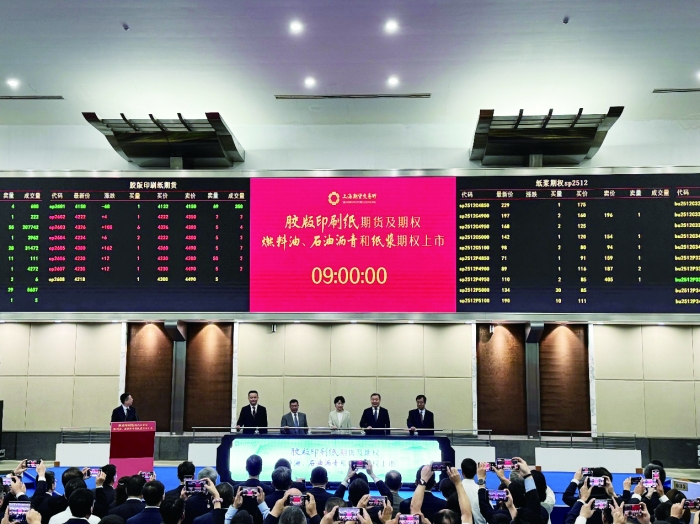
Core Viewpoint - The launch of futures and options for newsprint paper, fuel oil, asphalt, and pulp at the Shanghai Futures Exchange marks a significant step in enhancing risk management tools for the paper industry and promoting sustainable development [1][2][3]. Group 1: Industry Significance - The paper industry is a crucial part of China's light industry, with a production and consumption volume of 136 million tons in 2024, maintaining its position as the world's largest producer and consumer for 16 consecutive years [1]. - The introduction of newsprint paper futures and options is timely, providing essential financial instruments for upstream and downstream enterprises, thereby strengthening the industry's risk resilience [1][2]. - The new products are expected to stimulate green transformation in the paper industry and enhance international competitiveness, contributing to the establishment of "China prices" and attracting global resources [1][2]. Group 2: Market Development - The launch of these new futures and options is part of a broader strategy to enrich and improve the multi-layered derivative system in the market, catering to the refined and diversified needs of enterprises [2]. - The futures market has demonstrated effective risk management capabilities during market volatility, indicating a mature investor structure and strong contract continuity [2]. - The addition of newsprint paper and pulp options will further enhance the risk management framework within the paper industry, providing companies with more flexible hedging tools [2][3]. Group 3: Strategic Implications - The introduction of newsprint paper futures and options is seen as a milestone in supporting the green and low-carbon transformation of the paper industry, enhancing the risk management level across the pulp and paper supply chain [3]. - The Shanghai Futures Exchange aims to continuously expand its product offerings and improve efficiency, thereby supporting high-quality development in the real economy [3].
铸帝控股(01413)股东将股票由昌利证券转入富途证券国际香港 转仓市值606.05万港元
Zhi Tong Cai Jing· 2025-09-11 01:14
Core Viewpoint - The shareholders of Zhu Di Holdings (01413) have transferred their stocks from Changli Securities to Futu Securities International Hong Kong, with a transfer value of HKD 6.0605 million, accounting for 5.05% of the total shares [1] Group 1: Shareholder Activity - On September 10, shareholders transferred stocks valued at HKD 6.0605 million from Changli Securities to Futu Securities International Hong Kong [1] - The transfer represents 5.05% of Zhu Di Holdings' total shares [1] Group 2: Strategic Investment Plan - Zhu Di Holdings announced plans to establish a joint venture to diversify its investment portfolio and capture emerging opportunities in the digital asset sector [1] - The board has approved a strategic investment framework, allowing the group to invest up to HKD 4.5 million of its own capital in cryptocurrency [1] - The investment strategy will utilize a mature, delta-neutral quantitative approach, focusing on capital preservation and robust risk-adjusted returns [1] Group 3: Management and Expertise - The core objective is to achieve uncorrelated alpha returns and diversify the company's investments, leveraging the expertise of a professional team and a solid multi-layer risk management framework [1] - The strategic investment will only involve the group's own funds and will not constitute regulated third-party asset management services, thus avoiding licensing costs and regulatory complexities [1] - The investment initiative will be led by Mr. Wang Junjie, a seasoned professional with over 12 years of experience in the blockchain and Web3 sectors [1]
加快推进成熟期货品种期权全覆盖
Qi Huo Ri Bao Wang· 2025-09-11 00:04
Group 1 - The launch of futures and options for coated printing paper, fuel oil, asphalt, and pulp options on the Shanghai Futures Exchange (SHFE) marks a significant development in the financial tools available for the paper industry [1][2] - The paper and board production in China is projected to reach 136 million tons in 2024, maintaining its position as the world's largest producer and consumer for 16 consecutive years [2] - The introduction of these financial instruments is expected to enhance the risk management capabilities of upstream and downstream enterprises in the cultural paper sector, supporting the sustainable development of the paper industry [2][3] Group 2 - Coated printing paper is a crucial segment of the paper industry, widely used in cultural dissemination, writing, and printing, with a market size exceeding 100 billion yuan [3] - The pulp futures market, established in 2018, has become an essential tool for pricing and risk management in the industry, and the addition of new futures and options will further strengthen the hedging framework for enterprises [3][4] - The SHFE aims to enhance the risk management level of the pulp and paper industry chain and support the green and low-carbon transformation of the sector through these new financial products [4]
上期所5个期货、期权品种挂牌交易 加快推进成熟期货品种期权全覆盖
Qi Huo Ri Bao Wang· 2025-09-10 19:40
Core Viewpoint - The launch of futures and options for newsprint paper, fuel oil, asphalt, and pulp options on the Shanghai Futures Exchange marks a significant development in China's futures market, providing essential financial tools for the paper industry and enhancing risk management capabilities [1][2][4]. Industry Summary - The paper industry is a crucial sector in China's light industry, with a production capacity of 136 million tons in 2024, maintaining its position as the world's largest producer and consumer of paper and paperboard for 16 consecutive years [2]. - The introduction of newsprint paper futures and options, along with pulp options, is timely and significant for the industry's high-quality development and transition towards a stronger paper manufacturing nation [2][3]. - The new financial instruments will provide important risk management tools for upstream and downstream enterprises in the cultural paper sector, supporting the sustainable development of the paper industry [2][3]. - The market's liquidity and contract continuity for previously listed products like fuel oil and asphalt have demonstrated effective risk management capabilities during price volatility [2]. - The addition of these new products signifies a new phase of collaborative development between futures and options, enhancing the multi-layered derivative system in the industry [2][4]. Company Summary - Newsprint paper is a vital segment of the paper industry, widely used in cultural dissemination, writing, and printing, with China's market exceeding 100 billion yuan [3]. - The pulp futures market, established in 2018, has become an essential tool for pricing and risk management in the industry, and the new products will further strengthen the hedging system for the paper supply chain [3]. - The introduction of these financial instruments will help companies manage raw material costs and price fluctuations, thereby improving operational stability and resource allocation efficiency [3]. - The Shanghai Futures Exchange aims to enhance product offerings and promote high-level openness in the futures market, supporting the green and low-carbon transformation of the paper industry [4].
单日挂牌五个期货期权品种 上期所加速构建产融协同矩阵
Shang Hai Zheng Quan Bao· 2025-09-10 18:48
Core Viewpoint - The launch of futures and options for offset printing paper, fuel oil, asphalt, and pulp at the Shanghai Futures Exchange marks a significant step in enhancing risk management for the paper industry and meeting the diverse needs of enterprises in managing risks [1][2]. Group 1: Market Overview - China is the world's largest producer and consumer of cultural paper, with offset printing paper being a key segment, characterized by a large market size, high standardization, and significant price volatility [1]. - In 2024, China's production of offset printing paper is projected to reach 9.48 million tons, with apparent consumption at 8.71 million tons [1]. Group 2: Product Launch and Trading Performance - The first day of trading for offset printing paper futures saw a total of 21,900 contracts traded, amounting to 3.703 billion yuan, with an open interest of 2,900 contracts [2]. - The main contract OP2601 closed at 4,208 yuan per ton, down 10 yuan from the listing benchmark price, reflecting a decrease of 0.24% [5]. Group 3: Industry Impact and Risk Management - The introduction of offset printing paper futures fills a gap in the domestic market for financial derivatives related to cultural paper, enabling better risk management across the supply chain [4]. - The new products are expected to enhance the pricing model and supply-demand balance in the industry, allowing companies to adjust production capacity based on futures price signals [5][6]. Group 4: Expansion of Options Products - The launch of options for fuel oil, asphalt, and pulp, alongside the offset printing paper products, expands the Shanghai Futures Exchange's options offerings to 18, covering various sectors [7]. - Companies are increasingly exploring the use of options for more precise risk management, especially in the context of complex market conditions [7][8].
英华号周播报|如何把握趋势与市场情绪?长持30年VS频繁换基,哪种收益更佳?
Zhong Guo Ji Jin Bao· 2025-09-10 11:03
Group 1 - The article discusses the comparison between long-term holding of investments for 30 years versus frequent fund switching, analyzing which strategy yields better returns [1] - It highlights the recent performance of the ChiNext 50 Index, which saw a weekly increase of 3.42%, indicating a strong market trend in the new energy sector [1] - The article emphasizes the importance of understanding market trends and investor sentiment in making informed investment decisions [1] Group 2 - The article features insights from various financial institutions, including a focus on risk management as a primary investment objective [2] - It mentions the upgrade of the "China Manufacturing" investment research system by China Europe Fund, indicating a shift towards more sophisticated investment strategies [2] - The article includes a quote from a fund manager emphasizing the need to control risks while aiming for excess returns, underscoring the balance between risk and reward in investment strategies [2]
万洲金业立足香港黄金交易所,以专业与信任引领贵金属投资新格局
Sou Hu Cai Jing· 2025-09-10 10:31
Core Viewpoint - The article highlights the significance of WanZhou Gold as a trusted player in the Hong Kong gold trading market, emphasizing its commitment to customer service and robust operational strategies [1][3][7]. Group 1: Company Overview - WanZhou Gold is recognized as an AA-class member of the Hong Kong Gold Exchange, establishing a solid trust foundation among investors through its customer-centric service philosophy [1]. - The company provides a secure and efficient platform for precious metal investments, focusing on market analysis and risk management to support asset allocation for clients [3]. Group 2: Services and Education - WanZhou Gold prioritizes investor education by regularly publishing market analysis reports and offering tailored investment strategy suggestions to address information asymmetry [3][5]. - The company has implemented a 24/7 customer support service to minimize operational blind spots for clients, enhancing their investment experience [3]. Group 3: Compliance and Technology - The company adheres strictly to Hong Kong's financial regulatory requirements, ensuring a transparent and secure trading environment through the Hong Kong Gold Exchange [5]. - Continuous investment in technology has optimized the trading system, improving stability and response times for a seamless trading experience [5]. Group 4: Future Outlook - As the global asset allocation for precious metals increases, WanZhou Gold aims to enhance its product and service offerings to help investors achieve asset preservation and appreciation [7]. - The company is positioned to strengthen its industry influence and brand recognition, reflecting the market's acknowledgment of its commitment to quality and trust [7].