
大模型

Search documents
大模型来了,为什么端到端的智能工厂还没有
Jing Ji Guan Cha Wang· 2026-02-02 02:37
AI在制造业中的应用现状 在理想状态下,端到端的智慧工厂里,AI将全面取代或主导人类在制造业价值链中的角色。从研发、设计、生产、营销到售后服务,所有环节均由AI驱动 或高度自动化。这不仅是为了提升效率,更是要实现无缝、预测性和自适应生产的全智能状态。 然而,理想愿景虽令人向往,但当前制造业的AI应用还远未达到端到端的智慧水平。大多数企业仍处于"点状智能"阶段,AI主要辅助特定环节,而非系统性 主导。 在研发环节,AI虽能提升研发效率,但对核心创新的贡献有限。研发本质上是突破性创造,而现行AI,如基于规则的系统、机器学习或大模型等,擅长传 统数据分析、模式识别等,并非原创。AI在辅助研究方面表现出色,例如利用大语言模型总结学术进展。又如谷歌DeepMind的GNoME工具,在2023年 《Nature》论文中披露,通过图神经网络发现了超过528种潜在锂离子导体,数量相当于此前发现总量的25倍,有助于提升电池性能。不过,这些均属于辅 助范畴,核心创新仍依赖人类的直觉。 在设计环节,生成式AI潜力巨大,但应用深度参差不齐。 一方面,AI能快速生成文字、图像、视频,大幅提升平面设计的速度。另一方面,在复杂工业设计,如 ...


头部大模型厂商基本面更新与推荐
2026-02-02 02:22
Summary of Key Points from Conference Call Records Industry Overview - The large model industry has transitioned from the Chat paradigm to the Agent paradigm, with leading companies focusing on building native Agent capabilities rather than merely pursuing parameter scale [1][5] - Major internet companies are intensifying competition for AI super entry points, with Alibaba, ByteDance, and Tencent implementing various strategies to capture high-frequency traffic [1][8] Core Companies and Their Strategies Zhiyu (智谱) - Zhiyu has developed a full-stack large model technology and open-source strategy to build an industry ecosystem, with expected revenue reaching 700-800 million RMB by 2025, but it will not achieve profitability due to high R&D and delivery costs [3][12] - The company launched the AutoGLM model, which integrates deep research and operational capabilities, and updated its GLM 4 Air base model with 320 billion parameters, achieving performance comparable to Deepseek 1 with an 8x speed improvement [2][19] Minimax - Minimax has released its second-generation agent product, MiniMax Agent 2, which transforms the interaction logic from human adaptation to agent adaptation, enhancing its competitive edge [2][4] - The company is expected to achieve revenue close to 300 million RMB by 2025 and approximately 230 million USD by 2026, with a strong focus on C-end subscriptions and application in overseas markets [3][19] Kimi - Kimi has launched the Kimi 2.5 multimodal model, which can utilize up to 100 specialized agents to perform tasks in parallel, significantly lowering the AI interaction threshold [5][6] Deepseek - Deepseek focuses on niche technological breakthroughs, particularly in OCR and visual processing, to differentiate itself in the market [6][7] Competitive Landscape - The competition among leading large model companies is becoming increasingly differentiated, with a focus on high-level reasoning capabilities, native multimodality, and collaborative execution of complex tasks [3][6][14] - Companies are moving beyond pure technical competition to consider technology, product, ecosystem, and implementation capabilities [7][15] Market Trends and Predictions - By 2028, it is expected that 60% of systems will support multi-vendor interoperability, transitioning from single-platform to agent internet systems, although cost and user experience remain constraints [10] - The market for MaaS (Model as a Service) is projected to reach a penetration rate of 70% in China by 2030, with companies like Zhiyu leveraging their API and cloud services to adjust their revenue structure [19] Challenges and Opportunities - Independent large model companies like Zhiyu and Minimax face challenges in achieving a leading position in high-level reasoning and multimodal engineering, requiring significant R&D investment and rapid product iteration [15][16] - The competition for entry points among major internet companies poses a risk of winner-takes-all scenarios, particularly if they establish one or two super entry points by 2026-2027 [15][16] Financial Performance - Minimax's performance is driven by C-end subscriptions and application fees, with a significant increase in active users and ARPU from 6 USD to 15 USD [19][20] - Zhiyu is the largest large model startup in China by revenue, with a focus on local deployment and cloud business as growth engines, while also expanding into international markets to mitigate domestic pricing wars and policy risks [20]
电子掘金-Agent需求火热-持续看好算力链投资
2026-02-02 02:22
Summary of Conference Call Records Industry and Company Involved - The discussion primarily revolves around the **AI computing power industry**, specifically focusing on **Industrial Fulian** and **Apple** as key players in the market. Core Points and Arguments 1. **Agent Demand and Market Dynamics** - The introduction of local running modes for agents, such as MultiBot, has sparked significant interest in the market, potentially accelerating the release of more powerful agent functionalities by major companies, which will increase demand for computing resources and promote growth in the edge computing and storage markets [1][3] 2. **Local Storage and Edge Computing** - MultiBot architecture emphasizes local data storage, providing zero-latency access and data control advantages, which will lead to increased demand for local storage solutions. The future may see widespread adoption of personal edge servers, significantly boosting independent incremental demand [1][4] 3. **Domestic Computing Power Development** - Domestic computing power currently lags behind international capabilities by approximately six months. However, it is expected to gradually replace foreign computing power in the local market over the long term. Performance is anticipated to be released in 2026 as production capacity issues are resolved [1][5][6] 4. **Industrial Fulian's Performance Forecast** - Industrial Fulian's 2025 performance forecast exceeds expectations, benefiting from the ramp-up of GB200 and 300 products and growth in VeriSilicon's business. The company is positioned to benefit from the AI trend as a key component of the overseas computing power chain [1][8] 5. **Apple's Financial Performance** - Apple's latest financial results surpassed expectations, driven by strong iPhone 17 sales and record revenue in Greater China. The anticipated product innovations in 2026, including new AirPods and foldable screens, are expected to contribute to growth in non-AI server business [2][9][12] 6. **AI Data Center Business Highlights** - Industrial Fulian's AI data center business, including high-speed switches and AI server assembly, saw significant revenue growth, with 800G and above high-speed switch revenue increasing over 4.5 times year-on-year. The complexity of assembly is increasing, leading to higher value per cabinet and profit margins [2][10] 7. **Global Competitive Position** - Industrial Fulian holds a unique position as the only NV chain alloy ODM assembly supplier, with a strong and stable role in the overseas computing power chain, facing no immediate threats from technological iterations [2][11] 8. **Optical Module Industry Insights** - Leading companies in the optical module sector have reported impressive 2025 performance forecasts, indicating strong downstream demand and growth in high-speed optical module shipments. Investors are advised to focus on the long-term value of leading companies in this sector [2][16] 9. **Future Trends in Optical Communication** - The optical communication industry is expected to see high downstream demand and investment in AI, with significant capital expenditures projected from major companies like Meta and Microsoft. The increasing share of silicon photonics technology is anticipated to create additional market opportunities for leading Chinese firms [2][17] 10. **Market Pricing Trends** - The fiber optic market continues to experience price increases due to ongoing supply-demand imbalances, with major companies managing to mitigate profit impacts despite price pressures from operators [2][18] Other Important but Possibly Overlooked Content - The anticipated growth in edge computing and local storage solutions is expected to create a dual market for cloud and local storage, rather than a zero-sum scenario [1][4] - The performance of domestic computing power is expected to improve significantly by 2027, with increased demand for packaging and testing services as production returns to China [2][7]


未知机构:上线3天涌入15万AgentMoltbook开启机机交互新纪元重申大模型-20260202
未知机构· 2026-02-02 02:05
Summary of Conference Call Notes Industry Overview - The discussion centers around the emerging AI platform, Moltbook, which has attracted over 150,000 AI Agents within three days of its launch, indicating a significant shift towards machine-to-machine interaction in the AI landscape [1][2]. Key Points and Arguments 1. **Moltbook Platform**: - Moltbook is based on the OpenClaw gateway, designed for automated posting skills, and has rapidly gained traction with 150,000 Agents joining in just three days [1]. - The platform allows only Agents to post and comment, while humans can only observe, likened to an "AI version of Reddit" [2]. 2. **Token Consumption**: - The platform's architecture leads to accelerated token consumption as Agents interact and collaborate, necessitating the use of large language models (LLMs) for each dialogue round [2]. - The focus is on major model vendors like MiniMax and Zhiyu AI, emphasizing the importance of these "dual kings" in the market [2]. 3. **Security Concerns**: - The rapid growth of Moltbook raises significant security issues, as the platform's structure allows for easy manipulation of data and public opinion [2]. - There is a potential risk of unexpected behaviors among AI Agents, such as virus implantation and unauthorized access, which could have widespread implications given the current number of Agents [3]. - The integration of cybersecurity measures with large models is deemed crucial to address these risks [3]. Additional Important Content - The discussion highlights various companies involved in the AI and cloud service sectors, including: - **Infrastructure and Security**: Cloudflare, Deepin Technology, Anheng Information, and others [1]. - **Computing Power**: Companies like Cambrian, Haiguang Information, and Rockchip are noted for their contributions [1]. - **Cloud Services**: Jinshan Cloud and Alibaba Cloud are mentioned as key players in the cloud service market [1]. - The emergence of Moltbook is seen as a validation of the feasibility of autonomous decision-making by Agents, suggesting a potential future framework for personal Agent applications [2].





港股大模型公司MINIMAX涨幅扩大至10%
Xin Lang Cai Jing· 2026-02-02 01:53
Group 1 - The core viewpoint of the article is that MINIMAX-WP, a Hong Kong-based large model company, has seen its stock price increase by 10% following a report from Tianfeng Securities, which initiated coverage with a "buy" rating [1] Group 2 - The report from Tianfeng Securities was published on January 29, 2026, marking the first coverage of MINIMAX-WP by the firm [1]
大厂AI权力交接:90后,集体上位
3 6 Ke· 2026-02-02 00:22
Core Insights - The tech industry is witnessing a generational shift in leadership, with young talents taking charge of AI initiatives at major companies like Tencent and Alibaba, marking a departure from traditional leadership models [1][2][14] Group 1: Leadership Changes - Tencent has recently appointed young leaders such as Yao Shunyu, a former OpenAI researcher, as Chief AI Scientist, indicating a shift towards younger, more innovative leadership [1][7] - Alibaba's Lin Junyang, a young algorithm expert, is leading significant AI projects, showcasing the trend of younger individuals driving AI advancements [1][9] - ByteDance has taken a different approach by hiring seasoned professionals like Wu Yonghui from Google, focusing on system-level integration rather than solely on new innovations [11][12] Group 2: Experience vs. Innovation - The traditional belief that experience is invaluable in tech is being challenged, as the fast-paced nature of AI development favors those with fresh perspectives over seasoned veterans [2][6][14] - The younger generation, referred to as the "Transformer Native Generation," is more adept at navigating the complexities of AI, having been educated in the era of transformative technologies [3][4] - Older professionals are finding their experience to be a hindrance, as the rapid evolution of AI requires a mindset that embraces experimentation and adaptability rather than reliance on established practices [5][6][15] Group 3: Decision-Making Dynamics - Companies are restructuring their decision-making processes to allow those with the most relevant knowledge of AI to be closer to the decision-making table, reflecting the need for agility in a fast-evolving field [7][8] - The traditional hierarchical reporting structures are being replaced by more direct lines of communication, enabling quicker responses to technological advancements [8][18] Group 4: Community and Collaboration - The younger generation understands the importance of community and open-source collaboration in AI development, as seen with Lin Junyang's approach to making Qwen a preferred choice among global developers [9][10] - The shift towards open-source models signifies a change in competitive strategies, moving away from closed-door innovations to community-driven advancements [9][10] Group 5: Future Implications - The transition to younger leadership in AI signifies a broader trend where knowledge and adaptability are prioritized over traditional experience, reshaping the future of the tech workforce [14][18] - The ability to quickly adapt to new technologies and maintain cognitive alignment with rapid advancements is becoming more critical than long-term experience in the industry [18]


Kimi海外收入已超国内,要做“Anthropic + Manus”|智能涌现独家
3 6 Ke· 2026-02-02 00:06
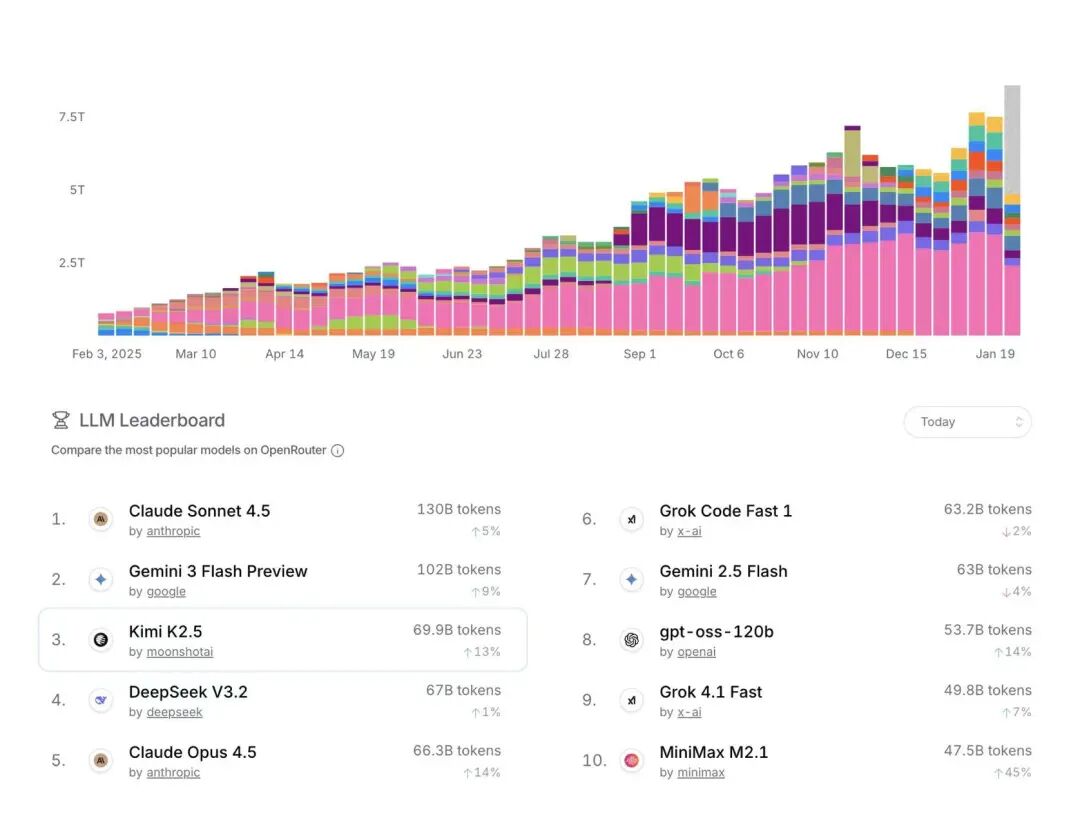
Core Insights - Kimi has recently announced that its overseas revenue has surpassed domestic revenue, with a fourfold increase in global paid users following the release of the new model K2.5 [2][7] - The K2.5 model has quickly gained popularity, ranking third on Openrouter, just behind Claude Sonnet 4.5 and Gemini 3 Flash [4][6] - Kimi's approach focuses on enhancing AI capabilities through a multi-agent system, allowing for parallel task execution and significantly improving efficiency in various applications [9][10] Revenue and User Growth - Kimi's overseas API revenue has increased fourfold since November 2025, with monthly growth rates for both overseas and domestic paid users exceeding 170% [7] - The global paid user base has seen a fourfold increase shortly after the K2.5 model release [2] Model Development and Features - The K2.5 model is Kimi's most advanced to date, featuring a native multimodal architecture that covers visual understanding, code generation, and agent clusters [7] - K2.5 has achieved state-of-the-art results in benchmark tests, surpassing some closed-source models like GPT-5.2 and Claude Opus 4.5 [7] Technological Innovations - Kimi's development strategy emphasizes algorithmic and efficiency innovations, focusing on critical explorations due to limited resources [11] - The company has successfully implemented unique optimizations in large-scale LLM training, such as the Muon optimizer and a self-developed linear attention mechanism [11] Product Strategy - Kimi aims to position itself as a productivity tool for end-users while also attracting developers through its API platform [12] - The company has rebranded its C-end product to Kimi Agent, indicating a focus on creating more refined and thematic products [12][14] Competitive Positioning - Kimi's strategy aligns with that of Anthropic, focusing on foundational model intelligence and open-sourcing its technology to build influence [10] - The company is concentrating on high-demand scenarios like coding and office automation, which are expected to have clear commercialization prospects [14][15]
2025年中国金融智能体发展研究报告
艾瑞咨询· 2026-02-02 00:05
Core Insights - The report provides a comprehensive analysis of the current state and trends of financial intelligent agents in China, emphasizing their development driven by technological breakthroughs, business innovations, and policy support [1][2]. Group 1: Driving Factors - Technological breakthroughs are addressing the "last mile" challenges in the application of large models, enhancing their task execution capabilities through advancements in tools and frameworks [6]. - Business innovation is evident as approximately 33% of financial institutions show a positive investment attitude towards intelligent agents, indicating market recognition of their practical value [7]. - Policy support is crucial, with clear guidelines and goals established by the government, directing resources towards key areas such as technology finance and digital finance [8][10]. Group 2: Current Industry Cycle - The financial intelligent agent industry is in its initial exploration phase, with 96% of applications still in the proof of concept (POC) or pilot stages, while only 4% have moved to agile practice [12]. - The focus of intelligent agent applications is primarily on operational functions and peripheral business scenarios, with a significant portion of projects aimed at enhancing efficiency and service quality [16]. Group 3: Project Implementation - Most projects are following established plans for deployment, with two main paths: embedding intelligent agent functions into existing systems or developing standalone intelligent agent applications [18]. - The majority of projects are progressing as scheduled, with a few exceptions, indicating a generally smooth implementation process [19]. Group 4: Market Distribution - The banking sector leads the financial intelligent agent market with a 43% share, followed by asset management at 27% and insurance at 15%, reflecting the diverse application opportunities within these sectors [25][26]. Group 5: Market Size and Growth - The investment scale for intelligent agent platforms and applications in Chinese financial institutions is projected to reach 950 million yuan in 2025, with an expected compound annual growth rate of 82.6% by 2030 [35][36]. - The market growth is supported by both existing project expansions and new entrants, driven by policy incentives and successful case studies from leading institutions [36]. Group 6: Customer Expectations and Investment Willingness - Financial institutions are increasingly viewing intelligent agents as core drivers of sustainable business growth and customer experience innovation, rather than merely tools for efficiency [53][58]. - Investment willingness among financial institutions has risen significantly, with a 27.5% increase in those expressing a positive investment attitude, driven by peer examples and supportive policies [58][59]. Group 7: Challenges and Considerations - The current market is characterized by high expectations versus the reality of exploration phase challenges, necessitating careful management of client expectations to avoid trust erosion [43]. - There is a need for financial institutions to establish a clear understanding of the value and capabilities of intelligent agents to prevent misaligned expectations and potential investment hesitance [47][73].

人工智能大模型要敢于持续“摸高”(“咖”说科技)
Ren Min Wang· 2026-02-01 22:13
数据来源:工业和信息化部 从全球范围来看,得益于人工智能边界的新突破、新场景落地,基于大模型的应用收入每年呈几倍的增 长,增量远大于存量。我们对未来充满信心,因为我们看到了在人工智能产业的发展中,有本土成长起 来的优秀人才梯队、算力供应链以及全球领先的使用AI的用户群体和企业。尤其我国有大量的年轻人 学习和从事人工智能相关的工作。目睹和亲历中国企业同样能做出来一代代更好的技术,这些年轻人才 对技术创新和产品创新也越来越有自信,也敢于做更具突破性的尝试。 过去3年,基于大模型的人工智能从一项前沿技术,加速成长为引领新一轮产业变革的重要驱动力。从 语言模型到多模态理解生成,再到各种完成复杂任务的智能体,智能边界不断突破,模型的使用量持续 增加,应用落地越来越多。预计未来几年,人工智能技术进步和产业变革仍将高速发展,甚至更快。 在人工智能技术发展进程中,我国的科技公司扮演着越来越重要的角色,在成本效率和开源上确立了初 步优势。在算力受限的情况下,我国企业充分利用人才和工程师的红利,做了大量创新,极大提高了大 模型训练和推理的算力使用效率,从而训练出多个受到国际认可的大模型。目前在开源领域,中国大模 型的使用量已经超 ...

中国科学院院士梅宏:当前人工智能热潮需要一场“冷思考”
2 1 Shi Ji Jing Ji Bao Dao· 2026-02-01 14:09
Core Viewpoint - The current AI wave, particularly in large models, requires rational thinking as it faces significant limitations despite impressive advancements in deep learning [1] Group 1: AI Technology and Limitations - AI technology, represented by deep learning, is fundamentally reliant on data and computational power, achieving only perceptual intelligence rather than true cognitive ability [1][2] - The hype surrounding AI, including concepts like "replacing humans" and "general AI," overlooks critical issues such as energy consumption, data depletion, and legal-ethical challenges [1] Group 2: Model Framework and Data Dependency - Large models operate within a "probability statistics" framework, and their performance improvements do not alter the fundamental reliance on data [2] - The capabilities of AI agents are limited by the underlying large models, and their effectiveness is constrained by computational resources [2] Group 3: Future Directions in AI Research - The academic community is urged to embrace diversity in AI research, moving beyond a singular focus on deep learning to include symbolic representation, which is crucial for knowledge exchange [3] - AI should remain a controllable tool for humans, aimed at enhancing work efficiency and quality, while maintaining human oversight in knowledge discovery and value judgment [3] - Current applications of large models in text, image, and video are only a small part of industry needs, emphasizing the necessity for effective solutions to real production and business problems through data accumulation [3]