
A股市场

Search documents
A股主要指数冲高回落,沪指翻绿,深成指跌近0.35%!PEEK材料、光刻机、燃气等方向跌幅居前,近3200只股票下跌
Ge Long Hui· 2025-08-19 02:14
Group 1 - The A-share major indices experienced a pullback after initially rising, with the Shanghai Composite Index turning negative and the Shenzhen Component Index declining by nearly 0.35% [1] - The sectors that saw the largest declines included PEEK materials, lithography machines, and gas, indicating a broad market weakness [1] - Approximately 3,200 stocks in the Shanghai, Shenzhen, and Beijing markets fell, reflecting a significant downturn in market sentiment [1]
费率触底,创业板ETF天弘(159977)涨近1%冲击三连阳,机构:A股市场仍有充足空间和机会
2 1 Shi Ji Jing Ji Bao Dao· 2025-08-19 02:12
创业板ETF天弘(159977)紧密跟踪创业板指数(399006.SZ),该指数是深交所多层次资本市场的核 心指数之一,由最具代表性的100家创业板上市企业股票组成,反映创业板市场层次的运行情况。创业 板指数新兴产业、高新技术企业占比高,成长性突出。截至最新,创业板指前十大权重股中包含宁德时 代、东方财富、中际旭创、新易盛、迈瑞医疗、汇川技术、胜宏科技等。创业板ETF天弘(159977)同 时配置场外创业板ETF联接基金(A:001592;C:001593)。 8月19日,创业板指低开后震荡走高,相关ETF方面,创业板ETF天弘(159977)涨0.92%冲击三连阳, 成交额突破2300万元。成分股方面,天孚通信涨超7%,新易盛、中际旭创、协创数据等多股跟涨。 值得关注的是,天弘基金上周发布公告称,自8月15日起创业板ETF天弘(159977)及联接基金(A类: 001592;C类:001593)的管理费、托管费将分别下调至0.15%、0.05%。此次降费后,上述两只基金的 管理费、托管费均已调至全市场指数基金最低一档费率。 (本文机构观点来自持牌证券机构,不构成任何投资建议,亦不代表平台观点,请投资人独立判 ...

中证报头版:A股市场情绪提升 更多增量资金可期
Zhong Guo Zheng Quan Bao· 2025-08-18 22:54
(文章来源:中国证券报) 中证报头版刊文指出,近期,公募基金、私募基金、保险资金、外资等多路增量资金积极入场,资金从 银行存款向权益市场迁移的"存款搬家"迹象明显,上市公司回购资金增多。市场人士预期,随着政策 面、基本面持续向好,投资情绪回暖以及风险收益比改善,股票配置的性价比持续提升,更多资金有望 流向A股市场。 ...
A股市场情绪彻底沸腾了,8月19日,今日凌晨的重要消息全面发酵!
Sou Hu Cai Jing· 2025-08-18 18:14
Group 1 - The unexpected interest rate cut announcement has led to a stronger performance of A-shares compared to Hong Kong stocks, primarily due to the uncertainty surrounding the Federal Reserve's decision on interest rates in September [1] - The market is currently predicting an 84% probability of a rate cut, but this is contingent on upcoming inflation data and Jerome Powell's speech [1] - If a rate cut is confirmed, Hong Kong stocks may outperform A-shares due to anticipated foreign capital inflows; otherwise, A-shares may continue to show strength due to internal factors [1] Group 2 - A-shares have reached significant milestones, with a market capitalization exceeding 100 trillion yuan for the first time and the Shanghai Composite Index hitting a nearly 10-year high [3] - The trading volume surged to 2.76 trillion yuan, marking the third-highest volume in history, indicating strong market momentum and investor participation [3][5] - The overall market sentiment is extremely positive, with major indices reaching new highs and significant capital inflows observed as investors react to the bullish trend [5] Group 3 - Despite the strong performance of the indices, caution is advised as the Shanghai Composite Index faces resistance at 3731 points, with potential pullbacks expected in the coming days [7] - A rotation of funds from low-volatility sectors to more active sectors is occurring, suggesting a shift in market dynamics [7] - Investors are encouraged to maintain their positions as all sectors are expected to experience upward movement over time, emphasizing the importance of patience in the current market environment [7]

每经热评丨沪指创下十年新高“00后”们入场当注意三件事
Mei Ri Jing Ji Xin Wen· 2025-08-18 14:39
Group 1 - The Shanghai Composite Index reached a ten-year high of 3745.94 points on August 18, indicating a significant influx of capital into the A-share market, with trading volumes exceeding 2 trillion yuan in recent days, peaking at over 2.7 trillion yuan on the 18th [1] - In July, A-share new account openings surged to 1.9636 million, a year-on-year increase of over 70%, reflecting growing investor interest [1] - The People's Bank of China reported a decrease of 1.1 trillion yuan in household deposits in July, while non-bank institutions saw an increase of 2.14 trillion yuan, indicating a shift in capital flow towards the stock market [1] Group 2 - The safety of principal is emphasized as a fundamental principle for investors, highlighting the importance of setting stop-loss lines and avoiding high-frequency trading to mitigate risks [2] - The increasing difficulty in stock selection requires higher professional knowledge from investors, as there are over 5400 listed companies in A-shares, with many in advanced sectors like AI and biotechnology that are less familiar to average investors [3] - New investors often experience a "newbie welfare period" during bullish markets, which can lead to overconfidence and aggressive trading, underscoring the need for a solid understanding of economic and industry principles to sustain long-term investment success [4]
沪指创近十年新高!今日市场情绪指数请查收
Di Yi Cai Jing Zi Xun· 2025-08-18 11:50
2025.08.18 微信编辑| 生产队的驴(又又见证历史版) 今日A股创纪录数据一览↓ ①A股盘中市值总和突破100万亿元,创历史新高。 ②上证指数收报3728点,创近十年新高。 ③北证50指数大涨6.79%,收报1576.63点,创历史新高。 ④深成指、创业板指均突破去年10月8日高点。 ⑤沪深两市全天成交额为2.76万亿元,创年内新高,历史第三高。 阿驴今天又又又见证历史了! (注:我们会对线索进行核实。您的隐私将严格保密。) 第一财经持续追踪财经热点。若您掌握公司动态、行业趋势、金融事件等有价值的线索,欢迎提供。专 用邮箱:bianjibu@yicai.com ...

见证历史:今日A股创纪录数据一览
Di Yi Cai Jing· 2025-08-18 10:08
A股盘中市值总和突破100万亿元,上证指数创近十年新高。 ③北证50指数大涨6.79%,收报1576.63点,创历史新高。 ④深成指、创业板指均突破去年10月8日高点。 ⑤沪深两市全天成交额为2.76万亿元,创年内新高,历史第三高。 ①A股盘中市值总和突破100万亿元,创历史新高。 ②上证指数收报3728点,创近十年新高。 ...
瑞达期货股指期货全景日报-20250818
Rui Da Qi Huo· 2025-08-18 09:49
Report Summary 1. Report Industry Investment Rating No information provided. 2. Core View of the Report Although economic data weakened in July, market expectations for policy intensification have increased. The market is focusing on the semi - annual reports of listed companies, with positive net profit growth in the four broad - based indices. Some companies' improved fundamentals support the stock market, but the potential drag from unreported companies' profit declines should be watched. A - shares with reasonable valuations are attracting foreign capital inflows. The strategy suggests light - position buying on dips [2]. 3. Summary by Relevant Catalogs 3.1 Futures Data - **Futures Contracts**: All main and secondary contracts of IF, IH, IC, and IM showed price increases. For example, the IF main contract (2509) rose 34.6 to 4237.8 [2]. - **Futures Spreads**: All spreads between different contracts showed increases. For instance, the IF - IH monthly contract spread rose 26.4 to 1389.4 [2]. - **Futures Net Positions**: The net positions of the top 20 in IF, IH, and IM increased, while that of IC decreased slightly [2]. - **Futures Basis**: The basis of IF, IH, and IC main contracts decreased, while that of IM increased [2]. 3.2 Market Data - **Spot Prices**: All major spot indices (CSI 300, SSE 50, CSI 500, and CSI 1000) rose. The CSI 300 rose 37.1 to 4239.41 [2]. - **Market Turnover and Margin Trading**: A - share trading volume remained at a high level, and the margin trading balance increased slightly [2]. - **Market Sentiment Indicators**: North - bound trading was active, and the proportion of rising stocks decreased. The Shibor rate increased [2]. 3.3 Industry News - **Economic Data**: In July 2025, fixed - asset investment, real - estate investment, and social retail sales growth slowed down compared to previous values. However, inflation data showed improvement, and the M2 - M1 gap continued to narrow [2]. - **Stock Market Performance**: A - share major indices closed higher, with over 4000 stocks rising. Communication, comprehensive, and computer sectors strengthened, while real - estate and oil sectors declined [2]. 3.4 Upcoming Key Data - August 20th, 9:00: China's one - year and five - year LPR quotes - August 21st, 15:00 - 16:30: France, Germany, Eurozone, and UK's August SPGI manufacturing, service, and composite PMI preliminary values; 21:45: US August SPGI manufacturing, service, and composite PMI preliminary values - August 22nd, 22:00: Fed Chairman Powell's speech at the Jackson Hole Global Central Bank Conference [3]

以史为镜!这次A股十年新高有何不同?
Zheng Quan Shi Bao· 2025-08-18 09:14
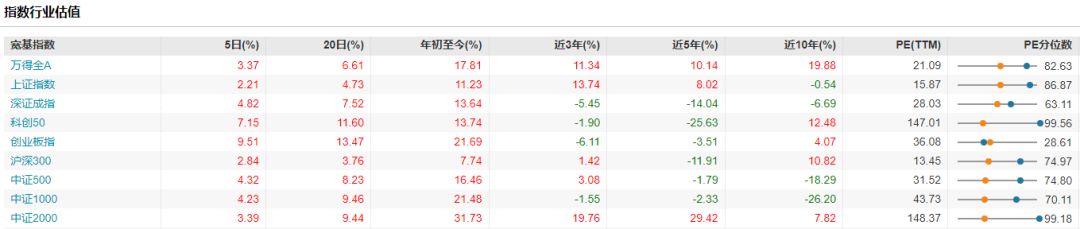
证券时报记者 吴少龙 王军 胡华雄 8月18日,A股市场涨势如虹,人气进一步高涨,多个指数盘中创阶段新高。 其中,上证指数盘中突破2021年2月18日曾触及的3731.69点高点,创出自2015年8月20日之后的近10年新高。深证成指、创业板指数均突破2024年10月8日 的高点,创出最近两年新高。北证50指数盘中突破1500点,创出历史新高。 在银行等权重的带领下,目前A股整体市盈率为21.09倍,处于近十年历史分位数的82.78%。 数据显示,截至2025年8月18日,上证指数滚动市盈率(PE-TTM)约15.87倍,处于近十年历史分位数的86.50%。而10年前的2015年8月20日,上证指数滚 动市盈率(PE-TTM)约为16.5倍,当年的6月12日,上证指数滚动市盈率(PE-TTM)最高一度达到23倍;4年多前的2021年2月18日,上证指数滚动市盈 率(PE-TTM)为16.81倍。 值得关注的是,目前,各大指数呈现较为明显的分化,其中深证成指处于近十年历史分位数的63.21%;创业板指较低,为28.98%。沪深300、中证500、 中证1000均已经超过70%。 招商证券的观点称,由于当前A股整 ...
A股总市值首破100000000000000元!公募机构这样看!
Zheng Quan Ri Bao Zhi Sheng· 2025-08-18 08:36
Core Viewpoint - The A-share market has entered a period of heightened activity, with total market capitalization surpassing 100 trillion yuan for the first time in history, driven by a positive cycle of capital flow and institutional support [1][2][3]. Market Performance - As of August 18, the A-share market's total capitalization reached 113.62 trillion yuan, with major indices showing strong performance: the Shanghai Composite Index rose by 0.85% to 3728.03 points, the Shenzhen Component Index increased by 1.73% to 11835.57 points, and the ChiNext Index surged by 2.84% to 2606.20 points [2]. - The market has seen a continuous trading volume exceeding 2 trillion yuan for four consecutive trading days, with sectors such as communication equipment, software, and cultural media leading the gains [2]. Institutional Insights - Multiple public fund institutions have indicated that the market is experiencing a positive cycle, with increasing capital inflow being a key driver of the sustained strong performance [4][5]. - Analysts from various funds believe that the combination of policy support, liquidity easing expectations, and ongoing industrial upgrades will lead the A-share market into a more resilient and sustainable "slow bull" phase [5]. Economic Indicators - Financial data shows promising trends, with M1 and M2 growth rates exceeding expectations, indicating accelerated activation of household deposits [4]. - The current market environment is seen as favorable for equity assets, with a strong capacity to absorb capital and a visible profit-making effect likely to enhance market risk appetite [4]. Sector Focus - Key sectors identified for attention include technology, large finance, and military industries, particularly during the earnings disclosure period, which may provide catalysts for market movement [7]. - The technology sector, especially AI applications and advanced semiconductor processes, is highlighted as having significant potential, aligning with national policies on self-sufficiency and reasonable valuation levels [7].