
生成式人工智能

Search documents
Cell子刊:生成式AI模型,从头生成抗菌肽,对抗抗生素耐药难题
生物世界· 2025-09-07 04:03
Core Viewpoint - The rapid development of antibiotic resistance outpaces the discovery of new antibiotics, highlighting the potential of antimicrobial peptides (AMPs) as promising alternatives due to their broad-spectrum antimicrobial activity and unique mechanisms of action [2][6]. Group 1: Antimicrobial Peptides (AMPs) - AMPs are small molecules (10-50 amino acids) that play a crucial role in the host immune defense system, targeting bacteria, fungi, viruses, and parasites [2]. - The mechanisms of AMPs differ from traditional antibiotics, primarily disrupting pathogen cell membranes or interfering with metabolic processes [2][6]. - Despite their potential, the discovery of AMPs remains challenging, necessitating advanced tools like machine learning and deep learning to accelerate research [6][8]. Group 2: Generative Artificial Intelligence in AMP Design - Generative artificial intelligence, particularly through models like AMP-Diffusion, offers a powerful approach for designing AMPs by exploring sequence space systematically [3][7]. - AMP-Diffusion utilizes a pre-trained latent diffusion model to generate potent AMP sequences, ensuring integration with established protein language models like ESM-2 [7][9]. - The model has successfully generated 50,000 candidate AMP sequences, with 76% demonstrating low toxicity and effective bacterial killing capabilities [8][9]. Group 3: Research Findings and Implications - The research team synthesized and validated 46 top-ranking AMP candidates, which exhibited broad-spectrum antimicrobial activity, including against multidrug-resistant strains, with low cytotoxicity [8][9]. - In preclinical mouse models, lead AMPs significantly reduced bacterial load, showing efficacy comparable to polymyxin B and levofloxacin without adverse effects [8][9]. - AMP-Diffusion represents a robust platform for antibiotic design, addressing the urgent need for new antimicrobial agents in the face of rising antibiotic resistance [8][9].


当AI大模型遇见人格权:海量数据训练下的侵权风险
Bei Jing Ri Bao Ke Hu Duan· 2025-09-06 00:54
Core Insights - Artificial intelligence is becoming a significant driving force behind a new wave of technological revolution and industrial transformation, fundamentally altering production methods, lifestyles, and social governance [1] - The development of large AI models requires vast amounts of data, which raises concerns about the protection of personal information rights and presents new challenges to the personal rights system [1] Group 1: Protection and Utilization of Publicly Available Personal Information - The protection of publicly available personal information is increasingly important in the training of AI models, as much of the training data comes from such sources [1] - The Personal Information Protection Law in China allows for the processing of publicly available personal information without consent, provided it meets certain conditions, including reasonable scope and significant impact on personal rights [1] - The challenge arises when AI models collect fragmented personal information, potentially leading to the reconstruction of sensitive personal data, which necessitates obtaining consent [1] Group 2: Safeguarding Sensitive Personal Information - The advancement of AI technology enhances data analysis capabilities, posing new threats to personal information security, particularly sensitive data [2] - During the training phase of generative AI, it is crucial to anonymize sensitive personal information to prevent severe consequences from potential leaks [2] - Historical incidents, such as vulnerabilities in ChatGPT, highlight the risks associated with sensitive information exposure and the need for ongoing regulatory measures [2] Group 3: Challenges in Generative AI Operations - Generative AI poses significant challenges to the protection of personal privacy and information, necessitating measures to prevent sensitive data from being included in generated content [3] - The risk of generative AI producing malicious or false content is a concern, as inaccuracies in training data can lead to harmful outputs that may relate to sensitive personal information [3] - The importance of protecting personal identifiers, such as voice, is increasingly recognized due to the potential for deepfake technology to exploit these identifiers [3] Group 4: Protection of Personal Identifiers - The rise of deepfake technology allows for the creation of fraudulent audio and visual content, posing significant risks to individuals [4] - High-profile cases, such as the exploitation of Scarlett Johansson's voice by OpenAI, underscore the urgent need for legal protections against the misuse of personal identifiers [4] - The necessity for stricter regulations to prevent the infringement of personal rights through deepfake technology is becoming more apparent [4] Group 5: Virtual Digital Humans and Personal Rights - The emergence of virtual digital humans presents new challenges to the personal rights system, particularly regarding the use of real individuals' likenesses in creating virtual representations [5] - The commercial viability of virtual digital humans is being explored, but their interaction with the real world raises questions about potential violations of personal rights [5] - The determination of whether a virtual digital human infringes on an individual's rights hinges on the recognizable similarity to the real person, necessitating legal standards for assessment [5] Group 6: New Types of Personal Rights - Virtual digital humans can act as "virtual avatars," extending beyond traditional rights to encompass new forms of personal rights [6] - Legal interpretations are evolving to recognize that the use of real personal information in training AI companions can infringe upon various personal rights, including name and likeness rights [6] - The concept of a "virtual avatar" represents a composite of an individual's identity, necessitating the establishment of new legal protections for these emerging personal rights [6]

专家解读|从制度破冰到体系完善 AI生成内容标识打造可信网络空间
Xin Lang Cai Jing· 2025-09-05 23:31
Core Viewpoint - The introduction of the "Artificial Intelligence Generated Synthetic Content Identification Measures" marks a significant advancement in China's governance of generative AI, transitioning from principle-based regulations to detailed, systematic governance [1][4]. Group 1: Framework and Implementation - The "Identification Measures" establish a comprehensive framework for identifying AI-generated content, utilizing both explicit (textual and audio prompts) and implicit (metadata embedding) identification methods to create a trust mechanism for users and machines [1][2]. - The measures provide operational guidelines for four main file formats: video, text, images, and audio, enhancing the granularity and operability compared to previous regulations [1][2]. - The identification requirements are differentiated based on content types, which helps reduce compliance costs for businesses and avoids unnecessary investments due to vague standards [1][2]. Group 2: Long-term Systematic Engineering - Establishing a robust content identification system is a long-term, systematic project requiring ongoing collaboration between government and enterprises, emphasizing a co-governance model [2]. - The "Identification Measures" delineate clear responsibilities across different stakeholders, enhancing control over critical processes and curbing issues like AI-generated misinformation [2][3]. - The measures also allow for flexibility in implementation, accommodating the varying capabilities of businesses, particularly small and traditional enterprises [2][3]. Group 3: Dynamic Iteration and Future Directions - The "Identification Measures" serve as a foundational starting point for the ongoing evolution of China's generative AI governance framework, addressing current industry challenges while setting a long-term direction [3][4]. - There is a need for the introduction of advanced technical methods for identification, as the complexity of content generation continues to increase with the integration of multimodal models [3]. - Future efforts should focus on enhancing the identification dimensions and accuracy, promoting a comprehensive certification technology system that is compatible across platforms and modalities [4].
数学战争警示录:我们需要什么样的数学教育?
Hu Xiu· 2025-09-05 11:46
Core Viewpoint - The article discusses the ongoing "math wars" in the United States, highlighting the debate over the approach to math education, whether it should serve as a gatekeeper for elite students or provide foundational skills for all students [1][2][3]. Group 1: Background and Context - The Gates Foundation recently donated funds to establish the Mathematics Science Education Board (MSEB) to enhance math education from kindergarten through graduate school in the U.S. [1][2]. - The debate over math education has involved various stakeholders, including mathematicians, educators, politicians, and the public, reflecting concerns over educational philosophy, resource allocation, and national competitiveness [3][4]. - Historically, U.S. math education has faced criticism for low performance in international assessments, with adults often scoring poorly in basic math skills [3][4]. Group 2: Historical Developments - The "math wars" have evolved over decades, with significant funding from organizations like the National Science Foundation (NSF) and the Gates Foundation, amounting to billions of dollars aimed at reforming math education [5][28]. - The National Council of Teachers of Mathematics (NCTM) established national standards in the late 20th century, promoting student-centered, exploratory learning [12][14][15]. - The NCTM standards faced backlash for neglecting basic skills and overemphasizing the use of calculators, leading to a decline in foundational math skills among students [20][21][24]. Group 3: Current Issues and Debates - The current debate centers around whether traditional subjects like algebra should be replaced with data science in college entrance exams, reflecting the changing landscape of math application in technology [9][10]. - The push for educational equity has led to a focus on ensuring all students achieve minimum proficiency, but this has sometimes resulted in a decline in the quality of education for advanced students [8][9][27]. - The article emphasizes the need for well-trained math teachers as a critical factor in improving math education, suggesting that teacher competency is often overlooked in the reform discussions [29][30][31].
“新格局·新路径”凤凰湾区财经论坛2025即将启幕:探寻全球破局之道
凤凰网财经· 2025-09-05 08:36
Core Viewpoint - The "Phoenix Bay Area Financial Forum 2025" aims to explore new paths and insights in the context of global economic changes and challenges, focusing on the Guangdong-Hong Kong-Macao Greater Bay Area as a strategic hub for high-quality development and international connectivity [1][3]. Group 1: Global Economic Changes - The world is undergoing multiple transformations, including adjustments in trade policies, restructuring of supply chains, rapid penetration of generative artificial intelligence across industries, and fluctuations in the global interest rate environment [3]. - These changes reflect a deep adjustment in the global economic landscape and present new challenges for corporate globalization [3]. Group 2: Forum Themes and Discussions - The forum will feature discussions on key topics such as "Reconstructing the New Global Economic Pattern," "New Paths for Corporate Globalization," "Digital Currency: Reshaping the Payment System?" "AI+: New Waves, New Blue Oceans," "Bull Market in China: A Decade of Growth," and "Cultural Revaluation and Asset Logic Transformation" [3]. - The event will gather government officials, business elites, and experts to facilitate in-depth dialogues aimed at enhancing the development of the Greater Bay Area and promoting international cooperation [3][4]. Group 3: Awards and Recognition - The "2025 Phoenix Star Listed Company Awards" will recognize outstanding listed companies based on five dimensions: market value management, reputation management, human-centered management, innovation management, and globalization [4]. - This evaluation framework combines online voting and expert reviews to provide investors with in-depth analysis beyond financial metrics, encouraging companies to achieve balanced development [4]. Group 4: Forum Objectives - The forum aims to leverage the global perspective and resources of Phoenix TV and Phoenix Network to create a high-end platform for intellectual exchange and practical cooperation [4]. - It will focus on new trends in global economic governance, technological innovation, and new driving forces for industrial development, contributing to the stability and prosperity of both the Chinese and global economies [4].

元数据:提升新闻可发现性
Refinitiv路孚特· 2025-09-05 06:03
Core Viewpoint - The article emphasizes the critical role of metadata in the digital age, asserting that while content quality is important, the ability to efficiently locate relevant content amidst vast amounts of information is paramount [1]. Group 1: Importance of Metadata - Metadata, defined as "data about data," serves as a guiding light for users to filter, search, and pinpoint specific news and insights relevant to them [1][4]. - The accuracy, transparency, and consistency of metadata are increasingly vital due to the complexity and volume of news driven by advanced technologies like generative AI [1]. Group 2: LSEG's Investment in Metadata - LSEG's financial news service provides comprehensive reporting from trusted sources, including Reuters and over 10,000 other news outlets, with metadata ensuring ease of access and precise filtering capabilities [2][3]. - The service processes approximately 1 million news articles daily, enriching each article with extensive metadata to enhance discoverability and usability [6][9]. Group 3: Metadata Application and Classification - LSEG employs a unified tagging system across all news content, enhancing searchability and allowing users to filter news more accurately, especially on trending topics [3][6]. - The classification system is continuously expanding, with new themes added monthly to reflect emerging trends and global events, thus improving the user experience in discovering relevant content [7][9]. Group 4: Customization and User Experience - Users can customize their news feeds based on specific interests, utilizing deeper metadata insights such as sentiment and relevance, which can inform decision-making [8][12]. - The metadata-driven products, like News Digest, provide personalized and relevant news, enhancing the overall user experience [7][8].

生成式AITop100展现全球竞争新格局
Sou Hu Cai Jing· 2025-09-05 04:08
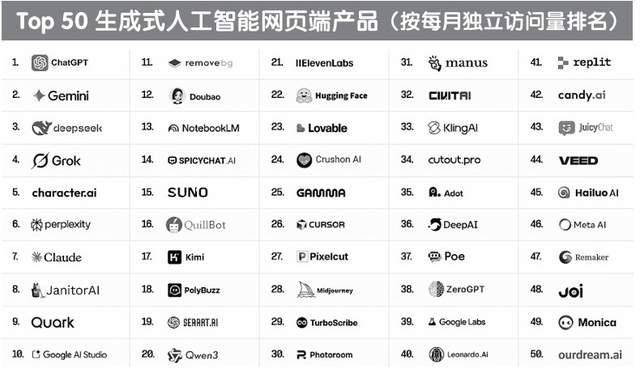
Group 1 - The recent global AI application ranking highlights the dominance of Chinese and American companies, with no South Korean products making the list, indicating a significant gap in South Korea's AI presence [1][5] - The report by a16z shows that while OpenAI's ChatGPT remains a leader in consumer AI, its advantage is narrowing, with competitors like Google's Gemini and Elon Musk's Grok rapidly gaining user numbers [2][4] - Chinese companies have made significant strides in the AI application space, with five Chinese firms ranking in the top 20 for web-based applications, including DeepSeek at third and Quark at ninth [2][3] Group 2 - The AI application market is shifting towards a more decentralized structure, with no single company dominating across all platforms, reflecting a diversification in product offerings [2][4] - In the mobile application category, Chinese applications occupy 22 out of the top 50 spots, showcasing their strong presence and competitive edge in this segment [4][5] - The competition in consumer AI products is intensifying, with a notable increase in the number of new entrants, particularly from Chinese teams, indicating rapid development in original AI applications [4][6] Group 3 - The contrasting development strategies of the US and China in AI are evident, with the US focusing on general artificial intelligence (AGI) and China emphasizing practical AI applications to enhance economic efficiency [5][6] - The global AI ecosystem is stabilizing, moving past its rapid growth phase, with established players like Google, X, and Alibaba intensifying competition in various specialized fields [5][6] - Analysts predict that by 2025, the AI landscape will feature multiple competitive players, each carving out niches in the market, leading to a richer array of consumer choices [6]
两年暴涨261%,博通一路狂飙
半导体行业观察· 2025-09-05 01:07
Core Viewpoint - Broadcom has experienced significant stock price growth, increasing over 100% since April, with a market capitalization of approximately $1.4 trillion, making it the second-largest semiconductor company globally, trailing only Nvidia [2][8]. Financial Performance - Broadcom's Q3 earnings per share were $1.69, slightly above Wall Street's expectation of $1.65, with revenue reaching $15.96 billion, a 22% increase year-over-year [8]. - The company reported a net profit of $4.14 billion for the quarter, a significant recovery from a loss of $1.88 billion in the same period last year, which was attributed to a one-time tax provision [8]. - AI revenue grew by 63% year-over-year, reaching $5.2 billion, exceeding previous forecasts [10]. Market Position and Strategy - Broadcom is positioned as a major beneficiary of the generative AI trend, providing customized chips for large-scale data center clients seeking alternatives to Nvidia's products [4][6]. - The company has launched new AI-focused networking chips, such as the Tomahawk Ultra and Jericho, to compete with Nvidia in the AI semiconductor market [6][12]. - Broadcom's semiconductor solutions business saw a 57% revenue increase, reaching $9.17 billion, while its infrastructure solutions business grew by 43% to $6.79 billion [9]. Future Outlook - Broadcom has secured a $10 billion order for custom AI chips from a major client, leading to an upward revision of its AI revenue forecast for fiscal year 2026 [10]. - The company anticipates Q4 sales to reach $17.4 billion, surpassing Wall Street's expectation of $17.02 billion [8]. - Analysts express optimism about Broadcom's potential to capture market share in the AI chip sector, especially as cloud operators increasingly adopt its solutions [9][16]. Competitive Landscape - Broadcom faces the challenge of competing against Nvidia, which has a stronghold in the AI GPU market, and must navigate the complexities of the AI ASIC design market [12][14]. - Nvidia's proprietary technologies, such as NVLink, are seen as significant competitive advantages, complicating Broadcom's efforts to penetrate the market [14]. - Despite the competitive landscape, Broadcom's recent performance and strategic initiatives position it as a strong contender in the AI semiconductor space [17].

股价年内近翻倍!AI东风助推 Credo Technology(CRDO.US)业绩指引惊艳华尔街
智通财经网· 2025-09-05 00:30
Core Viewpoint - Credo Technology's stock surged due to its Q1 earnings report and guidance exceeding market expectations, receiving high praise from Wall Street [1][2] Group 1: Financial Performance - The company's stock price increased by 7.40% on Thursday, with a year-to-date gain approaching 100% [1] - Analysts expect revenue growth of approximately 120% for the fiscal year 2026, with sequential revenue growth anticipated in Q2 to Q4 [2] Group 2: Client Contributions - Three major clients, identified as Amazon, Microsoft, and xAI, contributed over 10% of revenue, with respective contributions of 33%, 20%, and 35% [1] - A fourth major client made a significant revenue contribution in Q1, expected to exceed 10% by fiscal year 2026 [1] Group 3: Market Position and Product Offering - Credo Technology plays a critical role in the AI data center high-speed data connection sector, with a focus on active cable technology [2] - The company has a leading position in the active cable market, which is considered more reliable and energy-efficient compared to traditional optical cables and passive copper cables [2] Group 4: Analyst Insights - Susquehanna analyst Christopher Rolland raised the target price for Credo Technology from $115 to $165 following the earnings report [1] - Needham analyst N.Quinn Bolton also raised the target price, highlighting the company's strong performance and expanding market opportunities [2]

人工智能时代,孩子们需要软技能,但这对学校意味着什么?
3 6 Ke· 2025-09-05 00:06
Core Viewpoint - The rise of generative artificial intelligence (AI) may disrupt the demand for creative and analytical workers, particularly in knowledge-based jobs, raising questions about the future need for entry-level positions in the knowledge economy [1] Group 1: Impact on Employment - Employers are considering replacing certain white-collar jobs with AI, leading to concerns about the necessity of creative and analytical roles [1] - Generative AI excels in pattern matching and can simulate tasks traditionally performed by humans, making lower-level positions in programming, writing, and data analysis vulnerable to automation [1] Group 2: Importance of Soft Skills - Generative AI struggles with complex reasoning tasks and lacks understanding of human emotions, suggesting that soft skills will become increasingly important in the workforce [2] - Soft skills, such as emotional intelligence and interpersonal abilities, are essential for solving complex problems and collaborating effectively [2] Group 3: Teaching Strategies - Educators can integrate soft skills training with traditional subjects like math and reading, using techniques they are already familiar with [3] - Activities like exit tickets can help students reflect on their learning while enhancing their emotional and social skills [3][4] Group 4: Problem-Solving Skills - Teachers can encourage students to tackle complex, real-world problems, fostering critical thinking and problem-solving abilities [5][6] - Understanding the difference between textbook answers and exploring various possibilities in uncertain situations is crucial for students [6] Group 5: Learning Environment - The reliance on AI for completing assignments can hinder the learning process, as mastering new skills requires effort and engagement [7] - Classrooms should be protected as spaces for slow, deliberate learning, emphasizing the importance of self-reflection on the use of digital tools [7] Group 6: Future Skills - The future workforce will still require foundational skills in math and reading, along with unique human traits and interpersonal skills [8] - Self-awareness, prioritizing learning over shortcuts, and the ability to collaborate on complex challenges will be vital in an AI-driven economy [8]