
云原生

Search documents
国发股份:公司董事长姜烨完成增持计划 累计增持3001.66万元
Zhong Zheng Wang· 2025-08-27 14:56
Group 1 - The chairman of Guofa Co., Ltd., Jiang Ye, has completed a share buyback plan, acquiring a total of 4.8049 million shares for approximately 30.0166 million yuan [1] - Jiang Ye's recent share purchases occurred on multiple dates, with the total amounts being 9.888 million yuan, 4.1022 million yuan, 11.9964 million yuan, and 2.0304 million yuan for shares acquired on August 19, 20, 21, and 24 respectively [1] - Another executive, Wu Peicheng, also completed a share buyback plan, acquiring 381,500 shares for approximately 2.1393 million yuan, holding 0.74% of the company's total shares post-purchase [1] Group 2 - Guofa Co., Ltd. operates in pharmaceutical manufacturing and distribution, judicial in vitro diagnostics (IVD), and molecular medical imaging centers, generating 15.4 million yuan in revenue in the first half of 2025, with a net loss of 5.8417 million yuan, a 63.74% year-on-year reduction [2] - The pharmaceutical manufacturing segment includes products like "Haibao" pearl eye drops, contributing 1.274 million yuan in revenue, while the pharmaceutical distribution business generated 9.537 million yuan from operations in the Beibu Gulf region [2] - The IVD and molecular medical imaging center business, primarily through subsidiaries, achieved 4.362 million yuan in revenue in the first half of 2025 [2] Group 3 - Guofa Co., Ltd. is undergoing a strategic transformation and has made significant personnel adjustments to enhance its governance structure, appointing Zhang Xiaowei as president and Li Feng as assistant president [3] - The company plans to accelerate business innovation through a private placement financing and has engaged an auditing firm for this issuance [3] - Guofa Co., Ltd. is exploring opportunities in the AI sector, signaling potential strategic investments in "AI + health" and AI computing power, following a visit to a leading cloud-native technology company [3]

冲破垄断!中国数据库交出关键答卷:本地部署首超甲骨文!
Xin Lang Cai Jing· 2025-08-20 04:22
Core Insights - The article highlights the shift in the database market in China, where domestic databases like GaussDB have overtaken Oracle, marking a significant change in the competitive landscape [1][8] - The importance of databases in IT architecture is emphasized, particularly in the context of digital transformation and national technology sovereignty [3][4] Market Dynamics - Oracle, once a dominant player in the database sector, has seen its presence diminish in China, now only existing in a "small number of business systems" [1] - Huawei Cloud's GaussDB has achieved a market share of 13.9%, surpassing Oracle for the first time in the local deployment market [1][8] Technological Advancements - GaussDB has made significant advancements in performance and reliability, achieving transaction processing capabilities that are twice that of competitors under the same hardware configuration [4] - The database can handle 3-node clusters with 3.8 million transactions per minute, equating to 6,333 transactions per second [4] Security and Compliance - GaussDB is the only domestic database to receive the highest security certification (CC EAL4+) and has implemented a comprehensive data protection scheme [5] - The database features a "four defenses" system to ensure data integrity and security against various threats [5] Intelligent Features - GaussDB integrates AI to enhance operational efficiency, providing intelligent assistance for development and maintenance [6] - The database supports rapid fault diagnosis with a 90% accuracy rate, significantly improving system health checks [6] Case Studies - Postal Savings Bank has successfully implemented GaussDB to support a large-scale distributed core system, handling 650 million personal customers and 2 billion transactions daily [6] - Industrial and Commercial Bank of China improved its fault recovery time from 15-30 minutes to just 2 minutes after migrating to GaussDB, showcasing the database's efficiency [6] Strategic Positioning - GaussDB is positioned as a superior choice for enterprises, extending its application beyond finance to sectors like government and energy [7] - The article asserts that with the rise of domestic databases, Chinese enterprises can achieve true digital transformation without being constrained by foreign technology [8]


研判2025!中国关系型数据库行业市场规模、产品数量、竞争格局及未来趋势分析:仍占据市场主流地位,公有云关系型数据库发展迅速[图]
Chan Ye Xin Xi Wang· 2025-08-17 01:02
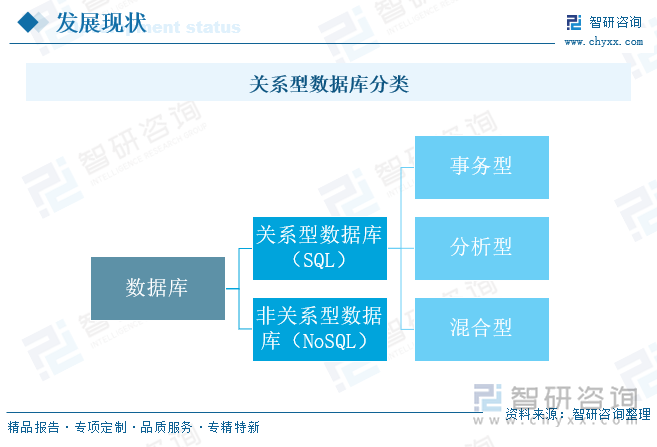
Core Insights - The relational database industry in China is experiencing rapid growth, driven by the "14th Five-Year Plan" which emphasizes digital development and the construction of a digital China [1][8] - The market size of China's relational database industry is projected to reach 29.98 billion yuan (approximately 4.21 billion USD) in 2024, with a year-on-year growth of 12.0% [8][10] - The public cloud has become the primary deployment method for relational databases, with the public cloud relational database market expected to reach 19.51 billion yuan in 2024, accounting for 65.1% of the market share [10][18] Market Overview - The overall database market in China is expected to reach 59.616 billion yuan in 2024, growing by 14% year-on-year [6][8] - The domestic relational database market is characterized by a diverse range of participants, including traditional vendors, startups, cloud providers, and cross-industry players, leading to intense competition [18][19] - The market concentration is increasing, with the top five players in the public cloud relational database market expected to hold nearly 85% of the market share by the second half of 2024 [18][19] Product Landscape - As of June 2025, there are 164 database products in China, with 96 being relational databases, representing 58.5% of the total [12][14] - The global database product landscape shows a predominance of non-relational and hybrid databases, while China maintains a focus on relational databases [12][14] Competitive Landscape - Major players in the public cloud relational database market include Alibaba Cloud and Tencent Cloud, which dominate the market [18][19] - In the on-premises relational database market, local companies like Huawei, Dameng, and Tencent compete with international firms such as Oracle, Microsoft, and SAP [18][19] Technological Trends - The relational database market in China is expected to exceed 75 billion yuan by 2029, driven by software localization, rapid AI application development, and the growth of the digital economy [21] - Key technological trends include the deepening of cloud-native databases and the integration of vector engines and multimodal data management [21]


研判2025!中国时序数据库行业市场数量、竞争格局及未来趋势分析:受益于物联网设备激增,时序数据库发展迅速[图]
Chan Ye Xin Xi Wang· 2025-08-13 01:11
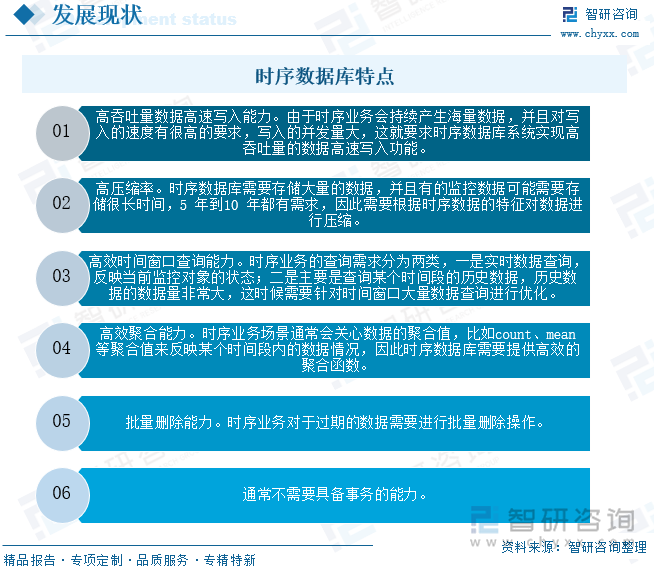
Core Viewpoint - The time series database (TSDB) industry is experiencing rapid growth driven by the exponential increase in time series data generated by IoT devices and cloud platforms, with the global market expected to grow from $388 million in 2024 to $776 million by 2031 [1][10]. Group 1: Industry Overview - Time series databases are specialized databases designed for storing and managing time series data, optimizing the ingestion, processing, and storage of timestamped data [2][3]. - The emergence of smart hardware, smart manufacturing, smart cities, and smart healthcare has led to a significant increase in time series data generation [1][9]. - Traditional relational databases and NoSQL databases face challenges in handling the high volume and concurrency of time series data, leading to the development of time series databases [1][10]. Group 2: Market Size and Trends - The global time series database software market is projected to reach $776 million by 2031, growing from $388 million in 2024 [10]. - As of June 2025, there are 41 time series databases globally, a decrease of 14 from the previous year, indicating increased industry concentration [14]. - In China, the number of time series databases is 17, down by 10 from the previous year, reflecting a competitive market landscape [16]. Group 3: Competitive Landscape - The industry features a mix of open-source and commercial models, with foreign markets leaning towards open-source solutions while domestic markets favor commercial offerings [18]. - Major domestic time series databases include Tdengine, KaiwuDB, DolphinDB, and openGemini, which play significant roles in driving industry development [20][21]. Group 4: Development Trends - Future trends indicate a deep integration of time series databases with artificial intelligence, enhancing capabilities for fault prediction and trend analysis [23][29]. - The adoption of cloud-native technologies is expected to grow, allowing for flexible resource management and cost reduction [25][29]. - The deployment of time series databases at the edge will facilitate real-time data processing and decision-making in IoT applications [26][29]. - There is a movement towards multi-model integration, enabling the management of diverse data types within time series databases [27][29].
全量核心数据库替换并迁移上云 保险公司信创征途收效几何
Jing Ji Guan Cha Bao· 2025-08-05 13:48
Core Insights - The insurance industry is undergoing a significant transformation from a "scale-driven" model to a "customer-oriented" approach, driven by the integration of cloud-native technologies, AI, and big data [1][3] - There is a pressing need for insurance companies to reconstruct their core systems to enhance quality, reduce costs, and improve efficiency, especially in light of increasing regulatory demands for data security and system autonomy [1][3] Cloud Migration and System Upgrades - Samsung Property Insurance has successfully migrated its core system to the cloud and switched its database from Oracle to Tencent Cloud's TDSQL-PG, becoming the first property insurance company in China to complete such a transition [1][2] - The transition to a cloud-native architecture has allowed Samsung Property Insurance to support high concurrency scenarios and accelerate the implementation of AI applications and ecosystem innovations [2][7] - The company has reported a 45% reduction in annual operational costs post-migration compared to traditional IDC solutions, including savings on hardware maintenance, database licensing, and software costs [7] AI Integration and Future Plans - The ongoing development of cloud-native, AI, and data intelligence is accelerating the digital and intelligent operations within the insurance sector [3][9] - Samsung Property Insurance plans to leverage AI to enhance risk control and optimize business processes, aiming to build a robust risk control model using Tencent Cloud's capabilities [8][9] - The integration of AI with cloud-native systems is expected to reshape the insurance industry's operational logic, facilitating product innovation and improving service efficiency [9]
国发股份:推进新发展战略 探索技术融合与产业拓展
Zhong Zheng Wang· 2025-07-23 07:17
Group 1 - Guofa Co., Ltd. (国发股份) expects a net loss of approximately 5.2 million yuan in the first half of 2025, a significant reduction compared to the same period last year [1] - The company has undergone a complete change in its core management team and is actively promoting a new development strategy focused on technological integration and industry expansion [1][2] - In Q1 2025, Guofa Co., Ltd. achieved operating revenue of 78.61 million yuan and a net profit attributable to shareholders of 3.14 million yuan, marking a turnaround from losses [1] Group 2 - Guofa Co., Ltd.'s main business includes pharmaceutical distribution, in vitro diagnostics (IVD), and pharmaceutical manufacturing, with a focus on optimizing its business structure and leveraging high-tech development [2] - The company has appointed Zhang Xiaowei, who has a strong technical background, as president, indicating a potential shift in business expansion strategies [2] - Guofa Co., Ltd. is focusing on the IVD sector, primarily serving the public security system, and has developed an automated DNA extraction workstation through its subsidiary, Gaosheng Bio [2] Group 3 - The IVD industry is transitioning from "single testing" to "precision and full-cycle management," with companies that have core technological breakthroughs and global integration advantages becoming more competitive [3] - Guofa Co., Ltd. plans to invest in brand marketing for its eye drops, leveraging its geographical advantage in Beihai, known as the "Pearl Capital of China" [3] - The company's "Haibao" brand eye drops, made from high-quality pearls, are a key technological innovation project and have been included in the national medical insurance and essential drug lists [3]
自主创新提速、AI回归价值!腾讯云副总裁胡利明:金融科技迈入深度重构期
Zheng Quan Shi Bao Wang· 2025-07-18 14:30
Core Insights - The financial industry's digital transformation is entering a critical phase, with technological architecture innovation and intelligent application becoming key drivers of competitive advantage [1] - Self-innovation has become a "mandatory course" for financial IT infrastructure, with a clear focus on domestic production and intelligent upgrades [2] - The AI large model technology is shifting from exploratory phases to practical applications, emphasizing the need for quantifiable efficiency improvements in core business scenarios [4] Group 1: Digital Transformation and Technological Innovation - The financial sector is experiencing a significant shift towards cloud-native and distributed modular architectures for core system upgrades, driven by self-innovation [2] - The demand for domestic databases and cloud platforms is surging, particularly among securities and insurance firms, indicating a robust trend towards localized IT solutions [2] - The complexity of long-term operations and iterations in core systems is being addressed through microservices, which decouple functional modules and enhance agility [2] Group 2: Database Development and Market Dynamics - The number of domestic database vendors has decreased by over 60 in the past year, leading to a "stronger becomes stronger" dynamic in the market [3] - Financial institutions are increasingly opting for top-tier products that have undergone rigorous security assessments and large-scale business validations [3] Group 3: AI Applications in Finance - AI technologies, particularly large models, are fundamentally changing financial service models, with a notable increase in the accessibility of model applications due to the emergence of quality open-source models [4] - Current applications of AI in finance are focused on low-precision scenarios such as code assistance, customer service, and marketing content generation, with ongoing exploration in more complex areas like trading strategies and credit decisions [4] - Challenges such as model hallucination and resonance risks remain, with companies employing various engineering methods to mitigate these issues, although complete resolution is still a challenge [4]
腾讯云「存储+智能」组合拳:AI时代的数据管理架构升级
Sou Hu Cai Jing· 2025-07-01 14:14
Core Insights - The article discusses Tencent Cloud's innovative approach to data management architecture, integrating cloud-native and AI-native concepts to enhance data storage and processing capabilities [1][3][4]. Group 1: Scene Analysis - The evolution of data storage has progressed through four stages, from basic cloud backup to advanced AI-driven data management, addressing the increasing complexity of non-structured data [3]. - Tencent Cloud has been recognized as an AI-native cloud provider, combining cloud-native technology with AI model training and intelligent agent development [3]. Group 2: Storage Foundation - Tencent Cloud's Object Storage Service (COS) offers a distributed storage solution that supports massive data storage without format restrictions, accessible via various methods [10]. - COS provides a full lifecycle management solution, allowing users to optimize storage costs by placing data in different storage classes based on access frequency [11]. - The introduction of GooseFS, a data accelerator, enhances performance for big data training and cleaning, addressing specific needs in AI scenarios [11]. Group 3: Processing and Management Engines - Data Vortex, a key processing tool, offers diverse services such as image cropping, watermarking, transcoding, and recognition, catering to various business needs [14]. - The management engine of Data Vortex excels in feature extraction and database creation for unstructured data, supporting multimodal retrieval [16]. Group 4: One-Stop Software Building Platform - The Smart Media Asset Hosting platform integrates storage, processing, and business access capabilities into a comprehensive package, significantly reducing development time and costs for SaaS applications [17]. - Features like file deduplication and on-the-fly transcoding enhance user experience and reduce storage costs [18].

华为CloudMatrix重磅论文披露AI数据中心新范式,推理效率超NV H100
量子位· 2025-06-29 05:34
Core Viewpoint - The article discusses the advancements in AI data center architecture, particularly focusing on Huawei's CloudMatrix384, which aims to address the limitations of traditional AI clusters by providing a more efficient, flexible, and scalable solution for AI computing needs [5][12][49]. Group 1: AI Computing Demand and Challenges - Major tech companies are significantly increasing their investments in GPU resources to enhance AI capabilities, with examples like Elon Musk's plan to expand his supercomputer by tenfold and Meta's $10 billion investment in a new data center [1]. - Traditional AI clusters face challenges such as communication bottlenecks, memory fragmentation, and fluctuating resource utilization, which hinder the full potential of GPUs [3][4][10]. - The need for a new architecture arises from the inability of existing systems to meet the growing computational demands of large-scale AI models [10][11]. Group 2: Huawei's CloudMatrix384 Architecture - Huawei's CloudMatrix384 represents a shift from simply stacking GPUs to a more integrated architecture that allows for high-bandwidth, peer-to-peer communication and fine-grained resource decoupling [5][7][14]. - The architecture integrates 384 NPUs and 192 CPUs into a single super node, enabling unified resource management and efficient data transfer through a high-speed, low-latency network [14][24]. - CloudMatrix384 achieves impressive performance metrics, such as a throughput of 6688 tokens/s/NPU during pre-fill and 1943 tokens/s/NPU during decoding, surpassing NVIDIA's H100/H800 [7][28]. Group 3: Innovations and Technical Advantages - The architecture employs a peer-to-peer communication model that eliminates the need for a central CPU to manage data transfers, significantly reducing communication overhead [18][20]. - The UB network design ensures constant bandwidth between any two NPUs/CPUs, providing 392GB/s of unidirectional bandwidth, which enhances data transfer speed and stability [23][24]. - Software innovations, such as global memory pooling and automated resource management, further enhance the efficiency and flexibility of the CloudMatrix384 system [29][42]. Group 4: Cloud-Native Infrastructure - CloudMatrix384 is designed with a cloud-native approach, allowing users to deploy AI applications without needing to manage hardware intricacies, thus lowering the barrier to entry for AI adoption [30][31]. - The infrastructure software stack includes modules for resource allocation, network communication, and application deployment, streamlining the process for users [33][40]. - The system supports dynamic scaling of resources based on workload demands, enabling efficient utilization of computing power [45][51]. Group 5: Future Directions and Industry Impact - The architecture aims to redefine AI infrastructure by breaking the traditional constraints of power, latency, and cost, making high-performance AI solutions more accessible [47][49]. - Future developments may include expanding node sizes and further decoupling resources to enhance scalability and efficiency [60][64]. - CloudMatrix384 exemplifies a competitive edge for domestic cloud solutions in terms of performance and cost-effectiveness, providing a viable path for AI implementation in Chinese enterprises [56][53].

达梦数据(688692):业绩保持高增,分布式、AI、云原生推动公司产品迭代升级
Haitong Securities International· 2025-06-19 09:27
Investment Rating - The report maintains an "Outperform" rating and adjusts the target price to RMB 290.30 [4][10]. Core Views - The company is expected to benefit from the localization of the database industry, with significant growth projected in revenue and net profit for 2024 and 2025 [4][10]. - The report highlights strong performance in the energy and transportation sectors, with notable increases in revenue and net profit in Q1 2025 [4][10]. - The company is focusing on technological innovation, particularly in distributed databases, AI, and cloud-native technologies, which are driving product upgrades [4][10]. Financial Summary - Revenue is projected to grow from RMB 794 million in 2023 to RMB 1,044 million in 2024, representing a year-on-year increase of 31.5% [3]. - Net profit attributable to shareholders is expected to rise from RMB 296 million in 2023 to RMB 362 million in 2024, a growth of 22.2% [3]. - The earnings per share (EPS) forecast for 2025 is RMB 4.32, with a projected price-to-sales (PS) ratio of 25x [4][10]. Business Performance - In 2024, the company's main business segments, including government, energy, transportation, and finance, are expected to see growth, particularly in energy and transportation [4][10]. - The operating cash flow for 2024 is anticipated to increase by 36.95% year-on-year, driven by higher sales returns and order growth [4][10]. - Revenue from software authorization is projected to grow by 22.79%, while maintenance services revenue is expected to increase by 38.50% [4][10]. Technological Development - The report notes successful R&D progress in distributed databases, with practical applications and further developments in high concurrency and multi-tenancy technologies [4][10]. - The company aims to enhance its database technology through AI and cloud-native innovations, focusing on integrated distributed architecture and multi-modal data fusion [4][10].