
创造性破坏

Search documents
创新如何驱动经济增长?2025诺贝尔经济学奖的启示
高毅资产管理· 2025-10-17 07:04
Core Insights - The article discusses the paradox of increasing competition leading to "involution" in various industries, despite advancements in technology and innovation [5][6]. - The 2025 Nobel Prize in Economic Sciences awarded to Joel Mokyr, Philippe Aghion, and Peter Howitt highlights the importance of innovation in driving economic growth and addresses the challenges faced by the Chinese economy [6]. Group 1: Mokyr's Insights - Mokyr emphasizes that an innovation ecosystem, consisting of knowledge enlightenment and institutional support, is crucial to countering involution [9][11]. - Historical examples, such as the "Bacon Plan" in the 17th century, illustrate how the dissemination of useful knowledge can spur technological breakthroughs, paralleling China's recent shift towards investing in human capital [10]. - The lack of knowledge dissemination and skill accumulation in certain Chinese industries contributes to low-level repetitive competition, while successful clusters like Zhongguancun and Hangzhou demonstrate the benefits of a supportive innovation ecosystem [10]. Group 2: Aghion and Howitt's Contributions - Aghion and Howitt propose a "U-shaped relationship" between competition and innovation, suggesting that moderate competition can stimulate innovation, while excessive competition can stifle it [12]. - The challenges faced by the Chinese electric vehicle industry exemplify this theory, where excessive price competition has led to reduced R&D investment and innovation [12][13]. - Their research indicates that non-frontier firms are more susceptible to losing motivation in highly competitive environments, highlighting the need for policy interventions to encourage technological advancement [13]. Group 3: Creative Destruction - Aghion and Howitt's "creative destruction" theory posits that innovation must replace outdated capacities to escape the cycle of involution, aligning with the central government's advocacy for new productive forces [14][15]. - The disparity between the largest U.S. companies, which are predominantly tech innovators, and China's A-share market, which lacks significant tech-driven firms, underscores the need for a robust creative destruction mechanism [15]. - Policies should focus on fostering an innovation ecosystem rather than engaging in subsidy competitions, ensuring that subpar capacities exit the market while promoting high-quality competition [15]. Group 4: Conclusion - The insights from the 2025 Nobel Prize in Economic Sciences suggest that countering involution requires competition to return to a reasonable range to stimulate innovation [16]. - Key strategies include establishing supportive institutions, regulating competition to maintain optimal levels, and encouraging deep technological and model innovation to transition from stagnant markets to new growth opportunities [16][17].


历史上的企业家精神
首席商业评论· 2025-10-17 04:31
Core Viewpoint - The article emphasizes that economic growth is driven by continuous innovation and the replacement of outdated practices, a concept recognized by the 2025 Nobel Prize in Economics, termed "creative destruction" [5][8][19]. Group 1: Innovation and Economic Growth - The article discusses how historical advancements, such as the steam engine, electricity, and digital cameras, have led to the obsolescence of previous technologies [5][6][7]. - It highlights that the emergence of AI is currently leading to the disappearance of certain professions, indicating a cycle of development that involves a "gentle reckoning" [9][10]. Group 2: Survival Strategies for Individuals - The article outlines three survival rules derived from the Nobel Prize conclusions: - First, individuals should learn to "command tools" rather than just "execute tasks," focusing on leveraging AI to amplify results [13][14]. - Second, it is crucial to "master change" rather than merely adapt to it, as those who drive change ask "is there a better way?" [15][16]. - Third, instead of seeking stable jobs, individuals should identify skills that are hard to replace, focusing on integration and transferability abilities [17][18]. Group 3: Broader Implications of Innovation - The article concludes that innovation is not solely the responsibility of nations or corporations but is essential for individuals to improve their lives [19][20].

AI革命下的社会政策重构:基于阿吉翁与厉以宁理论的分配制度创新
Xin Lang Zheng Quan· 2025-10-16 12:09
Group 1: Core Insights - The article emphasizes the need for a human-centered and forward-looking social policy framework in response to the economic and social changes brought about by the AI technology revolution [1] - It highlights that technological revolutions do not necessarily lead to mass unemployment, as historical changes often result in more job opportunities after a brief adjustment period [2][4] Group 2: Automation and Employment - A 1% increase in automation in a factory can lead to a 0.25% increase in employment two years later and a 0.4% increase ten years later, indicating a positive correlation between automation and job creation [2] - Industries with the highest levels of automation tend to experience the most significant employment growth, suggesting that more automation is associated with more jobs [2] Group 3: Creative Destruction and Institutional Response - The transition from old to new general technologies can intensify the process of creative destruction, where new firms can enter the market without the burden of transitioning costs [4] - The article stresses that appropriate institutional frameworks are crucial for ensuring that technological revolutions lead to widespread prosperity [4] Group 4: Redefining Labor and Population Dividend - The traditional concept of "demographic dividend" needs redefinition in the AI era, as robots will replace some human labor while enhancing human roles in emotional and creative tasks [5][6] - The potential for a reduction in weekly working hours to 35 or fewer is discussed, allowing more time for family and emotional engagement [6] Group 5: Human-Machine Collaboration - It is essential to delineate areas where AI and robots should be encouraged or restricted, particularly in emotionally intensive fields like elder care and creative arts [7] - Legal measures should be implemented to limit AI's role in sensitive areas while promoting its use in sectors where it excels, such as data analysis and precision manufacturing [7] Group 6: Employment Structure and Training Systems - The article notes that technological revolutions will alter employment structures rather than reduce overall employment, necessitating enhanced training for workers to adapt to AI collaboration [8] - New job types will emerge from the AI revolution, similar to past technological advancements, requiring a focus on developing irreplaceable human skills [8] Group 7: Income Distribution and the Three Distributions Theory - The "Three Distributions" theory proposed by Professor Li Yining provides a framework for income distribution in the AI era, emphasizing the need for innovation in secondary distribution mechanisms [9] - The article suggests lowering taxes on human labor while adjusting corporate taxes to account for profits generated by robots, thereby improving the secondary distribution system [9] Group 8: Policy Design for Robot Taxation - Special tax policies for robots should differentiate between their usage stages, encouraging AI adoption during initial phases while ensuring normal tax contributions during regular operations [11] - The article references international experiences indicating that taxing robots directly may hinder innovation, advocating for existing tax structures to capture productivity gains from AI [11] Group 9: Human-Centric AI Governance - A new social security system is needed to adapt to the challenges posed by AI, as traditional employment and pension systems may not be suitable for an intelligent society [12] - The establishment of an AI benefit-sharing fund is proposed to support affected workers in transitioning to new roles, ensuring that productivity gains from AI benefit all members of society [12]
创新,市场繁荣的真正秘诀
Sou Hu Cai Jing· 2025-10-16 07:39
Core Insights - The Nobel Prize in Economic Sciences for 2025 was awarded to economists Joel Mokyr, Philippe Aghion, and Peter Howitt for their contributions to the theory of innovation-driven economic growth [1][2] - Their research emphasizes that the true secret to market prosperity lies in innovation and entrepreneurship, challenging the prevailing focus on wealth distribution and regulation [1][3] Group 1: Innovation and Economic Growth - The Nobel laureates highlighted that economic growth is fundamentally driven by continuous technological innovation, a process referred to as "creative destruction" [1][2] - Creative destruction involves entrepreneurs disrupting old products and systems with new and improved alternatives, a concept originally introduced by economist Joseph Schumpeter [2][3] Group 2: Challenges to Entrepreneurship - The article notes a decline in entrepreneurial spirit, particularly in Europe, where it is described as "endangered" due to regulatory and tax burdens [3][4] - In the U.S., there has been a steady decrease in the number of startups since the 1970s, indicating a worrying trend in support for new ventures [3][4] Group 3: Policy Implications - The Nobel winners advocate for policies that encourage solitary innovators and entrepreneurs, suggesting that their ideas could lead to significant breakthroughs if supported adequately [4]
2025年诺奖得主莫克尔:英国经济转型中的制度、技术与资源逻辑
首席商业评论· 2025-10-16 04:09
Core Insights - The article discusses the concept of "creative destruction," emphasizing that economic growth is driven by innovation and the replacement of outdated practices rather than increased effort by individuals [2][11] - It highlights the importance of adapting to technological changes and the need for individuals to develop skills that are less likely to be replaced by automation [3][4][6] Group 1: Creative Destruction - The theory of "creative destruction" explains how new technologies replace old ones, leading to economic growth [2] - Historical examples include the steam engine replacing horse-drawn carriages and digital cameras replacing film [2] - The article warns that many individuals are unaware of their gradual replacement in the workforce due to technological advancements [2] Group 2: Survival Strategies - The first survival strategy is to learn how to "command tools" rather than just execute tasks, focusing on leveraging AI for greater results [3] - The second strategy emphasizes the importance of understanding the reasons behind tasks, not just how to perform them, to better navigate changes [4][5] - The third strategy suggests that individuals should focus on developing skills that are difficult to automate, such as integration and transferability across fields [6] Group 3: Broader Implications - The article posits that innovation is not solely the responsibility of nations or corporations but is essential for individual survival and improvement in quality of life [7][8] - It underscores the need for a constructive approach to managing the conflicts arising from creative destruction to prevent stagnation [11]

拥抱金融创新对AI的托举效应
第一财经· 2025-10-16 00:45
Core Viewpoint - The article discusses the current surge in capital expenditure within the AI sector, highlighting significant partnerships and agreements among major companies, and the transformative impact of AI on both the economy and financial systems [2][3][4]. Group 1: AI Capital Expenditure Trends - AI companies are exhibiting generous capital expenditures, with figures reaching trillion-dollar levels [3]. - Major players like Alibaba and Tencent are increasing their capital expenditures in the AI field, indicating intense competition [3]. - Financial innovations such as "equity-for-purchase" and "computing power-for-equity" are facilitating unprecedented levels of AI capital expenditure [3][4]. Group 2: Financial Support and Innovation - The financial system is crucial in supporting AI capital expenditures, with innovative financial products needed to enhance leverage and mobilize resources [5][7]. - Effective financial support should focus on transforming stagnant capital into active investments, improving capital turnover and risk management [5][7]. - The introduction of innovative financial strategies is essential for enabling efficient resource flow and reducing economic risks associated with the transition to AI [6][7]. Group 3: Economic and Social Impact - AI investment is reshaping the relationship between the real economy and the virtual economy, potentially mitigating financial risks and economic crises [5]. - The article emphasizes the need for a streamlined transaction structure to facilitate quick capital allocation towards AI investments [7]. - The ongoing AI revolution is seen as a new industrial revolution, with capital expenditure in AI being a necessary component for future economic development [5][7].


2025诺贝尔奖得主揭示经济学最重要因素:创新,市场繁荣的真正秘诀
Sou Hu Cai Jing· 2025-10-15 23:00
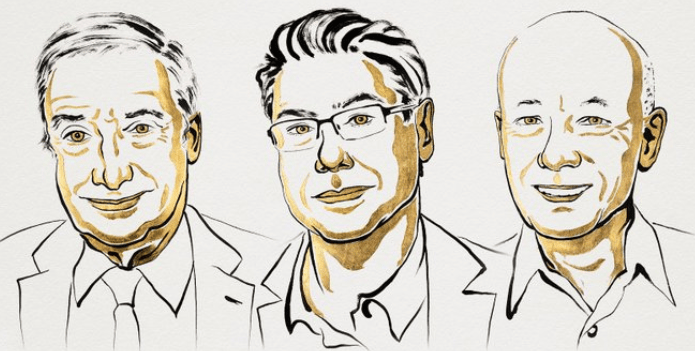
Core Insights - The Nobel Prize in Economic Sciences for 2025 was awarded to economists Joel Mokyr, Philippe Aghion, and Peter Howitt for their contributions to the theory of innovation-driven economic growth [1][3] - Their research emphasizes that the true secret to market prosperity lies in innovation and entrepreneurship, challenging the notion that stronger distribution methods are the solution to current economic challenges [1][3] Economic Growth and Innovation - The past 200 years have seen unprecedented economic growth, primarily driven by continuous technological innovation, with the process of "creative destruction" being central to this growth [3] - Mokyr, Aghion, and Howitt have expanded on the concept of creative destruction, demonstrating that it can be quantitatively measured and is constantly occurring in the economy [3][4] Challenges to Entrepreneurship - There is a growing concern that entrepreneurial spirit is declining, particularly in Europe, where it is described as "endangered" due to regulatory and tax burdens [5] - In the United States, the number of startups has been steadily decreasing since the 1970s, indicating a worrying trend in support for new ventures [5] - The current U.S. administrations have been criticized for their reliance on bureaucratic industrial strategies and trade policies, which may stifle innovation [5] Importance of Encouraging Innovation - The Nobel laureates highlight the importance of encouraging solitary founders who experiment with ideas, as they are the true drivers of economic prosperity [5]
拥抱金融创新对AI的 托举效应
Sou Hu Cai Jing· 2025-10-15 16:28
Group 1 - The AI sector is experiencing a significant surge in capital expenditure, with companies like Oracle and AMD making substantial investments in AI infrastructure and technology [1][2] - Major players in the AI field, including Alibaba and Tencent, are increasing their capital expenditures, indicating a highly competitive environment [2] - Innovative financial models such as "equity-for-purchase" and "computing power-for-equity" are emerging to support AI capital expenditures, reflecting a strong backing from the financial system [2][4] Group 2 - The current investment risks in the AI sector can be quantified, suggesting that the potential for systemic risk is relatively low despite concerns about valuation bubbles [3] - AI is characterized as a capital-intensive industry, necessitating financial support to align transformative goals with entrepreneurial capabilities [3][4] - The integration of AI is reshaping the relationship between the real economy and the virtual economy, potentially reducing financial risks associated with disconnection between the two [3] Group 3 - The simplification of transaction processes in AI capital expenditure, such as "equity-for-purchase," reduces risk exposure and transaction costs [4] - There is a call for the financial system to enhance support for AI capital expenditures, focusing on improving capital turnover and risk management [4][6] - The establishment of efficient transaction structures is crucial for transforming existing resources into capital for AI investments, enabling smoother transitions between old and new economic models [6]
2025年诺贝尔经济学奖,藏着AI时代普通人赚钱的密码
3 6 Ke· 2025-10-15 13:18
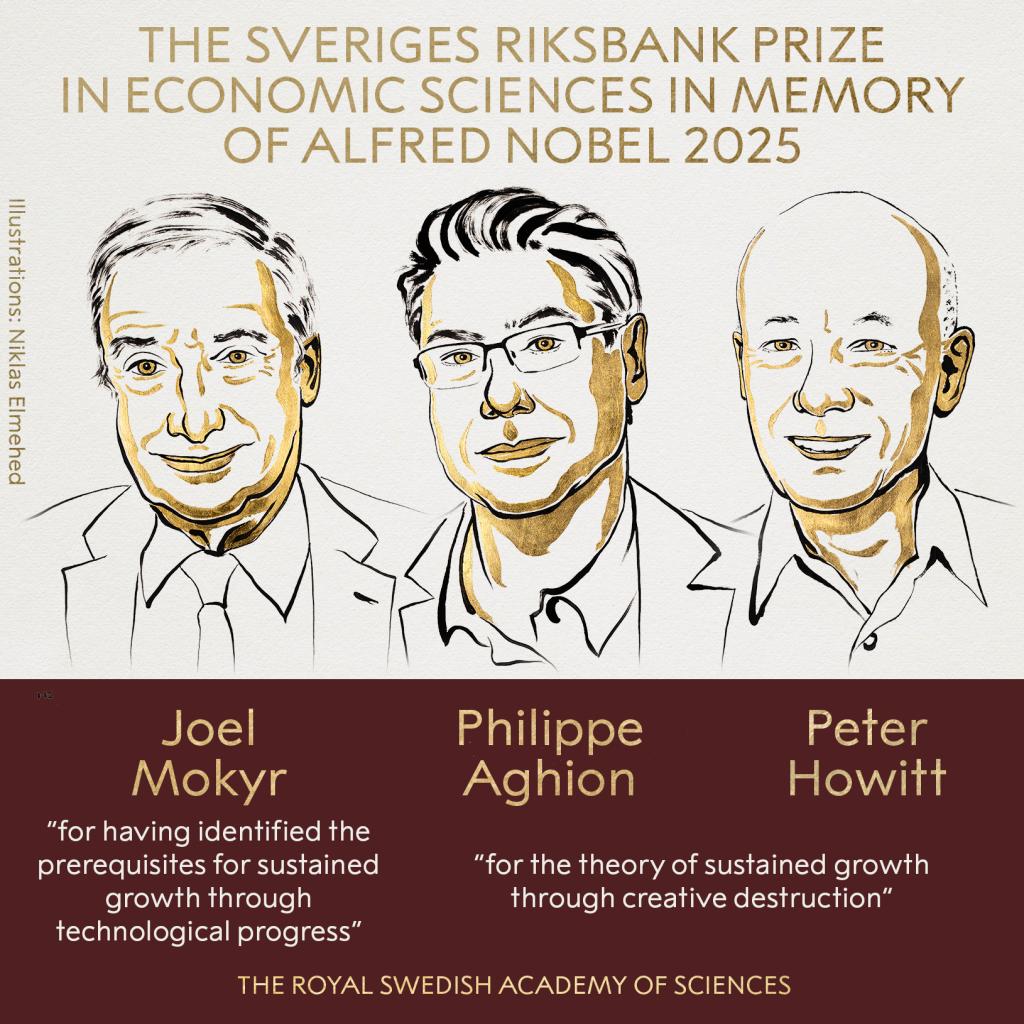
Core Insights - The Nobel Prize in Economic Sciences awarded this year emphasizes the theory of economic growth, particularly focusing on "creative destruction" as a key concept [4][6][12] - The prize is shared between Joel Mokyr, who is recognized for linking technological progress to sustained growth, and Philippe Aghion and Peter Howitt, who expanded on Joseph Schumpeter's ideas regarding creative destruction [4][6] Group 1: Creative Destruction - "Creative destruction" refers to the process where new technologies, products, or business models replace outdated economic structures, driving economic growth [9][10] - Schumpeter identified entrepreneurs as the leaders of economic development, capable of innovatively reconfiguring production factors to disrupt market equilibrium [7][9] - The dynamic imbalance created by creative destruction is essential for economic health, providing opportunities for entrepreneurs to earn excess profits [9][10] Group 2: Knowledge and Innovation - Mokyr's research highlights the profound connection between technological change and sustained economic growth, emphasizing the importance of knowledge accumulation and dissemination [13][15] - He categorizes knowledge into two types: propositional knowledge (understanding scientific principles) and procedural knowledge (practical skills to apply those principles) [13][14] - The interplay between these two types of knowledge is crucial for economic advancement, as scientific principles drive technological inventions while technical challenges stimulate scientific breakthroughs [14][15] Group 3: Implications for Individuals and Entrepreneurs - The insights from the Nobel Prize reveal that continuous innovation, knowledge accumulation, and a spirit of risk-taking are vital for sustained growth at individual, corporate, and national levels [16][17] - Entrepreneurs are encouraged to engage in "creative destruction" by breaking old rules and redefining problems, rather than merely replicating existing successful models [18][19] - Emphasizing the importance of knowledge as the foundational currency for innovation, the article suggests that entrepreneurs should adopt a mindset of experimentation and view failures as learning opportunities [23][30]
一财社论:拥抱金融创新对AI的托举效应
Di Yi Cai Jing· 2025-10-15 12:53
Core Insights - The AI investment landscape is undergoing a transformative phase characterized by significant capital expenditures and innovative financial strategies [1][2][3] Group 1: AI Capital Expenditure Trends - AI companies are exhibiting generous capital expenditures, with scales reaching trillion-dollar levels [2] - Major players like Alibaba and Tencent are increasing their capital expenditures in the AI sector, indicating intense competition [2] - Financial systems are providing robust support for the new technological revolution, with personalized financial innovations like "equity-for-purchase" and "computing power-for-equity" fueling AI capital expenditures [2][3] Group 2: Financial Innovations and Risk Management - The current investment risks in the AI sector can be quantified and regulated, suggesting a lower probability of systemic risk despite the presence of valuation bubbles [3] - Financial innovations such as "equity-for-purchase" and "computing power-for-equity" allow for direct trading between company equity and computing facilities, minimizing transaction costs and risks [4] - The financial system is inclined to support AI capital expenditures, which may accelerate the process of creative destruction in the industry [3][4] Group 3: Economic and Social Implications - AI investments are expected to lead to a comprehensive ecological reshaping of the economy and society, promoting a closer integration of the real and virtual economies [3][5] - A streamlined trading system is essential for efficiently converting existing economic resources into capital expenditures for AI, enabling countries to compete effectively in the AI landscape [5] - Expanding financial innovation space is crucial for mobilizing more economic resources into AI investments, which will not only support AI development but also shape the future of the economy and society [5]