
多模态技术

Search documents
Agent开始“卷”执行力,云厂商的钱包准备好了吗?
Di Yi Cai Jing· 2025-06-19 13:55
Group 1: Industry Trends - The large model industry is experiencing a shift from high valuations in the primary market to foundational infrastructure construction for computing power [1] - The upcoming release of GPT-5 by OpenAI will integrate o-Series and GPT-Series, emphasizing the need for strong execution and high computing power [1][4] - The demand for computing power is driven by the increasing complexity of tasks that AI agents can perform, marking a transition from passive response to active execution [4][5] Group 2: Investment and Spending - North America's major cloud providers are significantly increasing their investments in AI infrastructure, with Amazon Cloud planning to spend over $100 billion by 2025, while Microsoft and Google plan to invest $80 billion and $75 billion respectively [2] - OpenAI's Stargate project aims for a total investment of $500 billion to enhance its computing capabilities, with the first phase already underway [6] - Major cloud companies are ramping up their budgets for AI computing infrastructure, with a reported combined capital expenditure of $76.5 billion in Q1 2025, a 64% year-on-year increase [7] Group 3: Market Dynamics - The AI agent market is likened to mobile internet apps, indicating a new area for industry growth as AI begins to take on more active roles [5] - The competition among cloud service providers is intensifying, with companies adopting low-price strategies to capture market share in the AI cloud service sector [8] - The integration of AI into existing business models and the development of multi-modal technologies are also contributing to the growing demand for computing power [6]

科大讯飞回应:机器人超脑平台如何收费及未来功能升级计划
Sou Hu Cai Jing· 2025-06-18 11:13
Group 1 - The core viewpoint of the articles is that iFlytek is actively addressing investor concerns regarding its products and services, particularly the Robot Super Brain platform and the Spark Model [1][2] - iFlytek's Robot Super Brain platform utilizes a combination of audiovisual integration and advanced large model technology, offering a new interactive experience through a hardware-software integrated approach. The charging model includes both per-unit licensing and customized service fees [1] - Investors have suggested that iFlytek should provide full recordings of executive speeches and participation in various events on platforms like Weibo, Bilibili, and Douyin to keep small shareholders informed. The company expressed its commitment to optimizing communication methods while adhering to partner rules and compliance [1] Group 2 - Investors have high expectations for iFlytek's Spark Model, noting that it still lags behind GPT-3 in multimodal capabilities, particularly in complex image recognition tasks. Enhancements in these areas could lead to more personalized learning experiences [2] - iFlytek's management has committed to continuously improving the multimodal capabilities of the Spark Model by integrating algorithms, data, and application scenarios, with plans to promote the fusion of technology and application based on development progress [2]

李彦宏的电商梦,靠罗永浩们的数字人能圆吗?
Sou Hu Cai Jing· 2025-06-18 09:55
Core Insights - The digital human technology used in the live stream of Luo Yonghao has set a new record in digital human live streaming, attracting over 13 million viewers and generating a GMV of 55 million yuan, surpassing previous live streams by Luo Yonghao himself [2][3] - Baidu aims to establish Luo Yonghao's digital human as a benchmark in the e-commerce live streaming industry, leveraging AI advancements to enhance user interaction and engagement [2][8] - The cost of creating digital humans has been reduced to around 1,000 yuan, which is 80% lower than the average cost of live streaming with real hosts, indicating significant potential for scalability in the digital human market [8][10] Company Strategy - Baidu's e-commerce team has been working on the digital human project for about three weeks, focusing on refining the technology to meet Luo Yonghao's high standards for humor and interaction [3][6] - The digital human live stream is part of Baidu's broader strategy to capitalize on AI technology to transform the e-commerce landscape, with plans to enhance the capabilities of digital humans and reduce costs further [10][11] - Luo Yonghao has been appointed as the Chief Experience Officer for Baidu's e-commerce platform, indicating a deeper collaboration between him and Baidu in promoting digital human technology [10][12] Market Potential - The digital human live stream has shown promising results, with half of the live streams outperforming real hosts in terms of GMV and conversion rates, suggesting a strong market acceptance [8][10] - Baidu's digital human initiative is seen as a potential game-changer in the over 5 trillion yuan live e-commerce market, with the company aiming to attract more small and medium-sized businesses to utilize this technology [15] - The integration of digital humans into e-commerce is expected to enhance user experience and transaction efficiency, positioning Baidu to compete more effectively in the market [14][15]



从预训练到世界模型,智源借具身智能重构AI进化路径
Di Yi Cai Jing· 2025-06-07 12:41
Group 1 - The core viewpoint of the articles emphasizes the rapid development of AI and its transition from the digital world to the physical world, highlighting the importance of world models in this evolution [1][3][4] - The 2023 Zhiyuan Conference marked a shift in focus from large language models to the cultivation of world models, indicating a new phase in AI development [1][3] - The introduction of the "Wujie" series of large models by Zhiyuan represents a strategic move towards integrating AI with physical reality, showcasing advancements in multi-modal capabilities [3][4] Group 2 - The Emu3 model is a significant upgrade in multi-modal technology, simplifying the process of handling various data types and enhancing the path towards AGI (Artificial General Intelligence) [4][5] - The development of large models is still ongoing, with potential breakthroughs expected from reinforcement learning, data synthesis, and the utilization of multi-modal data [5][6] - The current challenges in embodied intelligence include a paradox where limited capabilities hinder data collection, which in turn restricts model performance [6][8] Group 3 - The industry faces issues such as poor scene generalization and task adaptability in robots, which limits their operational flexibility [9][10] - Control technologies like Model Predictive Control (MPC) have advantages but also limitations, such as being suitable only for structured environments [10] - The development of embodied large models is still in its early stages, with a lack of consensus on technical routes and the need for collaborative efforts to address foundational challenges [10]
腾讯AI,加速狂飙的这半年
雷峰网· 2025-05-27 13:15
Core Viewpoint - Tencent's AI strategy has accelerated significantly in 2023, with substantial investments and organizational restructuring leading to rapid advancements in AI model capabilities and product applications [2][19][26]. Group 1: AI Model Development - Tencent's mixed Yuan language model, TurboS, has achieved a ranking among the top eight global models, with improvements in reasoning, coding, and mathematics capabilities [6][5]. - The TurboS model has seen a 10% increase in reasoning ability, a 24% improvement in coding skills, and a 39% enhancement in competition mathematics scores [6][8]. - The mixed Yuan T1 model has also improved, with an 8% increase in competition mathematics and common-sense question answering capabilities [7]. Group 2: Multi-Modal Technology Breakthroughs - Tencent has made significant advancements in multi-modal generation technology, achieving "millisecond-level" image generation and over 95% accuracy in GenEval benchmark tests [8]. - The company has introduced a game visual generation model that enhances game art design efficiency by several times [9]. Group 3: Productization and Application - Tencent is focusing on providing tools that integrate AI capabilities into customer scenarios, rather than just offering raw models [11][12]. - The Tencent Cloud Intelligent Agent Development Platform has been upgraded to support multi-agent collaboration and zero-code development, making it easier for enterprises to implement AI solutions [12][13]. Group 4: Knowledge Base and Intelligent Agents - Tencent emphasizes the importance of knowledge bases for AI applications, as they help in efficiently collecting and categorizing enterprise knowledge [17][18]. - The company has upgraded its knowledge management product, Tencent Lexiang, to better serve enterprise needs, resulting in significant efficiency improvements for clients like Ecovacs [18]. Group 5: Acceleration Factors - The rapid development of Tencent's AI capabilities is attributed to the success of the DeepSeek model, which has catalyzed resource mobilization within the company [21][22]. - Organizational restructuring has led to the establishment of new departments focused on large language models and multi-modal models, enhancing research and product development efficiency [22][24].


谷歌IO大会点评
2025-05-21 15:14
Summary of Google I/O Conference Insights Company Overview - **Company**: Google - **Event**: Google I/O Conference - **Date**: May 21, 2025 Key Points and Arguments Industry and Competitive Landscape - Google is actively responding to challenges from competitors like ChatGPT by innovating at the application level, enhancing its AI search products significantly, with monthly active users reaching 1.5 billion [2][4] - The company has disclosed that its monthly token processing has reached 480 trillion, a 50-fold increase compared to the same period last year, far exceeding Microsoft's 50 trillion tokens [3][13] AI and Technological Advancements - Significant progress has been made in native multimodal technology, including native language understanding and updates to ImageFour, showcasing ongoing innovation in voice, audio, video, and image generation [2][6] - Google Lens app has introduced new features such as Project Xtra (renamed Jennifer Live), enabling real-time screen sharing and camera demonstrations, aimed at enhancing user experience and competing with ChatGPT [2][7] Computational Power and Ecosystem Support - To support its vast ecosystem, Google is significantly increasing its computational power, with projections of reaching 1.5 million equivalent H100 units by 2024 and 4.5 million by 2025 [2][8] - The company is integrating its ecosystem, including Android devices, Gmail, and Google Calendar, to enhance AI applications through a new feature called personal context, which utilizes user-authorized personal information [10] New AI Features and Applications - Google has launched the Action Intelligent AI agent based on the Gemini app, capable of proactively operating user phones and integrating with third-party servers via the MCP interface [2][9] - A new Chrome extension, Gmail on Chrome, allows users to view current web pages and ask questions directly, which has been fully rolled out in the U.S. [9] Future Developments - Google is developing a next-generation model known as the world model, which aims to learn and understand various aspects of the simulated world to advance robotics technology [12] - The company is also collaborating with Samsung and Qualcomm to launch a series of Android XR AI glasses, featuring capabilities like messaging, photo capture, real-time translation, and integration with Google services [11] Financial Outlook - Google's capital expenditure for the year is projected to be $75 billion, with significant growth in its cloud business [3] Additional Important Insights - The enhancements in AI search capabilities and the introduction of new features in Google Lens and the Gemini app reflect Google's strategy to maintain its competitive edge in the rapidly evolving AI landscape [4][7] - The focus on increasing computational power indicates a proactive approach to meet the growing demands of its ecosystem and user base [8]

每周一问大模型 | 基模“五强”谁最水,谁最强?
Sou Hu Cai Jing· 2025-05-19 07:26
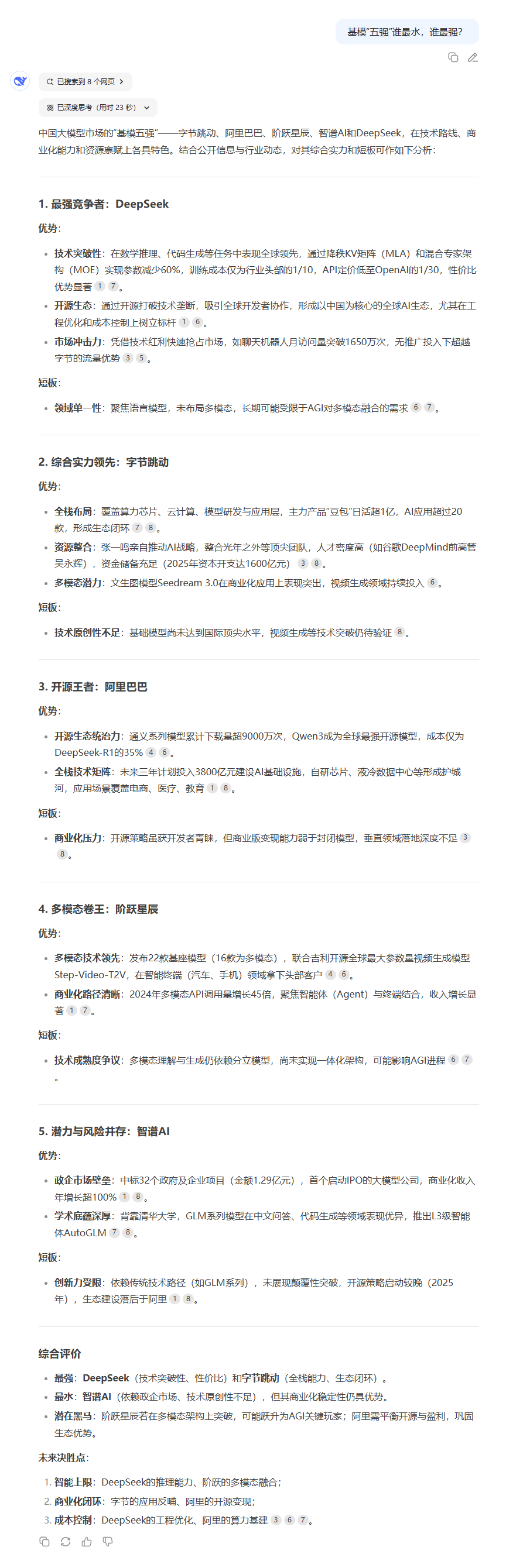
Group 1 - The core players in China's foundational model landscape are ByteDance, Alibaba, Jiyue Xingchen, Zhipu AI, and DeepSeek, collectively referred to as the "Five Strong" [1] - DeepSeek is recognized as a strong technical dark horse due to its breakthroughs in mathematical reasoning and cost-effectiveness, while ByteDance holds a comprehensive advantage with its full-stack layout and extensive user ecosystem [13][25] - Alibaba maintains its position as the king of open-source models, leveraging top-tier global open-source models and infrastructure, although it faces challenges in deepening commercialization [13][25] Group 2 - Jiyue Xingchen is noted for its multi-modal technology and rapid rise in terminal applications, but it needs to address the challenge of achieving an integrated architecture [11][25] - Zhipu AI, while having a solid presence in the government and enterprise market, is limited by its reliance on traditional technology paths and has not demonstrated disruptive breakthroughs [12][25] - The future competitive landscape will focus on three dimensions: DeepSeek's reasoning capabilities, how ByteDance and Alibaba convert their ecosystems into commercial success, and whether Jiyue Xingchen can overcome multi-modal integration challenges [16][23] Group 3 - DeepSeek excels in specialized fields like mathematical reasoning but has a relatively narrow commercial application scope, which may put it at a disadvantage in overall competition [22][25] - Zhipu AI's strong academic background is countered by its limited consumer applications and over-reliance on the B-end market, which weakens its risk resistance [22][25] - In contrast, Alibaba, ByteDance, and Jiyue Xingchen demonstrate stronger overall capabilities with tighter integration of technology and business [22][25] Group 4 - The competitive key points include the intelligence ceiling defined by model reasoning capabilities, the importance of multi-modal capabilities as a foundation for AGI, and the need for continuous validation of market acceptance for open-source ecosystems and vertical applications [23][25] - Alibaba and ByteDance are currently leading the first tier due to their comprehensive funding, ecosystem, and technology layouts, while Jiyue Xingchen shows significant potential with its multi-modal technology [23][25] - DeepSeek and Zhipu AI need to continue making breakthroughs in differentiated areas to remain competitive [23][25]

月之暗面Kimi牵手小红书,深挖场景、扩大市场营销合作
Di Yi Cai Jing· 2025-05-12 10:20
此次双方合作聚焦市场营销层面,且以小红书为主体。 挑战活动规则显示,用户需连续21天使用Kimi完成小红书热门AI任务,例如生成旅行攻略、拆解复杂知识框架或辅助创意文案等,完成任务可兑换周边礼 品及算力奖励。小红书作为以年轻用户为主的"种草"平台,据千瓜数据《2024小红书活跃用户报告》,小红书月活用户达3亿。双方的社区联动合作或为 Kimi触达C端用户、提升品牌认知提供一定助力。 C端市场中,DeepSeek爆火之前,Kimi以"支持20万字上下文"差异性技术特点与烧钱打市场策略占据先发优势。但DeepSeek推出的128k长窗口模型以更低价 格优势冲击市场,加之字节跳动豆包、腾讯元宝、阿里通义千问等大厂产品持续迭代,Kimi优势逐渐被稀释。 如今,大模型行业竞争已进入深水区,除了传统文本对话,行业逐渐侧重图像、视频、音频等多模态技术的探索与落地。另外,DeepSeek也令资本市场重 估投资逻辑,2025年的大模型一级市场维持审慎冷静态势。Kimi虽在创立初期完成多轮融资,但在一级市场投资节奏放缓、参与者更新速度加快的当下, 公司商业化压力大幅增加。行业认为,面对激烈竞争与头部企业挤压,如何将技术转化为实际 ...

突发!曝阿里通义薄列峰离职,此前为应用视觉团队负责人
是说芯语· 2025-05-08 23:32
Core Viewpoint - The article discusses the recent departure of key personnel from Alibaba's Tongyi Laboratory, particularly focusing on the implications of these changes for Alibaba's AI strategy and the competitive landscape in the tech industry [2][4]. Group 1: Personnel Changes - Bo Liefeng, the head of the application vision team at Alibaba's Tongyi Laboratory, left the company on April 30, 2023, after more than two years of service [2][6]. - His departure follows that of another senior employee, Yan Zhijie, who was the head of the voice team, indicating a trend of high-level exits from the laboratory [4][6]. - Bo Liefeng is speculated to have joined a major internet company in the U.S., possibly ByteDance or Tencent, as the vice general manager of the multimodal model department [4][6]. Group 2: Implications for Alibaba - The exit of Bo Liefeng may pose challenges for Alibaba's large model strategy, potentially slowing down the advancement of related technologies and extending product iteration cycles [4][6]. - The integration and commercialization of multimodal technologies may also be disrupted, necessitating a reassessment of commercial promotion plans [4][6]. - The competitive landscape could shift if Bo Liefeng contributes to a rival company's AI initiatives, creating additional obstacles for Alibaba's expansion in the AI sector [4][6]. Group 3: Background of Bo Liefeng - Bo Liefeng, born in 1978, holds a Ph.D. from Xi'an University of Electronic Science and Technology and has extensive experience in machine learning, deep learning, computer vision, and natural language processing [9]. - Prior to joining Alibaba, he worked at Amazon as a chief scientist, where he was instrumental in developing the Amazon Go cashier-less shopping experience [9]. - He also served as the chief scientist at JD Digital Technology Group before transitioning to Alibaba in 2022 [9].

巨头专家聊Agent与Coze
2025-04-24 01:55
Summary of Conference Call Records Company and Industry Overview - The conference call primarily discusses the developments and strategies of a low-code AI development platform, specifically focusing on the product "扣子" (Coze) and its integration with AI technologies [1][2][19]. Key Points and Arguments Product Features and Capabilities - The low-code AI platform allows for a no-code chatbot generation in 30 seconds and integrates nearly 500 plugins, ensuring user data security and privacy [1][2]. - The "扣子" product is positioned as an AI collaborative office ecosystem, utilizing the MCP protocol for automated workflows and strict data management, significantly enhancing work efficiency [1][2]. - The MCP protocol has been integrated with leading companies in finance and mapping, with 40% of capabilities developed by the company and 60% contributed by developers, ensuring data safety through a review mechanism [1][2][3]. User Engagement and Developer Ecosystem - The platform boasts over 7 million monthly active users, with more than 250,000 users from overseas, ranking it among the top five global AI development platforms [2][21]. - The developer ecosystem includes nearly 800 AI applications, with developers receiving a 70% revenue share, and over 150,000 developers have joined the platform [2][7][19]. Commercialization Strategies - Revenue generation strategies include a 30% commission on developer earnings, enterprise subscription services, customized private projects, advertising monetization, and cloud service enhancements [2][8][19]. - The platform processes over 150 million tasks daily, with peak concurrent requests reaching 100,000 per second [22]. Technological Advancements - The company is testing a multimodal model that supports text, image, and voice interactions, emphasizing image and visual understanding [1][4][18]. - The MCP protocol enhances the platform's capabilities by allowing it to execute tasks through various APIs, improving the practical application of large models [9][10][11]. Competitive Advantages - Compared to competitors, the company has a superior plugin ecosystem, multimodal capabilities, enterprise services, and a global presence, with a significant number of computing resources [19][20]. - The company plans to expand its product offerings and improve its plugin ecosystem, focusing on vertical industry solutions and enhancing its global data center capabilities [20][23]. Other Important Insights - The company anticipates a growth in its development team to nearly 800 by the end of 2025, which will enhance its market share and support for B2B enterprises [23]. - The platform's daily active user (DAU) and monthly active user (MAU) retention rates are expected to improve, with a projected monthly growth rate of 30% [23]. - The company is also exploring new product developments in the hardware sector, including AI glasses and headphones, indicating a strategic move towards integrating software and hardware solutions [34][35]. This summary encapsulates the key insights from the conference call, highlighting the company's strategic direction, product capabilities, user engagement, and competitive positioning in the AI development landscape.