
数字经济

Search documents
信息量大!五部门,重磅发声!事关民生热点
券商中国· 2026-03-07 06:29
Education Sector - China's compulsory education has reached the average level of high-income countries, with significant improvements in basic education indicators [2] - The gross enrollment rate for preschool education has reached 92.9%, an increase of 28.4 percentage points since before the 18th National Congress, surpassing the OECD average of 84.7% [3] - In the past two years, "Double First Class" universities have expanded enrollment by 38,000 students, addressing public demand for quality higher education [4] - Four key tasks will be implemented to build a fair and high-quality basic education system, including expanding quality resources, improving educational quality, enhancing teacher development, and ensuring safety in schools [5][6] Social Security and Employment - The Ministry of Civil Affairs has issued 17.2 billion yuan in elderly care service consumption vouchers, benefiting 892,000 elderly individuals [7] - Plans are in place to establish a three-tier elderly care service network by the end of the 14th Five-Year Plan [8] - The Ministry of Human Resources and Social Security is developing measures to leverage artificial intelligence for job creation and enhancing traditional roles [10] - This year, 12.7 million college graduates are expected, with initiatives to expand employment opportunities and provide skills training for various demographics [13][14] - Over 10 million subsidized vocational skills training sessions will be conducted this year, focusing on emerging industries [15] Cultural and Tourism Sector - By 2025, domestic tourist trips are expected to exceed 6.5 billion, with spending reaching 6.3 trillion yuan, marking a historical high [19] - The tourism industry will focus on smart and integrated development, enhancing service consumption through innovative products and experiences [20] - The Ministry of Culture and Tourism will address market issues such as false advertising and forced consumption, while improving service quality and safety measures [21][22] Health Sector - Approximately 33 million families have received childcare subsidies of 3,600 yuan per year for eligible infants [23] - Plans for the 14th Five-Year Plan include establishing around 1,000 tightly-knit county-level medical communities to improve healthcare continuity [24] - Key projects will be implemented in the health sector, including strengthening healthcare foundations and expanding rehabilitation services [25]


事关“校园餐”、养老、就业……五部门负责人发声
第一财经· 2026-03-07 04:39
Core Viewpoint - The press conference during the Fourth Session of the 14th National People's Congress highlighted significant advancements and initiatives in education, social welfare, human resources, culture, tourism, and health sectors in China, indicating a focus on improving public services and enhancing quality of life. Education Sector - Continuous efforts are being made to address issues such as illegal schooling, excessive study hours, and campus bullying, alongside special governance on "campus meals" and educational materials procurement [4] - The gross enrollment rate for preschool education has reached 92.9%, significantly higher than the OECD average [4] - The gross enrollment rate for higher education exceeds 60%, with "Double First Class" universities increasing enrollment by 38,000 students [4] - Initiatives like "15 minutes of break time" and "2 hours of physical education daily" have been implemented across all provinces [4] Social Welfare Sector - A comprehensive elderly care service network covering urban and rural areas has been preliminarily established [5] - Subsidies for elderly care services are being provided to over 892,000 elderly individuals with moderate to severe disabilities [5] - Training and development of elderly care service professionals are being prioritized, with "elderly care service workers" recognized as a new profession [5] - By the end of the 14th Five-Year Plan, efforts aim to establish a three-tier elderly care service network at the county, township, and village levels [5] Human Resources Sector - Research is underway to leverage artificial intelligence for creating new jobs and enhancing traditional roles [5] - Actions are being implemented to stabilize and expand employment in labor-intensive industries such as foreign trade, construction, and hospitality, while also tapping into the potential of the digital economy and high-end manufacturing [5] - A series of skill training programs tailored for older workers will be launched [5] - Post-holiday, the enterprise resumption rate and worker return rate have both exceeded 90% [5] - An estimated 12.7 million college graduates are expected this year, with policies being refined to support them [5] - Over 10 million subsidized vocational training sessions will be conducted this year [5] - The 48th World Skills Competition will take place in Shanghai from September 22 to 27 this year [5] Culture and Tourism Sector - Domestic travel and spending are projected to reach historical highs during the entire year of 2025 and the Spring Festival holiday of 2026 [5] - The "14th Five-Year Plan" for cultural and tourism development will be effectively implemented [5] - A zero-tolerance policy will be enforced against illegal practices such as overcharging and forced shopping by unscrupulous businesses [5] Health Sector - As of now, 33 million families have received childcare subsidies [5] - Grassroots medical and health institutions have seen a continuous increase in both the number of diagnoses and their proportion over the past five years [5] - By 2025, the average life expectancy in China is projected to reach 79.25 years [5]

中国银河证券:从“人工智能+”到“智能经济”,2026年政府工作报告科技创新工作解读
智通财经网· 2026-03-07 04:14
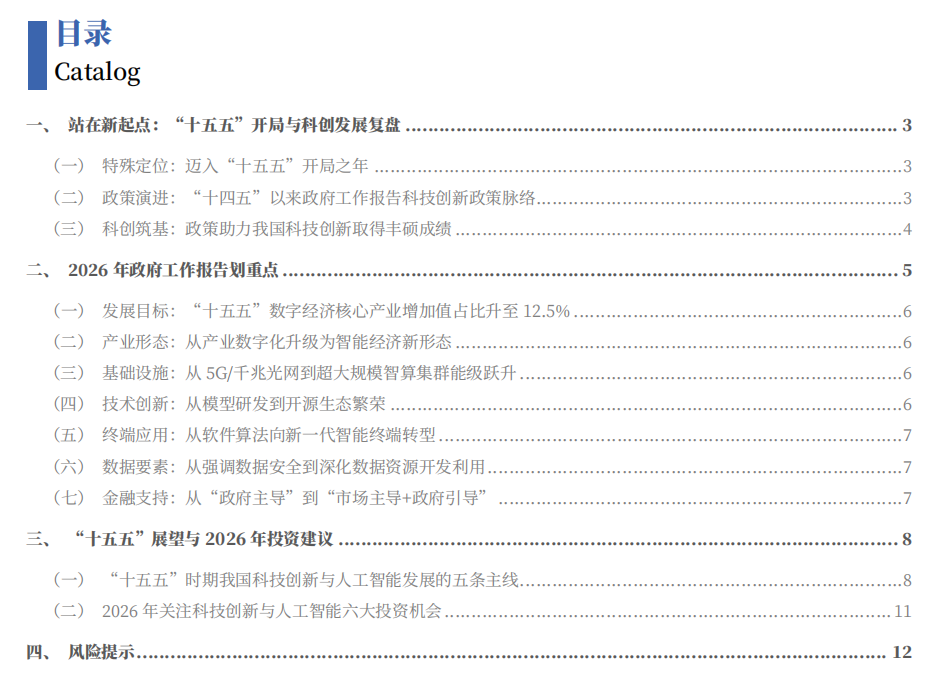
Core Insights - The 2026 government work report emphasizes the strategic task of increasing the value added of the digital economy's core industries to 12.5% of GDP, indicating a systematic policy shift towards the digital economy as a growth engine and stabilizer for the national economy [1][21] - The report introduces the concept of "intelligent economy," elevating artificial intelligence from a mere tool to a core economic form, signifying a shift in its impact on economic operations [1][22] Summary by Sections 1. Policy Evolution - The evolution of technology innovation policies since the 14th Five-Year Plan shows a clear path: initial focus on foundational infrastructure (2021-2022), followed by integration of digital technologies with traditional industries (2023-2024), and culminating in the emergence of an "intelligent economy" (2025-2026) [2][11][12] 2. Key Tasks in the 2026 Government Work Report - The report outlines ten key tasks, with a focus on nurturing new driving forces and accelerating high-level technological self-reliance, maintaining consistency with previous reports [17] - The goal of increasing the digital economy's core industries' value added to 12.5% of GDP is set, with an expected annual increase of 0.4 percentage points [21] - The transition from digitalization to an intelligent economy is highlighted, emphasizing AI as a core driver for new industries and business models [22][23] 3. Investment Opportunities in 2026 - Six major investment opportunities are identified, including AI smart terminals, computing power infrastructure, industrial digitalization, AI large models, data elements and security, and satellite internet [4][49] - The AI smart terminal market is expected to grow significantly, supported by government initiatives and consumer demand [50] - The computing power infrastructure sector is positioned as a core focus, with investments in hardware, operations, and green solutions [51] - Industrial digitalization is set to receive substantial support, with a focus on software, internet platforms, and intelligent manufacturing [52] - The AI large model sector is anticipated to see commercialization and scaling in various industries [53] - The data element market is highlighted for its potential in creating high-quality datasets and enhancing data security [54] - The satellite internet sector is recognized as a key area for investment, with a focus on manufacturing, ground equipment, and operational applications [55]

陕西“十五五”规划建议
Zhong Shang Chan Ye Yan Jiu Yuan· 2026-03-07 00:05
Investment Rating - The report does not explicitly provide an investment rating for the industry Core Insights - The "14th Five-Year Plan" period has been a significant milestone for Shaanxi's development, with a projected GDP of approximately 3.65 trillion yuan by 2025, indicating a new phase of high-quality development [7][8] - The report emphasizes the importance of innovation and the establishment of a modern industrial system, focusing on sectors such as new energy, advanced manufacturing, and strategic emerging industries [20][21] - The report outlines the need for a coordinated approach to urban and rural development, aiming to reduce disparities and enhance the quality of life for residents [19][20] Summary by Sections Section 1: Achievements and Challenges - Shaanxi has made significant progress in economic and social development during the "14th Five-Year Plan" period, with notable achievements in innovation, infrastructure, and social welfare [7][8][9] - The region faces complex challenges, including economic fluctuations and structural issues that require strategic planning and proactive measures [10][12] Section 2: Development Goals - The report sets ambitious goals for the "15th Five-Year Plan" period, focusing on high-quality development, innovation-driven growth, and enhanced public services [13][14][17] - Key targets include improving the innovation ecosystem, fostering a high-level open economy, and promoting cultural development [18][19] Section 3: Industrial Development - The report highlights the need to strengthen the modern energy industry, enhance manufacturing capabilities, and develop strategic emerging industries [21][22][23] - Emphasis is placed on the integration of culture and tourism, as well as the promotion of high-quality agricultural practices [24][26] Section 4: Innovation and Technology - The establishment of the Xi'an Regional Science and Technology Innovation Center is a priority, aiming to enhance innovation capabilities and foster collaboration between research institutions and industries [27][28] - The report advocates for the development of artificial intelligence and digital economy initiatives to drive economic transformation [27][28] Section 5: Infrastructure and Investment - The report stresses the importance of modernizing infrastructure and increasing effective investment to support economic growth [35][36] - It calls for a comprehensive approach to enhance the investment environment and promote sustainable development [37][38] Section 6: Open Economy and International Cooperation - The report emphasizes the need for deeper integration into the global economy, particularly through the Belt and Road Initiative, to expand trade and investment opportunities [42][43] - It highlights the importance of building strong international logistics and trade networks to enhance Shaanxi's role in regional and global markets [44][46]
2026年政府工作报告学习:稳中求进,科技引领
Guoxin Securities Co., Ltd· 2026-03-06 11:29
Group 1 - The core viewpoint of the report emphasizes a pragmatic and flexible economic target for 2026, with a GDP growth expectation of 4.5% to 5%, aiming for better results in practice [3][4][13] - The report outlines key tasks focusing on expanding domestic demand, nurturing new momentum, promoting reforms, improving people's livelihoods, and preventing risks [15][18] - The government aims to enhance macroeconomic governance effectiveness by integrating existing and new policies, with a focus on expanding domestic demand and boosting consumption [18][19] Group 2 - The report highlights the importance of technology innovation, with a focus on emerging industries such as quantum technology, AI, and 6G, aiming to create a new form of intelligent economy [5][21][22] - It mentions that by the end of the 14th Five-Year Plan, the core industries of the digital economy are expected to account for 12.5% of GDP, up from 10.5% in 2025 [21] - The report indicates that China has made significant advancements in AI, with the performance gap between Chinese and US AI models narrowing significantly [22][24] Group 3 - Investment recommendations suggest a focus on sectors such as AI, robotics, satellite internet, and new energy, driven by high-quality development and technological innovation [6][28] - The report anticipates that the stabilization of prices and the deepening of anti-involution measures will benefit investment in cyclical industries [28] - It notes that fluctuations in international markets may create better investment opportunities in commodities like precious metals and industrial metals [28]
2026年《政府工作报告》点评:《政府工作报告》的债市信号
Hua Yuan Zheng Quan· 2026-03-06 10:49
Report Industry Investment Rating - The report does not provide a clear industry investment rating. Core Viewpoints - The domestic supply - demand contradiction is prominent, with insufficient growth momentum in consumption and investment, and weak expectations. The 2026 economic growth is expected to be 4.5 - 5%, lower than last year. Fiscal policy remains mostly the same as last year, with an expected government bond net financing scale of 13.89 trillion yuan and a projected deficit rate of around 4%. Monetary policy is still oriented towards reserve requirement ratio and interest rate cuts, and may focus more on structural tools. In 2026, consumption subsidy support decreases while investment increases. The bond supply pressure is better than expected, and the supply - demand relationship may improve, presenting opportunities in long - term bond adjustments [2]. Summary by Relevant Content 1. Economic Environment and Goals - **Domestic and International Environment**: The external environment has a deepening impact, with geopolitical risks rising and the world economic momentum weak. Domestically, the task of transforming old and new growth drivers is arduous, the supply - demand imbalance is significant, and market expectations are weak [2][10]. - **Development Goals**: In 2026, the expected economic growth is 4.5 - 5%, the expected urban surveyed unemployment rate is around 5.5%, and the expected consumer price increase is around 2%. Other goals include balanced international payments, a grain output of about 1.4 trillion catties, and a 3.8% reduction in carbon dioxide emissions per unit of GDP [2][10]. 2. Fiscal Policy - **Budget and Deficit**: The deficit rate is expected to be around 4%, with a deficit scale of 5.89 trillion yuan, an increase of 230 billion yuan from last year. The general public budget expenditure is expected to reach 30 trillion yuan for the first time, an increase of about 1.27 trillion yuan from last year [10]. - **Bond Issuance**: The total new government bond issuance in 2026 is expected to be 11.89 trillion yuan. This includes a 1.3 - trillion - yuan ultra - long - term special treasury bond (unchanged from last year), a 0.3 - trillion - yuan special treasury bond (a decrease of 0.2 trillion yuan from last year), and 4.4 trillion yuan of local government special bonds (unchanged from last year). The expected net financing scale of government bonds is 13.89 trillion yuan (including 2 trillion yuan of special bonds for debt resolution), similar to last year's 13.84 trillion yuan [2][10]. 3. Monetary Policy - Policy Tools: The central bank will flexibly and efficiently use various policy tools such as reserve requirement ratio and interest rate cuts. It may focus more on using multiple tools to lower the comprehensive financing cost, and optimize and innovate structural monetary policy tools [2][10]. 4. Consumption Policy - **Subsidies and Support**: The support for consumer goods replacement with old ones using ultra - long - term special treasury bonds is 25 billion yuan, a decrease of 5 billion yuan from last year. A 10 - billion - yuan fiscal - financial coordinated special fund to boost domestic demand is newly established [2][10]. - **Promotion Measures**: The government will implement a special consumption promotion action, formulate income - increasing plans for urban and rural residents, promote the upgrading of commodity consumption, and expand the scope of loan interest subsidies for personal consumption loans and service - sector business entities [10]. 5. Investment Policy - **Central Budget and Special Bonds**: The central budgetary investment is planned to be 755 billion yuan, an increase of 20 billion yuan from last year. 800 billion yuan of ultra - long - term special treasury bond funds will be used for "two major" projects, and 800 billion yuan of new policy - based financial instruments will be issued [2][15]. - **Private Investment**: The government will implement policies to promote private investment, improve the long - term mechanism for private enterprises to participate in major projects, and guide private investment into new sectors [15]. 6. Industrial Policy - **Traditional Industry Upgrade**: The government will continue to promote the quality improvement of key industries, deploy major technological transformation and upgrading projects, and support large - scale equipment renewal with 200 billion yuan of ultra - long - term special treasury bonds [16]. - **New Productivity Development**: It will foster emerging pillar industries and future industries, build a mechanism for the growth of investment in future industries, and promote the development of small and medium - sized specialized and innovative enterprises [16]. - **Service Industry Expansion**: The government will deepen the integration of advanced manufacturing and modern service industries, and expand and improve the service industry [16]. 7. Other Key Areas - **Reform**: The government will strengthen anti - monopoly and anti - unfair competition, promote factor market reform, and advance fiscal, tax, and financial system reform [22]. - **Opening - up**: It will actively expand independent opening, participate in WTO reform, and promote the stable scale and optimized structure of foreign trade [22]. - **Real Estate**: The government will stabilize the real estate market through city - specific policies, promote the reform of the housing provident fund system, and explore new real - estate development models [22]. - **Risk Resolution**: It will actively resolve local government debt risks and financial risks in an orderly manner [23]. - **Rural Revitalization**: The government will consolidate and enhance the production capacity of soybeans and oilseeds, promote rural reform, and prevent large - scale poverty return [26][27]. - **Urbanization**: It will promote the citizenization of agricultural transfer population and the high - quality development of cities [27]. - **Regional Coordination**: The government will support the construction of world - class city clusters and promote the coordinated development of different regions [27]. - **Green Growth**: It will establish a national low - carbon transformation fund, promote carbon peaking and carbon neutrality, and develop green industries [28]. - **Livelihood**: The government will promote employment, improve medical insurance and social security, and support the development of the silver economy [29].
2026年政府工作报告科技创新工作解读:从“人工智能+”到“智能经济”
Yin He Zheng Quan· 2026-03-06 09:25
Group 1: Key Economic Goals - The core value added of the digital economy is targeted to reach 12.5% of GDP by 2026, up from 10.5% at the end of the 14th Five-Year Plan[10] - The digital economy's core industry value added increased from 7.8% at the end of 2020 to 10.5% by the end of 2025, achieving an average annual increase of 0.54 percentage points[25] - The government aims for an average annual increase of 0.4 percentage points in the digital economy's GDP share during the 15th Five-Year Plan[25] Group 2: Strategic Shifts in Technology and Infrastructure - The government report introduces the concept of "intelligent economy," positioning AI as a core driver for new industries and business models[26] - Infrastructure focus has shifted from 5G coverage to large-scale intelligent computing clusters and energy-efficient computing solutions[28] - The policy emphasizes the transition from model development to a thriving open-source ecosystem, aiming to lower technological barriers[29] Group 3: Investment Opportunities - Six key investment areas identified for 2026 include AI smart terminals, computing infrastructure, industrial digitalization, AI large models, data elements, and satellite internet[52] - The government plans to support the promotion of new generation smart terminals with a special bond issuance of 250 billion yuan for consumer electronics upgrades[53] - The industrial digital transformation is set to receive significant funding, with 200 billion yuan allocated for large-scale equipment updates[55]
居民收入增长和经济增长同步 拓宽居民增收渠道
Jing Ji Ri Bao· 2026-03-06 03:01
Group 1 - The government work report emphasizes the implementation of an urban and rural resident income increase plan, focusing on practical measures to boost income for low-income groups, enhance property income, and improve salary and social security systems [1] - The representative from Hunan Province highlights that the continuous optimization of the disposable income ratio for urban and rural residents lays a solid foundation for high-quality economic and social development [1] - To encourage consumption, it is essential for families to have savings for education and risk prevention, along with expectations and confidence in income growth, creating a virtuous cycle between income growth and consumption [1] Group 2 - The representative advocates for systematic policies to empower rural residents, activating the endogenous motivation for rural development and ensuring farmers share in the benefits of industrial development [2] - Strategies include developing moderately scaled agricultural operations, new rural collective economies, and enhancing rural specialty industries, while improving the interest connection mechanism between farmers and agriculture to ensure stable and continuous income growth for farmers [2]

未知机构:高盛英维克002837SZ深圳英维克科技002837SZ202-20260306
未知机构· 2026-03-06 02:25
Summary of Key Points from the Conference Call Company Overview - **Company**: Shenzhen Invec Technology Co., Ltd. (002837.SZ) - **Industry**: Liquid Cooling Technology Core Insights and Arguments - **Order Forecast**: Management expects liquid cooling business revenue to grow sequentially from Q1 to Q4 of 2026, with some large potential orders originally scheduled for Q4 being realized in Q3 [1][4] - **Customer Expansion**: The company anticipates further customer base expansion in the second half of 2026, securing more orders, including from Google for fifth-generation CDU and circulation systems, as well as cold plate modules for an unnamed cloud service provider [4] - **NPI Progress**: Invec's new product introduction (NPI) in the ASIC supply chain is progressing faster than within the NVIDIA ecosystem, particularly in facility-level liquid cooling products [4] Capacity and Supply Chain - **Capacity Assurance**: The company reaffirms that capacity will not be a bottleneck, supported by China's comprehensive supply chain, including ample outsourcing resources and component options [2][4] - **New Capacity Development**: A new quick disconnect (QD) capacity in Zhongshan, China, is nearing completion and is expected to pass customer factory audits within 1-2 months [4] - **International Expansion Plans**: Invec plans to continue expanding capacity in Thailand and the U.S., although overseas factory production is not currently mandatory [4] Industry Context - **Global Capacity Constraints**: The liquid cooling industry is facing capacity constraints in other overseas regions [3][5] - **Market Penetration**: The penetration rate of liquid cooling technology in new AI data centers in China is expected to rise rapidly to 30%-50% by 2026, driven by the increasing thermal density of domestic AI chips [5] Investment Logic and Valuation - **Investment Rating**: The company is rated as a "Buy" due to its focus on precision temperature control technology, which enhances energy efficiency and reduces total lifecycle costs [6] - **Market Growth Potential**: With the increasing focus on digital economy and carbon neutrality, technologies that improve energy efficiency, like precision temperature control, are expected to see broader applications [6] - **Future Market Share**: Invec is projected to capture 7% of the global server liquid cooling market by 2028, increasing to 10% by 2030 [6] - **Target Price**: The 12-month target price is set at RMB 118.6, based on a forecasted P/E ratio of 42 times for 2028 [6] Risks - **Potential Risks**: - Delays in R&D or business development with core clients [6] - Increased competition in the liquid cooling sector and pressure on profit margins [6] - Fluctuations in demand for energy storage systems (ESS) [6] - Geopolitical changes impacting global supply chains for servers/data centers and energy storage systems [6]

2026年两会政策点评:锚定新蓝图,奋进新征程
Changjiang Securities· 2026-03-06 02:16
Economic Goals - The GDP growth target for 2026 is set between 4.5% and 5%[6] - The budget deficit is proposed to be around 4%, amounting to approximately 5.89 trillion yuan[6] - The urban unemployment rate is targeted at around 5.5%[6] Policy Focus Areas - Emphasis on technological innovation with an annual R&D expenditure growth of over 7%[7] - The digital economy's core industry value-added ratio is expected to rise to 12.5%[7] - A commitment to reducing carbon emissions per unit of GDP by approximately 3.8%[6] Market Strategy - Focus on four main lines: resource sectors influenced by geopolitical tensions, upgrading key industries like chemicals and machinery, AI infrastructure and hard technology, and service consumption sectors like aviation and hotels[2][9] - The capital market is expected to benefit from policies supporting technological innovation and industrial upgrades, particularly in green and digital economies[7][25] Calendar Effect on A-shares - Historically, A-shares exhibit a calendar effect around the Two Sessions, typically showing an "upward-shock-rebound" pattern[8][27] - Small-cap stocks tend to outperform large-cap stocks before the Two Sessions, while consumer sectors may show significant recovery post-meeting[8][29] Risk Factors - Potential geopolitical risks exceeding expectations[10] - Policy implementation may not meet anticipated outcomes[10] - Macroeconomic performance could fall short of expectations[10]