
权益资产配置

Search documents
首批基金2025年中期报告出炉
Sou Hu Cai Jing· 2025-08-28 00:44
Group 1 - The first batch of mutual fund mid-term reports for 2025 has been released, with several fund managers including Ruiyuan Fund, Galaxy Fund, Zhonggeng Fund, and Nanhua Fund disclosing their reports [1] - Ruiyuan Growth Value Mixed Fund, managed by Fu Pengbo, has hidden heavy holdings in stocks such as BQ Materials, Sunny Optical Technology, Guanghui Energy, Innovent Biologics, Alibaba-W, BYD, Dongshan Precision, Bluestar Technology, Su Da Weige, and Berthelot [1] - Galaxy Industrial Power Mixed Fund, managed by Zheng Weishan, maintains a focus on high-end manufacturing industries, with adjustments in industry allocation but still primarily invested in electronics, computers, power equipment, new energy, communications, and machinery [1] Group 2 - The hidden heavy holdings of Galaxy Industrial Power Mixed Fund include stocks like Shunluo Electronics, Zhongke Feimeng, Shengbang Co., Jianghai Co., and Zhichun Technology, with each stock's market value accounting for over 2% of the fund's net asset value as of the end of Q2 [1] - Liu Sheng, manager of Zhonggeng Value Navigation Mixed Fund, expresses optimism about equity assets, highlighting strong business growth attributes in sectors such as pharmaceuticals, new energy, and smart electric vehicles [1] - The innovative drug sector has shown a continuous industrial trend since Q2, although some signs of bubble formation have emerged in trading, yet there are still opportunities to select undervalued companies with improving core competitiveness [1]
含权理财成增厚收益新选择 多因素助推理财资金增配权益资产
Shang Hai Zheng Quan Bao· 2025-08-27 23:53
Core Insights - The low interest rate environment and active capital markets are driving wealth management companies to increase their research on individual stocks and enhance the issuance of rights-based financial products [1][2] Group 1: Market Trends - Wealth management companies are shifting from traditional fixed-income products to a diversified asset allocation strategy, incorporating fixed income, equities, derivatives, and alternative assets to achieve stable returns across different market cycles [1][3] - The number of rights-based financial products has significantly increased, with a notable rise in equity asset allocation, currently stabilized at around 5% [1][2] - Recent data shows that the average annualized return for mixed and equity financial products has risen, with mixed products at 3.64% and equity products at 9.93% as of July [2] Group 2: Investment Strategies - Wealth management firms are increasingly focusing on individual stock research, with 22 firms conducting 207 investigations into listed companies in the past month, particularly targeting growth sectors like machinery, electronics, and pharmaceuticals [2][3] - The shift towards "fixed income + options" strategies is being adopted to slightly increase equity asset allocation in response to low interest rates [2][4] Group 3: Challenges and Opportunities - The traditional cash management and pure bond products are yielding lower returns, making it difficult for wealth management companies to meet investor expectations [4][5] - The capital market's sustained activity is enhancing the overall value of equity asset allocation, with significant trading volumes observed in the A-share market [4][5] Group 4: Research and Development - Leading wealth management companies are investing in building robust equity research capabilities, requiring time and structural support to develop a competitive edge against traditional equity players [6][7] - The focus is on creating a specialized research and risk management system to develop impactful equity products, with an emphasis on multi-asset strategies [6][7]
中国平安业绩会直击:适度加大权益资产配置
Xin Hua Cai Jing· 2025-08-27 08:36
Core Insights - China Ping An's operating profit for the first half of 2025 showed steady growth, with a strong increase of 39.8% in new business value for life and health insurance, and an interim cash dividend raised to 0.95 yuan per share [2][4][7] Group 1: Overall Performance - The operating profit attributable to shareholders reached 77.732 billion yuan, a year-on-year increase of 3.7%, while net profit was 68.047 billion yuan, a decrease of 8.8% [3] - The decline in net profit was attributed to one-time factors, including a 3.4 billion yuan loss from the consolidation of Ping An Good Doctor and the impact of convertible bonds [3][4] - Excluding these factors, the company reported a double-digit growth in profit, emphasizing the importance of focusing on operating profit rather than short-term fluctuations [3] Group 2: Business Growth - The life and health insurance segment contributed significantly to net profit, with new business value reaching 22.335 billion yuan, up 39.8% year-on-year [4] - The life insurance sector is entering a golden development period, with the silver economy expected to grow to a scale of 20 trillion yuan [4] - Recent reforms in distribution channels have led to a significant increase in new business value from non-agent channels, which now account for over 36% of the total [4] Group 3: Asset Management - As of June 30, 2025, the company's insurance fund investment portfolio exceeded 6.2 trillion yuan, reflecting an 8.2% growth since the beginning of the year [5] - The non-annualized comprehensive investment return rate was 3.1%, an increase of 0.3 percentage points year-on-year [5] - The company is increasing its equity asset allocation, focusing on growth stocks and high-dividend value stocks, while maintaining a 13% allocation to equity assets [6] Group 4: Market Confidence - The stock price of China Ping An has increased by approximately 16% year-to-date, indicating a rise in market valuation [7] - The management believes that the life insurance sector's growth potential remains significant, and the advantages of integrated finance and healthcare are becoming more apparent [7]


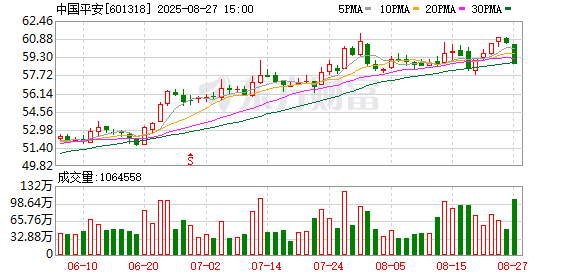
中国平安谢永林:会适度加大权益资产配置
Bei Jing Shang Bao· 2025-08-27 04:57
Group 1 - The core viewpoint of the article is that China Ping An plans to increase its allocation to equity assets, focusing on growth sectors and high-dividend value stocks [1] Group 2 - China Ping An's co-CEO, Xie Yonglin, emphasized the company's identity as patient and long-term capital [1] - The company will concentrate on two main areas: growth sectors representing new productive forces and high-dividend value stocks [1]
中国平安高管:平安作为耐心资本、长期资本,会适度加大权益资产的配置。
Xin Lang Cai Jing· 2025-08-27 04:46
Group 1 - The core viewpoint is that Ping An, as a patient and long-term capital, will moderately increase its allocation to equity assets [1] Group 2 - The company emphasizes its strategy of being a long-term investor, indicating a commitment to sustainable growth and stability in its investment approach [1]
融资融券每周观察(2025.8.18-2025.8.22)
申万宏源证券上海北京西路营业部· 2025-08-27 02:23
Market Overview - The A-share market demonstrated resilience this week, unaffected by external adjustments in overseas markets, indicating independent market behavior [15] - The Shanghai Composite Index closed at 12,166.06, up 4.57%, while the Shenzhen Component Index closed at 3,825.76, up 3.49% [4] - Average daily trading volume exceeded 25 billion yuan, marking a significant increase in market activity [15] Industry Performance - All 31 sectors in the Shenwan primary industry classification experienced gains, with no sectors declining [5] - The top three performing sectors were Communication, Electronics, and Comprehensive, while there were no sectors with negative performance [5] Financing and Margin Trading - As of August 22, the total margin trading balance in the market reached 2,155.1 billion yuan, an increase of 925 million yuan from the previous week [6] - The financing balance was 2,140.1 billion yuan, up 915 million yuan, while the margin balance increased by 9 million yuan to 14.9 billion yuan [6] Net Buying Trends - Most industries recorded positive net buying amounts, indicating strong investor interest across various sectors [7] - The top ten stocks by net financing purchases included ZTE Corporation (198.75 million yuan), SMIC (186.91 million yuan), and Cambricon Technologies (173.11 million yuan), primarily in the Communication and Electronics sectors [10] ETF Performance - The top ten ETFs by net financing purchases included the CSI 500 ETF (6.04 million yuan) and the Guotai CSI All-Share Securities Company ETF (3.99 million yuan), reflecting investor preferences for diversified exposure [11][12]

公募FOF年内平均业绩超9%
Zhong Guo Ji Jin Bao· 2025-08-24 14:09
Core Insights - The performance of Fund of Funds (FOF) has significantly improved, reaching its best state in the past five years due to market recovery [1][4] - The average performance of public FOFs has increased by 9.41% year-to-date, with nearly 40 funds showing a net value growth rate exceeding 20% [3][4] Performance Overview - As of August 22, 515 public FOFs have an average return of 9.41%, with only one product showing negative returns [3] - The top performers include Guotai's "Optimal Navigation" and "Industry Rotation A," with annual net value increases of 45.49% and 39.97%, respectively [3] Market Trends - The current market environment presents considerable investment opportunities in asset allocation and fund selection, particularly in domestic and overseas equity markets and commodities like gold [4][6] - The "stock-bond seesaw" effect is evident, with a balanced attractiveness between stocks and bonds, suggesting a cautious approach to asset allocation [6][9] Strategic Recommendations - Companies are advised to increase equity asset allocation, especially in "fixed income plus" assets, as the stock market is expected to strengthen structurally over the next three years [5][9] - The shift in FOF investment strategy from traditional fund selection to a core-satellite model focusing on ETFs is highlighted as a significant change [4][9] Asset Class Focus - Attention should be given to opportunities in commodities, Hong Kong stocks, and A-shares, with a focus on sectors like new materials and renewable energy [7][9] - The potential for a global monetary easing cycle and the impact of U.S. fiscal policies may create favorable conditions for domestic equity assets [8][9] Investment Strategy - It is recommended to avoid over-concentration in single sectors and to regularly adjust the stock-bond ratio to maintain alignment with initial risk levels [10] - Utilizing FOFs or "fixed income plus" funds can help achieve a balanced allocation across major asset classes [10]
公募FOF年内平均业绩超9%
中国基金报· 2025-08-24 14:06
Core Viewpoint - The average performance of public FOFs has exceeded 9% this year, marking the best state in nearly five years, driven by market recovery and opportunities in equity asset allocation [2][4][6]. Performance Overview - As of August 22, 515 public FOFs achieved an average performance of 9.41% this year, with only one product showing negative returns; nearly 40 FOFs recorded a cumulative net value growth rate exceeding 20% [5]. - The top performers include Guotai's "Optimal Navigation" with a 45.49% increase and "Industry Rotation A" with a 39.97% increase in net value [5]. Market Conditions - The current market environment is characterized by a significant recovery, with domestic and overseas equity markets, as well as commodities like gold, showing strong performance [6][12]. - The A-share market has seen substantial inflows, contributing to the overall positive performance of FOFs [6]. Investment Strategy - There is a shift in public FOF investment strategies from traditional fund selection to a core-satellite model focusing on ETFs, particularly in a structural bull market [7]. - The recommendation is to increase equity asset allocation, especially in "fixed income plus" assets, as the stock market is expected to strengthen structurally over the next three years [9][12]. Asset Allocation Insights - The current "stock-bond seesaw" effect indicates a balanced attractiveness between stocks and bonds, with a focus on technology growth sectors that are historically undervalued or supported by policy [9]. - The macroeconomic stability in China suggests limited upward potential for bonds, while the equity market is recovering, enhancing the risk-reward profile for equities [9][12]. Sector Opportunities - There are notable opportunities in commodities, Hong Kong stocks, and A-shares, with a focus on growth industries such as new materials and renewable energy, as well as cyclical industries like metals [11][13]. - The recommendation is to avoid over-concentration in single sectors and to regularly adjust the stock-bond ratio to maintain alignment with initial risk levels [13].

中国平安增持农业银行及中国人寿H股
Zhong Guo Ji Jin Bao· 2025-08-19 10:33
Core Viewpoint - China Ping An has increased its holdings in Agricultural Bank and China Life H shares, spending approximately HKD 465 million in total [1][2]. Group 1: Investment Activities - On August 13, Ping An Life purchased 26.515 million shares of Agricultural Bank H shares at an average price of HKD 5.5041 per share, totaling about HKD 146 million, raising its stake from 13.99% to 14.08% [2]. - On the same day, Ping An Life also acquired 14.067 million shares of China Life H shares at an average price of HKD 22.7439 per share, costing approximately HKD 319 million, increasing its ownership from 4.99% to 5.18% [2]. - On August 18, Ping An Life disclosed its previous acquisition of China Pacific Insurance H shares on August 11, raising its stake from 4.97% to 5.1% [2]. - Ping An Life has also increased its holdings in Postal Savings Bank H shares to 15% and has over 16% in China Merchants Bank H shares as of July 29 [2]. Group 2: Market Trends - Since the beginning of the year, Ping An has been actively acquiring bank and insurance stocks, with over 30 instances of stake increases, particularly favoring undervalued, high-dividend, and stable performance sectors [3][4]. - The insurance sector's allocation to stock assets has reached its highest level in recent years, with insurance funds' investment balance at CNY 36.23 trillion, a 3.73% increase from the previous quarter [5]. - The funds allocated to stocks increased to CNY 3.07 trillion, an 8.9% rise from CNY 2.81 trillion in the previous quarter, indicating a net purchase of approximately CNY 640 billion in the first half of the year, a 78% increase compared to the second half of last year [5].


兴银基金刘帆:指数化投资迎来“风口”
Shang Hai Zheng Quan Bao· 2025-08-17 13:36
Core Insights - Index investment is experiencing a significant surge, with pure index fund assets surpassing 4 trillion yuan in Q2, reflecting a 7.4% increase from Q1, driven by changes in resident asset allocation and the inherent advantages of index products [1][2]. Group 1: Market Trends - The shift in resident asset allocation is characterized by an increase in risk appetite, a trend referred to as "deposit migration," and a rising demand for quality equity assets [2][4]. - The number of aggressive risk-tolerant individual investors has increased by 1.25 percentage points over the past year, indicating a growing preference for higher risk-return products in a low-interest-rate environment [2]. Group 2: Product Characteristics - Index funds are becoming essential tools for asset allocation, offering benefits such as risk diversification, enhanced returns, increased transparency, and reduced management costs [2][4]. - New product categories like sci-tech bond ETFs and cross-market ETFs are emerging, providing diversified investment options and gaining market recognition [2]. Group 3: Future Growth Potential - The value of equity asset allocation is becoming increasingly evident, with index funds viewed as high-quality tools for entering the equity market [4]. - Three types of capital are expected to inject momentum into the equity market: insurance funds favoring high-dividend large-cap assets, household savings exceeding 120 trillion yuan, and foreign capital seeking stable, liquid blue-chip stocks [4][5]. Group 4: Internationalization and Foreign Investment - The increase in A-share profitability has attracted foreign investors, who prefer fundamentally strong, liquid leading stocks and passive investment strategies, thereby promoting value and index investment concepts [5][6]. - Since A-shares were first included in the MSCI Emerging Markets Index in 2018, the proportion of foreign ownership in total circulating market value has risen from approximately 1.3% in 2012 to 3.7% in 2020, with a notable acceleration post-MSCI inclusion [6][7]. Group 5: Market Evolution - The entry of long-term foreign capital has improved liquidity, pricing efficiency, and corporate governance transparency, aligning the market with international practices [7]. - As Chinese companies gain global influence, the process of foreign capital allocation to A-shares is expected to continue, leading to further innovations in product offerings and trading mechanisms [7].