汽车出口

Search documents
汽车视点丨冲击800万辆 !2026年中国汽车出口探寻新动能
Zhong Guo Jin Rong Xin Xi Wang· 2026-01-15 09:56
新华财经上海1月15日电(记者 王鹤)中国汽车出口规模再上新台阶。中国汽车工业协会14日发布数据显示,2025年全年,我国汽车出口突破700万辆,达 到709.8万辆,同比增长21.1%,其中新能源汽车出口261.5万辆,同比增长1倍,成为驱动增长的核心引擎。 "观察乘用车出口可以发现,五年前约100万辆水平,2025年约600万辆;更重要的是,五年前出口产品较低端,单车售价约10万元,如今出口单车售价可以 达到30万元。即规模显著上涨、产品快速趋向中高端化。"瑞银证券研究部总监徐宾对记者说。 中汽协预计,2026年汽车出口规模预计达到740万辆,同比增长4.3%。车百会则更为乐观,预计2026年,中国汽车出口有望冲击800万辆。 不过也有观点指出,中国汽车产业在经历了"天时、地利、人和"共同推动的出海红利期后,当前正面临多重挑战:海外市场竞争空前激烈,地缘政治带来不 确定性,本地化建厂浪潮兴起,竞争逻辑从产品出海升级为全价值链体系输出。 展望未来,市场普遍关注,汽车出口还有哪些想象空间?新动能何在? 欧盟市场或迎机遇期 中国品牌份额有望不断提升 随着国内市场增长放缓和需求饱和,海外扩张对2026年的增长前景 ...


中汽协:2025年汽车总销量增速超预期 自主乘用车市占率近七成
Jing Ji Guan Cha Wang· 2026-01-15 04:08
Core Insights - In 2025, China's automotive industry is projected to achieve a total production and sales volume of 34.53 million and 34.40 million vehicles, respectively, representing year-on-year growth of 10.4% and 9.4%, significantly exceeding the initial forecast of 3% [2] - The export of automobiles reached 7.10 million units, marking a year-on-year increase of 21.1%, also outperforming early expectations [2] - The domestic market saw a slowdown in growth in Q4 2025, particularly in December, where domestic sales declined significantly [2][3] Domestic Market Performance - In 2025, domestic sales of automobiles reached 27.30 million units, reflecting a year-on-year increase of 6.7%, while traditional fuel vehicle sales fell by 4% to 13.43 million units [3] - December 2025 saw domestic sales drop to 2.52 million units, a month-on-month decrease of 6.7% and a year-on-year decline of 15.6% [3] - The passenger vehicle segment achieved production and sales of over 30 million units, with year-on-year growth of 10.2% and 9.2% [3] New Energy Vehicle (NEV) Insights - NEV exports reached 2.62 million units in 2025, doubling year-on-year, while traditional fuel vehicle exports decreased by 2% to 4.48 million units [2] - The penetration of NEVs in the passenger vehicle market is notable, with sales of NEVs priced below 150,000 yuan showing significant growth [3] - In 2025, NEVs accounted for 50.8% of domestic vehicle sales, with NEV passenger vehicles making up 54% of passenger vehicle sales [6] Commercial Vehicle Market - The commercial vehicle market experienced growth in both domestic demand and exports, with total production and sales of 4.26 million and 4.30 million units, respectively, reflecting year-on-year growth of 12% and 10.9% [5] - NEV commercial vehicles saw a domestic sales increase of 63.7%, reaching 871,000 units [6] Future Projections - The China Automotive Industry Association forecasts total vehicle sales to reach 34.75 million units in 2026, with NEV sales projected at 1.90 million units, a year-on-year increase of 15.2% [7] - The focus for the industry is shifting towards high-quality development rather than just volume growth, emphasizing efficiency and competitive order [7]
两条主线支撑2025年汽车产销规模再创新高
Zheng Quan Ri Bao· 2026-01-14 22:46
本报记者 刘 钊 在政策支持、供给端持续丰富与基础设施改善等多重因素共同作用下,2025年我国汽车产业延续增长态 势,产销规模再创历史新高。 1月14日,中国汽车工业协会(以下简称"中汽协")举行信息发布会,会上,中汽协副秘书长陈士华发 布的2025年中国汽车销量数据显示,2025年汽车产销累计分别完成3453.1万辆和3440万辆,同比分别增 长10.4%和9.4%,产销规模连续3年保持在3000万辆以上,连续17年稳居全球第一。其中,新能源汽车 继续扮演"增长引擎",全年销量达1649万辆、同比增长28.2%,新车销量占汽车新车总销量的47.9%; 同时,汽车出口达到709.8万辆、同比增长21.1%,为行业扩张提供重要增量。 "强者恒强"态势延续 从全年走势看,2025年汽车市场实现稳健增长,核心支撑来自新能源持续放量与出口规模扩张两条主 线。去年我国汽车产销规模再创历史新高。同时,汽车国内销量达到2730.2万辆,同比增长6.7%。 新能源汽车仍为行业增长的关键驱动力。2025年新能源汽车产销分别完成1662.6万辆和1649万辆,同比 分别增长29%和28.2%,新能源新车销量占比达到47.9%,较 ...
瑞银:2030年中国汽车品牌在西欧市场占有率有望达15%
Zhong Guo Xin Wen Wang· 2026-01-14 09:57
Core Viewpoint - UBS predicts that by 2030, the market share of Chinese automotive brands in Western Europe is expected to increase from the current 5% to 15% [1] Group 1: Market Growth - Five years ago, China's passenger car export volume was approximately 1 million units, projected to reach around 6 million units by 2025, indicating significant growth [1] - The average export price of Chinese passenger cars has risen from around 100,000 RMB to approximately 300,000 RMB, reflecting a shift from low-end to mid-to-high-end products [1] Group 2: Product Diversification - Chinese automotive companies are not only exporting passenger cars but also other categories such as motorcycles, heavy trucks, and buses [1] - The integration of electric vehicle advantages along with features like autonomous driving and driver assistance has made Chinese automotive products more competitive in terms of cost-performance compared to global counterparts [1] Group 3: Strategic Collaborations - Current efforts by Chinese automotive companies to strengthen partnerships with local European firms, along with the growth of direct export volumes and local production capacity, are expected to contribute to the steady increase in market share in Western Europe [1] - Globally, the market share of Chinese automotive brands is currently at 20%, with a forecasted increase to 25% by 2030 [1]
外资机构分析师:中欧EV价格承诺指引显利好,吉利、小鹏等高欧洲敞口车企或受最大提振
Guan Cha Zhe Wang· 2026-01-14 07:15
【文/观察者网 潘昱辰 编辑/高莘】据《华尔街日报》1月13日报道,随着中欧电动汽车案磋商取得进 展、欧盟将向出口纯电动汽车的中国出口商提供关于价格承诺的通用指导,分析师认为,这一进展将对 中国汽车制造商的与市场产生积极影响。 花旗银行分析师在一份报告中写道,中欧磋商的进展可能对在欧洲有大量敞口的中国汽车制造商产生轻 微的积极影响,同时也将有助于宝马、大众和沃尔沃等欧洲车企向欧洲进口更多中国制造的汽车。不 过,这也将加剧欧洲市场的竞争,并进一步降低欧洲的生产能力。花旗同时认为,这笔交易无法以任何 方式帮助在中国的欧洲汽车制造商,因为其在中国的市场份额下降仍然是不可避免的。 星展银行分析师同样在一份报告中表示,与欧盟有业务往来的中国汽车制造商,可能会从中欧磋商的进 展中受益最多。星展表示,双方旨在解决补贴问题,而不仅仅依赖关税,通过降低关税风险,中国车企 可以提高出口竞争力,提高利润率,支持国际增长战略。包括上汽、比亚迪、小鹏、零跑和吉利在内的 公司可能会受益最多,因为它们在欧盟的敞口更大。相比之下,理想和蔚来这样专注于国内市场的企业 的影响可能较小。 分析师表示,星展首先看好的是吉利和小鹏,因为它们的销量增长 ...


中汽协:2025年我国汽车产销均超3400万辆,创历史新高
Bei Ke Cai Jing· 2026-01-14 06:29
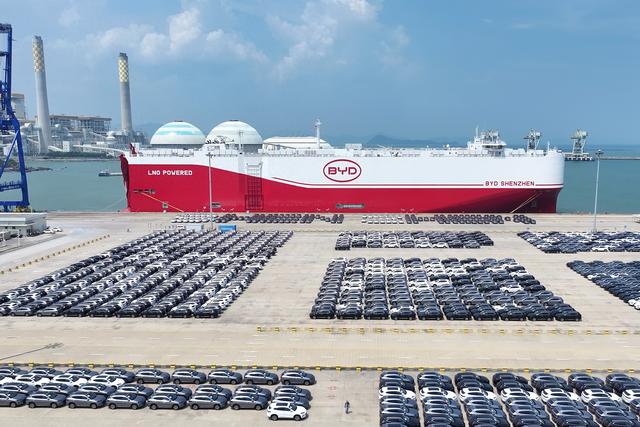
Core Insights - The China Automotive Industry Association (CAAM) reported that by 2025, China's automobile production and sales are projected to reach 34.53 million and 34.40 million units, respectively, representing year-on-year growth of 10.4% and 9.4%, exceeding earlier expectations [1] - China has maintained an annual automobile production and sales volume above 30 million units for three consecutive years, solidifying its position as the world's largest automobile market for 17 years [1] - Automobile exports are also expected to reach a record high, with projections of over 7 million units, specifically 7.098 million units, reflecting a year-on-year increase of 21.1% [1] Industry Performance - The automotive industry in China is increasingly focusing on expanding into overseas markets, with a notable improvement in the international competitiveness of Chinese brands [1] - Joint ventures are also performing well in terms of exports, contributing to the overall growth of the sector [1] - The rapid growth of new energy vehicle exports is a significant factor driving the increase in China's automobile export figures [1]
车企2025产销快报解析:四大板块齐头并进
Xin Lang Cai Jing· 2026-01-14 06:06
Core Insights - The Chinese passenger car market is projected to retail 23.78 million units in 2025, reflecting a 4% year-on-year growth, supported by policies like "trade-in" [20][21] - Major domestic automakers such as BYD, Geely, Changan, and Leap Motor have achieved significant breakthroughs, while several joint ventures are showing signs of recovery in China [20][21] Domestic Automakers Performance - BYD set a new annual sales record with 4.60 million units sold in 2025, a 7.73% increase, with pure electric vehicle sales reaching 2.25 million units, up 27.85% [21][22] - SAIC Group sold 4.51 million vehicles in 2025, marking a 12.3% increase, with its new energy vehicle sales growing by 33.1% to 1.64 million units [3][21] - China FAW achieved total vehicle sales of 3.30 million units, a 3.2% increase, with its new energy vehicle sales soaring by 71% to 366,000 units [3][22] - Geely exceeded its sales target with 3.02 million units sold, a 39% increase, and its new energy vehicle sales reached 1.69 million units, up 90% [4][22] - Changan's sales reached 2.91 million units, an 8.5% increase, with new energy vehicle sales growing by 51% to 1.11 million units [4][23] - Chery Group achieved a record high of 2.81 million units sold, with new energy vehicle sales increasing by 54.9% to 903,800 units [5][23] Joint Ventures Performance - Joint ventures are under pressure but some have found ways to adapt, with FAW-Volkswagen selling 1.59 million vehicles, maintaining its position as the top joint venture [26][27] - SAIC Volkswagen achieved sales of 1.06 million units, successfully surpassing the million mark [27] - Toyota's joint ventures in China reported positive growth, with FAW Toyota selling 805,500 units, marking three consecutive years of growth [27][28] New Energy Vehicle Market - The new energy vehicle segment is a common highlight across major automakers, with significant growth reported [21][22] - Leap Motor achieved a remarkable 103% year-on-year growth, delivering 596,600 units in 2025 [29] - Xpeng Motors delivered 429,400 units, a 126% increase, while NIO delivered 326,000 units, up 46.9% [30][31] Export Growth - China's automobile exports are expected to exceed 7 million units in 2025, marking a historic high [16][34] - Chery led the export of Chinese passenger cars with 1.34 million units, a 17.4% increase [34][35] - BYD's overseas sales surpassed 1 million units for the first time, reaching 1.05 million units, a 145% increase [35][36] Globalization Strategies - SAIC Group updated its overseas strategy, achieving 1.07 million units in overseas sales, a 3.1% increase [35][36] - Changan's overseas sales reached 637,000 units, an 18.9% increase, while Geely's overseas sales totaled 420,000 units [36][37] - New energy vehicle startups are also targeting international markets, with Leap Motor and Xpeng making significant strides in overseas deliveries [36][37]




四大板块齐头并进——车企2025产销快报解析
Zhong Guo Qi Che Bao Wang· 2026-01-13 09:43
Core Insights - The Chinese passenger car market is projected to retail 23.78 million units in 2025, reflecting a 4% year-on-year growth, supported by policies like "trade-in" [2] - Major domestic automakers such as BYD, Geely, Changan, and Leap Motor have achieved significant progress, while several joint venture companies are showing signs of recovery in China [2] Domestic Automakers Performance - BYD achieved a record annual sales of 4.60 million units in 2025, a 7.73% increase, with pure electric vehicle sales reaching 2.25 million units, up 27.85%, surpassing Tesla in global sales [3] - SAIC Group sold 4.51 million vehicles in 2025, a 12.3% increase, with its new energy vehicle sales growing by 33.1% to 1.64 million units [3] - China FAW's total vehicle sales reached 3.30 million units, a 3.2% increase, with its new energy vehicle sales soaring by 71% to 366,000 units [4] - Geely's total sales reached 3.02 million units, a 39% increase, with new energy vehicle sales hitting 1.69 million units, up 90% [4] - Changan's sales reached 2.91 million units, an 8.5% increase, with new energy vehicle sales growing by 51% to 1.11 million units [5] - Chery Group achieved a record high of 2.81 million units sold, with new energy vehicle sales increasing by 54.9% to 903,800 units [5] Joint Venture Automakers Performance - Joint venture automakers are under pressure but some have found ways to adapt, with FAW-Volkswagen leading in sales with 1.59 million units sold [7] - SAIC Volkswagen achieved sales of 1.06 million units, maintaining a strong position in the market [8] - Toyota's joint ventures in China reported positive growth, with FAW Toyota selling 805,500 units, a 3-year consecutive growth [8] New Energy Vehicle Market - New energy vehicles are a common highlight across major domestic automakers, with significant growth in sales and market penetration [3][4][5] - New entrants like Leap Motor and NIO are also showing strong growth, with Leap Motor achieving 596,600 units sold, a 103% increase [10] - Xpeng Motors delivered 429,400 units, a 126% increase, while NIO delivered 326,000 units, a 46.9% increase [11] Export Growth - China's automobile exports are expected to exceed 7 million units in 2025, marking a historic high [13] - Chery led the export of Chinese passenger cars with 1.34 million units, a 17.4% increase [13] - BYD's overseas sales surpassed 1 million units, a 145% increase, with significant growth in Europe [14] - New energy vehicle exports are also on the rise, with companies like Leap and Xpeng expanding their international presence [16]


2025年中国乘用车销售近3000万辆,新能源销量过半
Guan Cha Zhe Wang· 2026-01-11 03:09
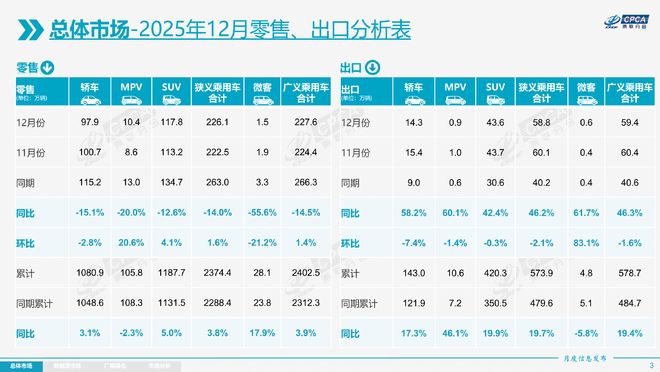
Core Insights - In 2025, China's passenger car market is projected to produce 29.63 million units, reflecting a year-on-year growth of 10.4% [1] - Wholesale sales are expected to reach 29.55 million units, up 8.8% year-on-year, while retail sales are forecasted at 23.74 million units, marking a 3.8% increase [1] Production and Sales Data - Cumulative production of new energy passenger vehicles is anticipated to be 15.35 million units, with a year-on-year growth of 26.1% [2] - Wholesale sales of new energy vehicles are projected at 15.32 million units, increasing by 25.2% year-on-year, and retail sales are expected to reach 12.81 million units, up 17.6% [2] Market Share and Brand Performance - In 2025, domestic brands are expected to capture 65% of the retail market share, an increase of 4.8 percentage points from the previous year [6] - The top ten wholesale sales rankings include BYD, Geely, Chery, Changan, FAW-Volkswagen, Great Wall, SAIC-GM-Wuling, SAIC Volkswagen, SAIC Passenger Cars, and Tesla China, with most brands (except FAW-Volkswagen, SAIC Volkswagen, and Tesla China) showing year-on-year growth [3][4] Export Trends - Passenger car exports are projected to reach 5.739 million units, reflecting a year-on-year increase of 19.7%, with new energy vehicle exports at 2.422 million units, up 86.2% [6] - The export of fuel vehicles is expected to decline by 5% [6] Market Dynamics - The penetration rate of new energy vehicles is nearing 60%, indicating a shift towards a "new energy-dominated" market phase [7] - The end of the vehicle purchase tax exemption is expected to boost new energy retail performance, achieving historical highs [6] Future Outlook - For January 2026, a slight year-on-year sales increase is anticipated due to more working days compared to the previous year [9] - New policies aimed at promoting domestic automotive consumption are expected to further stimulate sales [9]
2025车企目标达成率透视:巨头稳健、新势力分化,新能源与出口双引擎驱动
Ju Chao Zi Xun· 2026-01-09 10:11
Core Insights - The Chinese automotive market has undergone significant changes in 2025, moving away from broad high growth to a more structured competitive landscape, with increasing penetration of new energy vehicles (NEVs) and a shift in the importance of overseas markets from a strategic option to a core pillar for survival and development [2] Group 1: Annual Goals and Performance - BYD demonstrated strong resilience, achieving a sales target of 460.24 million units, which is a 100.05% target achievement rate after a pragmatic adjustment from an initial goal of 550 million units [3] - Other traditional automakers like Geely (302.46 million units), SAIC Motor (450.75 million units), and Chery (280.64 million units) also met or closely approached their annual targets, indicating stability during their transformation [3] - In contrast, Li Auto's sales of 40.63 million units fell significantly short of its adjusted target of 64 million units, achieving only about 58% of its goal, highlighting challenges in product iteration and market expansion [5] Group 2: Growth Dynamics - The growth drivers for the automotive industry are clearly identified as internal growth in the NEV sector and expansion into overseas markets [9] - BYD maintained its leading position in the NEV market with sales of 460.24 million units, while new entrants like Leap Motor and Xpeng Motors achieved impressive growth rates of 103.13% and 125.88%, respectively [10] - Traditional automakers like Chery and Geely have made positive strides in transitioning to NEVs, but companies like Dongfeng and GAC face significant growth pressures due to slower transitions [12] Group 3: Export Performance - Exports have become a critical variable in determining industry rankings, with BYD's exports skyrocketing from 416,000 units in 2024 to 1,046,000 units in 2025, a growth of over 150% [12] - Chery led exports with 1,344,000 units, while SAIC Motor also surpassed 1,070,000 units in overseas sales, contributing to a total export of 4,386,800 units among the top five Chinese automakers [12] - Tesla's export growth in China was weak, with only 222,700 units exported from January to November 2025, indicating increasing competition from local brands in the international market [13] Group 4: Future Outlook - The market performance in 2025 indicates a shift from relying solely on domestic market growth to a comprehensive capability competition among automakers [15] - Strategic resilience and operational rationality are crucial, with companies like BYD successfully adjusting targets based on market feedback, while others like Xiaomi and Leap Motor are breaking through by precisely targeting niche markets [15] - The competition has evolved from mere sales volume expansion to a comprehensive comparison of technological depth, product ecosystem breadth, user operation precision, and sustainable profitability [16]