
科创板第五套上市标准

Search documents
重启五套标准,一级医药市场熬过至暗时刻?
Sou Hu Cai Jing· 2025-06-19 08:16
Core Viewpoint - The enthusiasm of investors in the pharmaceutical primary market has been reignited due to the China Securities Regulatory Commission's announcement of the "1+6" policy measures, which will support unprofitable innovative companies in listing on the Sci-Tech Innovation Board (STAR Market) [1][9]. Group 1: Policy Changes - The introduction of the "new fifth set" listing standards aims to provide a differentiated listing channel for innovative companies that are in the high R&D investment phase but have not yet achieved stable revenue [3][4]. - The "1" in the "1+6" policy refers to the establishment of a Sci-Tech Growth Layer on the STAR Market, which will include all existing and newly registered unprofitable technology companies [3]. - The fifth set of standards will expand its applicability beyond biomedicine to include sectors such as artificial intelligence, commercial aerospace, and low-altitude economy [7]. Group 2: Market Impact - The previous tightening of the STAR Market and the discounting of Hong Kong IPOs led to a significant reduction in investment activity in the pharmaceutical sector, but the reintroduction of the fifth set of standards is expected to enhance investment willingness and risk appetite in the primary market [1][2]. - Since the STAR Market's inception, 20 innovative biopharmaceutical companies have utilized the fifth set of standards for fundraising, with the total investment amount in the biopharmaceutical sector reaching a peak of $34 billion in 2021 [8]. - In 2022, the total investment in the domestic pharmaceutical industry dropped to $15.6 billion, halving compared to the previous year, and further decreased to $10.9 billion in 2023, marking a 30% year-on-year decline [8]. Group 3: Investor Sentiment - The new policies are expected to restore key listing channels for unprofitable pharmaceutical companies, thereby boosting investor confidence and attracting social capital into the biopharmaceutical sector [9]. - There are concerns about potential overheating in the market due to the execution of these policies and the resonance with market sentiment, which could lead to high valuations or share price declines for some unprofitable technology companies post-listing [9].
科创板第五套上市标准重启
Sou Hu Cai Jing· 2025-06-18 23:16
【深圳商报讯】(记者 陈燕青)6月18日,在2025陆家嘴论坛上,证监会主席吴清宣布,将在科创板重 启未盈利企业第五套上市标准,同时扩大第五套标准范围,试点引入资深专业机构投资者制度。这意味 着未盈利企业IPO将提速。 科创板第五套上市标准是2019年设立科创板时推出的创新性制度安排,旨在支持尚未盈利但具备高成长 性的科技企业上市。吴清表示,将进一步深化改革的"1+6"政策措施,统筹推进投融资综合改革和投资 者权益保护,加快构建更有利于支持全面创新的资本市场生态。 具体来看,"1"在科创板设置科创成长层,并且重启未盈利企业适用于科创板第五套标准上市,更加精 准服务技术有较大突破、持续研发投入大、商业前景广阔的优质科创企业,在强化信息披露、加强投资 者适当性管理方面作出安排。"6"就是在科创板推出6项措施,引入资深专业机构投资者的制度,面向优 质科技企业试点IPO预先审阅机制,扩大第五套标准适用范围,支持在审的未盈利企业对老股东开展增 资扩股活动,完善科创板公司再融资制度和战略投资者认定标准,增加科创板投资产品和风险管理工具 等。 去年6月19日,证监会发布的"科创板八条"提出,支持具有关键核心技术、市场潜力大 ...
金融助力科创,涌现更多“DeepSeek时刻”
2 1 Shi Ji Jing Ji Bao Dao· 2025-06-18 17:48
6月18日上午,中国证监会主席吴清在2025陆家嘴论坛上宣布,将在科创板推出深化改革的"1+6"政策措 施,更加精准服务技术有较大突破、商业前景广阔、持续研发投入大的优质科技企业。 风险资本在我国过去数十年的科技产业发展中起到重要的作用。但在2023~2024年期间,由于美联储提 高利率以及全球经济衰退风险加剧,流入我国的美元风险资本减少。与此同时,国内IPO节奏阶段性收 紧,一些企业赴美上市定价过低,港股市场中小股票流动性不足,在一定程度上影响了部分创投机构通 过IPO退出与资金回流,国内风险投资活动有所减少。 但是,在我国当前经济发展阶段,以人工智能、生物科技、商业航天、低空经济等为代表的前沿技术与 新兴产业蓬勃发展,技术突破正向市场应用加快转化,这对加快构建与之相适配的金融服务体系提出了 新的更高要求。因此,及时重启第五套上市标准并扩大适用范围,积极吸引包括社保基金、保险资金、 产业资本等在内的各类社会资本参与私募股权投资,才能更好促进科技创新和产业创新融合发展,实现 科技、资本、产业良性循环。 我国诸多初创企业在互联网革命期间最终成长为巨头,比如高盛最近推出的中国十大民营上市公司中有 一半是互联网公司 ...

第五套上市标准激发创新药企活力 19家生物医药企业科创板“落地生金”
Mei Ri Jing Ji Xin Wen· 2025-06-18 16:15
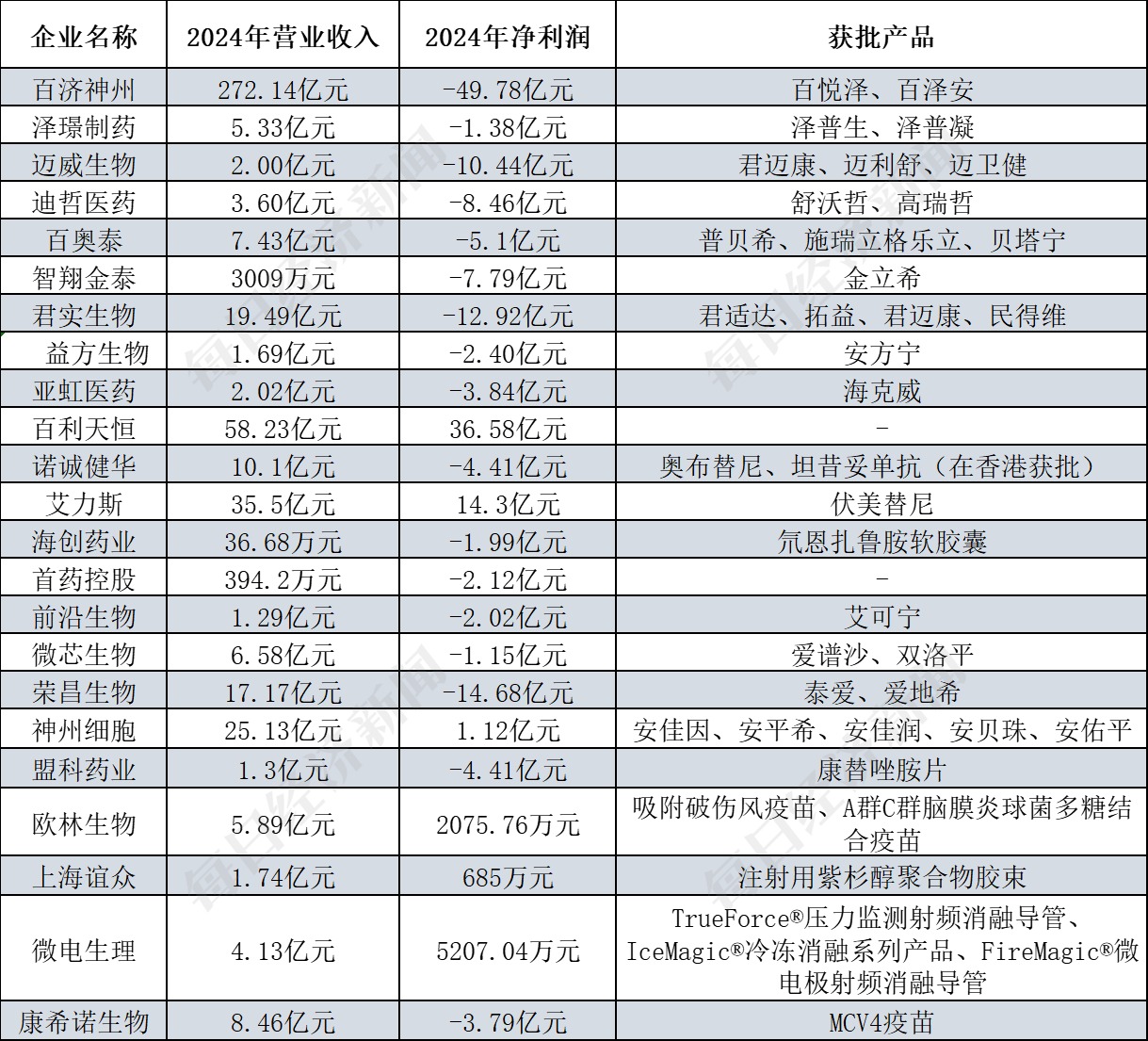
Group 1 - The China Securities Regulatory Commission (CSRC) has issued opinions on establishing a growth tier in the Sci-Tech Innovation Board (STAR Market) to enhance the inclusiveness and adaptability of the system, allowing unprofitable or loss-making companies to list [1][5] - Since the launch of the STAR Market, 54 unprofitable companies have successfully listed, with 22 of them achieving profitability post-listing, indicating a positive trend in the commercialization of innovative companies [2][3] - The STAR Market has facilitated significant fundraising for innovative biopharmaceutical companies, with 23 unprofitable firms raising nearly 700 billion yuan, which is crucial for their drug development [2][3] Group 2 - In 2024, 19 out of 20 biopharmaceutical companies that adopted the fifth listing standard achieved core product approvals, with several new drugs receiving regulatory approval [3][4] - The revenue of innovative biopharmaceutical companies is showing growth, with BeiGene reporting 272.14 billion yuan in revenue for 2024, a 56.19% increase year-on-year [3][4] - The "H+A" dual-platform operation model is becoming the preferred choice for innovative pharmaceutical companies, as the capital market plays a vital role in funding their research and development [5][6] Group 3 - The CSRC plans to deepen reforms in the STAR Market and support unprofitable innovative companies through new policies, while the Hong Kong Stock Exchange has also introduced measures to facilitate listings for biotech firms [5][6] - As of May 2025, China has become the largest country in the world for innovative drug research and development, with 3,258 projects in the pipeline, accounting for 39.1% of the global total [6]

A股或迎创新药企上市潮
21世纪经济报道· 2025-06-18 15:26
Core Viewpoint - The China Securities Regulatory Commission (CSRC) announced the implementation of the "1+6" policy measures to enhance the role of the Sci-Tech Innovation Board (STAR Market) as a "testing ground" for reforms, aiming to better support innovative companies and improve the capital market ecosystem [1]. Group 1: Policy Measures - The "1" in the "1+6" policy refers to the establishment of a Sci-Tech Growth Tier on the STAR Market, which will allow unprofitable companies to list under the fifth set of standards, targeting high-potential tech firms with significant breakthroughs and ongoing R&D investments [1]. - The "6" includes six reform measures such as introducing a professional investor system, expanding the applicability of the fifth set of standards, and improving refinancing systems for STAR Market companies [1]. Group 2: Market Environment - The STAR Market's fifth set of listing standards previously faced a "zero acceptance" situation, but the recent policy shift signals a positive change for unprofitable biotech companies, indicating a more favorable financing environment [1][4]. - Data shows that in 2024, the number of biotech companies listed on A-shares decreased significantly, with only five companies raising a total of 2.561 billion yuan, reflecting a year-on-year decline of 77.27% in the number of listings and 87.91% in total fundraising [4][6]. Group 3: Company Performance - Among the 20 companies that listed under the fifth set of standards, 19 have successfully developed 45 drugs that have been approved or are under review, showcasing strong growth potential despite market challenges [5][8]. - In 2024, these companies collectively generated revenues of 14.339 billion yuan, a staggering increase of 445% year-on-year, with several companies exceeding 1.5 billion yuan in revenue [6][7]. Group 4: International Trends - The Hong Kong Stock Exchange's "18A" listing rules have opened doors for unprofitable biotech companies, leading to a surge in mainland companies seeking IPOs in Hong Kong, with nine biotech firms raising a total of 2.525 billion yuan in 2024 [10]. - The trend of "going out" is becoming a common strategy among innovative drug companies, as they seek to navigate the current capital market challenges and explore more favorable listing environments [10][11].

科创成长层重点服务未盈利科技型企业 特点是技术有大突破、商业前景广、研发投入大
Zhong Guo Jing Ying Bao· 2025-06-18 13:42
Core Viewpoint - The China Securities Regulatory Commission (CSRC) has issued the "Opinions on Setting Up a Growth Tier in the Sci-Tech Innovation Board to Enhance Institutional Inclusiveness and Adaptability" to support unprofitable technology companies and improve the listing process for high-quality tech firms [1][2]. Group 1: Key Measures and Reforms - The establishment of the Sci-Tech Innovation Board Growth Tier aims to facilitate technology companies with significant breakthroughs and broad commercial prospects that are currently unprofitable [2]. - Six reform measures have been introduced, including the trial introduction of seasoned professional institutional investors for companies applying under the fifth listing standard, and the expansion of the applicable scope to include more frontier technology sectors such as artificial intelligence and commercial aerospace [1][2]. - The CSRC will enhance the pre-IPO review mechanism for quality tech firms to improve communication services provided by the stock exchange [1][2]. Group 2: Entry and Exit Conditions - All unprofitable technology companies will be included in the Growth Tier, with specific exit conditions based on profitability and revenue thresholds [2]. - New unprofitable companies can exit the Growth Tier if they meet certain criteria, such as achieving positive net profits for two consecutive years with a cumulative profit of no less than 50 million yuan, or having a positive net profit and revenue of at least 100 million yuan in the most recent year [2]. Group 3: Investor Protection and Regulation - The CSRC emphasizes the protection of investors' legal rights and interests, with a focus on establishing standards for seasoned professional institutional investors and enhancing disclosure requirements [2]. - A "blacklist" system will be implemented to combat illegal activities such as profit transfer and commercial corruption among institutional investors [2]. Group 4: Future Steps - The CSRC plans to work with the Shanghai Stock Exchange and relevant market participants to implement the reforms and enhance the attractiveness and competitiveness of the system [3].
【新华解读】设置科创成长层、试点IPO预审机制……科创板深耕“试验田”
Xin Hua Cai Jing· 2025-06-18 12:37
Core Viewpoint - The China Securities Regulatory Commission (CSRC) has announced a series of reforms aimed at enhancing the inclusivity and adaptability of the STAR Market, including the establishment of a "Growth Layer" for unprofitable technology companies, which will facilitate their access to capital markets [1][2][5]. Group 1: Establishment of the Growth Layer - The Growth Layer will specifically serve technology companies that have significant breakthroughs, broad commercial prospects, and substantial ongoing R&D investments but are currently unprofitable [2][3]. - All existing and newly registered unprofitable technology companies will be included in the Growth Layer, with their stock symbols marked with a "U" for identification [2][3]. - The exit criteria for the Growth Layer will be clearly defined to avoid impacting existing listed companies, ensuring a smooth transition for companies that meet profitability thresholds [2][3]. Group 2: Reopening of the Fifth Listing Standard - The reopening of the fifth listing standard for unprofitable companies is a key aspect of the reforms, allowing more technology firms to access the STAR Market [5][6]. - The new policy aims to attract high-quality technology companies that are currently unprofitable but have significant technological advancements and market potential [6][7]. - The introduction of seasoned professional institutional investors is intended to enhance the investment structure and provide better assessments of companies' technological attributes and commercial prospects [6][7]. Group 3: IPO Pre-Review Mechanism - A pilot IPO pre-review mechanism will be introduced to allow eligible companies to have their application documents reviewed before formal submission, enhancing information security and reducing exposure during the listing process [8][9]. - This mechanism aims to streamline the IPO process for technology companies engaged in critical core technology development [8][9]. Group 4: Overall Market Ecosystem Enhancement - The reforms are part of a broader strategy to create a more attractive and competitive market ecosystem that supports comprehensive innovation [10][11]. - The CSRC emphasizes the importance of integrating various capital market segments to provide diversified financing support for technology companies throughout their lifecycle [4][11]. - The focus on enhancing the role of capital markets in supporting technological innovation is expected to attract more quality investments into the sector [11][12].
科创改革再出发:扩大第五套上市标准适用范围,引入资深专业机构投资者制度
Di Yi Cai Jing· 2025-06-18 12:08
Core Viewpoint - The recent reforms in the Sci-Tech Innovation Board (STAR Market) aim to enhance the listing process for high-quality technology companies while maintaining strict entry standards for IPOs, avoiding large-scale expansions [1][2]. Group 1: Reform Measures - The STAR Market has introduced six reform measures, including expanding the applicability of the fifth listing standard, introducing a system for seasoned professional institutional investors, and supporting pre-IPO review mechanisms for quality tech firms [1][2]. - The new policies are designed to better serve technology companies with significant breakthroughs, ongoing R&D investments, and promising commercial prospects, reflecting the government's commitment to supporting tech enterprises [1][2]. Group 2: Fifth Listing Standard - The China Securities Regulatory Commission (CSRC) has resumed the application of the fifth listing standard for unprofitable companies, expanding its scope to include sectors like artificial intelligence, commercial aerospace, and low-altitude economy [2][3]. - Currently, 20 companies listed under the fifth standard are primarily in the biopharmaceutical sector, but the new reforms are expected to facilitate listings from other high-potential industries [2][3]. Group 3: Institutional Investor System - The STAR Market will pilot a system for seasoned professional institutional investors to help accurately assess the innovation attributes and commercial prospects of tech firms, addressing the challenges of evaluating high-risk, high-reward investments [4][5]. - This system aims to leverage the expertise of institutional investors to guide financial capital towards early-stage, long-term investments in hard technology [5][6]. Group 4: Pre-IPO Review Mechanism - A pre-IPO review mechanism will be trialed to allow tech companies to manage sensitive information before formal applications, reducing the risk of negative impacts on their operations during the listing process [7][8]. - The pre-review is not mandatory and does not replace the formal application process, ensuring that the existing standards and procedures for IPO reviews remain stringent [8].
“1+6”政策措施来了!科创板设置科创成长层,推出6项改革举措
Bei Jing Shang Bao· 2025-06-18 10:38
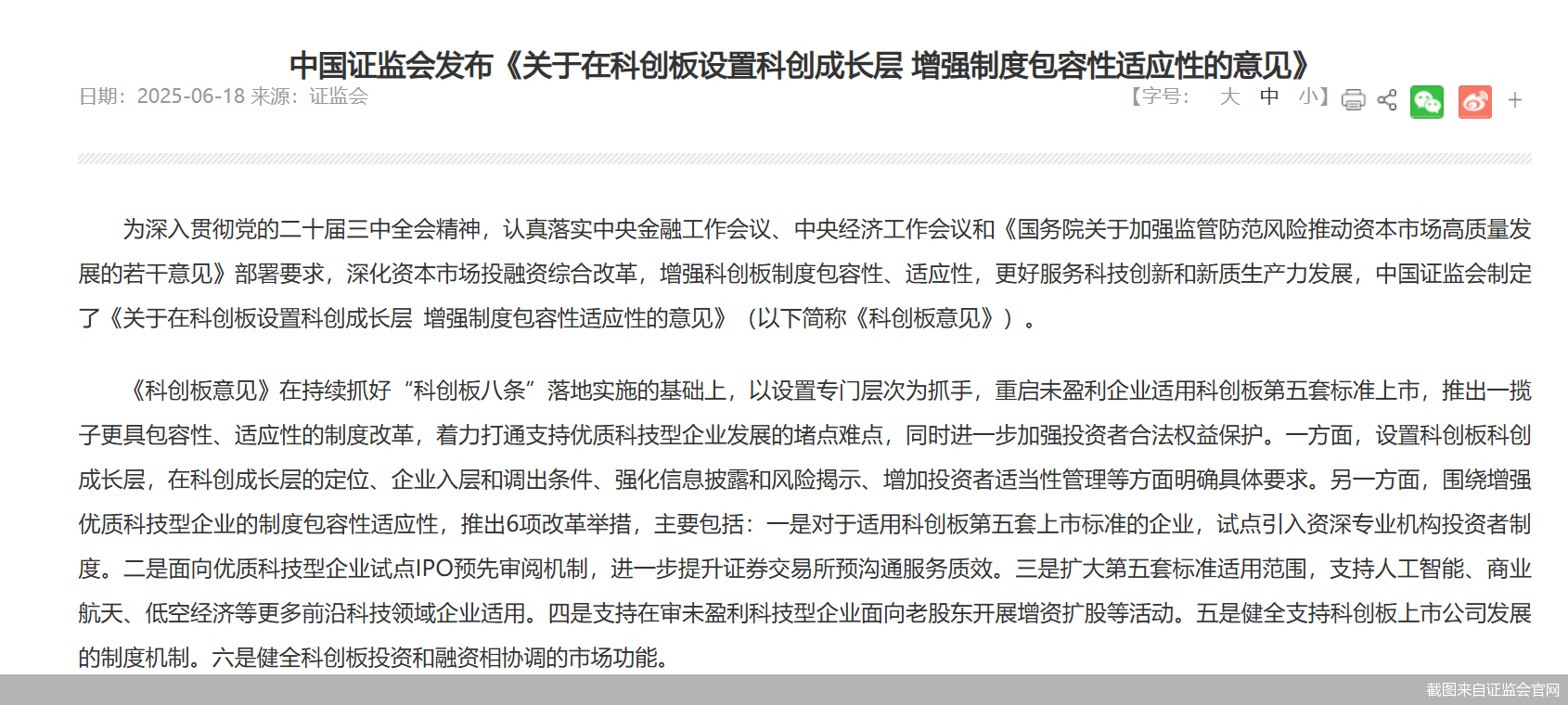
在科创板开板六年之际,科创板改革进一步深化!6月18日,在2025陆家嘴论坛上,证监会主席吴清表示,将更好发挥科创板"试验田"作用,加力推出进一 步深化改革的"1+6"政策措施。当日,"1+6"政策措施出炉,证监会发布《关于在科创板设置科创成长层 增强制度包容性适应性的意见》(以下简称《科创 板意见》),1即设置科创板科创成长层;6即围绕增强优质科技型企业的制度包容性适应性,推出6项改革举措。 设置科创板科创成长层 根据证券法规定,证券交易所可以根据证券品种、行业特点、公司规模等因素设立不同的市场层次。本次改革在科创板设置科创成长层,重点服务技术有较 大突破、商业前景广阔、持续研发投入大,但目前仍处于未盈利阶段的科技型企业。 据证监会介绍,设置科创成长层后,现有和新注册的未盈利科技型上市公司将全部纳入其中。从全球实践看,科技型企业往往经营业绩不确定性大、转盈利 周期长,资本市场服务能不能覆盖优质未盈利科技型企业,是市场各方判断制度包容性、适应性的标识性因素。在科创板设置科创成长层,一是有利于进一 步彰显资本市场支持科技创新的政策导向,稳定市场预期;二是有利于为增量制度改革提供更可控的"试验空间",可以试点一些 ...
平衡风险与包容性,科创板“0 营收”企业IPO重启
2 1 Shi Ji Jing Ji Bao Dao· 2025-06-17 03:21
Core Viewpoint - The implementation of the "K8 Measures" has led to a renewed focus on the fifth listing standard for unprofitable biotech companies on the STAR Market, aiming to enhance the financing environment for innovative drug firms and shift A-share valuation logic towards "technological value" and "commercial prospects" [1][5][15] Group 1: K8 Measures and STAR Market - The "K8 Measures" were introduced by the China Securities Regulatory Commission (CSRC) to support high-quality, unprofitable tech companies with key technologies and market potential to list on the STAR Market [1] - Since the introduction of the K8 Measures, two unprofitable hard tech companies have been accepted for listing, but the specific "Standard Five" for unprofitable innovative drug companies has yet to be activated [1][3] - The CSRC has reiterated its commitment to promoting the new cases under the fifth listing standard, which is expected to accelerate the financing pace for biotech companies [1][3] Group 2: Impact on Biotech Companies - Biotech companies, particularly innovative drug firms, face longer investment periods and greater uncertainty due to strict approval processes, making them highly dependent on capital [1][5] - The fifth listing standard has previously allowed 20 unprofitable biotech companies to list, with 19 of them successfully bringing 45 self-developed drugs/vaccines to market [3][5] - The introduction of the fifth standard has significantly shortened the capital cycle for these companies and has contributed to the prosperity of the biopharmaceutical primary market [3][5] Group 3: Commercialization and Financial Performance - As of 2024, the 20 companies that listed under the fifth standard collectively achieved revenues of 14.21 billion yuan, a year-on-year increase of 44.17%, with four companies expected to surpass 1 billion yuan in revenue in the coming years [12] - Companies like Ailis and Shenzhou Cell have reported significant revenue growth and profitability, attributing their success to continuous R&D investment and effective commercialization strategies [12][13] - The revised "STAR Market Attribute Evaluation Guidelines" for 2024 emphasize the importance of commercialization capabilities and revenue growth for companies seeking to list [11] Group 4: Future Prospects and Challenges - The market is keenly observing which companies will benefit first from the reactivation of the fifth listing standard, with five companies currently under review [14] - Companies with strong technological innovation capabilities and significant market potential are expected to be the first beneficiaries of the new standard [14][15] - The fifth listing standard presents both opportunities and challenges for unprofitable companies, requiring them to demonstrate their technological strengths and market potential despite not being profitable [15]