资产多元化

Search documents
Analysis-Asian investors flock to Gulf debt in hunt for yield and growth
Yahoo Finance· 2025-12-10 04:04
ABU DHABI/SINGAPORE, Dec 10 - Asian investors are piling into Gulf bonds and loans this year, reflecting both deepening trade and finance ties with the fast-growing region and an uncertain outlook elsewhere, including the world's top two economies, the United States and China. Bond issuance in the Middle East and North Africa region jumped 20% year-on-year to $126 billion in the first nine months of this year, according to LSEG data, with full-year records in sight both for the region and broader emergi ...
我们为何要买这么多美国国债?如果全部抛掉,会对美国有什么影响?
Sou Hu Cai Jing· 2025-12-08 18:11
Core Viewpoint - The article discusses China's significant reduction in its holdings of U.S. Treasury bonds, which have decreased from approximately $1.3 trillion in early 2022 to about $784.3 billion, reflecting a nearly 50% decline over three years. This trend raises questions about the motivations behind such a strategy and its implications for both China and the U.S. [1][3][4] Group 1: Reasons for Initial Investment in U.S. Treasury Bonds - In the mid-2000s, China's rapid economic growth and increased export trade led to a substantial influx of foreign exchange, which was optimally placed in U.S. Treasury bonds due to their status as the safest and most liquid financial assets globally [1][3]. - U.S. Treasury bonds are considered "risk-free assets" and can be easily traded in the global financial market, unlike bonds from other countries that may face liquidity issues [3]. Group 2: Recent Trends in U.S. Treasury Bond Holdings - In 2024, China reduced its holdings of U.S. Treasury bonds by $57.3 billion, continuing this trend into the first half of 2025, indicating a strategic shift in asset management [3][4]. - The current global landscape shows Japan as the largest holder of U.S. Treasury bonds at over $1.1 trillion, with China in second place and the UK in third, highlighting a changing structure in foreign ownership of U.S. debt [5]. Group 3: Motivations Behind Reducing U.S. Treasury Holdings - Risk management is a primary reason for the reduction, as geopolitical tensions have raised concerns about the potential "weaponization" of the dollar by the U.S., which could lead to asset freezes [4][9]. - Asset diversification is another motivation, with China increasing its gold reserves and investing in other dollar-denominated assets, such as U.S. corporate bonds and real estate, to mitigate risks associated with holding too much U.S. debt [5][10]. Group 4: Implications of a Large-Scale Sell-Off - If China were to sell all its U.S. Treasury bonds, it would not significantly impact the overall market due to its relatively small proportion of total U.S. debt, which exceeds $36 trillion [5][6]. - However, such a sell-off could lead to increased U.S. Treasury yields and a loss of confidence in U.S. debt, potentially triggering a market reaction where other investors might also sell off their holdings [8][9]. Group 5: Long-Term Strategy and Global Trends - China's strategy reflects a rational approach to risk management, balancing the need to maintain some dollar-denominated assets for financial stability while reducing exposure to U.S. Treasury bonds [10]. - This trend indicates a broader shift among countries to rethink their foreign exchange reserves and asset management strategies in light of rising geopolitical uncertainties [10][12].


美联储降息预期升温白银价格刷新历史新高
Sou Hu Cai Jing· 2025-12-04 08:23
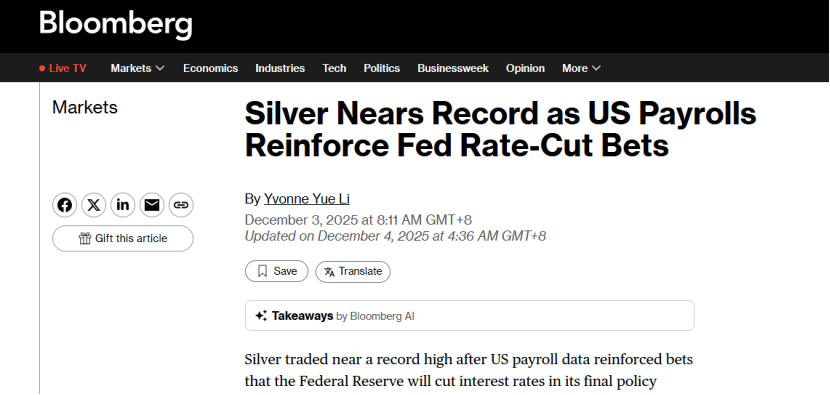
当地时间12月3日,美国公布的11月私营部门就业岗位减少3.2万个,强化了市场对美联储即将降息的预期,推动贵金 属市场走强。 其他市场方面,LME三个月期锡价格涨至2022年5月以来新高,现货黄金小幅上涨。原油市场亦受带动,WTI原油价 格涨超1%。 有市场观点认为,黄金、白银和铜等大宗商品同步上涨,反映出部分投资者正基于降息预期及对美元购买力的考量, 积极寻求资产多元化。 在降息预期与供应担忧共同作用下,基础金属市场表现更为强劲。伦敦金属交易所(LME)三个月期铜价格日内一度 涨近3%,最高至每吨11435美元,刷新历史新高。上海期货交易所沪铜主力合约也站上每吨9万元人民币关口,同步创 出纪录。 铜价剧烈波动背后,是全球供应链的紧张与库存结构的失衡。数据显示,纽约商品交易所(COMEX)铜库存已突破 40万吨,较去年底激增超过300%,占全球三大交易所总库存的比例高达62%。分析指出,COMEX与LME之间的价差 持续存在,促使大量铜库存流入美国。这一囤货行为除关税预期因素外,亦包含战略考量,降低了全球市场的流动 性,放大了区域短缺风险。 供应端的脆弱性进一步凸显。由于智利产量增长乏力、非洲项目开发滞后以及 ...
美联储降息预期升温 白银价格刷新历史新高
Huan Qiu Wang· 2025-12-04 03:52
Core Insights - The U.S. private sector employment decreased by 32,000 jobs in November, reinforcing market expectations for an imminent interest rate cut by the Federal Reserve, which has led to a surge in the precious metals market [3][9] - Silver prices reached an all-time high of $58.972 per ounce, with significant investor interest reflected in a 200-ton increase in silver-backed ETF holdings, marking the highest level since 2022 [3][9] Precious Metals Market - The expectation of interest rate cuts and supply concerns have strengthened the precious metals market, particularly silver [5] - The rise in silver prices has attracted investors, as evidenced by the substantial increase in ETF holdings [3][9] Base Metals Market - The London Metal Exchange (LME) three-month copper price surged nearly 3% to a record high of $11,435 per ton, while the Shanghai Futures Exchange's main copper contract also reached a historic level of 90,000 RMB per ton [5][11] - The volatility in copper prices is attributed to global supply chain tensions and inventory imbalances, with COMEX copper inventories exceeding 400,000 tons, a 300% increase from the previous year [5][11] - The ongoing supply chain pressures are exacerbated by factors such as stagnant production growth in Chile, delays in African project developments, and export restrictions from Indonesia [5][11] Market Dynamics - The simultaneous rise in prices of gold, silver, and copper indicates that investors are actively seeking asset diversification based on interest rate cut expectations and considerations of the dollar's purchasing power [6][12] - Morgan Stanley predicts that supply disruptions and inventory mismatches could drive copper prices to $12,500 per ton by mid-2026 [5][11]

Charlie Munger had this to say of get-rich gurus. Here's his advice to build wealth
Yahoo Finance· 2025-11-26 10:09
Core Insights - The article discusses the importance of finding trustworthy financial advisors and highlights the prevalence of misleading financial advice in the market, particularly from social media influencers [2][3]. Group 1: Financial Advisory Services - Advisor.com offers a free service to help individuals find a financial advisor tailored to their needs, ensuring they receive trustworthy guidance [1]. - A 2024 survey by the Consumer Finance Institute revealed that 28.5% of individuals seeking financial advice turned to social media, indicating a significant reliance on potentially unreliable sources [2]. Group 2: Investment Strategies - Warren Buffett and Charlie Munger advocate for passive investing strategies, arguing that most investors struggle to outperform the market, making index funds a compelling choice [5][6]. - The S&P 500 has delivered an average annual return of over 10% since its inception, reinforcing the benefits of passive investment strategies [6]. Group 3: Alternative Investment Opportunities - Real estate investing is highlighted as a solid portfolio hedge, with platforms like Arrived allowing individuals to invest in rental properties without the responsibilities of property management [12][13]. - Fine art has been noted as an investment that consistently outperforms the stock market, with some contemporary art delivering an annual return of 11.5% from 1995 to 2023, compared to the S&P 500's 9.6% during the same period [16].
美债仍具吸引力?海外持仓接近历史新高,日本大举增持
Jin Shi Shu Ju· 2025-11-19 01:29
作为美国国债最大的海外持有国,日本的持仓增加了89亿美元,至1.19万亿美元,为2022年8月以来的 最高水平。 "最让我关注的是日本的动向,"道富银行(State Street)策略师李·费里奇(Lee Ferridge)表示,"增持 美国国债可能是日元持续走弱的一个因素,也可能表明尽管日本国内收益率上升,日本投资者仍对日本 国债持谨慎态度。" 近几个月来,日元兑美元汇率持续走弱,周二跌至2月以来的最低水平,同时也是今年十国集团 (G10)货币中表现最差的币种。 英国是美国国债第二大海外持有国,其持仓减少了393亿美元,至8650亿美元。 中国作为美国国债第三大海外持有国,9月持仓较前一月微降5亿美元,至7005亿美元。市场分析师表 示,比利时的持仓中包含中国的托管账户,该国9月持仓增加了125亿美元,至4668亿美元。 海外投资者持有的美国国债在8月创下历史新高后,9月仅出现小幅回落,其中英国减持,而日本的持仓 攀升至三年多来的最高水平。 9月,外国投资者持有的美国国债总额为9.25万亿美元,8月为9.26万亿美元。持仓变化受净买卖以及估 值变动影响,彭博美国国债指数在8月和9月均有所上涨。 美国财政部周 ...
Elon Musk, Barack Obama X Account Hacker Ordered To Return $5.4 Million In Bitcoin Obtained In The Cyber Heist
Yahoo Finance· 2025-11-18 21:31
Benzinga and Yahoo Finance LLC may earn commission or revenue on some items through the links below. A person who hacked the X accounts of famous people, including former President Barack Obama and Amazon founder Jeff Bezos, has been ordered to pay back the Bitcoin (CRYPTO: BTC) gained from the crime, prosecutors said Monday. Stolen Bitcoin To Be Recovered The England and Wales’ Crown Prosecution Service said it has obtained a Civil Recovery Order to recover 42 Bitcoin and other cryptocurrencies that Jos ...
澳大利亚主权财富基金增持黄金
Di Yi Cai Jing Zi Xun· 2025-11-18 14:55
Core Viewpoint - The Future Fund of Australia highlights increasing risks of "more frequent and severe new shocks" to the global economy, prompting a shift in asset allocation towards gold, actively managed stocks, and hedge funds [1][3]. Group 1: Investment Strategies - The Future Fund has raised its allocation to gold and other commodities to provide asymmetric protection against supply-driven inflation and stagflation [3][4]. - The fund aims for long-term returns exceeding 4% to 5% above the consumer price index (CPI) while managing risk at an acceptable level [3]. - The report indicates a fundamental shift in the global investment landscape, characterized by increased uncertainty, rising inflation pressures, and heightened market volatility [3]. Group 2: Gold Demand and Price Projections - Global gold demand increased by 1% year-on-year in the first ten months of the year, reaching 3,717 tons, with a value increase of 41% to $384 billion [1]. - Goldman Sachs projects that gold prices could rise to $4,900 per ounce by the end of 2026, driven by private investors diversifying their portfolios with gold [1][6]. - Central banks are expected to continue significant gold purchases, with a projected average monthly purchase of 80 tons from Q4 2025 to 2026 [5]. Group 3: Central Bank Trends - A survey indicates that 64% of central banks plan to increase foreign exchange reserves, with 47% explicitly stating intentions to increase gold holdings as a strategic tool against geopolitical and financial risks [5]. - In the first three quarters of the year, global central bank gold demand reached 220 tons, a 28% increase from the previous quarter [5]. Group 4: Gold ETFs and Market Performance - Global physically-backed gold ETFs experienced net inflows for five consecutive months, with October's inflow reaching $8.2 billion, indicating strong annual performance [6]. - As of the end of October, total assets under management (AUM) for global gold ETFs grew by 6% to $503 billion, with holdings increasing by 1% to 3,893 tons [6]. - Major financial institutions have raised their gold price forecasts, with Bank of America projecting a target price of $5,000 per ounce by 2026 [6].

澳大利亚主权财富基金增持黄金,预警全球经济“新型冲击”风险
Di Yi Cai Jing· 2025-11-18 09:31
Core Insights - The global investment landscape is undergoing a fundamental shift, with traditional rules becoming less effective and uncertainty increasing significantly [1][4] - The Future Fund of Australia has raised its allocations to gold, actively managed stocks, and hedge funds in response to these changes [1][4] - Central banks are increasingly diversifying their reserves and increasing gold holdings as a strategic tool to hedge against geopolitical and financial risks [6] Group 1: Investment Strategies - The Future Fund aims for long-term returns exceeding 4% to 5% above the consumer price index (CPI) while managing risk at an acceptable level [4] - The fund's strategy includes reducing nominal government bond exposure, increasing inflation-linked bonds, and expanding allocations to commodities like gold to provide asymmetric protection against supply-driven inflation [4][5] - The report emphasizes that physical assets, particularly commodities, can provide strong hedging effects during periods of unexpected high inflation [5] Group 2: Gold Demand and Price Projections - Global gold demand increased by 1% year-on-year in the first ten months of the year, reaching 3,717 tons, with a value increase of 41% to $384 billion [1] - Goldman Sachs projects that gold prices could rise to $4,900 per ounce by the end of 2026, with current spot prices around $4,011 per ounce [2] - Central banks are expected to continue significant gold purchases, with a projected average monthly purchase of 80 tons from Q4 2025 to 2026 [6] Group 3: ETF Trends - Global physically-backed gold ETFs have seen net inflows for five consecutive months, with October's inflow reaching $8.2 billion, indicating strong annual performance [7] - As of the end of October, total assets under management (AUM) for global gold ETFs increased by 6% to $503 billion, with holdings rising to 3,893 tons [7] - Major financial institutions have raised their gold price forecasts, with Bank of America projecting a target price of $5,000 per ounce by 2026 [7]
中国再抛2700亿美债!累计减持达2.7万亿,中日达成一致?
Sou Hu Cai Jing· 2025-11-15 10:11
Core Viewpoint - China's recent reduction of U.S. Treasury holdings reflects deeper economic strategies and considerations, with significant implications for both domestic and global financial markets [1][3]. Group 1: China's Reduction of U.S. Treasury Holdings - In August 2025, China reduced its U.S. Treasury holdings by $270 billion, bringing its total to $780 billion, the lowest level since 2009 [1]. - Since the peak of $1.32 trillion in 2013, China has cumulatively reduced its U.S. Treasury holdings by approximately $2.7 trillion, a decline of over 60% [1][3]. - Japan, the largest holder of U.S. Treasuries, also reduced its holdings by about $185 billion in 2025, raising speculation about a coordinated reduction between China and Japan [3]. Group 2: Reasons Behind the Reduction - Concerns over asset safety are paramount, as the U.S. federal debt surpassed $37 trillion in 2025, with a debt-to-GDP ratio exceeding 130%, raising doubts about long-term repayment capabilities [3]. - The risk of U.S. dollar depreciation is significant, with the Federal Reserve having cut interest rates by 250 basis points since 2024, leading to a more than 10% decline in the dollar index over the past 18 months [3]. - There is an increasing demand for asset diversification, as China aims to optimize its foreign exchange reserve structure by increasing allocations to gold, euros, and yen [4]. - Yield considerations are also important, as the 10-year U.S. Treasury yield was around 3.2% in October 2025, while yields on bonds from emerging markets could reach 6% [4]. Group 3: Impacts on China - Reducing reliance on U.S. Treasuries and increasing allocations to gold and other assets can enhance the overall return on foreign exchange reserves and mitigate risks associated with asset concentration [5]. - Funds from the reduction of U.S. Treasuries can be redirected to invest in other sovereign bonds, equity investments, or support domestic infrastructure and key industry development [5]. - There may be short-term adjustment costs, as large-scale reductions could lead to a decline in U.S. Treasury prices, affecting the market value of remaining holdings [7]. Group 4: Impacts on the U.S. - A decrease in Chinese purchases of U.S. Treasuries could lead to higher financing costs for the U.S. government due to reduced demand [7]. - The reduction may indirectly affect trade relations between China and the U.S., although the high degree of economic complementarity suggests limited impact [7]. - The market may interpret China's actions as a signal of concerns regarding the U.S. economy or debt sustainability, potentially affecting investor confidence [7]. Group 5: Global Financial Market Implications - Large-scale reductions by China could lead to volatility in U.S. Treasury prices, influencing global asset prices and potentially triggering a "run" effect if market expectations shift [8]. - The reduction reflects a trend towards diversification of global reserve currencies, potentially accelerating changes in the international monetary system [8]. - If other major holders follow China's lead, it could result in larger market fluctuations, which is why countries typically adjust their holdings gradually [8]. Group 6: Insights for Investors - The reduction indicates a shift in the global investment environment, suggesting that investors should consider diversifying their asset allocations to mitigate systemic risks [9]. - Strategic adjustments at the national level often precede market recognition, providing insights for investors, such as China's increased gold holdings as a recognition of its value as a safe asset [9]. - The complexity of financial market changes necessitates a comprehensive analysis of various factors rather than overemphasizing a single event [10]. Group 7: Future Trends - In the short term, a moderate reduction in U.S. Treasury holdings is likely to continue, as they remain a significant part of China's foreign exchange reserves [12]. - In the medium term, China may further diversify its foreign exchange reserve structure by increasing allocations to gold and bonds from developed countries [12]. - Long-term trends may see a decreased reliance on U.S. Treasuries as the international use of the renminbi expands, with its share in global payments rising to 3.2% in the first half of 2025 [14].