
超节点

Search documents
华为AI芯片计划全盘托出!全球最强超节点+超级集群,未来2年全面领先
量子位· 2025-09-18 10:33
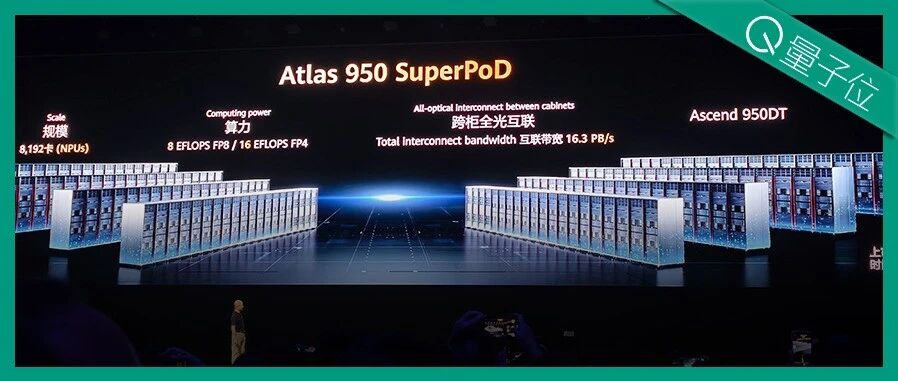
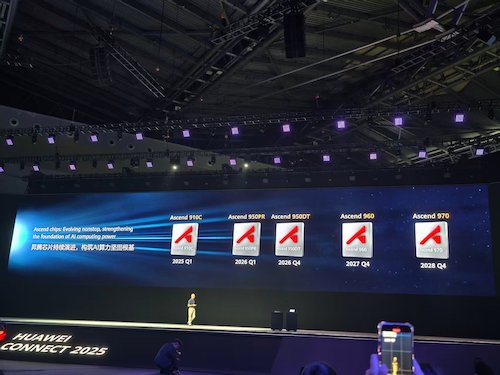
Core Viewpoint - Huawei's chip development has entered a new phase, focusing on AI computing power and advanced chip architecture to compete with global leaders like NVIDIA [1][2][3]. Group 1: Chip Development and Innovations - Huawei has introduced the Atlas 950 SuperPoD and Atlas 960 SuperPoD, which support 8192 and 15488 Ascend cards respectively, aiming to maintain the world's leading computing power [3]. - The company plans to release the Ascend 950PR in Q1 2024, adhering to a "one generation per year, doubling computing power" strategy [7]. - The Ascend 950 series, 960 series, and 970 series have been outlined for future development, with significant enhancements in performance and capabilities [8][21][24]. Group 2: Performance Metrics - The Atlas 950 SuperNode is expected to achieve 8 EFlops in FP8 computing power and 16 EFlops in FP4, with a memory capacity of 1152 TB and interconnect bandwidth of 16.3 PB/s [35]. - The Atlas 960 SuperNode will have a total throughput of 4.91 million TPS for training and 19.6 million TPS for inference, with FP8 computing power reaching 30 EFlops [42]. - The Atlas 950 SuperPlus cluster will integrate 64 Atlas 950 SuperNodes, achieving a total computing power of 524 EFlops [58]. Group 3: Strategic Positioning - Huawei acknowledges a short-term performance gap in single-chip capabilities compared to NVIDIA but aims to leverage system architecture to create supercomputers that outperform at the cluster level [5][30]. - The company emphasizes the importance of interconnect technology for large-scale supernodes, introducing the UnifiedBus interconnect protocol to enhance reliability and bandwidth [54]. - Huawei's strategy includes the development of general-purpose computing supernodes, with the TaiShan 950 supernode set to replace traditional database servers [49][50].

徐直军:华为对为人工智能发展提供充裕算力充满信心
Zheng Quan Shi Bao· 2025-09-18 10:26
Core Insights - The article emphasizes the critical role of computing power in the development of artificial intelligence (AI) and highlights Huawei's advancements in this area through the launch of powerful supernodes and clusters [1][6]. Group 1: Huawei's Supernodes and Clusters - Huawei introduced the Atlas 950 SuperPoD and Atlas 960 SuperPoD, which support 8192 and 15488 Ascend cards respectively, claiming to be the world's strongest supernodes in terms of scale, total computing power, memory capacity, and interconnect bandwidth [1][2]. - The Atlas 950 SuperCluster and Atlas 960 SuperCluster were also launched, with computing power exceeding 500,000 cards and reaching one million cards, respectively, positioning them as the strongest computing clusters globally [1][2]. Group 2: Ascend Chips and AI Strategy - The Ascend chips are foundational to Huawei's AI computing strategy, with a roadmap that includes the Ascend 950 series, Ascend 960, and Ascend 970 series, with the Ascend 950PR chip expected to launch in Q1 2026 [2][6]. - The article notes that the Ascend 910C chip, part of the Atlas 900 supernode, can achieve a maximum computing power of 300 PFLOPS, maintaining its status as the largest supernode globally [2]. Group 3: Innovations in Interconnect Technology - Huawei faced significant challenges in designing the Atlas 950 and Atlas 960 supernodes, particularly in achieving long-distance, high-reliability connections and high bandwidth with low latency [4][5]. - The company implemented innovative solutions to enhance interconnect reliability by introducing high-reliability mechanisms at various protocol layers and achieving a 100-fold increase in optical interconnect reliability [5]. Group 4: Future of AI Infrastructure - The concept of supernodes is redefining AI infrastructure, enabling a new paradigm where multiple machines function as a single entity capable of learning, reasoning, and inference [3]. - Huawei's mixed supernode architecture is positioned as a solution for next-generation generative recommendation systems, supporting high-dimensional user features and low-latency inference [3].
打造全球最强算力 华为徐直军时隔六年再谈芯片进展
Di Yi Cai Jing· 2025-09-18 08:51
Core Viewpoint - Huawei has made significant advancements in self-developed chips and AI infrastructure, showcasing its commitment to enhancing computing power for artificial intelligence applications in the coming years [1][3][5]. Group 1: Chip Development - Huawei plans to release multiple Ascend chips, including the 950PR, 950DT, and Ascend 960 and 970, with the 950PR set to launch in Q1 2026 featuring Huawei's self-developed HBM technology [1]. - The company has emphasized the importance of computing power as a key driver for artificial intelligence, particularly in the context of China's AI development [3]. Group 2: AI Infrastructure - The deployment of over 300 Cloud Matrix 384 supernodes marks a new norm in AI infrastructure, with Huawei focusing on a "supernode + cluster" computing solution to meet the growing demand for computing power [3]. - Huawei introduced the Atlas950 SuperPoD and Atlas 960 SuperPoD supernodes, supporting 8192 and 15488 Ascend cards respectively, positioning them as global leaders in key performance metrics [5]. Group 3: Technological Innovations - The launch of the TaiShan 950 SuperPoD marks Huawei's entry into general computing supernodes, aiming to replace various large and small machines as well as Exadata database systems [5]. - Huawei has overcome significant challenges in interconnecting large-scale supernodes, introducing the UnifiedBus protocol, with plans to open up the Lingqu 2.0 technology specifications in the future [5]. Group 4: Competitive Positioning - Despite facing challenges due to U.S. sanctions and limitations in chip manufacturing capabilities, Huawei leverages its extensive experience in connectivity technology to maintain a competitive edge in supernode capabilities [6].
华为官宣昇腾芯片迭代时间表
财联社· 2025-09-18 08:49
Core Viewpoint - Computing power is crucial for artificial intelligence and will continue to be a key factor for China's AI development, as stated by Huawei's rotating chairman Xu Zhijun [3]. Group 1: Huawei's Chip Development - Huawei plans to launch the Ascend 950PR chip in Q1 2026, the Ascend 950DT in Q4 2026, the Ascend 960 chip in Q4 2027, and the Ascend 970 chip in Q4 2028 [3]. - The company has introduced the Atlas 900 A3 SuperPoD, with over 300 units deployed, serving more than 20 customers, and will release the Atlas 950 SuperPoD in Q4 2026, supporting 8192 Ascend cards with a computing power of 8 EFLOPS FP8 / 16 EFLOPS FP4 [5]. Group 2: Supernode Infrastructure - Huawei is developing the Atlas 960 SuperPoD, expected to support 15488 Ascend cards with a computing power of 30 EFLOPS FP8 / 60 EFLOPS FP4, planned for Q4 2027 [7]. - The company announced the Atlas 950 SuperCluster and Atlas 960 SuperCluster, with computing power exceeding 500,000 cards and reaching one million cards, respectively [9]. Group 3: General Computing and Open Technology - Huawei revealed the roadmap for the Kunpeng chip, with the Kunpeng 950 chip set to launch in Q4 2026 and the Kunpeng 960 chip in Q1 2028 [9]. - The company introduced the TaiShan950 SuperPoD, the world's first general computing supernode, expected to launch in Q1 2026, which aims to replace various large and small machines as well as Exadata database integrated machines [9]. - Xu Zhijun announced that the supernode technology will be fully open, including the Lingqu 2.0 technology specifications, which encompass foundational, firmware, and operating system reference design specifications [9].
华为徐直军时隔六年再谈芯片进展
Di Yi Cai Jing Zi Xun· 2025-09-18 05:56
Core Insights - Huawei has unveiled multiple self-developed chip advancements at the 2025 Global Connectivity Conference, including the launch timeline for the Ascend 950PR chip in Q1 2026, which utilizes Huawei's self-developed HBM technology [2] - The concept of "super nodes" has emerged as a new norm in AI infrastructure, with over 300 Cloud Matrix 384 super nodes deployed, emphasizing the critical role of computing power in the future of artificial intelligence in China [4][5] Group 1 - Huawei's newly released Atlas950 SuperPoD and Atlas 960 SuperPoD super nodes support 8,192 and 15,488 Ascend cards respectively, showcasing global leadership in key metrics such as card scale, total computing power, memory capacity, and interconnect bandwidth [7] - The company has also introduced super node clusters, Atlas950 SuperCluster and Atlas960 SuperCluster, with computing power exceeding 500,000 cards and reaching one million cards [7] - Huawei is confident in providing sustainable and ample computing power for the long-term rapid development of artificial intelligence, leveraging the strongest computing power globally through super nodes and clusters [8] Group 2 - Huawei has pioneered the introduction of super node technology into general computing, launching the world's first general computing super node, TaiShan 950 SuperPoD, which aims to replace various large and small machines as well as Exadata database integrated machines [8] - The company has overcome significant challenges in interconnect technology for large-scale super nodes, introducing the UnifiedBus interconnect protocol, with plans to open the Lingqu 2.0 technical specifications in the future [8] - Despite facing restrictions from U.S. sanctions that limit access to TSMC for chip production, Huawei emphasizes its strengths in connectivity technology, which has been developed over 30 years, enabling the achievement of super nodes with tens of thousands of cards [8]
华为徐直军时隔六年再谈芯片进展
第一财经· 2025-09-18 05:50
Core Viewpoint - Huawei has made significant advancements in self-developed chips, planning to release multiple models in the coming years, emphasizing the importance of computing power for AI development in China [3][5]. Group 1: Chip Development - Huawei plans to launch several Ascend chips, including the 950PR in Q1 2026, utilizing self-developed HBM technology [3]. - The company has introduced the Atlas950 SuperPoD and Atlas960 SuperPoD, which support 8192 and 15488 Ascend cards respectively, showcasing global leadership in key performance metrics [7]. Group 2: AI Infrastructure - The concept of "super nodes" has become a new norm in AI infrastructure, with over 300 Cloud Matrix 384 super nodes deployed [5]. - Huawei's super node and cluster solutions, such as Atlas950 SuperCluster and Atlas960 SuperCluster, exceed 500,000 and 1 million cards in computing scale, respectively [7]. Group 3: Connectivity and Collaboration - Huawei has made breakthroughs in large-scale super node interconnection technology, introducing the UnifiedBus protocol, which will be open-sourced in the future [7]. - The company aims to build a robust foundation for AI computing needs globally, leveraging over 30 years of experience in connectivity technology [8].

昇腾AI人工智能产业峰会三大亮点抢先看
Huan Qiu Wang Zi Xun· 2025-09-16 09:23
Core Insights - Huawei's Ascend AI Summit 2025 will take place in Shanghai on September 18, 2025, focusing on the latest technological achievements and innovations in Ascend's hardware, software, and industry solutions, along with sharing successful business cases and insights from partners [1] Group 1: New Technologies - The summit will present significant advancements in Ascend's foundational hardware, software, and industry solutions, showcasing breakthroughs in ultra-node technology, comprehensive open-source software, and innovations across the entire technology chain including pre-training, post-training, and inference solutions [2] Group 2: New Directions - The summit will introduce the "Ultra-Node Development Report," which defines ultra-nodes and outlines their core characteristics, analyzing global industry evolution, stability challenges, and technological ecosystem patterns to provide clear directions for industry development [3] - Practical applications of Ascend ultra-nodes in various sectors such as internet, telecommunications, finance, energy, and manufacturing will be shared, with guest speakers from Midea discussing real-world applications and value [3] Group 3: New Value - The summit will highlight large-scale expert parallel practices across six major industries including telecommunications, government, education, finance, large models, and electricity, with a focus on innovative practices in digital finance by Postal Savings Bank [4] - New products including a large model application integrated machine and 2025 Ascend hardware partner products will be showcased, demonstrating the latest achievements and innovative directions in the Ascend ecosystem [4] - An Ascend MVP appointment ceremony will take place, inviting top industry experts and scholars to provide professional guidance and advice for the development of Ascend AI [4] Group 4: Event Highlights - The Huawei Connect 2025 will feature three major Ascend-themed forums focusing on open-source frameworks and intelligent cluster operations, showcasing how Ascend technology drives AI computing towards greater efficiency and openness [5] - The exhibition area will present the latest Ascend products and solutions, interactive demos, industry case studies, and open speeches, allowing attendees to experience advanced AI technologies and their business applications firsthand [5]
一场贯穿AI与算力全景生态的“数字开物·奇点π对”亮相2025服贸会!
Huan Qiu Wang· 2025-09-15 03:17
Core Insights - The event focused on the evolution of large model technology and its applications, including AI companionship and AI office solutions, as well as innovations in intelligent computing infrastructure and management [3][5][9]. Group 1: Large Model Technology and Applications - Large models have become the core direction of AI development, with rapid improvements in capabilities over recent years [5]. - The shift in data focus from public to private and specialized domains is necessary due to the impending exhaustion of public data [5]. - Intelligent agents are emerging as the core application model for large models, with three active product innovations: general intelligent agent development platforms, general intelligent agent applications, and task-specific intelligent agents [5]. Group 2: AI Application Revolution - AI applications are significantly enhancing office system efficiency, with companies like Sibiqi leveraging AI voice algorithms for clearer communication [9]. - Laihua Technology is creating AI companions and communication bridges, utilizing open-source models combined with industry-specific data [7]. - The integration of AI hardware and software is enabling comprehensive management from meeting execution to minutes generation [9]. Group 3: Intelligent Computing Infrastructure - The rise of large models is driving changes in server hardware and intelligent computing center infrastructure, necessitating solutions to overcome communication and memory bottlenecks [11]. - The industry is moving towards "super node" solutions that require higher physical load and advanced cooling technologies [11]. - Companies like UCloud are focusing on standardized construction and high-standard operations to support the growth of intelligent computing centers [13]. Group 4: Cooling Technology Evolution - The AI industry is evolving towards ultra-high-density clusters, making traditional cooling methods inadequate, thus liquid cooling is becoming essential [18][20]. - Innovations in liquid cooling technologies, such as immersion cooling, are being explored to meet the demands of high-power density computing [18][20]. Group 5: Industry Dialogue and Future Outlook - The roundtable discussion highlighted the potential of AI companionship applications, predicting a market value exceeding $100 billion by 2030 [23]. - The AI industry is characterized by a new "open innovation" model, with significant interconnections across the application and infrastructure layers [23]. - Challenges in global deployment of liquid cooling technology include the lack of unified standards and the need for skilled professionals [24].
电子行业点评报告:国产算力认知强化!GPU“芯片”视角向“超节点”转换
Soochow Securities· 2025-09-11 04:06
Investment Rating - The report maintains an "Overweight" rating for the electronic industry [1] Core Viewpoints - The current strength of domestic computing power is not the end of the "domestic computing power" market, but rather a preparation for a healthier rise in the next round. Recent signs indicate a potential "start" [1] - Active developments in the industry include major internet companies placing GPU orders, which fosters positive sentiment [1] - Companies are actively pursuing capital operations, such as Cambricon's fundraising approval and Haiguang's acquisition of Shuguang [2] - Major moves by downstream internet companies, such as Alibaba's strategic partnerships and AI ecosystem developments, suggest optimistic expectations for AI in the coming year [1] Summary by Sections Industry Trends - The report highlights a significant upcoming market trend driven by AI, with companies like Cambricon and Haiguang expected to open new market spaces [2] - The perspective on AI chips is shifting, with new product launches indicating a fresh evaluation framework for existing chips [2] - The report notes a strong correlation between domestic and overseas markets, with positive demand for ASICs and significant orders contributing to company valuations [2] Investment Recommendations - The report recommends focusing on companies such as Cambricon, Haiguang Information, Chipone, and Shengke Communication for investment opportunities [2] - Specific company metrics include: - Cambricon: Market cap of 532.56 billion, projected EPS growth from -1.08 to 9.62 [7] - Haiguang Information: Market cap of 427.75 billion, projected EPS growth from 0.83 to 1.85 [7] - Chipone: Market cap of 80.43 billion, projected EPS growth from -1.14 to 0.39 [7] - Shengke Communication: Market cap of 43.36 billion, projected EPS growth from -0.17 to 0.08 [7]


算力产业跟踪:超节点引领新一代算力基础设施
Changjiang Securities· 2025-08-22 15:11
Investment Rating - The industry investment rating is "Positive" and maintained [7] Core Viewpoints - Supernodes are the new generation of computing infrastructure, with leading companies in the computing industry launching supernode products to address performance bottlenecks in large model training and inference, particularly in communication speed [2][10] - The introduction of supernodes is expected to enhance the value across multiple computing segments, suggesting investment opportunities in related sectors of the industry chain [2][10] Summary by Sections Event Description - Global computing leaders like NVIDIA and Huawei are set to launch supernode products in 2025, with NVIDIA's GB200 and Huawei's Ascend 384 supernode being notable examples [4][10] - Inspur also announced its supernode AI server "Yuan Brain SD200" at the 2025 Open Computing Technology Conference, capable of running trillion-parameter models [4][10] Technical Insights - Supernodes, initially proposed by NVIDIA, utilize high-bandwidth interconnections among GPUs to form a scalable system, significantly improving computing density and communication complexity compared to traditional AI servers [10] - The architecture of supernodes supports parallel computing tasks, accelerating parameter exchange and data synchronization, thus shortening training cycles for large models [10] Investment Opportunities - The report suggests focusing on investment opportunities in the following areas: 1. Leading domestic AI chip companies like Cambricon 2. Supernode server manufacturers 3. Supporting manufacturers for supernode components such as PCBs and liquid cooling systems 4. Partners related to Huawei's supernode initiatives [10]

