
通胀控制

Search documents
欧洲降息终点将至?多位央行官员称通胀已被控制,但仍面临风险
智通财经网· 2025-06-16 09:19
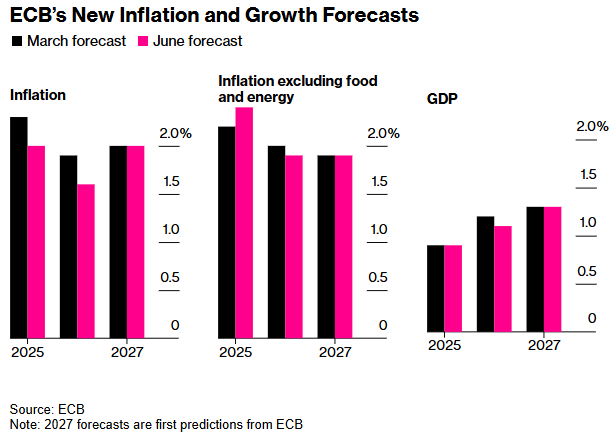
Core Viewpoint - The risk of inflation falling below the European Central Bank's (ECB) 2% target is now under control, with expectations for consumer price growth to slow to 1.4% by Q1 2026, without shaking market expectations [1] Group 1: Inflation and Monetary Policy - ECB Vice President Luis de Guindos stated that the risks of inflation declining are very limited, and the assessment indicates that inflation risks are balanced [1] - The ECB has lowered the key deposit rate from 4% to 2% over the past year, indicating the end of the easing cycle is near, as the economy shows resilience [1] - The market has understood the ECB President Lagarde's statement about being in a favorable position, believing that the goal of maintaining sustainable inflation at 2% is close [1][2] Group 2: Economic Uncertainty and Flexibility - Joachim Nagel, President of the German Central Bank, emphasized the need for flexibility in interest rate decisions due to high uncertainty in growth and inflation outlooks [2] - Nagel noted that recent data and ECB forecasts show that inflation has achieved its mission, but vigilance is necessary regarding price stability risks, particularly due to the ongoing Middle East tensions [2] Group 3: Future Projections - After a cumulative rate cut of 200 basis points within a year, policymakers are assessing whether borrowing costs have reached the cycle's endpoint or if further cuts are needed [6] - The eurozone's inflation rate fell slightly below the 2% target in May, with expectations for further slowdown by 2026 and a return to target by 2027 [6] - Nagel agreed that a prolonged period below the inflation target is unlikely, highlighting that core inflation remains elevated, particularly in service costs [6]

英国央行调查:公众对英国央行控制通胀的信心从+1升至+6。
news flash· 2025-06-13 08:38
Group 1 - The core viewpoint of the article indicates that public confidence in the Bank of England's ability to control inflation has increased from +1 to +6 [1] Group 2 - The survey reflects a growing optimism among the public regarding the effectiveness of the Bank of England's monetary policy [1] - This change in sentiment may influence future economic decisions and consumer behavior in the UK [1] - The increase in confidence could potentially lead to a more stable economic environment as public expectations align with the Bank's objectives [1]
报道:欧央行官员倾向7月暂停降息,部分官员认为降息周期或已结束
Hua Er Jie Jian Wen· 2025-06-05 16:24
Group 1 - The European Central Bank (ECB) is likely to pause interest rate cuts in July after eight consecutive reductions, primarily due to uncertainties surrounding Trump's tariff policies [1][2] - Some ECB officials believe the current rate-cutting cycle may be over, while others suggest waiting until September for another cut, with the outcome dependent on the trade negotiations deadline on July 9 [1][2] - ECB President Lagarde indicated that current inflation is close to the 2% target, with the eurozone's May inflation rate falling below 2% for the first time in eight months, leading to a belief that the task of controlling inflation is nearing completion [2] Group 2 - Trump's tariff policies are seen as a key variable affecting global confidence and economic growth prospects, creating uncertainty for the ECB's future actions [2] - Lagarde emphasized that the ECB's policy tools are ready to address uncertainties arising from global trade and increased European spending [2] - Following Lagarde's statements, market expectations for further ECB rate cuts this year have cooled, with traders no longer fully confident in another reduction [2]
加拿大央行:我们将支持经济增长,同时确保通胀保持在可控范围内。
news flash· 2025-06-04 13:50
Core Viewpoint - The Bank of Canada emphasizes its commitment to supporting economic growth while ensuring that inflation remains within a controllable range [1] Group 1 - The Bank of Canada aims to balance economic support with inflation control [1]
美联储理事库克:贸易政策为美联储的通胀控制和就业任务带来了风险。将在货币政策制定过程中平衡美联储的目标。
news flash· 2025-06-03 17:01
Core Viewpoint - The Federal Reserve Governor Cook indicated that trade policies pose risks to the Fed's inflation control and employment objectives, suggesting a need to balance these factors in monetary policy formulation [1] Group 1 - Trade policies are impacting the Federal Reserve's ability to manage inflation and employment effectively [1] - The Federal Reserve will consider these trade-related risks when making decisions regarding monetary policy [1]
凯德北京投资基金管理有限公司:卡什卡利表示不要忽视了关税对美国经济的长期影响
Sou Hu Cai Jing· 2025-05-29 09:55
Core Viewpoint - The Federal Reserve's decision to maintain stable interest rates is crucial in the current economic climate, particularly as the impact of tariffs on inflation has yet to fully materialize [1][3]. Group 1: Economic Environment - The U.S. inflation rate has exceeded the Federal Reserve's 2% target for four consecutive years, raising concerns about long-term inflation expectations [3]. - The impact of tariffs, especially on intermediate goods, will not be immediate, leading to delayed effects on consumer prices [3]. - Ongoing global trade negotiations may last for months or even years, complicating the situation further [3]. Group 2: Federal Reserve's Stance - Some policymakers advocate for interest rate cuts to support economic growth, viewing tariff impacts as short-term inflation shocks [1][3]. - However, the Federal Reserve, particularly through the views of Kashkari, emphasizes the need to remain vigilant regarding the long-term effects of trade policies and tariffs on inflation and economic stability [1][3][5]. - Since December of the previous year, the Federal Reserve has maintained the policy interest rate between 4.25% and 4.5%, primarily due to uncertainties surrounding the new tariff policies [5].

黄金期货沪金维持跌势 新西兰联储宣布降息25个基点
Jin Tou Wang· 2025-05-28 06:57
Group 1: Macro News - The Reserve Bank of New Zealand has cut interest rates by 25 basis points to 3.25%, marking the sixth rate cut since August of the previous year, totaling a reduction of 225 basis points [3] - The current inflation rate in New Zealand is 2.5%, which is within the target range of 1%-3%, allowing for further monetary policy adjustments [3] - The central bank highlighted the "sharp shift in U.S. trade policy" as a key reason for increasing monetary easing, indicating potential negative impacts on New Zealand's export-dependent economy due to U.S. tariffs on Chinese goods [3] Group 2: Gold Futures Analysis - Gold futures prices are currently down, with the latest price at 771.64 CNY per gram, reflecting a decline of 0.67% [4] - The highest price reached today was 773.80 CNY per gram, while the lowest was 767.20 CNY per gram [4] - Resistance levels for gold are identified between 796-806 CNY per gram, with support levels between 733-743 CNY per gram [4]
德意志银行:投资者正在担心美国以外的国家的财政平衡
news flash· 2025-05-21 13:40
Core Viewpoint - Concerns about fiscal balance are not limited to the United States, with Japan's recent bond auction demand hitting a 10-year low, indicating broader global debt worries [1] Group 1: Debt Levels - The debt-to-GDP ratios for the US and UK stand at 100%, while Japan's is significantly higher at 250% [1] - In 1999, the debt-to-GDP ratios for these countries were much lower, at 41% for the US, 42% for the UK, and 113% for Japan [1] Group 2: Bond Market Dynamics - The current environment presents unprecedented challenges for the long-term bond market, as it has not been experienced in over 30 years amid high global debt levels [1] - An increase in bond supply is anticipated in the coming years, creating a pressing need for inflation control in the long-term market [1]

澳洲利率两年来首次跌至“3”字头 联储释放宽松信号
Xin Hua Cai Jing· 2025-05-20 05:07
Core Viewpoint - The Reserve Bank of Australia (RBA) has lowered the cash rate target by 25 basis points to 3.85%, marking the first time since 2023 that the rate has fallen below 4%, indicating a shift towards a more accommodative monetary policy [1] Economic Conditions - Inflation has significantly decreased from its peak in 2022, with expectations to stabilize at 2.6% over the next three years, but economic growth is under pressure [2] - GDP growth is projected to be 1.8% by June 2025, with subsequent years at 2.2% for both 2026 and 2027 [3] - The unemployment rate is expected to rise slowly, reaching 4.2% by June 2025 and stabilizing at 4.3% for 2026 and 2027 [3] - In a trade war scenario, the unemployment rate could approach 6%, with GDP potentially declining by over 3% and the Australian dollar depreciating by about 6% [3] Global Risks and Policy Outlook - The RBA has noted a significant increase in global economic uncertainty and financial market volatility over the past three months [4] - Geopolitical tensions may further weaken global economic activity, potentially leading households and businesses to delay spending, which would negatively impact Australia's growth, employment, and inflation outlook [4] - If trade tensions ease, global economic growth may accelerate, potentially reducing the extent of future rate cuts by the RBA [4] - Future cash rate predictions include 4.0% by June 2025 and a decrease to 3.2% by June 2026 and 2027, indicating that future policy direction will heavily depend on inflation control and external economic conditions [4]
澳大利亚第一季度薪资增长略高于预期 但市场降息预期未受影响
Xin Hua Cai Jing· 2025-05-14 08:20
Group 1 - The Australian Bureau of Statistics reported a 0.9% increase in the wage price index for Q1, slightly above the market expectation of 0.8% [1] - The wage growth was primarily driven by government pay increases for care workers, particularly one-off bonuses for childcare and aged care staff [1] - Private sector wage growth remains weak, indicating that despite a tight labor market, it has not prevented the Reserve Bank of Australia from considering interest rate cuts [1] Group 2 - Investors widely expect the Reserve Bank of Australia to lower the interest rate by 25 basis points to 3.85% in the upcoming meeting on May 20 [1] - The year-on-year wage price index growth for Q1 rose from a two-year low of 3.2% to 3.4%, exceeding market expectations [1] - Public sector wage growth surged to 3.6%, reversing a significant decline from the previous quarter, while private sector wage growth remained at 3.3%, well below the peak of 4.2% expected in 2024 [1] Group 3 - Upcoming labor data for April is expected to show a steady increase of about 20,000 jobs, with the unemployment rate holding at 4.1% [2] - Despite some broad labor cost indicators rising, productivity growth remains disappointingly weak, which could threaten progress in controlling inflation [2] - The overall inflation rate for Q1 was 2.4%, with the key core inflation measure's year-on-year growth slowing to 2.9%, the lowest level in three years, returning to the RBA's target range for the first time since the end of 2021 [2]