
产业转型升级

Search documents
陵水:扬帆风正劲 奋楫阔步行
Hai Nan Ri Bao· 2025-05-07 01:16
Group 1: Economic Development and Industry Transformation - Lingshui is accelerating its transformation by focusing on data industries, modern services, and upgrading tourism and agriculture, aiming to create a high-quality coastal city and an innovative entrepreneurial hub [7][12] - The Lingshui Global Investment Promotion Conference highlighted the establishment of a mini-game creator base, attracting 102 game-related enterprises and over 116 million overseas players accessing 212 games hosted on local servers [8][9] - The Lingshui Digital Cultural Industry is diversifying with various sectors such as short dramas and creative design, with 224 enterprises and nearly 2,000 industry personnel in the Hai Gui Town [10][11] Group 2: Agricultural and Industrial Integration - The Wenluo Industrial Park is developing an integrated ecosystem for agriculture, industry, and tourism, focusing on deep processing of agricultural products and industrial tourism [13] - Lingshui is addressing previous agricultural challenges by promoting a cluster development model that integrates agriculture, industry, and tourism, enhancing the value chain and expanding processing trade [13][14] Group 3: Social Welfare and Healthcare - Lingshui has implemented a new healthcare model allowing patients to manage multiple appointments with a single registration, improving the overall medical experience [15][16] - The county has enhanced its healthcare resources by collaborating with top universities to expand medical services, ensuring residents can access quality healthcare locally [16] Group 4: Education and Community Development - Lingshui is investing in education, establishing partnerships with prestigious universities to improve local educational resources and quality [17] - The county has initiated various social welfare projects, including a home-based elderly care service, addressing the needs of vulnerable populations [18] Group 5: Governance and Party Leadership - Lingshui emphasizes high-quality governance through effective party leadership, focusing on community engagement and the integration of returning talents into local development [19][20] - The county has established multiple talent workstations to harness the potential of returning professionals, enhancing local economic growth [21]

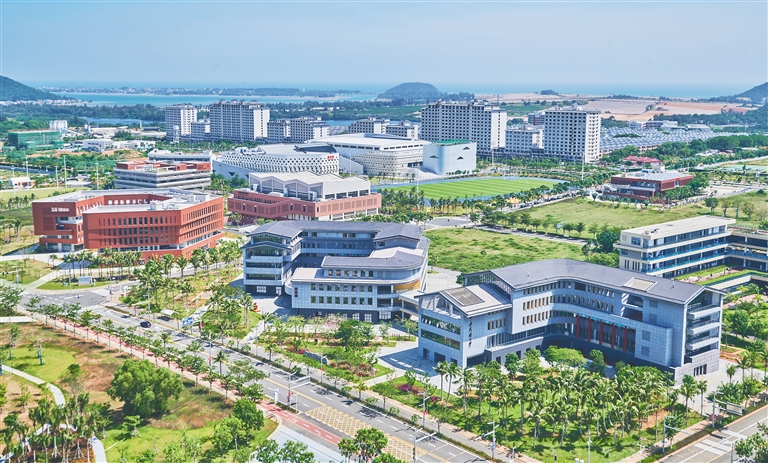
在协同合作中推进转型升级(评论员观察) ——更好发挥高质量发展动力源作用③
Ren Min Ri Bao· 2025-05-06 21:42
Group 1 - The core viewpoint emphasizes the necessity for the Guangdong-Hong Kong-Macau Greater Bay Area to transition from low-end to mid-high-end product, industry, and economic structures in response to market changes and challenges [1][2] - The Canton Fair, known as "China's No. 1 Exhibition," showcased over 70,000 booths and saw more than 30,000 participating export enterprises, highlighting the region's manufacturing upgrade towards intelligence, greenness, and high-end products [1][2] - The Greater Bay Area's unique advantages include world-class industrial clusters, a complete supply chain, and a favorable business environment, which collectively drive high-quality development and innovation [1][2][3] Group 2 - The region faces challenges such as rising factor costs and global supply chain adjustments, necessitating a focus on industrial transformation and collaboration to enhance competitiveness [2][3] - The success of companies like Absen Optoelectronics at the 2024 Paris Olympics illustrates the benefits of the Greater Bay Area's collaborative mechanisms and infrastructure connectivity [2][3] - The manufacturing system's robustness and strong supporting capabilities are significant advantages for China, enabling effective responses to external shocks and enhancing supply chain resilience [3][4] Group 3 - The Greater Bay Area aims to enhance internal collaboration while promoting external connectivity, contributing to national development and supporting Hong Kong and Macau's integration into the broader economic landscape [4] - The region has seen rapid growth in cross-border traffic, with over 10 million travelers crossing the Hong Kong-Zhuhai-Macao Bridge, indicating increasing connectivity and economic activity [4]

中部六省一季报扫描:河南、湖北差距缩窄,持续向消费要增长
Sou Hu Cai Jing· 2025-05-06 12:56
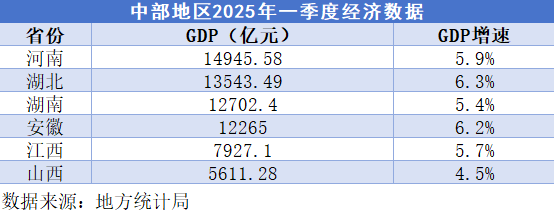
Economic Overview - The central region of China, comprising six provinces (Henan, Hubei, Hunan, Anhui, Jiangxi, and Shanxi), achieved a total GDP of 6.70 trillion yuan in Q1 2025, accounting for approximately 21% of the national GDP [1][2] - Among these provinces, Henan, Hubei, Hunan, and Anhui each surpassed a GDP of 1 trillion yuan, with figures of 1,494.56 billion yuan, 1,354.35 billion yuan, 1,270.24 billion yuan, and 1,226.5 billion yuan respectively [1][3] GDP Growth Rates - The GDP growth rates for the six provinces in Q1 2025 were as follows: Hubei (6.3%), Anhui (6.2%), Henan (5.9%), Jiangxi (5.7%), Hunan (5.4%), and Shanxi (4.5%), with four provinces outperforming the national average of 5.4% [2][3] Industrial Performance - All six provinces reported industrial added value growth rates exceeding the national average, with new industrial drivers playing a significant role [1][6] - Hubei led in various economic indicators, including industrial added value, fixed asset investment, and retail sales, all surpassing national averages [3][4] Consumer Spending Trends - Hubei exhibited the highest growth in consumer spending at 7.3%, driven by policies promoting consumption upgrades and a flourishing cultural tourism sector [4][8] - The retail sales growth rates for the provinces were: Hubei (7.3%), Henan (7%), Shanxi (5.9%), Anhui (5.8%), Hunan (5.6%), and Jiangxi (5.5%), all exceeding the national average of 4.6% [8][9] Automotive Industry Insights - Anhui's automotive industry showed remarkable growth, with a 31.7% increase in industrial added value and a 76.17 million vehicle production in Q1 2025, ranking first in the nation [5][6] - The province's exports also surged, with a total export value of 147.83 billion yuan, marking a 17.3% year-on-year increase [5] Challenges and Opportunities - Shanxi was the only province with a GDP growth rate below the national average, facing challenges in export diversification and reliance on low-value resource products [7] - The central provinces are focusing on expanding domestic demand and enhancing consumer spending as a primary economic strategy for 2025 [8][9]
中国经济信心说丨以法治力量护航民营经济发展壮大
Sou Hu Cai Jing· 2025-04-30 14:41
Core Viewpoint - The promulgation of the Private Economy Promotion Law marks a significant milestone in China's reform and development of the private economy, set to take effect on May 20, 2025, and aims to support the healthy development of private enterprises and entrepreneurs [1][6]. Group 1: Legislative Significance - The Private Economy Promotion Law is the first foundational law specifically addressing the development of the private economy in China, reflecting the high level of attention it has received from various sectors of society [1]. - The law is intended to consolidate the achievements of reforms and respond to concerns from various stakeholders, thereby boosting confidence in development and creating a favorable legal environment for the coexistence of different ownership economies [5]. Group 2: Current State of Private Economy - The private economy has become a significant force in China's economic landscape, contributing to innovation and industrial transformation, with Zhejiang province exemplifying the vibrant development of private enterprises [3][5]. - The private sector's growth is supported by a conducive business environment fostered by local governments, which emphasizes a non-intrusive approach to governance and responsiveness to business needs [3]. Group 3: Challenges and Government Support - Despite its growth, the private economy faces challenges that hinder fair market competition and the protection of the rights of private enterprises and entrepreneurs [5]. - Recent government initiatives, including the emphasis on the broad prospects for private economic development and the release of the 2025 version of the Market Access Negative List, aim to further reduce market entry barriers and promote fair competition [5].

多维度观察“金三银四”招聘旺季 火热细分数据折射中国经济向新向好
Yang Shi Wang· 2025-04-30 03:52
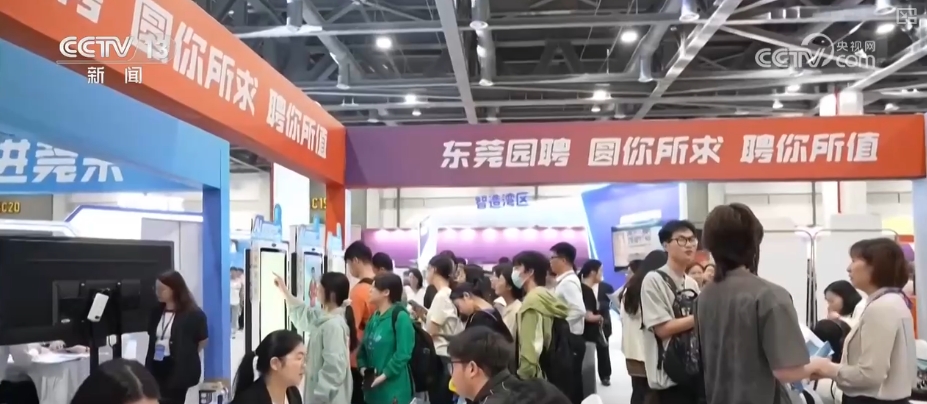
Group 1 - The core viewpoint is that there is a strong demand for high-skilled talent in China due to the accelerated transformation and upgrading of the industrial structure since 2025, particularly in manufacturing hubs like Dongguan [1][5] - Dongguan has sent 580 companies to Zhejiang for recruitment, offering over 14,790 positions mainly in new generation information technology, high-end equipment manufacturing, new materials, artificial intelligence, and healthcare [1][5] - The demand for skilled workers and professional technical positions in Dongguan exceeded 30,000 in the first quarter of 2025, with a resume submission increase of over 70% [5] Group 2 - Not only coastal regions but also central and western regions, as well as third and fourth-tier cities, are enhancing talent acquisition efforts to build high-skilled talent teams around their characteristic industries [6][7] - Local governments are implementing various support measures to retain and effectively utilize skilled talent, such as establishing training bases and providing financial support [7] - The "Skills Illuminate the Future" training initiative has been launched nationwide to provide targeted vocational training for skilled workers, facilitating their career development [9] Group 3 - In the first quarter of 2025, 3.08 million new urban jobs were created, an increase of 50,000 year-on-year, reflecting a positive trend in China's economic development [10] - Consumer spending on services grew by 5.4%, significantly boosting demand for jobs in the life services sector, with online life services, transportation logistics, elderly care, and residential services seeing year-on-year recruitment demand increases of 43%, 35%, 17%, and 10% respectively [12] - The ongoing advancement of high-end, intelligent, and green manufacturing is leading to a rapid increase in demand for technical skill positions, with mechanical engineers and automation engineers seeing recruitment demand growth of 40% and 10% year-on-year, respectively [14]
沂源的进化与淄博的底盘
Qi Lu Wan Bao Wang· 2025-04-26 05:40
Group 1 - The core viewpoint emphasizes the importance of county economies as a foundation for urban economic growth, highlighting the case of Yiyuan as a model for industrial and agricultural development [2][19] - Yiyuan's industrial output has significantly increased from 1 million yuan in 1949 to 38.02 billion yuan currently, showcasing a successful transition from agriculture to a robust industrial base [2][9] - The pharmaceutical company Ruiyang Pharmaceutical is highlighted as a key example of Yiyuan's economic evolution, having grown from a small factory to a leading enterprise in the new pharmaceutical industry [3][5][6] Group 2 - Yiyuan's new pharmaceutical industry has reached a scale of 19.147 billion yuan, becoming a pillar of the local economy alongside new materials, which contribute 13.15 billion yuan [7][9] - In 2024, Yiyuan's GDP is projected to be 37.91 billion yuan, with the new pharmaceutical and new materials industries accounting for 85% of the total GDP, demonstrating their critical role in economic stability [9][19] - The county's economic growth rate of 7.6% in 2024 is above the city average, indicating a strong performance in industrial output and value-added contributions [9][19] Group 3 - The article discusses the challenges faced by Zibo, where the county-level economies are seen as a weakness, lacking strong leadership in economic growth [10][19] - Zibo's GDP in 2024 is expected to be 488.408 billion yuan, with a year-on-year growth of 5.5%, but it faces significant industrial profit declines and energy consumption reductions [23][24] - The need for Zibo to strengthen its county economies is emphasized, with plans to develop 2-3 advantageous industrial chains in each county to enhance overall economic strength [27][28] Group 4 - Yiyuan's ongoing economic initiatives include a focus on industrial development, agricultural modernization, and urban renewal, aiming for high-quality growth [31][32] - The local government is implementing a fruit industry revitalization plan to enhance agricultural productivity and expand the value chain through deep processing [32] - The expansion of chemical parks and the development of new projects by key enterprises like Shandong Yaobang and Ruiyang Pharmaceutical are expected to provide further growth opportunities for Yiyuan [32]

201亿元订单筑牢基本盘 23亿元新能源项目打开增长极 北新路桥2024年营收增长20.37%
Zheng Quan Shi Bao Wang· 2025-04-23 02:07
Core Viewpoint - North New Road and Bridge (002307) reported a revenue of 10.215 billion yuan for 2024, a year-on-year increase of 20.37%, despite a downturn in the construction industry [1] Financial Performance - The company achieved a net profit attributable to shareholders of -423 million yuan [1] - Total assets reached 56.393 billion yuan, reflecting a growth of 3.98% [1] - The company secured 91 new projects with a total value of 20.195 billion yuan [1][3] Business Development - North New Road and Bridge primarily operates in traditional construction sectors such as highways, municipal projects, and housing, while gradually expanding into new sectors like 5G infrastructure, photovoltaic wind power, and water conservancy projects [1] - The company has transitioned from regional operations to a national and international presence, undertaking projects in 26 provinces and 9 countries [1] Project Highlights - The company successfully won contracts for various projects, including rural water management in Sichuan and multiple highway construction projects [3] - In 2024, the company secured 7 new projects in the 5G and renewable energy sectors, amounting to 2.31 billion yuan, which represents 11.44% of the total contract value [3] Competitive Position - The company maintains a 100% contract performance and quality compliance rate, earning numerous accolades such as "National Excellent Construction Enterprise" and "China Construction Engineering Luban Award" [1] - North New Road and Bridge holds high-level industry qualifications, enhancing its market competitiveness [1] Future Outlook - The company plans to develop a "3+3+N" business model, focusing on traditional construction and new infrastructure sectors, aiming to integrate resources and extend its service capabilities across the construction lifecycle [4] - The company is actively pursuing opportunities in the overseas market and enhancing collaborations with state-owned enterprises to leverage quality resources [2]

营收降逾三成,净利亏逾3.5亿元 裕兴股份的2024年有点难
Mei Ri Jing Ji Xin Wen· 2025-04-21 14:15
Core Viewpoint - The photovoltaic battery technology iteration and changes in supply-demand structure are causing significant disruptions in the industry chain, exemplified by the performance of Yuxing Co., Ltd. in 2024, which reported a substantial decline in revenue and a net loss [1][3]. Financial Performance - Yuxing Co., Ltd. achieved an operating revenue of 1.1 billion yuan in 2024, a year-on-year decrease of 34.75% [1][3]. - The company reported a net loss attributable to shareholders of 357 million yuan [1]. Industry Dynamics - The polyester film industry is experiencing continuous capacity growth, while demand from downstream applications, particularly in photovoltaics, is decreasing, leading to an imbalance in supply and demand [2][3]. - The overall industry capacity utilization rate is at a historical low due to intensified competition in mid-to-low-end products, with some product prices falling below production costs [2][3][4]. Production and Sales - Yuxing Co., Ltd. saw a reduction in polyester film production and sales volumes, with a decrease of 66,300 tons and 51,600 tons respectively compared to the same period in 2023, representing declines of 38.58% and 32.92% [2][3]. - The demand for photovoltaic polyester films has significantly dropped, particularly for single-glass components, leading to substantial reductions in production and sales [2][3]. Capacity and Utilization - The company's polyester film capacity is approximately 250,000 tons, with a capacity utilization rate of 50.72% during the reporting period [5]. - Some production lines were not operational due to outdated technology and ongoing modifications, contributing to low capacity utilization [5][6]. Strategic Shift - In response to the ongoing downturn in the photovoltaic business, Yuxing Co., Ltd. is shifting its strategic focus towards the electronic optics sector, aiming to transform and upgrade its product offerings [6]. - The company reported a significant increase in the production and sales of electronic optical polyester films, with production reaching 37,200 tons and sales at 28,700 tons, reflecting year-on-year growth of 90.28% and 84.34% respectively [6][7]. Product Development - Yuxing Co., Ltd. is adjusting its production line structures to enhance the capacity of key products, including modifications to two production lines originally designated for photovoltaic films to produce electronic optical films and specialty films [7].

珠海巨无霸诞生之后
3 6 Ke· 2025-04-21 02:52
Group 1 - The establishment of Zhuhai Technology Industry Group is a significant strategic layout for Zhuhai state-owned assets in the current economic situation, aiming to occupy an important position within the Zhuhai state-owned system [1][3] - Zhuhai Technology will focus on the "3+2" industrial layout, which includes new energy, semiconductors, medical health, artificial intelligence, and smart home sectors [5][6] - The integration of resources from Huafa Group and Gree Group is expected to optimize state-owned capital layout, enhance technological industry collaboration, and improve overall competitiveness [3][4] Group 2 - Other regions, including Shanghai, Jiangsu, Changsha, and Zhengzhou, are also accelerating the restructuring and construction of local state-owned platforms, indicating a broader trend in state-owned enterprise reform [2][7] - Jiangsu has established the Jiangsu National Financial Investment Group with a registered capital of 30 billion RMB, aimed at market-oriented financial enterprise equity investment [9] - The restructuring of state-owned platforms in various regions is expected to enhance investment capabilities and promote innovation in strategic emerging industries [7][9]


原木期货助力西南林木产业转型蜕变
Qi Huo Ri Bao Wang· 2025-04-17 16:43
Core Viewpoint - The timber industry in Southwest China is facing challenges in meeting domestic demand for timber despite having abundant forest resources, and the introduction of lumber futures could provide opportunities for industry transformation and better pricing mechanisms [2][5][8] Group 1: Current Industry Status - Southwest China has rich forest resources, with the total value of forest products exceeding 1.2 trillion yuan, making it a core area for domestic timber supply [2] - The actual utilization rate of timber in Sichuan is only about 25% of the annual logging quota of 17.97 million cubic meters, indicating a significant gap between supply and demand [2][3] - The region faces a "more trees, less timber" phenomenon, with many trees not reaching maturity due to various factors, including pest issues and inadequate management practices [3][4] Group 2: Challenges in Timber Supply - The quality and quantity of domestic timber are insufficient to meet market needs, leading to reliance on imports from countries like Russia, New Zealand, and Canada [2][3] - The harvesting process is labor-intensive and inefficient due to difficult terrain and lack of machinery, which increases timber costs [4] - The pricing of domestic timber is often unclear, with current market prices significantly lower than futures prices, leading to a lack of incentive for producers to cultivate higher-quality timber [5][6] Group 3: Opportunities with Lumber Futures - The introduction of lumber futures is seen as a potential catalyst for industry transformation, as it imposes stricter quality standards and provides tools for managing price volatility [5][6] - The futures market could help establish a clearer pricing mechanism for domestic timber, encouraging producers to improve the quality and value of their products [6][8] - There is a growing interest among timber producers in learning about futures trading and risk management to enhance economic returns from timber sales [7][8]