汽车电子

Search documents
华润微(688396):25Q1盈利同比高增,汽车和AI应用持续带来需求增量
Orient Securities· 2025-05-13 01:54
Investment Rating - The report maintains a "Buy" rating for the company with a target price of 52.49 CNY, based on a valuation of 3.0 times the average price-to-book ratio for comparable companies in 2025 [2][5][10]. Core Insights - The company is expected to see significant growth in earnings, with a projected net profit of 919 million CNY in 2025, representing a 21% year-on-year increase. This is part of a broader recovery trend following a substantial decline in previous years [9][10]. - The automotive and AI applications are driving demand growth, with automotive electronics revenue increasing from 19% in 2023 to 21% in 2024. The company is enhancing its market share in key automotive systems through a comprehensive product offering [9][10]. - The company is investing heavily in R&D, with a forecasted increase in R&D expenses, which is expected to support new product development and market competitiveness [9][10]. Financial Summary - Revenue is projected to grow from 10,119 million CNY in 2024 to 14,377 million CNY in 2027, reflecting a compound annual growth rate (CAGR) of approximately 11% [4][12]. - The gross margin is expected to stabilize around 28.8% by 2027, while the net profit margin is projected to improve to 10.8% [4][12]. - The company's return on equity (ROE) is anticipated to rise from 3.5% in 2024 to 6.2% in 2027, indicating improved profitability and efficiency [4][12].

战略再进阶 太龙股份在半导体领域精耕汽车电子与AI蓝海
Zheng Quan Ri Bao Wang· 2025-05-11 13:43
Core Insights - Tai Long Electronics Co., Ltd. reported a significant annual performance for 2024, achieving total revenue of 2.574 billion yuan and a net profit of 51.1622 million yuan, reflecting a year-on-year growth of 19.44%, surpassing market expectations [1][2] Financial Performance - The company’s total revenue for 2024 was 2.574 billion yuan, with a net profit of 51.1622 million yuan, indicating a strong growth trajectory [1] - The company plans to distribute cash dividends of 0.30 yuan per 10 shares, totaling approximately 6.5489 million yuan for 2024, with an expected cumulative cash dividend of 10.9148 million yuan [3] Business Transformation - Since the strategic acquisition of Bosi Technology (Hong Kong) Co., Ltd. in 2020, Tai Long has made significant inroads into the semiconductor distribution sector, establishing a robust supply chain system [2] - The semiconductor distribution business maintained stable operations in 2024, benefiting from the growth in AI technology in smartphones and the automotive electronics market [2] Strategic Partnerships - The company has formed strategic alliances with leading chip design firms to explore opportunities in the new energy vehicle and AI sectors, enhancing its market responsiveness and commercial value [4] - Tai Long's subsidiary, Bosi, has entered into a strategic partnership with Shouchuan Microelectronics, a leader in high-speed vehicle communication solutions, to enhance market penetration and product offerings [4] - Collaboration with Chongqing Woqi Microelectronics focuses on developing high-performance chips for IoT and automotive electronics, leveraging each other's strengths [5] Industry Outlook - The semiconductor industry is currently benefiting from inventory replenishment and domestic substitution policies, with automotive electronics and AI emerging as new growth areas [6] - The automotive electronics market is expected to expand significantly, driven by the integration of AI technologies, with over 50% penetration of smart features in vehicles [6] - Tai Long is well-positioned to capitalize on these trends through its strategic partnerships and technological capabilities, aiming for high-quality growth in the automotive electronics and AI sectors [6]

紫光国微(002049) - 2025年5月9日投资者关系活动记录表
2025-05-09 12:28
Group 1: Company Performance and Market Conditions - The company's operating performance in 2024 declined due to intense market competition and cyclical fluctuations in the special integrated circuit industry, resulting in reduced demand and lower order volumes [4][8]. - The company's stock price has decreased by 70% from its peak, reflecting broader macroeconomic and market conditions [6][8]. - The special integrated circuit business's revenue accounted for 46.76% of total revenue, while the smart security chip business contributed 47.87% [10]. Group 2: Research and Development Efforts - The company has made significant investments in R&D, focusing on high-reliability chips, automotive electronics, and smart chips [5][10]. - The HBM product is currently in the R&D phase, with a longer user introduction cycle due to its application in specialized industries [9][11]. - The company aims to enhance its core competitiveness by continuously launching new products and expanding into new markets [11][12]. Group 3: Future Outlook and Strategic Plans - The company anticipates a substantial change in orders for special integrated circuits in 2025 compared to 2024, indicating potential recovery [3][11]. - The management is exploring opportunities for external growth through acquisitions, although no specific plans have been confirmed [12][14]. - The company is focusing on expanding its automotive domain control chips, which are expected to break the market monopoly of foreign high-end products [6][10]. Group 4: Investor Relations and Market Confidence - The company is committed to enhancing communication with investors and utilizing share buybacks as a tool to improve market confidence [4][6]. - There are no current plans for management to increase their shareholdings, reflecting a cautious approach to market conditions [10][12]. - The company is considering various strategies to improve its market value and protect investor interests amid ongoing challenges [8][13].

全球半导体用氯硅烷市场前10强生产商排名及市场占有率
QYResearch· 2025-05-07 09:06
Core Insights - The global semiconductor chlorosilane market is projected to reach $1.26 billion by 2031, with a compound annual growth rate (CAGR) of 8.2% in the coming years [2] - The primary product in this market is trichlorosilane, which holds approximately 41.8% market share [9] - The main application for chlorosilane is in silicon wafer preparation, accounting for about 44.0% of the demand [11] Market Overview - The semiconductor chlorosilane market is driven by the rapid development of the semiconductor industry, with increasing demand for chips due to advancements in 5G, AI, IoT, and automotive electronics [15] - Technological innovations in chip manufacturing processes are pushing the need for high-quality silicon materials, which chlorosilane can provide [15] - The growth of the photovoltaic industry is also contributing to the demand for chlorosilane, as it is used to produce high-purity silicon for solar cells [15] Market Challenges - Chlorosilane poses safety risks due to its volatility and corrosiveness, necessitating strict safety protocols during production, storage, and transportation [16] - The high purity requirement for chlorosilane in semiconductor applications, often exceeding 99.9999%, presents significant technical and cost challenges [16] - The stability of raw material supply, such as silicon powder and chlorine gas, is crucial for chlorosilane production, as fluctuations can impact market stability [16] - The market is highly competitive, with both established international giants and emerging companies vying for market share, necessitating continuous R&D investment [16] Key Players - Major global manufacturers of semiconductor chlorosilane include Wacker, Air Liquide, Shin-Etsu, Tokuyama, and SK Specialty, with the top five companies holding approximately 45.0% of the market share in 2024 [5]

韦尔股份:2025年一季报点评:1Q25收入创同期历史新高,汽车电子成长可期-20250507
Minsheng Securities· 2025-05-07 06:23
Investment Rating - The report maintains a "Recommended" rating for the company, indicating a potential upside of over 15% relative to the benchmark index [5][11]. Core Insights - The company achieved a record high revenue of 6.472 billion yuan in Q1 2025, marking a year-on-year growth of 14.68% and a quarter-on-quarter decline of 5.13%. The net profit attributable to shareholders reached 866 million yuan, up 55.25% year-on-year but down 8.65% quarter-on-quarter [1]. - The company is benefiting from an optimized product structure and enhanced supply chain efficiency, leading to improved profitability. The gross margin for Q1 2025 was 31.03%, an increase of 3.14 percentage points year-on-year and 2.05 percentage points quarter-on-quarter [1]. - The company is seeing significant growth in its high-end smartphone product share and accelerated penetration in the automotive electronics sector. In 2024, the company generated approximately 9.802 billion yuan from the smartphone market, accounting for 51% of its image sensor revenue, with a year-on-year growth of 26.01% [2]. - The company continues to invest heavily in R&D, with 3.245 billion yuan allocated in 2024, representing 15% of its semiconductor design revenue. This investment supports product upgrades and the development of new products [3]. Financial Forecasts - The company is projected to achieve net profits of 4.39 billion yuan, 5.6 billion yuan, and 7.034 billion yuan for the years 2025, 2026, and 2027, respectively, with corresponding price-to-earnings ratios of 37, 29, and 23 [4][8]. - Revenue is expected to grow from 25.731 billion yuan in 2024 to 40.697 billion yuan in 2027, with growth rates of 22.4%, 16.6%, 16.8%, and 16.1% for the respective years [4][9]. - The company’s net profit margin is projected to improve from 12.92% in 2024 to 17.28% in 2027, reflecting enhanced operational efficiency [9].

【私募调研记录】高毅资产调研纳芯微
Zheng Quan Zhi Xing· 2025-05-07 00:07
Group 1 - Gao Yi Asset Management recently conducted research on a listed company, Naxin Micro, highlighting the demand trends in various downstream application fields, particularly the high growth in new energy vehicle sales and the impact of smart technology on automotive electronics [1] - Naxin Micro reported that the impact of US-China tariff policies is minimal, with the majority of revenue coming from domestic markets [1] - The company has launched its first generation of SerDes chips aimed at camera applications, and has introduced automotive chips including isolation smart drivers and motor drivers, with some products experiencing rapid volume growth [1] Group 2 - Naxin Micro is making good progress in overseas markets, collaborating with leading automotive manufacturers in Europe, Japan, and South Korea [1] - The company anticipates share-based payment expenses of 80 million yuan, with a quarterly expense of 20 million yuan [1] - Naxin Micro is expanding its product portfolio by developing real-time control MCUs and automotive SoCs, although future gross margins may decline due to market competition, improvements are expected through cost management and mass production of high-complexity products [1]

纳芯微接待136家机构调研,包括AMC Entertainment Holdings、Daiwa(Shanghai)Corporate Strategi...
Jin Rong Jie· 2025-05-06 15:00
Core Viewpoint - The company has shown significant revenue growth in 2024 and Q1 2025, with a focus on expanding its automotive electronics and emerging application fields, despite facing losses in net profit due to market competition and R&D investments [1][3][4]. Financial Performance - In 2024, the company achieved a revenue of 1.96 billion yuan, a year-on-year increase of 49.53% [3] - In Q1 2025, the revenue reached 717 million yuan, a year-on-year increase of 97.82% and a quarter-on-quarter growth of 20.66% [3] - The net profit for 2024 was a loss of 403 million yuan, while Q1 2025 saw a reduced loss of approximately 51.34 million yuan [3][4]. Market Segments - The general energy market accounted for 49.49% of revenue in 2024 and 48.67% in Q1 2025 [4] - Automotive electronics revenue in Q1 2025 was 262.82 million yuan, representing 36.68% of total revenue, consistent with 36.88% in 2024 [4] - Consumer electronics maintained a stable revenue share of 13.63% in 2024 and 14.64% in Q1 2025 [4]. Product Development - The company has four main product directions: sensors, signal chains, power management, and MCUs, with a focus on automotive electronics and emerging applications [5][12] - The acquisition of Maiguan has expanded the product range to include various magnetic sensors, enhancing customer resources and optimizing sales channels [5][6]. - The company is actively developing new products for humanoid robots, leveraging existing automotive product technologies [6]. Strategic Initiatives - The company has established an overseas sales team, achieving good results in automotive electronics collaborations with leading global firms [2][11] - It is focusing on enhancing product competitiveness and establishing emergency response plans to adapt to changing macroeconomic conditions [8][12]. Future Outlook - The company anticipates improvements in gross margins due to stable pricing and cost management strategies, alongside the introduction of higher-margin products [13] - The MCU product line is expected to grow significantly, addressing the evolving needs of automotive electronic architectures [12].
希荻微(688173)2025年一季报点评:战略并购助力业绩释放 卡位高景气应用领域
Xin Lang Cai Jing· 2025-05-06 04:32
Group 1: Financial Performance - In Q1 2025, the company achieved revenue of 178 million yuan, representing a year-on-year growth of 44.56% and a quarter-on-quarter growth of 11.38%. The net profit attributable to shareholders was -27 million yuan, with a year-on-year increase of 44.23% and a quarter-on-quarter increase of 71.34% [1] - Revenue growth was primarily driven by increased demand from end customers compared to the same period last year, along with the outsourcing of certain products in the audio coil motor driver chip product line starting from Q4 2024, which significantly boosted revenue [1] - The expansion of the consolidated scope due to the acquisition of the controlling subsidiary Zinitix Co., Ltd. in 2024 also contributed to the increase in operating scale [1] - The company saw a significant reduction in losses, attributed to an increase in gross margin and improved management efficiency [1] Group 2: Product Development and Market Positioning - The company launched customized DC/DC chip products for silicon anode batteries, enhancing the endurance of smart electronic devices such as AI phones and AI glasses. These products have been successfully integrated into the supply chains of major global brands like Xiaomi, Lenovo, and Vivo, contributing significantly to revenue [2] - In the automotive electronics sector, the company's automotive-grade DC/DC chips have been incorporated into Qualcomm's smart cockpit automotive platform, leading to shipments to renowned automotive manufacturers such as Audi, Hyundai, Kia, and others [2] - The company has developed core power supply chips for CPU, GPU, and DSP with revolutionary architecture and superior load transient response, capable of delivering continuous output currents of up to 50A and efficiencies exceeding 90%, meeting the demands of AI servers for compact and efficient power modules [2] Group 3: Strategic Acquisitions - In August 2024, the company completed the acquisition of Zinitix, adding a sensor chip product line and quickly entering the touch IC market, enhancing its capabilities in smart terminal solutions. Zinitix achieved revenue of approximately 268 million yuan in 2024, a 64% increase year-on-year, and turned a profit [3] - The company plans to acquire Chengxin Micro to integrate resources in power management, motor chips, and MOSFETs, addressing technological gaps in AC-DC chip technology. The complementary strengths of both companies are expected to accelerate expansion in the automotive electronics sector [3] Group 4: Investment Outlook - The company has a strong financial reserve, positioning it well to seize industry consolidation opportunities and achieve leapfrog development. The diversified product matrix and cutting-edge technology layout are viewed positively [4] - Revenue projections for 2025-2027 are estimated at 933 million yuan, 1.161 billion yuan, and 1.370 billion yuan, respectively, with current price-to-sales ratios of 5.72, 4.60, and 3.90 times [4]

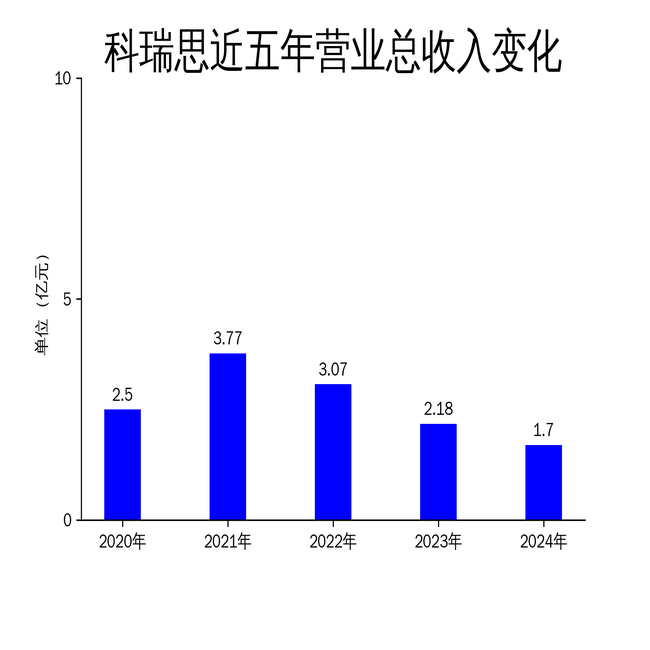
科瑞思2024年财报:营收利润双降,新能源业务成亮点
Sou Hu Cai Jing· 2025-05-06 00:20
Core Business Challenges - The core business of the company, small magnetic ring coil winding services, faced significant challenges in 2024, with both volume and price declining due to market conditions [4] - The revenue from the network transformer winding business dropped sharply, despite efforts to maintain relationships with existing major clients through service optimization and quality improvement [4] - The inductance winding business, characterized by high customization and product diversity, progressed slowly, and despite increased investment in R&D and market expansion, the overall impact was limited [4] New Product Development - The company actively developed new products, such as transformer coil winding services for electric vehicle battery management systems, achieving small-scale production [4] - Efforts to co-develop customized inductance products with downstream clients were initiated to enhance competitiveness and market share, although the effectiveness of this strategy remains to be validated [4] Growth in New Energy Sector - Despite overall poor performance, the company's automation equipment business in the new energy and automotive electronics sectors showed promising results, with increased investment and a growing customer base [4] - The successful development of various automation equipment for the production of magnetic components in the new energy sector, such as fully automated assembly lines for photovoltaic inverter components, received high recognition from clients [4][5] Magnetic Component and Mechanical Parts Performance - The magnetic component finished goods business achieved scale production in 2024, particularly in common mode and differential mode inductors for consumer electronics, although its overall scale remains small and contributes limited revenue and profit [7] - The mechanical parts manufacturing business performed steadily, with optimized management leading to increased production capacity and significant growth in external orders, providing some support amid overall revenue decline [7] Overall Performance Summary - The company faced numerous challenges in 2024, with core business setbacks leading to declines in both revenue and profit, but progress in the new energy and automotive electronics automation equipment business offers new growth points for the future [6][7] - Addressing market competition and price pressure remains a critical issue for the company [7]

中芯国际的财务模型分析,成熟制程占比多少?
傅里叶的猫· 2025-05-04 15:32
Core Viewpoint - The article provides an in-depth analysis of SMIC (Semiconductor Manufacturing International Corporation), focusing on its financial model and growth prospects, particularly in the context of China's semiconductor policies and market dynamics [1]. Financial Indicators - Revenue is projected to grow from $2.07 billion in 2017 to $23.04 billion in 2028, with a compound annual growth rate (CAGR) of 24.8%, driven by the expansion of 28nm and above mature process capacities, especially post-2020 due to global chip shortages and domestic semiconductor policies [2]. - Gross margin is expected to increase from 21.2% in 2017 to 26.1% in 2028, benefiting from scale effects in mature processes, although it remains significantly lower than TSMC's 55% during the same period [2]. - EBITDA is forecasted to rise from $730 million to $12.17 billion, with EBITDA margin improving from 35.5% to 48.5%, indicating enhanced operational efficiency [2]. Capital Expenditure - Capital expenditures (Capex) are set to reach $7.326 billion in 2024, increasing to $8.69 billion in 2025 and peaking at $9.622 billion in 2026, reflecting a CAGR of 18.4% from 2017 to 2028, which is higher than the revenue growth rate [3]. - 90% of Capex is allocated to equipment procurement, primarily for mature process technologies, with 10% for wafer fab infrastructure [4]. - High Capex leads to significant depreciation costs, projected to reach $3.742 billion in 2024, which will pressure profit margins [4]. Business Structure - The wafer business is the core revenue driver for SMIC, contributing approximately 93.2% of total revenue in 2018, expected to rise to 95% by 2024 [7]. - Revenue from the 12/14nm nodes has shown rapid growth, from nearly negligible in 2019 to an estimated $838 million in 2024, driven by increasing market demand [8]. - The 28nm node remains a significant revenue contributor, with expected revenue of approximately $1.145 billion in 2024, despite facing competitive pressures [9]. Capacity and Market Competitiveness - Total capacity is projected to reach 884,000 wafers per month in 2024, increasing to 941,000 in 2025, with major production bases in Shanghai, Beijing, Shenzhen, and Tianjin [13]. - The Shanghai facility focuses on advanced processes, while the Beijing plant targets mature processes, with a significant portion of Capex directed towards expanding capacity in response to rising automotive electronics demand [13]. - Risks include potential impacts from U.S. sanctions on equipment maintenance and over-reliance on policy subsidies, which could lead to price competition [13]. R&D Investment and Technological Innovation - R&D expenditures are expected to rise to $1.031 billion in 2024, accounting for 9.4% of revenue, with a focus on optimizing 14nm FinFET processes and developing IoT chips [16]. - Despite increased R&D spending, challenges remain due to U.S. sanctions limiting access to advanced equipment, resulting in lower yield rates for 14nm processes [16]. - The company aims to balance high R&D intensity with policy requirements, although the return on investment in R&D is projected to be below the cost of capital, indicating diminishing marginal returns [17][18].