
通用人工智能(AGI)

Search documents
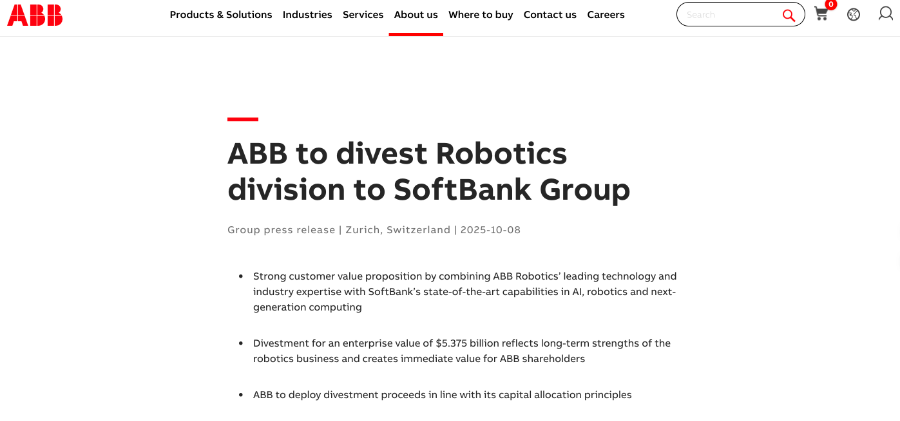
软银孙正义豪掷53亿美元 收购ABB机器人业务
2 1 Shi Ji Jing Ji Bao Dao· 2025-10-09 15:53
Group 1 - SoftBank has made a significant investment of $5.375 billion to acquire ABB's robotics business, leading ABB to abandon its plans for a separate IPO of this unit [4][6][7] - ABB's robotics business generated $2.3 billion in sales in 2024, accounting for approximately 7% of ABB's total revenue, with an EBITDA margin of 12.1% [4][5] - The decision to sell the robotics unit reflects ABB's shift in focus towards electrification and automation, reducing its operations to three main divisions [7] Group 2 - The global industrial robotics market has experienced a slowdown in growth, with increasing competition from local Chinese manufacturers impacting multinational companies [5] - SoftBank's CEO Masayoshi Son has a long-term vision for AI, emphasizing the potential of Artificial Super Intelligence (ASI) and its integration with robotics [12][13] - The acquisition aligns with SoftBank's strategy to build an ecosystem around AI, including investments in AI chips, robotics, and data centers [13]


任少卿的智驾非共识:世界模型、长时序智能体与 “变态” 工程主义
晚点Auto· 2025-10-09 12:17
Core Viewpoint - The article discusses the innovative approach of NIO in the field of autonomous driving, emphasizing the importance of world models and reinforcement learning as key components for achieving advanced artificial general intelligence (AGI) in automotive technology [4][9][26]. Group 1: NIO's Approach to Autonomous Driving - NIO is positioning itself as an AI company, focusing on the development of autonomous driving technology through a unique combination of high computing power, multiple sensors, and a new architecture based on world models and reinforcement learning [5][8][34]. - The company has established a three-layer data system to support its autonomous driving capabilities, which is considered one of the most advanced in the industry [36][54]. - NIO's strategy involves a shift from traditional end-to-end models to a more complex world model that integrates spatial and temporal understanding, aiming to enhance the vehicle's ability to navigate real-world scenarios [10][13][26]. Group 2: Reinforcement Learning and World Models - Reinforcement learning is viewed as essential for developing long-term decision-making capabilities in autonomous systems, moving beyond short-term imitation learning [7][29][33]. - The world model is defined as a high-bandwidth cognitive system that allows AI to understand and predict physical interactions in the environment, which is crucial for effective autonomous driving [10][16][26]. - NIO believes that the integration of language models with world models will lead to a more comprehensive understanding of both concepts and physical realities, ultimately contributing to the development of AGI [13][28][33]. Group 3: Data Utilization and Training - NIO utilizes a combination of real-world driving data and simulated environments, including gaming data, to train its models, ensuring a robust understanding of various driving scenarios [27][30]. - The company emphasizes the importance of using large-scale, diverse datasets for training, as opposed to relying solely on expert data, which may lack the complexity of real-world situations [28][30]. - NIO's approach to data collection and training is designed to enhance the vehicle's performance in edge cases and improve overall safety [41][44]. Group 4: Future Developments and Industry Position - NIO plans to introduce an open-set interaction system that allows for more natural communication between users and the vehicle, moving beyond limited command sets [18][20]. - The company is committed to continuous innovation and exploration in the field of autonomous driving, even if it means facing initial skepticism from the industry [8][25][39]. - NIO's advancements in autonomous driving technology are expected to position it ahead of competitors, particularly with the upcoming release of its open-set interaction capabilities [22][47].


从AGI到ASI:万亿赛道潜力待释放
Xin Lang Ji Jin· 2025-10-09 10:30
Core Insights - The realization of Artificial General Intelligence (AGI) is seen as a certainty, with the ultimate goal being the development of Artificial Superintelligence (ASI) that surpasses human intelligence [1][2] - The evolution towards ASI is divided into three key stages: emergence of intelligence ("Learning Human"), autonomous action ("Assisting Human"), and self-iteration ("Surpassing Human") [1][2] Stage Summaries - **Stage 1: Emergence of Intelligence - "Learning Human"** The development of digital knowledge through the internet has laid the foundation for intelligent technologies. Current large models exhibit generalized intelligence and basic multi-step reasoning capabilities, marking the entry into the "Learning Human" phase [1] - **Stage 2: Autonomous Action - "Assisting Human"** AI is currently in this critical stage, characterized by the ability to break through language interaction limitations. AI can decompose complex tasks and autonomously interact with both digital and physical worlds, significantly impacting reality [2] - **Stage 3: Self-Iteration - "Surpassing Human"** This stage requires AI to connect with comprehensive raw data from the physical world and achieve autonomous learning. As AI penetrates more physical scenarios and understands raw data better, its capabilities will significantly enhance, leading to self-iteration and surpassing human intelligence [2] Investment Trends - Significant investments are being made in AI infrastructure to prepare for the era of superintelligence. For instance, a major domestic tech company has initiated a three-year AI infrastructure plan worth 380 billion yuan, with plans for continued investment [2] - Globally, AI investment is rapidly increasing, with IDC forecasting that total AI IT investment will grow from $315.9 billion in 2024 to $1,261.9 billion by 2029, reflecting a compound annual growth rate (CAGR) of 31.9% [2] Market Potential - AI is poised to reshape production efficiency and unlock trillion-dollar markets. The global AI market is projected to surge from $189 billion in 2023 to $4.8 trillion by 2033, representing a 25-fold increase over ten years [4] - The share of AI in global cutting-edge technology is expected to rise from 7% to 29%, establishing itself as a dominant force in the sector [4] - In light of the technological evolution and capital influx into ASI, AI-related sectors are becoming focal points for investors [4]

任少卿的智驾非共识:世界模型、长时序智能体与 “变态” 工程主义
晚点LatePost· 2025-10-09 10:14
Core Viewpoint - The article emphasizes the challenging yet necessary path that NIO is taking in the field of intelligent driving, focusing on the development of world models and reinforcement learning to achieve advanced capabilities in autonomous driving [2][4][6]. Group 1: Company Background and Leadership - Ren Shaoqing, a prominent figure in NIO, has a strong academic background and significant contributions to deep learning, including the development of Faster R-CNN and ResNet [3][4]. - He co-founded the autonomous driving company Momenta before joining NIO, where he took on the challenge of building the second-generation platform from scratch [4][6]. Group 2: Technological Approach - NIO's approach to intelligent driving involves a combination of high computing power, multiple sensors, and a new architecture based on world models and reinforcement learning [5][6]. - The company aims to move beyond traditional end-to-end models, which are limited in their ability to handle long-term decision-making, by focusing on world models that integrate spatial and temporal understanding [8][11]. Group 3: World Model Concept - The world model is defined as a system that builds high-bandwidth cognitive capabilities based on video and images, addressing the limitations of language models in understanding complex real-world scenarios [11][14]. - NIO is the first company in China to propose the concept of world models, which includes understanding physical laws and the ability to predict movements in three-dimensional space over time [12][24]. Group 4: Reinforcement Learning Importance - The article highlights that the intelligent driving industry has yet to fully embrace the significance of reinforcement learning, which is crucial for developing long-term planning capabilities in autonomous systems [5][24]. - NIO recognizes that traditional imitation learning is insufficient for handling complex driving scenarios that require extended memory and decision-making [30][31]. Group 5: Data Systems and Training - NIO has developed a three-tier data system to ensure the quality and relevance of training data, emphasizing the importance of real-world data over expert data for training models [34][36]. - The company utilizes a combination of game data and real-world driving data to enhance the model's understanding of temporal dynamics and decision-making [25][26]. Group 6: Future Directions and Innovations - NIO plans to implement open-set instruction interaction, allowing users to communicate with the vehicle in a more natural and flexible manner, moving beyond limited command sets [16][18]. - The company is focused on continuous improvement and innovation, with plans to release new versions of their systems that enhance user interaction and safety features [19][20].

OpenAI奥特曼:从未像现在这样乐观,在基础设施上投巨资是战略豪赌
Feng Huang Wang· 2025-10-09 09:58
Core Insights - OpenAI is making a significant strategic investment in infrastructure, aiming to build powerful AI systems that benefit humanity [3][4] - The company has announced collaborations with major tech partners for large-scale AI infrastructure, estimated at around $1 trillion [3][4] - OpenAI's CEO, Sam Altman, emphasizes the need for substantial resources in infrastructure, product, and research to achieve their goals [3][4] Infrastructure Investment - OpenAI's collaboration with partners like NVIDIA, AMD, Samsung, and Oracle is part of a massive infrastructure investment [3][4] - Altman describes this investment as a "strategic gamble" for the company, indicating that the decision's success will be tested in practice [4] - The company plans to support partners financially to meet the costs associated with these large-scale projects [4] Product Development - OpenAI has launched the Sora 2 video and audio generation model, which has quickly gained popularity, topping the Apple App Store [6][10] - The Sora App is primarily an entertainment product, with a significant portion of early users being creators [7] - Altman believes that the integration of various applications within ChatGPT is essential for user experience and aims to develop an API business to enhance service continuity [8][10] Competitive Landscape - Altman acknowledges the presence of many well-funded and technologically advanced competitors in the AI market, suggesting it will not be a winner-takes-all scenario [4] - OpenAI aims to capture a significant market share and sees AI as a pervasive technology across consumer products and business solutions [4] Future Outlook - OpenAI is also venturing into AI hardware, planning to release devices like smart speakers and wearables by late 2026 or early 2027 [10] - Altman expresses optimism about the company's research and product development, indicating a strong belief in the potential for scientific breakthroughs in the coming years [8][10]
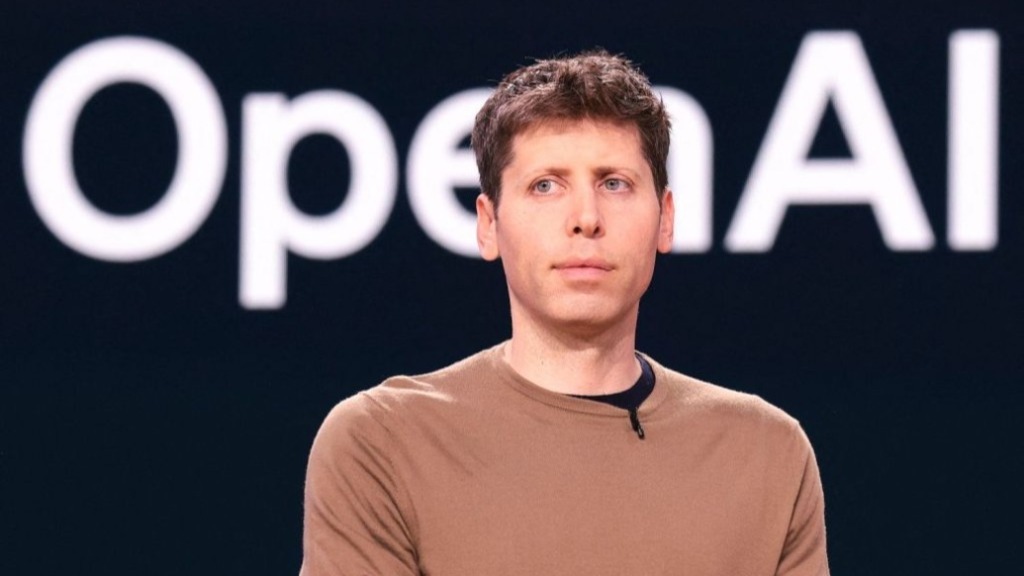
Altman深度访谈:将激进押注基础设施,瞄准AI全产业链垂直整合
硬AI· 2025-10-09 09:52
Core Insights - OpenAI is transitioning from a research lab to a vertically integrated "AI empire" with significant infrastructure investments requiring industry-wide collaboration [2][3][8] - The company's strategy is driven by confidence in future model capabilities, anticipating substantial economic value creation in the next one to two years [3][15] - OpenAI's partnerships with major tech companies like NVIDIA, Oracle, and AMD are part of a broader effort to leverage the entire AI industry chain [3][8] Group 1: Infrastructure Investment - OpenAI's CEO Sam Altman announced a "very aggressive infrastructure bet" that necessitates support from the entire industry [8][15] - This investment is based on the expectation of future model capabilities rather than current models, indicating a proactive approach to meet anticipated demand [15][68] - Altman hinted at more collaborations to be announced in the coming months, emphasizing the scale of this initiative [8][15] Group 2: Energy and AI - Altman linked the future of AI directly to energy availability, stating that AI's exponential growth will depend on cheaper and more abundant energy sources [6][9] - He predicts that the future energy landscape will be dominated by a combination of solar energy with storage and advanced nuclear energy [9][16] - The cost of nuclear energy will be a critical factor in its adoption and ability to support AI development [9][16] Group 3: Strategic Positioning of Sora - The recently released video generation model Sora is seen as a strategic tool for building "world models" to advance AGI and help society adapt to AI developments [10][17] - Sora also presents new commercialization challenges, as users engage with it for both professional and entertainment purposes [17] Group 4: Emergence of AI Scientists - Altman expressed excitement about the potential for AI models to make significant scientific discoveries within the next two years, marking a transformative moment for the world [12][20] - The capabilities of GPT-5 are already showing promise in making small, novel scientific discoveries [12][20] Group 5: Shift to Vertical Integration - Altman acknowledged a change in perspective regarding vertical integration, now viewing it as essential for OpenAI to achieve its mission [13][22] - He compared this shift to the success of Apple's iPhone, highlighting the need for OpenAI to control its entire stack from foundational computing to application [22][36]

OpenAI 与甲骨文达成 3000 亿超级算力协议 埃里森短暂登顶全球首富
Sou Hu Cai Jing· 2025-10-09 08:18
Core Insights - Oracle has signed a groundbreaking five-year cloud computing service agreement with OpenAI, involving a procurement of $300 billion in computing resources, which represents nearly 15% of the global cloud computing market and sets a record for the largest single contract in the industry [1][3] Group 1: Agreement Details - Oracle will build 4.5 GW of data center capacity for OpenAI, equipped with over 2 million NVIDIA H200/H250 GPUs, primarily located in energy-rich regions like Texas and New Mexico [3] - The computing power will support the training of OpenAI's next-generation GPT-6 model, expected to exceed 100 trillion parameters, marking a significant step towards artificial general intelligence (AGI) [3] Group 2: Market Reaction - Following the announcement, Oracle's stock surged by 36% on September 10, marking its largest single-day increase since 1992, with a market capitalization increase of $250 billion to $923 billion, briefly surpassing Tesla to become the third-largest tech company globally [4] - Larry Ellison's personal wealth increased by $89 billion, briefly making him the world's richest person, although he later lost this title as Tesla's stock rebounded [4] Group 3: Industry Dynamics - The signing of this mega-deal highlights the intense competition for computing resources in the global AI industry, with OpenAI facing a computing shortfall that is several times its current capacity [5] - Oracle's commitment to OpenAI secures a stable revenue stream of $60 billion per year for the next five years, significantly increasing its remaining performance obligations (RPO) from $98 billion to $455 billion, comparable to Saudi Arabia's annual GDP [5] Group 4: Financial Implications - Oracle is sacrificing short-term profits to secure this deal, with its cloud infrastructure business gross margin dropping from 67% to 16%, but the market is focusing on long-term growth potential, leading to a rise in its price-to-earnings ratio from 25 to 48 [5] - This strategy mirrors NVIDIA's investment of $100 billion in exchange for chip procurement orders, indicating a deep interconnection within the AI industry supply chain [5] Group 5: Future Outlook and Risks - The partnership is expected to accelerate the differentiation in the cloud computing market, with Oracle emerging as a strong player in AI infrastructure, projecting a 77% increase in cloud infrastructure revenue to $18 billion by fiscal year 2026, and exceeding $144 billion by 2030 [6] - However, there are risks associated with the massive order, as OpenAI must quintuple its annual revenue from $12 billion to $60 billion by 2027 to avoid potential default, while Oracle faces dependency on a single client, with OpenAI's order constituting 95% of its new RPO [6]


Altman深度访谈:将激进押注基础设施,瞄准AI全产业链垂直整合
Hua Er Jie Jian Wen· 2025-10-09 04:18
Core Insights - OpenAI is transitioning from a research lab to a vertically integrated "AI empire," focusing on aggressive infrastructure investments to meet future demands for AI models [1][4][5] - The company is confident in the economic value that upcoming AI models will generate, prompting collaborations with major tech firms like NVIDIA, Oracle, and AMD [1][5] - Altman emphasizes the interconnection between AI growth and energy needs, predicting that cheaper and abundant energy sources, particularly solar and advanced nuclear energy, will be crucial for AI's exponential growth [1][6][8] Group 1: Infrastructure and Strategic Direction - OpenAI's decision for a "very aggressive infrastructure bet" is based on strong confidence in future model capabilities rather than current products [4][5] - The scale of this investment requires collaboration across the industry, covering all aspects from electronics to model distribution [5][41] - Altman anticipates more partnerships to be announced in the coming months, indicating a strategic shift towards vertical integration [1][5][41] Group 2: Energy and AI Integration - Altman links the future of AI directly to energy availability, asserting that AI's growth will depend on cheaper and more abundant energy sources [1][6] - He predicts that the dominant energy sources will be a combination of solar energy with storage and advanced nuclear technologies [6][8] - The economic viability of nuclear energy will be a key factor in its rapid adoption, with Altman criticizing past decisions to limit nuclear energy development [6][8] Group 3: AI Development and Applications - Altman expresses excitement about the potential of "AI scientists," predicting that AI models will soon be capable of making significant scientific discoveries [8][21] - The recent video generation model, Sora, is positioned as a strategic tool for building "world models" essential for advancing AGI [7][8] - Altman acknowledges the need for new business models as AI-generated content raises copyright concerns, suggesting that training AI may be viewed as fair use [7][8][61] Group 4: Organizational Philosophy and Culture - Altman reflects on his shift from an investor mindset to an operational role, realizing the necessity of vertical integration for achieving OpenAI's mission [9][16] - He compares OpenAI's approach to that of Apple's iPhone, emphasizing the importance of controlling the entire tech stack from infrastructure to applications [9][16] - The company aims to foster a culture of innovation that resembles a successful seed-stage investment firm, which is crucial for its research-driven environment [48]

蚂蚁、OpenAI、DeepSeek卷疯了!国产最强万亿参数旗舰模型Ling-1T开源
Tai Mei Ti A P P· 2025-10-09 04:14
Core Insights - Ant Group has released and open-sourced its trillion-parameter general language model, Ling-1T, marking a significant advancement in AI technology [2][3] Model Performance - Ling-1T is the flagship model of the Ant Group's Ling 2.0 series, achieving state-of-the-art (SOTA) performance in various complex reasoning benchmarks, including code generation and mathematical reasoning [3][10] - In the AIME 25 competition math benchmark, Ling-1T achieved a 70.42% accuracy rate with an average consumption of over 4000 tokens, outperforming Google's Gemini-2.5-Pro, which had a 70.10% accuracy rate with over 5000 tokens [3][10] Competitive Landscape - The AI model competition is intensifying, with major players like OpenAI, Alibaba, and DeepSeek launching new models around the same time [4][9] - The AI industry is experiencing a "arms race" for foundational models, as noted by industry leaders [5] Investment Trends - In 2023, global AI startups attracted a record $192.7 billion in venture capital, with the U.S. investing 62.7% of its funds into AI companies [15][16] - OpenAI has become the most valuable startup globally, with a valuation of $500 billion and projected annual revenue of $12 billion [16] Technological Innovations - Ant Group's Ling-1T utilizes a hybrid precision training method (FP8), which significantly reduces memory usage and enhances training efficiency by over 15% [11][12] - The model incorporates a novel policy optimization method (LingPO) for stable training and a new reward mechanism to improve its understanding of visual aesthetics [12][14] Future Developments - Ant Group is also training a deep-thinking model, Ring-1T, which is expected to be released soon [14]

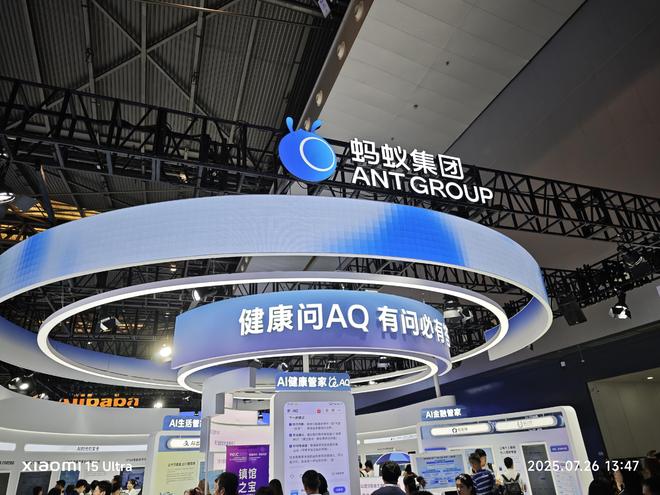
马云彻底翻身,阿里未来不可估量
Sou Hu Cai Jing· 2025-10-09 02:32
Core Viewpoint - Alibaba is transforming from a retail company into a "super intelligent entity" that aims to lead in the global AI industry, focusing on the development of Artificial Super Intelligence (ASI) to address major scientific challenges like climate change and energy crises [1][3][5]. Group 1: AI Development Strategy - Alibaba's CEO, Wu Yongming, stated that achieving Artificial General Intelligence (AGI) is a certainty, but the ultimate goal is to develop ASI that can self-iterate and surpass human intelligence [1][3]. - The company is investing significantly in AI infrastructure, with a plan to allocate 380 billion yuan (approximately 53 billion USD) over three years to support this initiative [5]. - The strategy aims to position Alibaba as a leading force in AI innovation, competing with top firms like OpenAI [3][5]. Group 2: Technological Advancements - Alibaba has recently updated its large model offerings, including seven new models that cover various fields such as language processing and programming, achieving breakthroughs in multiple areas [4]. - The company is also collaborating with NVIDIA to integrate Physical AI technologies, enhancing its AI platform capabilities and shortening development cycles for applications like autonomous driving [11][13]. Group 3: Market Positioning and Future Outlook - The shift towards ASI is seen as a necessary move for Alibaba to secure its future market position and to transition from a traditional e-commerce platform to an industry enabler [6][15]. - The company aims to leverage ASI to penetrate various sectors, including manufacturing and healthcare, addressing efficiency and innovation challenges [6][10]. - Alibaba's recent resurgence in e-commerce growth and technological advancements has restored market confidence, positioning the company for future success in the AI domain [15][16].

