
生成式人工智能

Search documents
IDC:2025年全球ICT市场总投资规模接近5.9万亿美元 有望在2029年增至7.6万亿美元
智通财经网· 2025-08-28 05:57
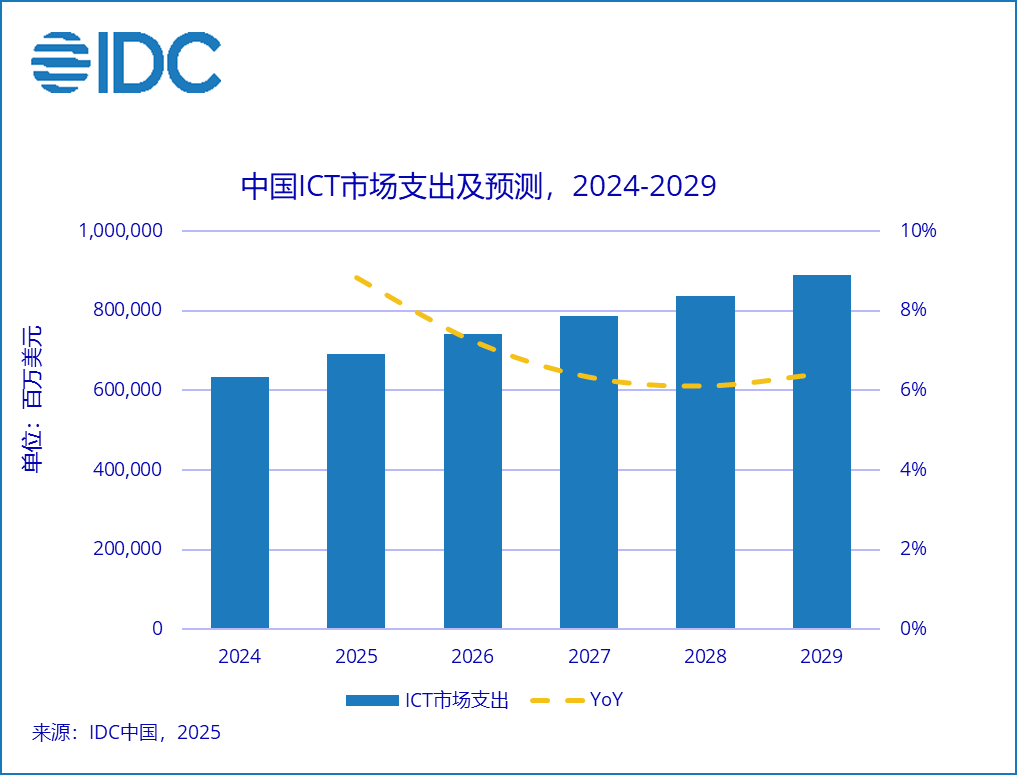
Core Insights - The global ICT market is projected to reach nearly $5.9 trillion by 2025, with an expected increase to $7.6 trillion by 2029, reflecting a compound annual growth rate (CAGR) of 7.0% over five years [1] - China's ICT market is forecasted to approach $889.4 billion by 2029, also with a CAGR of 7.0% [2] Market Overview - The enterprise-level ICT market in China is expected to reach approximately $314.7 billion by 2025, marking a 14.3% increase from 2024, outpacing GDP growth [4] - From 2025 onwards, the Chinese enterprise-level ICT market is projected to grow at a CAGR of 12.2%, reaching nearly $488.9 billion by 2029 [4] - The demand for generative artificial intelligence is a key driver of growth in the ICT market, particularly in the deployment of GPU servers by large enterprises [4] - Investment in enterprise-level servers and storage in China is expected to grow at a CAGR of 21.7% from 2024 to 2029 [4] - The IaaS spending in China is projected to grow at a CAGR of 14.7% [4] Technology Dimension - The hardware market is anticipated to be the largest segment, with spending expected to exceed $249.6 billion by 2029 [6] - The enterprise software market is projected to grow at the highest rate, with a CAGR of nearly 13.6% [6] - IT services are increasingly critical for enterprise digital transformation, enhancing operational efficiency and information security [7] Industry Insights - The software and information services sector remains a key area for ICT investment, with a projected CAGR of 22.9% starting in 2025, reaching nearly $150.7 billion by 2029 [8] - The education sector is rapidly adopting AI applications, driven by government policies and increasing demand for smart teaching solutions [8] - The wholesale and retail sector is accelerating its adoption of public cloud services, supported by government incentives and the growth of new retail formats [8] Enterprise Size Insights - Very large businesses (1000+ employees) are expected to account for nearly 30% of ICT spending in 2025 [9] - The demand for customized AI applications is creating numerous market opportunities, particularly in the service sector [9] - IDC's spending guide quantifies market potential across various dimensions, including global regions, technologies, industries, and enterprise sizes [9] IDC Spending Guide Purpose - The IDC Spending Guide aims to provide data support for IT vendors, industry users, and investment/financial institutions in strategic planning and investment decisions [10]

华为预告三折叠新品;小米2030年要成大家电头部丨科技风向标
2 1 Shi Ji Jing Ji Bao Dao· 2025-08-28 03:29
Group 1: Technology Sector Developments - Huawei is set to unveil its new Mate XTs foldable smartphone on September 4, featuring the new Kirin 9020 processor and satellite communication capabilities [2] - Nvidia reported Q2 2026 revenue of $46.743 billion, a 56% year-over-year increase, but its data center revenue fell short of expectations, leading to a market cap loss of $130 billion [3] - IBM and AMD announced a collaboration to develop a next-generation computing architecture that combines quantum computing and high-performance computing [5] - Huawei launched a new high-end SSD series optimized for AI workloads, enhancing performance and lifespan through innovative software [7] Group 2: Consumer Electronics and Appliances - Xiaomi aims to become a leading brand in the home appliance sector by 2030, with a 66% revenue growth in Q2 for its tech appliances, particularly a 60% increase in air conditioning sales [4] - Apple is expected to release the iPhone 17 series on September 10, with plans to discontinue several existing models, including the iPhone 15 and Apple Watch Series 10 [6] Group 3: Transportation and Delivery Services - Tesla expanded its Robotaxi service area in Austin from 91 square miles to 173 square miles and increased its fleet size by 50% [8] - Meituan announced plans to eliminate overtime penalties for its delivery riders by the end of 2025, focusing on improving rider experience [9] - Meituan's CEO stated that the company has reached a daily order volume of 100 million and aims to increase it to 150 million [10] Group 4: Strategic Partnerships and Investments - Horizon Robotics' CEO indicated that the industry is moving towards full-scene autonomous driving within the next five to ten years, with upcoming collaborations in the RoboTaxi sector [11] - JD Supermarket has become the largest importer of Ecuadorian roses in China, reducing prices by 30% through direct sourcing [12] - ZTE and China Guoxin signed a strategic cooperation agreement to enhance investment and market development in emerging industries [12] Group 5: Corporate Changes and Financial Updates - Nanwei Semiconductor appointed Chris Allexandre as the new CEO, effective September 1, 2025, marking a management transition [13] - Nikon announced the closure of its Yokohama manufacturing plant by September 30, 2025, with minimal financial impact expected [15] - Hongjing Technology plans to raise up to 1.35 billion yuan for smart computing projects [16] - Guanghe Technology intends to invest 2.6 billion yuan in a new manufacturing base project [17] - Cambridge Technology's major shareholder reduced its stake by 1.8 million shares [18] - Guoxin Technology announced plans to reduce its shareholding by up to 5% due to fund exits [19] - Yongji Co. terminated its acquisition plan for Turnafly Electronics after negotiations [20] - Chip Enjoy Technology completed a multi-billion B+ round financing to enhance its semiconductor automation services [21]




华为预告三折叠新品;小米2030年要成大家电头部丨新鲜早科技
2 1 Shi Ji Jing Ji Bao Dao· 2025-08-28 03:01
Group 1: Technology Sector Developments - Huawei is set to unveil its new Mate XTs foldable smartphone on September 4, featuring the new Kirin 9020 processor and satellite communication capabilities [2] - Nvidia reported Q2 2026 revenue of $46.743 billion, a 56% year-over-year increase, but its data center revenue fell short of expectations, leading to a market cap loss of $130 billion [3] - IBM and AMD announced a collaboration to develop a next-generation computing architecture that combines quantum computing and high-performance computing [5] Group 2: Consumer Electronics and Appliances - Xiaomi aims to become a top brand in the home appliance sector by 2030, with a 66% revenue growth in Q2 for its tech appliances, particularly a 60% increase in air conditioning sales [4] - Apple is expected to hold its fall event on September 10, where it will likely announce the iPhone 17 series and discontinue several existing models [6] Group 3: Transportation and Delivery Services - Tesla announced an expansion of its Robotaxi service area in Austin, increasing the coverage from 91 square miles to 173 square miles and boosting its fleet size by 50% [8] - Meituan plans to eliminate overtime penalties for its delivery riders by the end of 2025, enhancing rider experience and safety [9] Group 4: Semiconductor and Manufacturing - Nanjing-based semiconductor company, Cambridge Technology, reported a significant share reduction by its controlling shareholder, indicating potential challenges in its business operations [17] - National Integrated Circuit Industry Fund and other shareholders of Guoxin Technology plan to reduce their holdings by up to 5% due to fund exit requirements [18] - Chip Enjoy Technology completed a B+ round financing of several hundred million yuan, focusing on automation solutions for semiconductor manufacturing [20]
布米普特拉北京投资基金管理有限公司:美国年轻开发者就业下滑,AI替代效应显现
Sou Hu Cai Jing· 2025-08-28 02:59
Core Insights - The rise of artificial intelligence (AI) is significantly reshaping the U.S. job market, particularly affecting younger workers who are the first to experience these changes [1][3] - A recent study from Stanford University highlights that since the launch of ChatGPT at the end of 2022, generative AI has notably reduced employment rates for younger workers in automatable positions, especially in technical and language service roles [1][3] Employment Impact - The research team analyzed detailed employment data from ADP, isolating the independent impact of AI by excluding macroeconomic factors [3] - Employment in highly structured and easily automatable fields, such as software development, customer service, translation, and front desk roles, has shown a significant decline [3] - For instance, the employment of young workers aged 22 to 25 in software development has decreased by nearly 20% since late 2022, while older age groups have maintained stable employment or even seen growth [3] AI's Dual Effect - Despite fluctuations in hiring within the tech industry, the impact of AI is distinct and significant, particularly in customer service where AI's replacement effect is evident [5] - Conversely, in "augmented roles" such as AI-assisted medical diagnostics, young workers have experienced above-average employment growth, indicating that AI can enhance human capabilities rather than solely replace them [5] Future of Work and Skills - Erik Brynjolfsson, one of the study's authors, emphasizes that the value of AI should focus on enhancing human capabilities and creating new service demands rather than just cost-cutting automation [7] - This shift presents new challenges for talent development, as traditional career paths based on accumulating experience through basic tasks may diminish, necessitating systemic changes in education and industry to equip young workers with complex skills that AI cannot easily replace [7]

台积电集成创新模式分析
Xin Lang Cai Jing· 2025-08-28 01:41
Core Viewpoint - TSMC has established itself as the absolute leader in the global foundry industry through integrated innovation, driven by demand, technology leadership, deep collaboration, and an ecosystem of mutual benefits [2] Group 1: Integrated Innovation System - TSMC's success is attributed to a demand-driven, technology-led, deeply collaborative, and ecosystem-oriented integrated innovation system that connects demand insights to value realization [2] - The company has created a diverse product supply capability by integrating customer needs through innovative business models and a customer-first strategy [3] - TSMC's "customer-first" strategy emphasizes growth and shared success with high-quality clients, exemplified by its partnership with Apple, where TSMC absorbed defect costs to support Apple's chip orders [4] Group 2: Technological Leadership - TSMC maintains its position as a technology leader by deeply researching and mastering processes, equipment, and materials, leading to significant advancements in wafer fabrication and packaging technologies [5] - The company has consistently outpaced competitors, achieving milestones such as the first 7nm process in 2018, 5nm mass production in 2020, and plans for 2nm production by 2025 [5] Group 3: Organizational Efficiency - TSMC has adopted a fluid organizational structure to break down departmental barriers, ensuring effective collaboration between R&D and production [6] - The company has implemented a "headquarters innovation + global production" strategy, allowing for efficient conversion of laboratory results into mass production [7] Group 4: Ecosystem Collaboration - TSMC fosters a multi-win ecosystem through investments, joint R&D, and platform integration with industry partners [8] - The company has engaged in strategic investments, such as acquiring a 15% stake in ASML to ensure priority supply of critical equipment and materials [10] - TSMC's establishment of the TSMC Alliance promotes collaboration among customers, partners, and suppliers, enhancing competitiveness and innovation within the semiconductor industry [11]

OpenAI因致美国青少年自杀遭起诉 紧急升级ChatGPT安全机制
智通财经网· 2025-08-27 01:48
智通财经APP获悉,因被指导致16岁少年自杀,OpenAI 面临诉讼,其安全防护机制备受质疑。目前, OpenAI正计划对这款热门聊天机器人进行改进。此前,一名美国青少年于今年春季自杀,其家长起诉 称该青少年曾将ChatGPT当作"指导者"。 目前已出现至少一个名为"人类热线计划"(Human Line Project)的支持组织,旨在帮助那些称因使用聊天 机器人而产生妄想及其他心理问题的人群。 OpenAI在周二的博客中提到,对于表达自杀想法的用户,ChatGPT会建议其寻求专业帮助。该公司还已 开始为美国和欧洲的用户提供本地援助渠道,并将在ChatGPT内部设置可直接点击的紧急服务入口。此 外,OpenAI表示正研究如何在用户陷入危机早期提供帮助,例如可能搭建一个持证专业人士网络,让 用户能通过聊天机器人与这些专业人士建立联系。 "要实现这一目标,需要时间和细致的工作,以确保万无一失。"该公司在博客中称。 此外,OpenAI计划推出家长管控功能:家长可设定孩子使用ChatGPT的方式,并查看其使用详情。 这篇博客发布当天,美国加利福尼亚州16岁高中生亚当·雷恩(Adam Raine)的父母对OpenAI及 ...
斯坦福大学研究:AI 正让美国职场新人更难找到开发、客服等工作
Sou Hu Cai Jing· 2025-08-27 01:46
Core Insights - AI is making it more difficult for young workers aged 22 to 25 to find jobs in software development and customer service, with employment rates in these sectors declining by 16% [1] - Positions most affected by AI, such as accounting, developers, and administrative assistants, have seen a 13% decrease in employment rates for new entrants over the past three years, while experienced workers' employment remains stable or improves [1][3] - Low-skilled jobs, such as nursing assistants, are experiencing an upward trend in employment [1] Impact of AI on Employment - The research indicates a complex impact of AI on the labor market, with limited data supporting the notion that AI leads to job losses [3] - The unemployment rate for young graduates began to decline as early as 2009, prior to the current AI wave, suggesting that other factors may be at play [3] - Surprisingly, jobs like translation, which seem vulnerable to AI, have actually seen an increase in employment opportunities in recent years [3] Experience and Skill Level - The impact of AI largely depends on the experience and skills of employees rather than the type of job [4] - In industries adopting generative AI, experienced workers are less likely to be replaced, with job opportunities remaining stable or slightly increasing [4] - Repetitive tasks, such as writing API connection code, are more susceptible to automation, aligning with previous assertions from software developers [4] Salary Levels - Despite the reduction in job opportunities, AI has not yet led to a decrease in salary levels [4]
杨红霞:跑通大模型“最后一公里”,让AI不再只是“富人的玩具”
Sou Hu Cai Jing· 2025-08-26 19:05
Core Insights - The article discusses the significant investment gap in AI between US and Chinese tech companies, with US firms investing nearly five times more than their Chinese counterparts by 2025 [7][8] - It highlights the challenges and opportunities in AI development, particularly in the context of healthcare and the application of generative AI [16][22] Investment Disparity - In the past five years, US tech giants like Microsoft and Amazon have collectively spent 5.36 trillion RMB on AI, while leading Chinese companies like Tencent and Alibaba have only invested 630 billion RMB [7][8] - By 2025, US companies are projected to invest around 2.5 trillion RMB in AI, compared to approximately 500 billion RMB from Chinese firms [8] AI Model Development - OpenAI's latest model, GPT-5, is claimed to be the best model yet, but it reportedly lacks the emotional interaction and imagination of its predecessor, GPT-4o [3][4] - The complexity of multi-modal AI remains a significant challenge, with current models struggling to accurately extract and correlate image and text data [4][5] Healthcare Applications - The Hong Kong Polytechnic University is developing a specialized small language model for cancer treatment, collaborating with major hospitals to enhance AI's role in complex medical diagnoses [16][22] - The focus is on creating an AI that can assist in cancer patient follow-ups and streamline processes like target area delineation in radiation therapy [22][23] Future Prospects - The article emphasizes the need for Chinese companies to invest more confidently in AI, suggesting that the future breakthroughs may lie in deeper industrial applications rather than just internet-based solutions [12][13] - There is optimism about overcoming current limitations in AI capabilities, particularly in the context of localized data and specialized applications in healthcare [20][21]

人工智能下一站:新消费硬件
腾讯研究院· 2025-08-26 09:35
Core Viewpoint - The article discusses the emergence of AI-native companies that prioritize artificial intelligence as their core product or service, leading to new technologies, products, and business models in the AI hardware industry [2]. Group 1: AI Consumer Hardware Development Routes - AI consumer hardware has seen significant innovation in 2023, with new categories like AI phones, smart glasses, rings, headphones, and companion robots rapidly emerging [4]. - The development routes can be categorized into three main paths: 1. AI-native devices exploring new interaction paradigms, represented by products like Rabbit R1 and Humane AI Pin, which rely on semantic understanding and task execution driven by large models [5]. 2. Gradual enhancement of existing devices with AI capabilities, exemplified by Apple and Meta, which integrate AI into established hardware like smartphones and wearables [6]. 3. Model-centric empowerment paths led by companies like OpenAI, focusing on providing AI capabilities through APIs and SDKs to third-party devices [7]. Group 2: Emerging Business Models in AI Consumer Hardware - The article identifies the initial emergence of business models corresponding to the three development routes, highlighting their respective core challenges: 1. AI-native exploration models rely on high-priced hardware and subscription services to generate stable revenue streams, but face challenges in proving hardware value and user adoption [10]. 2. Gradual enhancement models focus on hardware sales and value-added subscription services, benefiting from low user recognition barriers and high market acceptance [12]. 3. Model empowerment paths replicate aspects of the Android model, charging for API access and enterprise-level services, but face challenges in cost and adaptation to various hardware [15]. Group 3: Future Trends in AI Consumer Hardware - The integration of upstream and downstream in the industry is becoming tighter, with model vendors collaborating with chip manufacturers to optimize model performance across devices [18]. - The trend towards "unobtrusive" interaction is accelerating hardware paradigm shifts, with AI glasses becoming a focal point for competition among tech giants and emerging brands [21]. - Long-term, AI hardware is expected to evolve towards a model where AI acts as a primary interface, with voice and natural language interactions becoming the norm, potentially replacing traditional graphical user interfaces [27].




张静:筑牢人工智能发展安全防线
Jing Ji Ri Bao· 2025-08-26 00:07
Core Viewpoint - The article emphasizes the importance of establishing a comprehensive risk prevention system for generative artificial intelligence (AI) development, highlighting its implications for national security, social stability, and international competitiveness [1][5]. Group 1: Technological Development and Safety - The Chinese government aims to ensure that technological innovation serves the public good, with a focus on improving people's lives and promoting social equity through generative AI [2][6]. - There is a need to balance development and safety, recognizing that safety is a prerequisite for development, and that effective risk management should be integrated throughout the entire lifecycle of AI technology [2][4]. Group 2: Data Governance - Data is crucial for training AI models, and its management must adhere to strict regulations to prevent misuse and ensure security, drawing on frameworks like the EU's General Data Protection Regulation [3][4]. - Establishing a robust data governance framework is essential, including real-time monitoring and quality control measures to enhance data reliability and prevent privacy breaches [3][6]. Group 3: Regulatory Framework - A clear legal framework is necessary for AI governance, which should define the responsibilities of developers, users, and regulators, ensuring compliance and effective oversight [4][5]. - Collaborative governance involving multiple departments is essential to enhance regulatory efficiency and address potential blind spots in AI oversight [4][6]. Group 4: Public Engagement and Education - Raising public awareness and understanding of AI is critical, with educational initiatives aimed at different age groups to foster a rational approach to technology and its risks [5][6]. - Encouraging societal participation in monitoring AI applications can create a supportive environment for sustainable development in the AI sector [5][6].