
去美元化

Search documents
机构看金市:2月3日
Xin Lang Cai Jing· 2026-02-03 04:22
贺利氏贵金属:近期金价的大起大落中基本面作用很小 FXStreet网站:短期内金价的上涨可能会受到限制 继续关注美伊会谈进展 【机构观点分析】 转自:新华财经 银河期货:金银市场调整是对前期累积风险的释放 中长期来看宏观逻辑并未发生根本性转变 南华期货:金银短期震荡仍是主基调 中长期上涨趋势未改 新湖期货:全球白银ETF流入超1000吨 金银止跌企稳信号初现 南华期货表示,短期来看,金银已完成60日均线回踩,进一步下探风险明显降低,但考虑隐含波动率仍 处于高位,震荡整理或仍是短期主基调。当前金银的阶段性调整并未改变其中长期上涨趋势,反而为中 长期做多投资者提供了优质的补仓机会。 从更长周期来看,全球以美元为主导的信用货币体系信誉持 续走弱,美国财政的不可持续性、美元霸权等核心问题日益凸显,加速了全球去美元化进程。这一趋势 推动全球各国央行持续增持黄金储备,同时引发黄金定价权的争夺与全球黄金市场体系的重构,为金银 中长期上涨奠定了坚实基础。 新湖期货表示,全球主要白银ETF在连续多日流出后,在2日大幅流入超1000吨,接近前期新高,黄金 ETF持仓量保持在高位附近,变动不大。另外,美国劳工统计局表示,由于联邦政 ...
黄金涨3%、白银涨5%,这轮回调稳了吗
Sou Hu Cai Jing· 2026-02-03 04:03
Core Viewpoint - The precious metals market has experienced significant volatility, with gold and silver prices rebounding after sharp declines, indicating a turbulent trading environment influenced by market sentiment and external factors [2][3]. Group 1: Market Performance - As of February 3, 2026, gold was priced at $4809.25, reflecting a daily increase of over 3%, while silver reached $83.808, with a daily rise exceeding 5% [2][3]. - On February 2, 2026, gold prices fell below $4800 per ounce, marking a daily decline of 3.35%, and silver saw a drop of 6% to $79.57 per ounce [2]. - The maximum intraday drop for gold on January 31, 2026, was 12%, reaching a low of $4682 per ounce, while silver experienced a historic intraday decline of over 36%, hitting $74.28 per ounce [3]. Group 2: Institutional Responses - Major state-owned banks have issued multiple risk warnings regarding precious metal price volatility, with the Industrial and Commercial Bank of China (ICBC) issuing four alerts within a week [4]. - ICBC advised investors to adopt a medium to long-term perspective and to diversify their investment strategies in light of increased market volatility [4]. - Several banks have raised the investment thresholds for precious metals and implemented limit management to help investors manage risks [5]. Group 3: Market Analysis - Analysts have noted that the extreme volatility in the precious metals market is partly due to increased leverage and positions, leading to a broader market sell-off [3][6]. - The nomination of Kevin Warsh as the next Federal Reserve Chairman by President Trump has created expectations of potential policy shifts, impacting market sentiment [6]. - Despite short-term pressures from a stronger dollar and liquidity contraction, some analysts believe that the long-term outlook for precious metals remains positive due to geopolitical factors and fiscal sustainability concerns [6][7].

黄金牛市还在吗?华尔街坚定看多:技术性回调不要怕,中国买家已成黄金市场强劲支柱!
Hua Er Jie Jian Wen· 2026-02-03 03:05
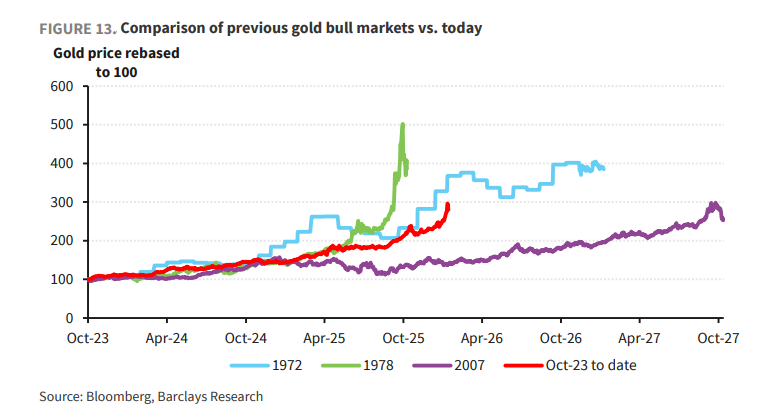
Core Viewpoint - The recent volatility in the gold market, characterized by a rapid price surge to $5,600 followed by a sharp decline below $4,500, is viewed as a technical correction rather than a fundamental market collapse, with expectations of a rebound towards $6,000 in the future [1][2][4]. Group 1: Market Dynamics - Gold prices experienced a dramatic fluctuation, rising from $4,300 to $5,600 and then falling below $4,500, marking one of the largest single-day declines in history [1]. - Major financial institutions like Barclays, UBS, and Deutsche Bank maintain that the current market adjustment is a healthy correction following excessive speculation, with UBS noting a 21% drop from peak prices due to a "cleaning out" of short-term positions [2][4]. - The fair value of gold is estimated at around $4,000, with current prices still reflecting a premium that has returned to reasonable levels after a drop to $4,900 [4]. Group 2: Demand Factors - Chinese investors are significantly increasing their gold purchases, with a reported threefold increase in buying intensity for gold ETFs compared to the previous year, indicating a strong demand driver in the market [2][14]. - In January 2026 alone, Chinese gold ETF holdings increased by 940,000 ounces, suggesting a potential annual increase of 11.5 million ounces, far surpassing the previous year's record [14]. - Despite high gold prices dampening jewelry demand, there is a notable shift towards investment in physical gold bars and coins, with Chinese investors showing a tendency to buy more as prices rise [21][17]. Group 3: Economic and Geopolitical Context - The macroeconomic environment remains supportive for gold, with ongoing geopolitical tensions, fiscal expansion, and concerns over fiat currency devaluation driving investors towards gold as a safe haven [8][9]. - The U.S. fiscal policy under the "Trump 2.0" era, characterized by expansive fiscal measures, is seen as undermining the safe-haven status of U.S. Treasury bonds, increasing fears of currency devaluation [9]. - The anticipated inflation rate of 3% in the U.S. could provide a 15% intrinsic upward pressure on gold prices, as each 1% increase in CPI correlates with a 5% rise in gold prices [10]. Group 4: Investment Opportunities - Barclays highlights the attractiveness of gold mining stocks, which historically perform well during gold bull markets, suggesting potential for significant returns as the current bull market is still in its early stages [23]. - The ongoing trend of central banks diversifying their reserves away from the dollar, with countries like Poland and South Korea increasing their gold holdings, indicates a sustained demand for gold in the long term [24]. - UBS notes that despite recent price volatility, many long-term institutional investors still have low gold allocations, presenting an opportunity for these investors to enter the market at favorable prices around the $4,500 support level [22].
金价震荡加剧,但宏观环境未变?
日经中文网· 2026-02-03 02:53
Core Viewpoint - Gold prices are experiencing significant volatility, influenced by geopolitical risks and political pressure on the Federal Reserve, but the underlying environment has not changed much [2][7]. Group 1: Price Movements - On January 29, the London spot price of gold reached a peak of $5,594.82 per ounce, followed by a dramatic drop to $4,864.35 on January 30, marking a decline of $530 (9.8%) in a single day, the largest daily drop since 1980 [4]. - The total market value of gold saw a loss of approximately $4.3 trillion in just one day, with the total mined gold amounting to about 220,000 tons by the end of 2025 [4][5]. - Following the price drop, gold prices continued to decline, reaching around $4,400 in Asian trading on February 2, marking a one-month low [4]. Group 2: Investment Trends - Gold has increasingly been viewed as a speculative asset rather than just a safe haven, with rising demand from individual investors and central banks [5][7]. - The World Gold Council reported an 80% increase in investment demand for gold in 2025 compared to the previous year, with ETFs seeing a shift from a net outflow of 2.9 tons to a net inflow of 801.2 tons [7]. - The volatility in gold prices has attracted more hedge funds and investors seeking returns, further pushing gold away from its traditional role as a stable asset [5][7]. Group 3: Market Influences - The nomination of former Fed Governor Walsh as the next Fed Chair, perceived as a hawk favoring tighter monetary policy, triggered a sell-off in gold as investors anticipated negative impacts on prices [7][9]. - Increased leveraged trading has exacerbated the sell-off, contributing to the rapid decline in gold prices [7]. - Despite the recent volatility, long-term trends suggest that the upward trajectory of gold prices remains intact, according to market analysts [8].
华安基金:黄金短期波动加剧 关注中长期配置价值
Xin Lang Cai Jing· 2026-02-03 02:52
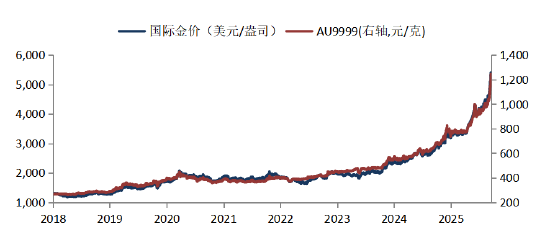
Group 1: Market Overview - The global gold market has experienced significant volatility, with London gold prices reaching a historical high of nearly $5,600 per ounce on January 29, followed by a drop of over 9% the next day, falling below the $5,000 mark [1][7] - Last week, the London spot gold closed at $4,880 per ounce, reflecting a week-on-week decrease of 2.0%, while domestic AU9999 gold was priced at 1,164 yuan per gram, showing a week-on-week increase of 4.8% [1][7] Group 2: Causes of Market Fluctuation - The recent market turmoil is attributed to a combination of internal market vulnerabilities and external catalysts, primarily driven by overheated trading conditions and crowded positions in the gold market [1][8] - The immediate trigger for the market pullback was the nomination of Kevin Warsh as the next Federal Reserve Chairman, which sparked fears regarding policy expectations. His perceived hawkish stance has raised concerns about a potential tightening of liquidity, impacting gold prices [2][8] Group 3: Policy Implications - Warsh's policy proposals are complex, advocating for both interest rate cuts and significant balance sheet reduction, which the market has interpreted as hawkish. This has led to a reassessment of the previous expectations of ongoing liquidity and inflation concerns that supported rising gold prices [2][9] - The combination of "rate cuts + balance sheet reduction" aims to create space for future rate cuts by addressing the oversized balance sheet, which is seen as a constraint on monetary policy [9] Group 4: Geopolitical Factors - Geopolitical risks, particularly the tensions between the U.S. and Iran, are also influencing market sentiment. Recent developments include increased military presence in the Middle East and potential back-channel communications, which have created mixed signals regarding the risk of escalation [11] Group 5: Future Outlook - The recent drop in gold prices is viewed as a short-term technical adjustment rather than a long-term trend reversal. The market is transitioning from a phase of unilateral gains to a more complex environment characterized by intense competition between bulls and bears [11] - Long-term structural factors supporting gold remain intact, including ongoing demand from central banks amid de-dollarization, pressures on the dollar's long-term credibility due to fiscal policies, and systemic risks arising from a fragmented geopolitical landscape [11]
首席点评:贵金属继续调整
Shen Yin Wan Guo Qi Huo· 2026-02-03 02:45
报告日期:2026 年 2 月 3 日 申银万国期货研究所 首席点评:贵金属继续调整 2026 年春节将迎来 9 天假期,为繁荣节日市场、丰富群众文化生活、激发假期 消费活力,日前,商务部等 9 单位发布关于印发《2026"乐购新春"春节特别活 动方案》的通知。《方案》紧扣年俗文化、家庭团圆、购物出行等核心需求,扩 大优质商品和服务供给,丰富多元化消费场景,激发实体商业活力。中共中央、 国务院批复同意《现代化首都都市圈空间协同规划(2023-2035 年)》,要求建 成以首都为核心的世界一流都市圈、先行示范中国式现代化的首善之区,支撑京 津冀世界一流城市群建设。国内商品期货夜盘收盘,原油主力合约下跌 4.8%报 450 元/桶;贵金属方面,沪金主力合约下跌 3.86%报 1045 元/克,沪银主力合约 下跌 20%报 20600 元/千克。 重点品种:贵金属、原油、股指 贵金属:白银:夜盘沪银期货再度跌停。此次贵金属巨震主要受两方面因素影响: 一是因为 1 月 30 日特朗普宣布提名凯文·沃什为下一任联储主席,沃什的传统 鹰派立场,带动美元指数明显回升,市场对美联储独立性担忧有所缓解。二是此 前贵金属短期内快 ...
品种策略日报:铂、钯-20260203
Shen Yin Wan Guo Qi Huo· 2026-02-03 02:45
2026年02月03日 申万期货品种策略日报-铂、钯 | | | 申银万国期货研究所 | | | 陈梦赟(从业资格号:F03147376;交易咨询号:Z0022753) | | | | --- | --- | --- | --- | --- | --- | --- | --- | | | | | sunxm@sywgqh.com.cn | | 021-50585921 | | | | | | pt2606 | pt2608 | pt2610 | pd2606 | pd2608 | pd2610 | | | 现价 | 552.15 | 545.35 | 548.20 | 413.70 | 410.60 | 407.05 | | 期 | 前收盘价 | 630.55 | 625.00 | 625.50 | 464.05 | 455.00 | 459.00 | | 货 | 涨跌 | -105.15 | -103.85 | -104.40 | -78.80 | -78.20 | -77.50 | | 市 场 | 涨跌幅 | -16.00% | -16.00% | -16.00% | -16.00% | -16.00% ...
股商波动剧烈,全球资源品大周期?丨周度量化观察
申万宏源证券上海北京西路营业部· 2026-02-03 02:15
Core Viewpoint - The article discusses the recent volatility in the stock market, particularly in resource-related sectors, and highlights the ongoing global resource cycle, with a focus on investment opportunities and market dynamics [1]. Equity Market Summary - A-shares experienced a decline in prices but an increase in trading volume, with average daily trading exceeding 3 trillion yuan. Resource sectors such as oil, coal, non-ferrous metals, and agriculture led the market, indicating a broad revaluation of physical assets [1]. - The CSI Value Index rose by 1.01%, while the CSI Growth Index fell by 0.59%. The Hang Seng Index outperformed A-shares with a 2.38% increase [1]. - The market is expected to exhibit a "slow bull" characteristic until the Spring Festival, with rapid thematic rotations. Long-term investment strategies focusing on resource competition and technological self-reliance are recommended [4]. Bond Market Summary - The bond market remained stable, with the central bank supporting liquidity. Short-term bonds showed little volatility, while long-term bonds were relatively weaker. The low interest rate environment is expected to persist, but increased market speculation and volatility are anticipated [5]. Commodity Market Summary - Gold prices experienced significant fluctuations, reaching historical highs before a technical correction. The volatility was driven by geopolitical risks and a strengthening dollar due to potential hawkish signals from the Federal Reserve [6]. - The South China Commodity Index rose by 2.60%, with notable increases in precious metals and energy sectors, while non-ferrous metals and black commodities saw declines [35]. Overseas Market Summary - The US stock market showed overall gains, with large-cap stocks outperforming small-cap stocks. The Federal Reserve maintained interest rates, aligning with market expectations, while the dollar weakened significantly due to political statements [2]. - The AI industry trend remains strong, with a focus on productivity and revenue growth, while traditional cycles are being monitored for recovery [7].

黄金续跌创逾两周新低 多重利空共振触发千点回调
Jin Tou Wang· 2026-02-03 02:14
此轮跌势的直接导火索,源于美国总统特朗普对美联储人事的"鹰派"提名。上周五特朗普宣布,提名前 美联储理事凯文.沃什接替鲍威尔出任下一届美联储主席(任期2026年5月开启)。由于沃什素以鹰派立场 著称,其提名被市场解读为美联储未来政策可能转向更紧缩的方向——这一预期直接挫败了投资者 对"进一步降息"的押注。受此推动,美元指数自低位大幅反弹,前期积累大量多头的黄金市场随即触发 获利了结潮,成为金价下行的核心推力。 除货币政策预期生变外,地缘局势的阶段性缓和进一步削弱了黄金的避险吸引力。最新消息显示,美国 方面已释放与伊朗谈判的积极信号,伊朗外长回应称双方接触"取得成效",并认为达成公平协议"存在 可能",甚至有望在短期内落地。与此同时,乌克兰总统泽连斯基也表示准备就相关议题展开"实质 性"讨论,下一届三方会议计划于2月4-5日在阿布扎比举行。地缘紧张氛围的降温,使得黄金作为"避险 锚"的配置需求短期回落。 不过,黄金市场的深层支撑逻辑尚未完全瓦解。一方面,地缘局势的不确定性仍未彻底消除——中东局 势的复杂性、俄乌问题的长期化特征,均可能随时引发新的避险情绪升温;另一方面,全球"去美元 化"浪潮持续推进,各国央行对 ...
西南期货早间评论-20260203
Xi Nan Qi Huo· 2026-02-03 02:10
1. Report Industry Investment Ratings No relevant content provided. 2. Core Views of the Report - The macro - economic recovery momentum needs to be strengthened, and the monetary policy is expected to remain loose. Treasury bond futures may face pressure, and investors should be cautious [6]. - The domestic economy is stable, but the recovery momentum is weak. However, due to low asset valuations and economic resilience, the stock index's fluctuation center is expected to gradually rise, and previous long positions can be held [9]. - The global trade - financial environment is complex. Although gold's allocation and hedging values are favorable, the recent sharp rise in precious metals has led to significant speculation. It is recommended to exit long positions and wait and see [12]. - The prices of rebar and hot - rolled coils may continue to fluctuate weakly. Investors can look for opportunities to go long on dips and pay attention to position management [14]. - The iron ore market has a weak supply - demand pattern and may continue to fluctuate in the short term. Investors can look for opportunities to go long on dips [16]. - Coke and coking coal futures may continue to fluctuate in the medium term. Investors can look for low - level buying opportunities [19]. - Ferroalloys are in an overall oversupply situation, but the cost has limited downward space. After a decline, investors can consider long positions in the low - level range [22]. - Crude oil may regain strength after a pullback, but it is recommended to exit the main contract and wait and see [24][25]. - Fuel oil may have room to rise after a pullback, but it is recommended to exit the main contract and wait and see [26][27]. - For polyolefins, investors can look for long - buying opportunities [30]. - Synthetic rubber is expected to be in a relatively strong oscillation [32]. - Natural rubber may run relatively strongly in the short term [33]. - PVC is expected to be in a relatively strong oscillation, but attention should be paid to export sustainability and post - holiday demand recovery [34][36]. - Urea prices are expected to be oscillating and relatively strong in the short term, driven by export demand and cost support [37]. - PX may be in an oscillating adjustment in the short term, and investors should participate cautiously [39]. - PTA may oscillate in the short term, and it is recommended to operate cautiously [40]. - Ethylene glycol may maintain an oscillating bottom - building pattern, and it is recommended to operate cautiously [42]. - Short - fiber may follow the raw material price in the short term, and it is recommended to wait and see cautiously [45]. - Bottle chips may follow the cost side, and it is recommended to participate cautiously before the Spring Festival [46]. - Soda ash is expected to be lightly and stably sorted before the festival, and investors should be cautious [47][48]. - Glass is expected to oscillate before the festival, and investors should pay attention to the risk of returning to the fundamentals [49]. - Caustic soda has a high - supply pattern, and due to the approaching Spring Festival, the trading sentiment may fluctuate, but investors should be cautious [50][51]. - Pulp is expected to have limited fluctuations in the market before the festival [52]. - Lithium carbonate may have increased short - term fluctuations, but the support at the bottom is still strong, and investors should control risks [54]. - Copper prices are expected to be adjusted before the festival [55]. - Aluminum prices are under pressure in the short term [57]. - Zinc prices may enter an adjustment period [59]. - Lead prices maintain a range - bound oscillation [61]. - Tin prices have support at the bottom, but short - term fluctuations may intensify, and investors should control risks [63]. - Nickel is in an oversupply pattern, and investors should pay attention to relevant policies in Indonesia [65]. - For soybean meal, investors can look for long - position opportunities in the low - cost support range; for soybean oil, it is advisable to wait and see after the price leaves the low - cost range [67][68]. - For palm oil, investors can consider long - buying opportunities after a pullback [70]. - For rapeseed meal and rapeseed oil, it is recommended to wait and see for the time being [73]. - Cotton prices are expected to be strong in the medium and long term, but there is pressure on the domestic market in the short term. Investors can go long in batches after a sufficient pullback [77][78]. - Sugar prices are expected to be weak in the medium and long term [80]. - Apple prices are expected to be strong in the medium and long term. After a pullback, investors can go long in batches [81]. - For live pigs, it is recommended to wait and see [84]. - For eggs, it is recommended to take profit on previous long - spread positions [85]. - Corn and corn starch may follow the market trend, and it is recommended to wait for the release of supply pressure [87]. - Logs show a strong performance in the short term, but the fundamental structure needs time to improve. Attention should be paid to external quotes, holiday progress, and shipping dynamics [90]. 3. Summary by Catalog Pulp - The previous trading day, the main 2605 contract closed at 5,266 yuan/ton, down 1.39%. The port inventory continued to accumulate, terminal demand stagnated, and some holders sold at a discount due to capital needs. The market is expected to have limited fluctuations before the festival [52]. Carbonate Lithium - The previous trading day, the main contract fell 13.99% to 132,440 yuan/ton. The supply is at a high level, the demand is strong, and the inventory is gradually decreasing. The price has short - term support, but short - term fluctuations may increase [53][54]. Copper - The previous trading day, the Shanghai copper main contract closed at 100,820 yuan/ton, down 1.01%. Geopolitical events stimulate risk - aversion demand, but the real demand is weak, and the price is expected to be adjusted before the festival [55]. Aluminum - The previous trading day, the Shanghai aluminum main contract closed at 23,530 yuan/ton, down 2.12%; the alumina main contract closed at 2,821 yuan/ton, up 1.18%. The supply of alumina is loose, and the electrolytic aluminum supply has limited growth space. The demand is weak, and the price is under pressure in the short term [57]. Zinc - The previous trading day, the Shanghai zinc main contract closed at 24,890 yuan/ton, down 1.07%. The supply is tightened, the demand is weak, and the price may enter an adjustment period [59]. Lead - The previous trading day, the Shanghai lead main contract closed at 16,675 yuan/ton, down 0.77%. The supply and demand are both weak, and the price maintains a range - bound oscillation [61]. Tin - The previous trading day, the Shanghai tin main contract fell 12.3% to 360,000 yuan/ton. The supply is tight, the demand has some resilience, and the short - term fluctuations may intensify [63]. Nickel - The previous trading day, the Shanghai nickel main contract fell 2.83% to 1,432,670 yuan/ton. The cost is expected to rise, the consumption is not optimistic, and the first - grade nickel is in an oversupply pattern [64][65]. Soybean Oil and Soybean Meal - The previous trading day, the soybean meal main contract fell 0.94% to 2,750 yuan/ton, and the soybean oil main contract fell 2.62% to 8,092 yuan/ton. The Brazilian soybean harvest is progressing quickly, and the demand for soybean meal is growing moderately, while the demand for soybean oil is slightly improving [66][67]. Palm Oil - The Indonesian government plans to restrict the export of palm oil waste. The domestic palm oil inventory is at a medium level in the past seven years. It is recommended to consider long - buying opportunities after a pullback [69][70]. Rapeseed Meal and Rapeseed Oil - The price of Canadian rapeseed is weak. The domestic rapeseed meal inventory is at the second - highest level in the past seven years, and the rapeseed oil inventory is at a medium level. It is recommended to wait and see for the time being [71][73]. Cotton - The previous trading day, domestic Zheng cotton decreased in position and fell. The USDA supply - demand report is favorable, and the domestic cotton supply is expected to be tight in the future. The price is expected to be strong in the medium and long term, but there is pressure in the short term [74][77]. Sugar - The previous trading day, Zheng sugar decreased in position and fell. India has a strong production - increase expectation, and the domestic market is under the pressure of new domestic sugar and imported sugar. It is expected to be weak in the medium and long term [79][80]. Apple - The previous trading day, the domestic apple futures fell slightly. The current inventory is at a low level in recent years, and the new - season apple production has declined. It is expected to be strong in the medium and long term. After a pullback, investors can go long in batches [81]. Live Pigs - The previous trading day, the main contract fell 0.04% to 11,220 yuan/ton. The supply pressure in the first quarter may still be large, and it is recommended to wait and see [83][84]. Eggs - The previous trading day, the main contract fell 1.51% to 3,002 yuan/500kg. The supply in February may remain at a relatively high level. It is recommended to take profit on previous long - spread positions [85]. Corn & Starch - The previous trading day, the corn main contract fell 0.70% to 2,261 yuan/ton; the corn starch main contract fell 0.63% to 2,513 yuan/ton. The domestic corn is basically in balance between production and demand, and the corn starch may follow the corn market [86][87]. Logs - The previous trading day, the main 2603 contract closed at 795.0 yuan/ton, up 0.13%. The supply is slightly reduced, the inventory is decreasing, and the cost is slightly increasing. The short - term performance is strong, but the fundamental improvement needs time [88][90].