避险工具

Search documents
疯狂黄金!十年涨3倍,从走势图复盘金价上升之路
Sou Hu Cai Jing· 2026-02-10 05:03
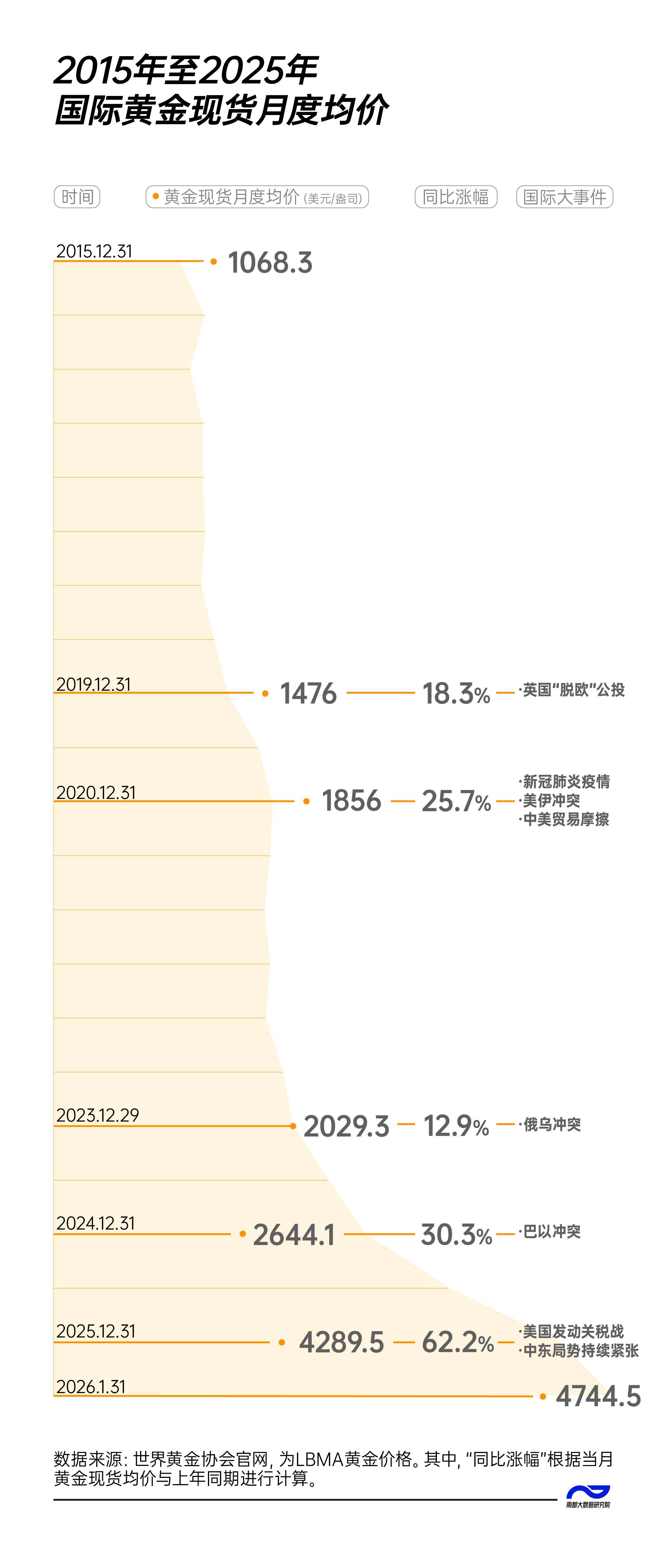
Core Viewpoint - The international gold price has experienced significant fluctuations and a remarkable increase over the past decade, with a rise of over 300%, establishing gold as a core asset in global asset allocation [1][17]. Group 1: Price Trends - By the end of January 2026, the international spot gold price surpassed $5,500 per ounce, with subsequent volatility leading to a drop and recovery above $5,000 [1][16]. - In 2016, gold prices ended a three-year decline, with an annual increase of nearly 8%, influenced by events like the Brexit vote [2]. - In 2017, gold prices rebounded from a low of $1,146.14 per ounce to a high of $1,357.67, closing the year at $1,302.67, with an average price of $1,257.2 [7]. - The year 2018 saw central banks purchase a record 651.5 tons of gold, contributing to a slight annual price increase despite market fluctuations [7]. - In 2019, gold prices surged to around $1,500 per ounce, with an annual increase of 18.3%, marking the best performance since 2010 [8]. - The year 2020 experienced a 25% increase in gold prices, maintaining an upward trend despite minor fluctuations [8]. - In 2022, gold prices fluctuated significantly due to geopolitical tensions and inflation, achieving a 5.6% annual increase [9]. - In 2023, gold prices reached a peak of $2,152.3 per ounce, with an annual increase of approximately 13% [9]. - The year 2024 saw gold prices rise significantly, with a nearly 30% annual increase, marking the largest annual gain since 2010 [10]. - In 2025, gold prices exploded, surpassing $4,600 per ounce, with an annual increase exceeding 60%, the largest since the 1979 oil crisis [11]. Group 2: Market Dynamics - The demand for gold has shifted from a mere safe-haven asset to a core component of global central bank reserves, with gold's share in official reserves rising to 28.9% by Q3 2025 [17]. - The global economic uncertainty and geopolitical tensions have reinforced gold's status as a tangible asset, challenging the dominance of the US dollar [17]. - Central banks have increasingly diversified their asset allocations by purchasing gold, indicating a structural change in global gold market demand [17].

黄金创纪录上涨,美元储备地位降至数十年新低
Huan Qiu Wang· 2026-01-10 03:05
Group 1 - The core viewpoint of the articles highlights a significant surge in gold prices, which rose by 65% in 2025, reaching a historical high of $4549.71 per ounce, marking the largest annual increase since 1979 [1][3] - Morgan Stanley predicts that gold prices will rise to $4800 per ounce by Q4 2026, driven by declining interest rates, changes in Federal Reserve leadership, and continued purchases by central banks and funds [3] - Analysts from Bank of America also view gold as a crucial hedge in investment portfolios for 2026, estimating an average price of $4538 per ounce for the year [3] Group 2 - The decline of the US dollar is evident, with its share in global foreign exchange reserves dropping to just above 40%, the lowest level in decades, while the dollar index fell by 9.4% in 2025, marking its worst performance in eight years [1][3] - The increasing role of gold in sovereign reserves is a key driver of its price surge, as central banks actively accumulate gold to hedge against dollar risks, with significant increases in gold holdings reported by the International Monetary Fund (IMF) [4] - The unusual rise in prices of major metals like gold, silver, and copper signals the underlying weakness of the dollar, suggesting a potential for further depreciation of the dollar as alternative currencies may begin to appreciate [3][4]
中国国际经济交流中心学术委员会副主任陈文玲:乱世黄金再次得到验证
Bei Jing Ri Bao Ke Hu Duan· 2026-01-07 06:19
Core Viewpoint - The international gold price is expected to reach historical highs by the end of 2025, driven by geopolitical tensions, supply-demand imbalances, and increased demand for safe-haven assets, with a cumulative increase of over 70% in gold prices during the year [1][2]. Group 1: Factors Driving Gold Price Increase - Geopolitical turmoil is identified as the primary driver of the current surge in gold prices, with events such as the U.S. military intervention in Venezuela and the ongoing Russia-Ukraine conflict contributing to increased uncertainty [2]. - The restructuring of the international monetary system from a unipolar to a multipolar reserve system is accelerating, with central banks, particularly in emerging markets like China, Russia, and India, increasing their gold reserves as a form of diversification [2]. - Concerns over the purchasing power and value retention of the U.S. dollar are rising, exacerbated by the U.S. federal debt surpassing $38 trillion, leading to a reassessment of the dollar's safety and a renewed emphasis on gold as a "non-sovereign asset" and ultimate safe haven [2]. Group 2: Characteristics of Gold Price Surge - The significant rise in gold prices in 2025 is characterized by a "multi-logical resonance," combining long-term trends from the collapse of the Bretton Woods system, traditional geopolitical risk, inflation hedging, and the impact of "de-dollarization" [1][2]. - The current environment is described as a "great upheaval," validating the age-old logic of purchasing gold during chaotic times, reinforcing its status as a critical investment choice [2].
现货黄金再度刷新历史高点,黄金ETF、上海金ETF上涨,年内涨幅超62%
Ge Long Hui· 2025-12-23 03:14
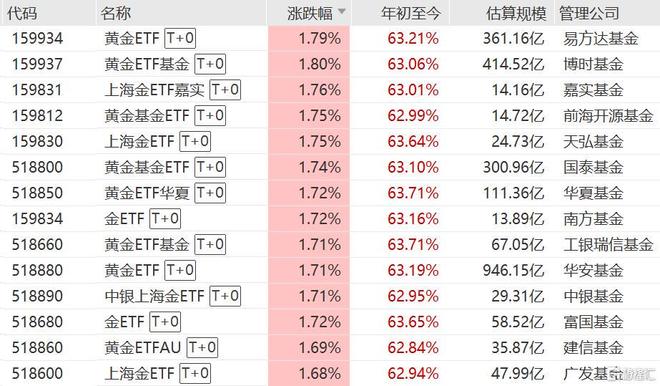
Group 1 - Spot gold has reached a new historical high, with London gold prices surpassing $4,490 per ounce, marking a year-to-date increase of 70.87%, nearing the largest annual increase since 1979 [1] - Gold ETFs, including various funds, have also seen significant gains, with year-to-date increases exceeding 62% [1] Group 2 - International gold and silver futures prices have reached historical highs, influenced by geopolitical tensions, particularly the U.S. seizure of a Venezuelan oil tanker, adding uncertainty to the market [3] - Analysts from UBS noted that gold prices rebounded quickly from a drop at the end of October, solidifying its position as one of the strongest assets this year, driven by geopolitical unrest and changes in the U.S. interest rate environment [3] - Central banks and investors continue to show strong demand for gold, with global central bank purchases expected to reach between 900 to 950 metric tons this year [3] Group 3 - Wall Street is optimistic about gold prices in the coming year, with target ranges between $4,800 and $5,000, driven by strong central bank purchases and ongoing fiscal concerns in the U.S. [4] - HSBC's report emphasizes that the U.S. fiscal deficit is a significant factor driving gold demand, as investors increasingly view gold as a hedge against debt sustainability risks and potential dollar weakness [4] Group 4 - The Federal Reserve's recent decision to lower interest rates is seen as dovish, which is favorable for gold, with expectations of further rate cuts increasing [5] - Long-term factors indicate a continued decline in global dollar reserves and rising U.S. fiscal deficits, which are beneficial for gold's monetary attributes [5] - Concerns about domestic physical gold demand due to new tax policies and potential declines in jewelry demand by 2026 highlight the importance of central bank purchases and investment demand to offset these declines [5]
金价又涨,最近黄金还能继续涨上去吗?普通人投资黄金需注意3点
Sou Hu Cai Jing· 2025-11-16 23:22
Core Insights - Gold prices have surged over 60% this year, while silver has increased nearly 70%, but recent volatility raises concerns among investors [1] - A significant drop in gold prices occurred recently, with a nearly 7% decline in one day, marking the largest single-day drop since 2013 [1] Group 1: Long-term Investment Perspective - Investing in gold requires a long-term strategy rather than a short-term focus, as price fluctuations are influenced by various factors, particularly the perception of gold as a safe-haven asset [3] - Current estimates indicate that private and official investors hold approximately $9.4 trillion in gold, compared to a $29 trillion public market for U.S. Treasury securities, suggesting potential for gold price increases amid declining dollar confidence [3] Group 2: Investor Mindset - A good mindset is essential for gold investment, as it is considered a relatively aggressive investment strategy; investors often react emotionally to price changes, which can lead to missed opportunities or poor decisions [4] Group 3: Investment Strategy - Investors should allocate funds for gold purchases wisely, using only surplus funds that do not affect regular household expenses, to avoid forced exits that could impact overall investment returns [5]
金价又跌了,还会回升吗?
Sou Hu Cai Jing· 2025-10-31 05:10
Core Insights - The recent surge in gold prices, which saw an increase of over 60% this year, is attributed to concerns over the dollar and inflation, but has since corrected by 9% as stock markets reached historical highs [1][3] - Analysts suggest that the rise in gold prices is driven more by speculative behavior and fear of missing out rather than fundamental value, indicating a potential bubble [1][3] - The stability of the dollar and the performance of stock markets are diminishing gold's appeal as a safe-haven asset, leading to a reassessment of its long-term value [5][7] Market Dynamics - The gold market has been characterized by irrational anxiety, with short-term profit motives overshadowing long-term value considerations [3][5] - Despite some bullish forecasts predicting gold could reach $5,000 or even $10,000 per ounce by the end of the decade, these predictions may overlook the underlying market logic and the potential for a bubble to burst [3][5] - The relationship between gold prices and global financial stability is crucial, as a strong dollar and rising U.S. Treasury yields exert downward pressure on gold [5][7] Investment Sentiment - Chinese investors are particularly aware of the irony in the current gold price surge, as it contrasts with their advocacy for rational investment and diversified asset allocation [5][7] - The volatility in gold prices serves as a reminder that the market is not a one-way street, and investors should remain vigilant about the interplay of risks and opportunities [5][7] - The current market environment emphasizes the importance of rational judgment in gold investments, taking into account global financial trends and actual economic data rather than succumbing to short-term emotions [5][7]
特朗普仅用一句话,让金价再次狂飙!或许黄金将不再是顶级奢侈品
Sou Hu Cai Jing· 2025-10-14 12:31
Group 1 - Trump's threat to impose a 100% tariff on all imports from China has caused significant turmoil in global financial markets, leading to a surge in gold prices [3][4][10] - The immediate reaction in the market saw gold futures prices surpassing $4000 per ounce, reflecting a combination of multiple risks rather than a sudden spike [3][14] - The luxury goods sector, particularly gold, has experienced heightened activity, with increased foot traffic in jewelry stores as investors seek to sell their assets at peak prices [4][18] Group 2 - The U.S. dollar has begun to decline, indicating growing concerns about the future of the U.S. economy amidst these geopolitical tensions [8] - Investors are rapidly shifting their funds from high-risk equities to perceived safe havens like bonds and precious metals, demonstrating a classic risk-averse behavior [11][12] - The price of silver has also risen significantly, breaking the $50 per ounce mark, the highest level since 1980, indicating a broader trend in precious metals [16] Group 3 - In contrast to the global panic, China has shown strategic resilience, leveraging its vast domestic market to mitigate external shocks [25][28] - The interconnectedness of the U.S. and Chinese economies limits the feasibility of extreme measures like decoupling, as both sides would face significant repercussions [28] - Trump's tariff threat is viewed as a bluff that ultimately does not address the underlying issues, suggesting that rational negotiations will prevail in the long run [30]
金荣中国:白银早盘高位震荡微涨,关注上方压力空单布局
Sou Hu Cai Jing· 2025-09-22 04:19
Core Viewpoint - The silver market is experiencing a complex interplay of factors, including rising U.S. Treasury yields, a strengthening dollar, and geopolitical tensions, which are influencing both gold and silver prices [1][3][4]. Fundamental Analysis - Silver prices have shown slight increases amidst high volatility, with the Federal Reserve's interest rate cuts not leading to significant price surges [1]. - U.S. Treasury yields have risen, with the 10-year yield reaching 4.141%, marking an 8.1 basis point increase over the week, reversing a previous downward trend [1]. - Strong economic data, such as initial jobless claims and manufacturing activity, has alleviated concerns about a weakening labor market, contributing to the rise in yields [1]. Dollar and Gold Dynamics - The rise in U.S. Treasury yields enhances the attractiveness of the dollar, which in turn exerts downward pressure on gold prices [3]. - The dollar index increased by 0.3% to 97.662, reflecting a rebound against major currencies following the Federal Reserve's mixed signals [3]. - Despite potential short-term risks for gold due to a stronger dollar, global monetary policy divergence and ongoing geopolitical tensions may support gold as a safe-haven asset [3][4]. Global Demand and Geopolitical Factors - There is a notable divergence in gold demand, with Indian premiums reaching a 10-month high due to strong buying ahead of festivals, while Chinese gold prices are at a five-year discount, indicating weaker demand [3]. - Central banks continue to purchase gold as a strategy for de-dollarization and reserve diversification, leading to a 43% increase in ETF holdings, reaching a historical high [3]. - Geopolitical risks, including tensions in Ukraine, Poland, and the Middle East, are contributing to a favorable environment for gold and silver, with predictions of gold prices potentially reaching $3960 to $4000 by year-end if uncertainties persist [4].

山海:黄金陷入震荡状态,周尾盘看反弹力度!
Sou Hu Cai Jing· 2025-09-19 02:11
Group 1 - The core viewpoint emphasizes that the bullish trend for gold remains intact despite significant adjustments, indicating a high-level consolidation within a bullish trend [2][4] - Key support and resistance levels for gold are identified at 3615 and 3672, respectively, with the market expected to maintain a bullish trend as long as it stays above 3615 [2][4] - The recent price movement of gold saw a decline from 3707 to 3628, a drop of nearly 80 USD, but the overall outlook remains positive due to global geopolitical instability and poor economic conditions [2][4] Group 2 - Domestic gold trading strategies suggest exiting all long positions before the Federal Reserve's interest rate decision, with specific price levels for potential long positions set at 830 and 820 [3] - The Shanghai gold market is projected to see upward movement towards 840, with a focus on maintaining long positions as long as the trend remains unchanged [3] Group 3 - The silver market is also in a bullish trend, with key levels to watch at 41 and 40.5, indicating potential for further upward movement if these levels hold [5] - The domestic silver market has shown resilience, with a focus on maintaining long positions as long as the support level at 9700 is not broken [5] Group 4 - The international crude oil market is experiencing a range-bound trading pattern between 64.6 and 63.3, with no significant price movements observed [6] - Domestic fuel oil is expected to have upward potential, with a focus on buying opportunities around 2750, while monitoring resistance levels at 2850 and 3000 [6]

2025年9月18日金价快讯:黄金和金条价格双双下跌,各大金店最新报价一览
Sou Hu Cai Jing· 2025-09-18 18:34
Group 1 - The international gold price reached $3682.2 per ounce, while the domestic base price in China was 834.6 yuan per gram, indicating a high market value [1] - Major jewelry brands in China, such as Chow Tai Fook and Lao Feng Xiang, priced their gold jewelry between 1086 to 1092 yuan per gram, significantly higher than the base price due to brand, craftsmanship, and overhead costs [1] - The Shenzhen Shui Bei market offers a more competitive price for gold, with 999 gold priced at 842 yuan per gram, closely aligning with the base price [2][3] Group 2 - Shui Bei is recognized as the largest gold wholesale market in China, operating on a low-margin, high-volume business model [3] - In Shui Bei, gold pricing is primarily determined by purity and market conditions, with less emphasis on branding [4] - Even within the wholesale market, variations in craftsmanship lead to different pricing, such as 999.9 purity gold priced at 843 yuan per gram [5][6] Group 3 - Investment gold bars sold by banks are priced around 850 yuan per gram, with slight variations among different banks [7] - Brand-name gold bars, however, are priced significantly higher, with Chow Tai Fook's investment gold bar at 965 yuan and Lao Feng Xiang at 1036 yuan, reflecting the added value of brand prestige [9] - The recovery price for 999 gold is 822 yuan per gram, indicating that resale value is primarily based on purity rather than brand [10] Group 4 - Major financial institutions like Morgan Stanley and JPMorgan predict that gold prices could reach $3800 by the end of the year, with potential for further increases to $4000 or even $5000 in the future [10] - The growing interest from both central banks and individual investors is seen as a new driving force behind rising gold prices [10] - UBS previously forecasted gold prices to reach $3700, which was achieved sooner than expected, highlighting the volatility and potential for further price increases [10][11]