大模型

Search documents
阿里巴巴平头哥上线自研AI芯片“真武810E”
Zhi Tong Cai Jing· 2026-01-29 02:44
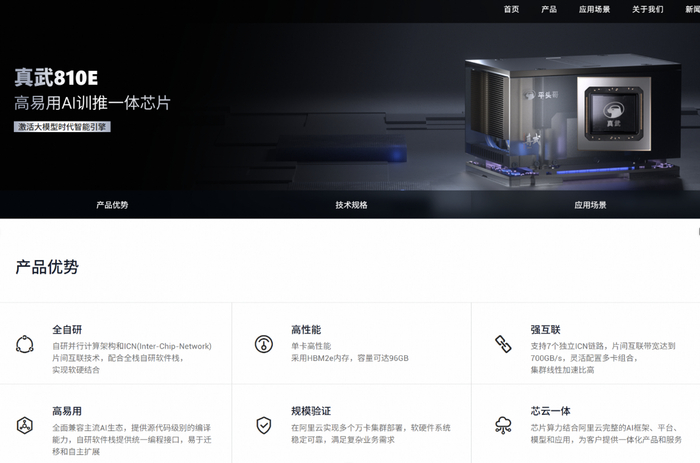
Group 1 - Alibaba's T-Head has launched the high-end AI chip "Zhenwu 810E," which features fully self-developed hardware and software, and has been deployed in multiple large-scale clusters on Alibaba Cloud [1] - The "Zhenwu" PPU chip is equipped with 7 ICN interconnect ports and utilizes T-Head's self-developed interconnect acceleration library to support efficient multi-card collaboration for large model training and inference [1] - The chip has a memory of 96G HBM2e and an interconnect bandwidth of 700GB/s, making it suitable for AI training, inference, and autonomous driving applications [1] Group 2 - T-Head Semiconductor Co., Ltd. was established in September 2018 as Alibaba's wholly-owned semiconductor chip business, covering end-to-end design for data center chips, IoT chips, and more [2] - T-Head has launched several chips, including the AI chip "PPU," inference chip "Hanguang 800," CPU "Yitian 710," SSD controller chip "Zhenyue 510," and IoT chip "Yuzhen" [2] Group 3 - Alibaba plans to advance T-Head towards an independent IPO, restructuring it into a business entity partially owned by employees [1]

云知声早盘一度涨超15% 公司领跑AI变现赛道
Xin Lang Cai Jing· 2026-01-29 02:39
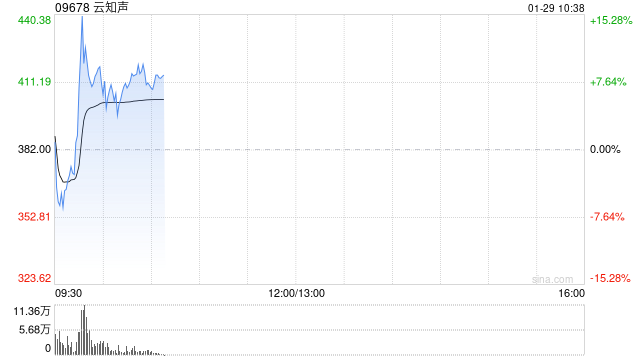
Core Viewpoint - Yunzhisheng (09678) has experienced a significant stock price increase following the announcement of a positive earnings forecast, with shares rising over 80% cumulatively and currently trading at 412.20 HKD, up 7.91% [1][4]. Group 1: Earnings Forecast - The company has released its earnings forecast for 2025, indicating substantial growth in revenue from its large model-related business [1][4]. - This revenue growth is attributed to the company's continued industry leadership in core large model technology and accelerated commercialization processes [1][4]. Group 2: Product Development - Yunzhisheng has launched the "Shanhai·Zhiyin" large model 2.0, which leverages the multimodal and cross-language capabilities of "Shanhai·Atlas" [1][4]. - The new model focuses on three key enhancements: understanding professional and regional dialects, fostering emotional connections in conversations, and achieving rapid responsiveness [1][4].

港股大模型概念股MINIMAX-WP涨幅扩大至20%
Mei Ri Jing Ji Xin Wen· 2026-01-29 02:17
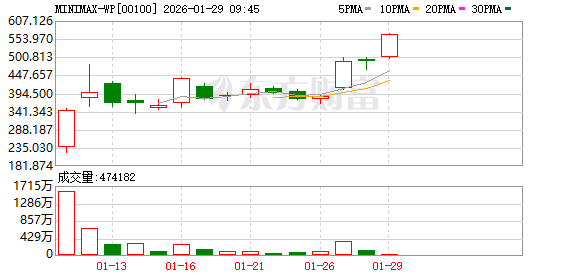
每经AI快讯,1月29日,港股大模型概念股MINIMAX-WP涨幅扩大至20%,股价一度涨至590港元创上 市来新高。 ...
阿里平哥头自研AI芯片“真武”正式上线
Xin Lang Cai Jing· 2026-01-29 02:13
Core Viewpoint - Alibaba's chip design unit, Pingtouge, has launched a high-end AI chip named "Zhenwu 810E" following reports of its potential IPO, indicating significant progress in external market penetration and product development [1][2]. Group 1: Product Launch and Features - The "Zhenwu" PPU has been deployed in multiple clusters on Alibaba Cloud, serving over 400 clients including State Grid, Chinese Academy of Sciences, Xiaopeng Motors, and Sina Weibo [1]. - The PPU features a self-developed parallel computing architecture and inter-chip communication technology, with a memory of 96G HBM2e and an inter-chip bandwidth of 700 GB/s, suitable for AI training, inference, and autonomous driving [1]. - The overall performance of the "Zhenwu" PPU surpasses Nvidia's A800 and mainstream domestic GPUs, and is comparable to Nvidia's H20, with an upgraded version reportedly outperforming Nvidia's A100 [2]. Group 2: Strategic Integration and Market Position - Alibaba is integrating its AI, cloud computing, and chip technologies through a collaboration known as "Tongyun Ge," which includes Tongyi Lab, Alibaba Cloud, and Pingtouge, allowing for focused hardware development and optimized AI frameworks [2]. - The company aims to establish "Tongyun Ge" as an AI supercomputer, leveraging its self-developed chips, leading cloud services, and open-source models to achieve maximum efficiency in training and deploying large models [2]. - Alibaba and Google are currently the only two global tech companies with competitive capabilities across large models, cloud, and chip sectors [4].
港股大模型概念股盘初拉升,MINIMAX-WP涨超10%
Mei Ri Jing Ji Xin Wen· 2026-01-29 01:47
每经AI快讯,1月29日,港股大模型概念股盘初拉升,MINIMAX-WP涨超10%,智谱涨超6%。 (文章来源:每日经济新闻) ...
是基石更是起点!”新一批广东备案大模型“领证
Nan Fang Du Shi Bao· 2026-01-29 01:43
Core Insights - The Guangdong Province has achieved a significant milestone with the approval of 124 generative AI models, marking a shift from "single-point breakthroughs" to "ecological resonance" in the AI industry [1][2] - The event highlighted the importance of compliance and trust in the development of AI, emphasizing that model registration is not only a policy requirement but also a market expansion opportunity for enterprises [4][7] Group 1: Model Registration and Impact - A total of 748 generative AI services have been registered nationwide, with Guangdong leading by registering 124 models, including 19 new ones [2] - The registered models span various sectors such as culture, education, e-sports, media, industrial manufacturing, and marketing, showcasing the integration of AI technology into the real economy [2][3] Group 2: Model Features and Innovations - The "Lingnan Culture Model" introduces a unique methodology for embedding regional cultural DNA into its architecture, enhancing the understanding of local culture beyond superficial recognition [3] - Other models, such as the "Zebra AI Education Model," have launched innovative products like the world's first AI foreign teacher one-on-one service, demonstrating the diverse applications of AI in education [3] Group 3: Industry Collaboration and Development - The event served as a platform for industry leaders to share insights on how model registration can lead to tangible business growth and enhance competitive advantages [4] - Various models are designed to facilitate industry-specific needs, such as the "Lingzhi AI Model" for industrial internet knowledge and the "SocialGPT" model for social media insights, indicating a trend towards deeper integration of AI in specific sectors [5][6] Group 4: Future Directions and Goals - The initiative aims to promote deep integration between supply and demand in the AI model industry, fostering a collaborative environment for innovation and development [7] - Guangdong's proactive approach in AI model registration and management is positioned to contribute significantly to the digital economy and serve as a model for other regions [7]
广东备案大模型达到124款,占全国超15%
2 1 Shi Ji Jing Ji Bao Dao· 2026-01-29 01:35
Core Insights - The Guangdong province has registered a total of 124 generative AI models, marking a significant shift from "single-point breakthroughs" to "ecological resonance" in the AI industry [1] - The national total of registered generative AI services has reached 748, indicating a growing trend in the sector [1] Group 1: Industry Developments - The recent event showcased the latest batch of 19 generative AI models that received registration, positioning Guangdong among the leaders in the country [1] - Various sectors such as culture, education, e-sports, media, industrial manufacturing, and marketing are represented by the newly registered models, highlighting the diverse applications of AI technology [1][2] Group 2: Company Innovations - Zebra Children's Education has launched a comprehensive business matrix including "Zebra AI Learning," "Zebra Encyclopedia," and "Zebra Oral English" based on its educational AI model [2] - Lingchuang Digital Technology's "Lingnan Culture" model offers services related to cultural consultation and promotion, emphasizing the integration of AI in cultural heritage [2] - Mushroom IoT's "Lingzhi AI Model" focuses on knowledge Q&A in the industrial internet sector, showcasing the model's application in enhancing industrial efficiency [2] Group 3: Model Applications - Soming Information's "Soming Smart Shadow Model" provides research assistance and strategic planning, demonstrating the model's utility in business analysis [3] - Social Story's "SocialGPT" model offers social media insights and industry analysis, indicating its role in enhancing information dissemination [3] - The "GPTCoder Model" from Fabben Information is designed to assist in coding tasks, highlighting the model's practical applications in software development [3] Group 4: Market Impact - The event served as a platform to promote the effectiveness of newly registered models and aimed to facilitate supply-demand matching within the AI industry [4] - Guangdong's proactive approach in AI model registration and management is intended to establish the region as a hub for AI innovation and governance, contributing to the broader digital economy [4]
公募机构开年火速布局港股市场
Zheng Quan Ri Bao· 2026-01-28 16:19
Group 1 - The Hong Kong stock market has become a key focus for public fund institutions since 2026, with 27 Hong Kong-themed funds reported as of January 28, focusing on technology, pharmaceuticals, and cyclical sectors [1][2] - Major public fund institutions are leading the way in new product applications, with notable submissions from Guangfa Fund (4 products), and others like Fuguo Fund and Huatai-PineBridge Fund submitting 2 products each [1] - The technology sector remains a primary focus, with various funds targeting technology assets, including actively managed and index-based products, indicating sustained optimism from public institutions [1][2] Group 2 - The pharmaceutical investment scope has broadened, with new products covering not only innovative drugs but also medical devices and services, reflecting a comprehensive approach to the healthcare industry [1] - The cyclical sector is gaining attention from public fund institutions, with new funds targeting traditional industries such as non-ferrous metals and energy, driven by rising resource prices [2] - There is a trend of continuous capital inflow into the Hong Kong stock market, with significant growth in the scale of Hong Kong-themed ETFs, exemplified by the Fuguo CSI Hong Kong Stock Connect Internet ETF reaching a scale of 910.07 billion yuan [2] Group 3 - Different fund managers have varying focuses on investment opportunities in the Hong Kong market, with some emphasizing AI developments and their potential impact on both A-shares and Hong Kong tech leaders [3] - Other fund managers highlight the attractiveness of the adjusted price levels in the Hong Kong medical sector, particularly in innovative drugs, while maintaining a high allocation to the internet sector [3]
傅利叶:未来1-2年将脑机接口引入机器人康复训练,提升治疗效率
Xin Lang Cai Jing· 2026-01-28 14:43
Core Insights - Fourier Exploration aims to integrate embodied intelligence technology with brain-machine interface (BMI) technology to enhance rehabilitation efficiency and improve patient quality of life [1][4] - The CEO, Gu Jie, announced plans to scale the introduction of BMI technology in robotic rehabilitation training within the next 1-2 years, emphasizing the importance of recognizing patient intent during training [1][3] Group 1: Technology Integration - The combination of BMI and robotic systems allows for real-time recognition of patient intentions, enabling robots to provide appropriate assistance during rehabilitation [3][4] - Traditional rehabilitation methods often lead to passive training, while the new approach encourages active participation from patients, resulting in better rehabilitation outcomes [3][4] Group 2: Development Challenges - There is a lack of large-scale datasets and necessary hardware and software infrastructure for BMI and embodied intelligence technologies globally [1][6] - The company has initiated a collaborative project with several academic institutions to enhance interdisciplinary cooperation and support the exploration of BMI and embodied intelligence integration [6] Group 3: Technological Advancements - Recent advancements in BMI hardware have led to lighter, modular devices, and the transition from single EEG systems to multi-modal signal acquisition methods has improved accuracy and reliability [5][6] - The development of large models has transformed the processing of EEG signals, allowing for more effective classification and interpretation of complex brain signals [5]

国泰海通|轻工:智能眼镜产品力系列二:大模型催化,AI眼镜异军突起
国泰海通证券研究· 2026-01-28 14:08
Core Viewpoint - The article emphasizes that AI glasses without display functions are better suited to meet the underlying needs of traditional eyewear, suggesting they are likely to see earlier market adoption compared to AR glasses [1] Industry Growth Potential - The smart glasses industry is expected to enter a rapid growth phase, with companies in the supply chain poised to benefit from an upturn in market conditions [2] - The launch of the Ray-Ban Meta smart glasses marks a new product cycle, featuring improved audio-visual quality and integration with Meta's social platforms, enhancing user experience and application scenarios [2] Market Penetration Insights - AI glasses are currently at a nascent stage, with a projected penetration rate of only 0.1% in 2024, similar to the early adoption phase of smartwatches [3] - Forecasts indicate that global AI glasses shipments could reach 291 million units by 2034, with a compound annual growth rate (CAGR) of 55.16% from 2025 to 2034 [3] Product Development Challenges - Key factors hindering the rapid penetration of smart glasses include reliance on traditional offline channels for customer engagement, necessitating partnerships between brands and retailers [4] - The comfort of AI glasses is influenced by weight and design, with current models averaging around 50g, while traditional glasses weigh about 20g; achieving a balance between functionality and comfort is crucial [4] - Battery capacity and performance are critical for convenience, requiring advancements in battery materials and technology to enhance longevity [4] - The system-on-chip (SoC) is vital for the performance of AI glasses, impacting user experience through its ability to handle various tasks efficiently [4]