
强化学习

Search documents
DanceGRPO:首个统一视觉生成的强化学习框架
机器之心· 2025-05-14 08:09
Core Insights - The article introduces DanceGRPO, an innovative framework that unifies visual generation reinforcement learning, covering various tasks and models [2][8]. Group 1: Motivation and Background - The rapid development of generative AI has brought RLHF (Reinforcement Learning from Human Feedback) into focus, particularly in the context of LLMs (Large Language Models) [4]. - Current mainstream RLHF solutions for visual generation tasks are less mature compared to LLMs, with two main categories identified: Diffusion/Flow-DPO and ReFL [4][5]. Group 2: Goals and Features - The goal of the DanceGRPO framework is to enhance performance significantly, manage memory pressure during video generation, train on large prompt datasets, and be adaptable to rectified flow and video generation models [7]. Group 3: Framework Design and Implementation - DanceGRPO is the first unified framework for visual generation and reinforcement learning, applicable to diffusion and rectified flow, as well as text-to-image, text-to-video, and image-to-video tasks [8]. - The framework follows the GRPO strategy, optimizing using a prompt to generate data and applying the GRPO objective function without including KL divergence regularization [9]. Group 4: Reward Models - Five types of reward models were utilized: image aesthetics, video aesthetics, text-image alignment, video dynamic quality, and a new binary reward model combining aesthetics and alignment [10]. Group 5: Experimental Results - Experimental results show significant improvements in various models, with notable performance increases in metrics such as HPS-v2.1 and CLIP Score for Stable Diffusion and FLUX [12]. - The results indicate a 45% improvement in VQ and a 181% increase in MQ for the HunyuanVideo model when using the proposed method [13].


自研算法是否将成为主机厂的必选项?——第三方算法厂商的“护城河”探讨
2025-05-13 15:19
Summary of Conference Call Notes Industry Overview - The conference call discusses the challenges and opportunities in the autonomous driving industry, particularly focusing on traditional automakers and their ability to develop self-driving algorithms and chips compared to new entrants and leading third-party companies [1][3][4]. Key Points and Arguments Challenges for Traditional Automakers - Traditional automakers are significantly weaker in self-developed autonomous driving algorithms compared to new players and leading third-party firms, due to factors such as leadership quality, development models, slow iteration speeds, and insufficient data accumulation [1]. - The main barriers for traditional automakers in self-developing algorithms include: - **Technical Capability**: Traditional firms lack the understanding and development capabilities for algorithms compared to new entrants [3]. - **Development Cycle**: New players can iterate versions in one to two weeks, while traditional firms have slower iteration speeds [3]. - **Financial Investment**: Developing autonomous driving algorithms is costly, with leading firms spending millions annually on talent and computational resources [3]. - **Data Closure**: Traditional automakers have lower data accumulation rates due to lower penetration of intelligent features [3]. Self-Developed Chips - The challenges in self-developing chips include: - **Technical Capability**: Traditional firms lag in core architecture and IP selection [4]. - **Development Cycle**: The fastest design to production cycle is about 1.5 years, but traditional firms face delays due to rigid development models [4]. - **Financial Support**: The cost of chip production exceeds 150 million yuan, which is burdensome for many traditional automakers [4]. - **Algorithm and Chip Optimization**: Many traditional firms struggle to define their algorithm direction, complicating optimization efforts [4]. Market Segmentation - The autonomous driving market can be segmented into three tiers: - **First Tier**: Companies like Huawei, Xiaopeng, and Li Auto that are fully self-developing and have achieved mass production [5]. - **Second Tier**: Companies like Xiaomi, Geely, and BYD that are combining self-development with third-party collaborations [5]. - **Third Tier**: Companies like SAIC and FAW that rely entirely on third-party solutions [5]. Opportunities for Mid-Tier Companies - Mid-tier companies have the potential to either advance or decline based on their ability to enhance R&D capabilities, increase financial investment, shorten development cycles, and collaborate with advanced technology partners [6]. Conditions for Successful Chip Development - Companies aiming to develop chips should have: - **Moderate Computational Power**: At least 200 TOPS or 80 TOPS [7]. - **Data Closure**: A significant amount of data from mass-produced vehicles, ideally over 600,000 units [7]. - **Computational Requirements**: A minimum of 300 million FLOPS to ensure iteration speed and closure capabilities [7]. - **Leadership and Organizational Support**: Strong leadership with business acumen and a supportive organizational structure for rapid iteration [7]. IP Licensing and Costs - The industry standard for IP licensing includes: - A one-time authorization fee of approximately 30 million yuan, with an annual maintenance fee of about 2 million yuan [8][9]. - Royalties based on chip sales, typically around 5% [8][9]. Data Scarcity and Its Importance - Data scarcity remains a critical issue, as companies with rich data resources can optimize and expand their capabilities more effectively than those with limited data [14]. Future Trends and Developments - The autonomous driving technology landscape is expected to undergo significant changes in the next two years, with a focus on world models and reinforcement learning [29][30]. - Companies that continue to invest in R&D and enhance their technical capabilities may catch up with or surpass current leaders in the long term [29]. Academic Insights - Academic discussions are focusing on using reinforcement learning for model generation and exploring new architectures to improve existing models [32]. Other Important Insights - The impact of new regulations from the Ministry of Industry and Information Technology (MIIT) is expected to widen the gap between first and second-tier companies, affecting market competition and investment decisions [20][21]. - The transition from software to hardware development poses challenges for companies like Monta, which require significant experience in hardware processes [11]. This summary encapsulates the key discussions and insights from the conference call, highlighting the competitive landscape and the challenges faced by traditional automakers in the autonomous driving sector.
特斯拉发布人形机器人擎天柱“跳舞”视频
news flash· 2025-05-13 10:53
Core Insights - Tesla has released a video showcasing its humanoid robot Optimus performing a dance, highlighting advancements in its training capabilities [1] Group 1 - The humanoid robot Optimus has undergone optimization in its "Sim-to-Real" training code, indicating improvements in its simulation-to-reality transition [1] - The training of the robot was completed through reinforcement learning, showcasing Tesla's commitment to enhancing AI and robotics technology [1]


文生图进入R1时代:港中文MMLab发布T2I-R1,让AI绘画“先推理再下笔”
量子位· 2025-05-13 04:45
Core Viewpoint - The article discusses the introduction of T2I-R1, the first reinforcement learning-based reasoning-enhanced text-to-image model developed by the MMLab team at the Chinese University of Hong Kong, which significantly improves image generation through a dual-level Chain of Thought (CoT) reasoning framework [2][27]. Group 1: Model Development - The T2I-R1 model builds on previous work in image generation with CoT, focusing on integrating semantic understanding and image generation [6][8]. - T2I-R1 introduces a dual-level CoT reasoning framework, consisting of Semantic-level CoT and Token-level CoT, to enhance the quality of generated images [12][16]. - The model utilizes BiCoT-GRPO, a reinforcement learning method that optimally coordinates the two levels of CoT, allowing for efficient training and improved image generation [21][23]. Group 2: Performance and Evaluation - T2I-R1 demonstrates improved performance, achieving a 13% and 19% increase in benchmarks T2I-CompBench and WISE, respectively, compared to baseline models [33]. - The model effectively generates images that align with human expectations by reasoning through the underlying intent of image prompts, showcasing enhanced robustness in unusual scenarios [29][30]. - The evaluation method incorporates multiple visual expert models to provide a comprehensive quality assessment of generated images, ensuring reliable results [32]. Group 3: Future Implications - The framework of T2I-R1 is expected to extend to more complex tasks such as video generation and 3D content synthesis, contributing to the evolution of generative AI towards more intelligent and creative systems [36].

最先进的AI大模型,为什么都在挑战《宝可梦》?
Hu Xiu· 2025-05-12 06:57
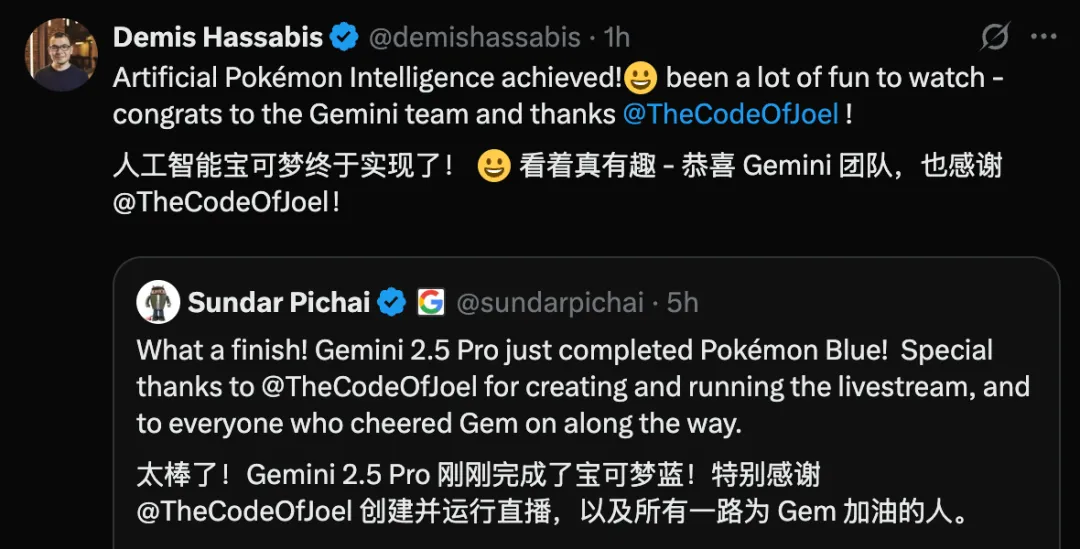
Core Insights - The article discusses the evolution of AI models using games as a testing ground, highlighting the recent achievement of Google's AI model Gemini 2.5 Pro in independently completing the original Pokémon game, which has reignited interest in AI capabilities [4][30]. Group 1: AI Development and Gaming - AI has been tested through games for nearly a decade, with notable milestones including AlphaGo's victory over human players in Go and DeepMind's success in games like DOTA2 and StarCraft II [2][3]. - The use of games as a benchmark for AI intelligence remains prevalent, as demonstrated by Gemini's recent accomplishment, which was celebrated by Google's CEO and DeepMind's head [4][5]. Group 2: Challenges in AI Learning - The Moravec's paradox suggests that tasks perceived as easy for humans can be significantly more challenging for AI, which is exemplified by Gemini's achievement in Pokémon [6][7]. - The process of AI learning in games like Pokémon is complex, requiring the AI to develop its own understanding and strategies without predefined rules or guidance [16][17]. Group 3: Comparison of AI Models - Anthropic's Claude 3.7 struggled to progress in Pokémon, achieving only three badges after a year of iterations, while Gemini completed the game with approximately 106,000 actions, significantly fewer than Claude's 215,000 actions [11][30]. - The differences in performance between Claude and Gemini are attributed to their respective frameworks, with Gemini's agent harness providing better input processing and decision-making capabilities [34][35]. Group 4: Implications for AI Research - The ability of AI to navigate and complete games like Pokémon indicates its potential for independent learning and problem-solving in real-world scenarios [37][38]. - The choice of Pokémon as a training ground reflects the game's themes of growth, choice, and adventure, paralleling the journey of AI in understanding complex rules and environments [39][40].

RL训练总崩溃?R1-Reward稳定解锁奖励模型Long-Cot推理能力
机器之心· 2025-05-12 04:31
Core Viewpoint - The article discusses the development and application of the R1-Reward model, which utilizes a new algorithm called StableReinforce to enhance the performance of multimodal reward models (MRMs) through reinforcement learning (RL) techniques, addressing issues of training instability and inconsistency in reward modeling [1][38]. Group 1: R1-Reward Model and Its Applications - R1-Reward has shown significant academic value and has been successfully applied in practical scenarios at Kuaishou, such as in short videos, e-commerce, and live streaming, achieving notable performance improvements [2]. - The R1-Reward model outperforms state-of-the-art (SOTA) models by 5%-15% on existing multimodal reward model benchmarks, with further improvements observed as the number of inference samples increases [1][38]. Group 2: Algorithm Improvements - The article introduces a new algorithm, StableReinforce, which optimizes existing RL methods to enhance training stability and efficiency [9]. - Key improvements include a gradual training strategy, a robust advantage value handling method called Advantage Filter, and a novel "consistency reward" mechanism that checks the coherence between the model's analysis and its final answer [12][25]. Group 3: Training Methodology - The training process involves a two-step approach: first, a supervised fine-tuning (SFT) phase using a dataset of 200,000 preference data points, followed by a reinforcement learning phase focusing on more challenging samples [27][30]. - The SFT phase allows the model to learn the task format and process, while the RL phase targets samples deemed "harder" to improve the model's ability to discern subtle differences [32]. Group 4: Experimental Results - R1-Reward has demonstrated exceptional performance on multiple multimodal reward model leaderboards, significantly surpassing previous best models [34]. - A voting strategy during evaluation, where the model outputs multiple judgments and selects the most frequent answer, has led to substantial accuracy improvements, with accuracy rising from approximately 71% to 86.47% when voting 15 times [35]. Group 5: Future Directions - The article suggests that there are many unexplored avenues for applying RL in reward modeling, including advanced voting strategies and improved training methodologies to further enhance the model's foundational capabilities [38].

人形机器人到底是产业革命还是资本泡沫?
机器人大讲堂· 2025-05-11 04:26
Core Viewpoint - The humanoid robot industry is experiencing a capital bubble due to blind investment in emerging technologies, despite the lack of substantial commercial progress and technological maturity [2][4][20]. Group 1: Capital Investment and Market Dynamics - The humanoid robot sector has attracted significant capital investment, leading to rapid valuation increases for some startups, even those established less than a year [1]. - The influx of capital has not effectively promoted technological advancements, resulting in a market bubble where expectations exceed actual capabilities [2][20]. - Historical examples, such as Honda's Asimo and Boston Dynamics' robots, illustrate the disconnect between technological aspirations and market realities, often leading to project failures [4]. Group 2: Technological Challenges - Humanoid robots face significant technical bottlenecks in perception and motion control, limiting their effectiveness in real-world applications [5][10]. - Despite advancements in sensor systems and motion control technologies, robots struggle with environmental perception accuracy and dynamic adaptability [8][10]. - Current humanoid robots lack true intelligent decision-making capabilities, relying instead on pre-programmed instructions, which hinders their ability to adapt to complex environments [11][13]. Group 3: Future Prospects - The development of humanoid robots is expected to be gradual, with small-scale commercialization anticipated in the next 3-5 years [20]. - Emerging technologies like reinforcement learning may enhance robots' adaptive capabilities, but significant computational resources and time are required for effective implementation [16]. - The future of humanoid robots lies in improving their cognitive abilities to make autonomous decisions in dynamic environments, moving beyond mere mechanical control [16].
前谷歌CEO:千万不要低估中国的AI竞争力
Hu Xiu· 2025-05-10 03:55
Group 1: Founder Psychology and Roles - Eric Schmidt emphasizes the difference between founders and professional managers, stating that founders are visionaries while professional managers are "amplifiers" who help scale ideas [4][10] - Schmidt reflects on his experience at Google, noting that he was not a typical entrepreneur but rather a professional manager who contributed during the company's scaling phase [3][4] - He discusses the challenges of attracting talent, highlighting that many talented individuals often choose to start their own companies instead of joining established firms [3][5] Group 2: Market Dynamics and Startup Ecosystem - Schmidt points out that many startups are often acquired for their talent rather than their products, indicating a market structure that can be inefficient [6][7] - He notes that the majority of startups fail, with traditional venture capital experiences suggesting that 4 out of 10 will fail completely, and 5 will become "zombies" with no growth potential [7] - The conversation highlights the importance of competition for startups, suggesting that true leadership is demonstrated when facing challenges from larger companies [11][12] Group 3: AI and Future Trends - Schmidt believes that AI is currently underestimated rather than overhyped, citing the scaling laws that drive AI advancements [33][34] - He discusses the potential of AI to transform business processes and scientific breakthroughs, emphasizing the importance of understanding how humans will coexist with advanced AI systems [35][39] - The conversation touches on the competitive landscape between the U.S. and China in AI development, with China investing heavily in AI as a national strategy [41][42] Group 4: Talent Acquisition and Management - Schmidt stresses the importance of attracting top talent by creating an environment where individuals feel they are solving significant problems [18][20] - He differentiates between "rockstar" employees who drive change and "mediocre" employees who are self-serving, advocating for the retention of the former [21][22] - The discussion includes insights on how to identify and nurture high-potential talent within organizations [24][25] Group 5: Challenges in AI Development - Schmidt highlights the challenges of defining reward functions in reinforcement learning, which is crucial for AI's self-learning capabilities [51] - He warns about the potential pitfalls of over-investing in AI infrastructure without a clear path to profitability, suggesting that many companies may face economic traps [47][48] - The conversation concludes with a call for companies to focus on the most challenging problems in AI, as solving these will yield the most significant rewards [52][53]
9年实现爱因斯坦级AGI?OpenAI科学家Dan Roberts谈强化学习扩展的未来
机器之心· 2025-05-10 03:42
Core Insights - The core insight of the article is the prediction that reinforcement learning will play an increasingly significant role in the development of AI models, potentially leading to the creation of models capable of discovering new scientific knowledge within the next nine years [2][37]. Group 1: Presentation Highlights - Dan Roberts, a research scientist at OpenAI, discussed the importance of scaling laws in pre-training and reinforcement learning during his presentation at AI Ascent [2][4]. - The presentation highlighted a significant finding: as the "thinking time" of models increases, their performance improves, indicating that models can learn to think more effectively [9][12]. - OpenAI's recent model, o3, demonstrates enhanced reasoning capabilities, allowing it to solve complex problems in a fraction of the time it would take a human [14][31]. Group 2: Future Predictions - The company aims to expand the scale of reinforcement learning significantly, with plans to invest $500 billion in computational resources to enhance model training [48]. - Predictions suggest that AI's ability to process tasks will double approximately every seven months, potentially allowing for computations lasting up to eight years by 2034 [56][57]. - The ultimate goal is to develop models that can contribute significantly to human knowledge and scientific discovery, akin to the time it took Einstein to formulate the theory of general relativity [31][57].

21对话|卓驭陈晓智:用有限算力做极致性能,这是我们血液里的东西
2 1 Shi Ji Jing Ji Bao Dao· 2025-05-10 00:36
Core Insights - The article discusses the rise of intelligent driving technology in the automotive market, particularly focusing on Zhuoyue Technology's approach to providing cost-effective driving assistance solutions [1][2][3]. Group 1: Company Overview - Zhuoyue Technology, formerly known as DJI Automotive, has transitioned from a team within DJI focused on intelligent driving technology to an independent entity, leveraging its expertise in sensors and computer vision from the drone industry [2]. - The company aims to provide high-performance driving assistance features at lower costs, utilizing its self-developed hardware and software [1][2]. Group 2: Product Development - Zhuoyue's 7V (7 cameras) + 32 TOPS configuration has become standard in vehicles priced between 80,000 to 150,000 RMB, enabling features like urban memory navigation and highway driving [1]. - The company plans to launch the "Chengxing Platform" in November 2024, offering 7V and 9V solutions that reduce reliance on high-precision maps and LiDAR, thus lowering costs for advanced driving assistance [2]. Group 3: Market Position and Strategy - The mid-to-low-end market is expected to grow significantly by 2025, which aligns with Zhuoyue's strengths [3]. - Zhuoyue has established partnerships with major automotive manufacturers, including FAW, Volkswagen, and BYD, with over 20 models already in production and more than 30 models set to launch soon [2]. Group 4: Technological Innovations - The company is focusing on enhancing its capabilities through the introduction of the Thor platform, which offers higher computing power at a lower cost compared to existing solutions [3][6]. - Zhuoyue is also exploring the integration of reinforcement learning and world models to improve safety and decision-making in driving assistance systems [12][19]. Group 5: Future Directions - The company is preparing to develop hardware for L3 and L4 autonomous driving, including necessary sensors and controllers, while emphasizing the importance of first perfecting L2 assistance before advancing to higher levels of automation [9][10]. - Zhuoyue aims to enhance user experience by implementing a more intuitive point-to-point navigation system that mimics human driving behavior [20].