
新零售

Search documents
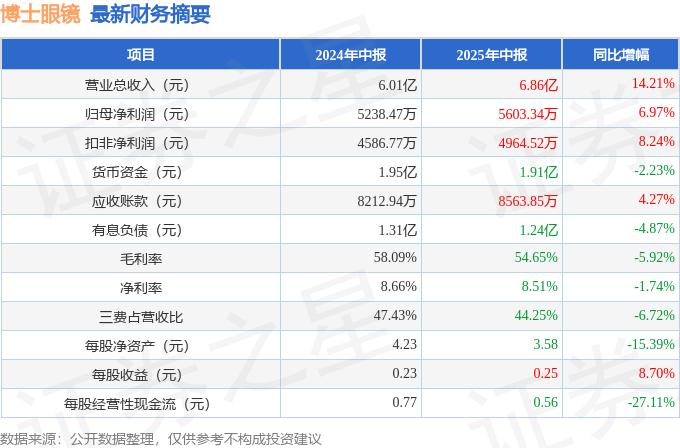
博士眼镜2025年中报简析:营收净利润同比双双增长,公司应收账款体量较大
Zheng Quan Zhi Xing· 2025-08-28 22:59
Core Viewpoint - The recent financial report of Doctor Glasses (300622) shows moderate growth in revenue and net profit, but declining margins and cash flow metrics indicate potential challenges ahead [1][2]. Financial Performance - Total revenue for the first half of 2025 reached 686 million yuan, a year-on-year increase of 14.21% [1] - Net profit attributable to shareholders was 56.03 million yuan, up 6.97% year-on-year [1] - Gross margin decreased to 54.65%, down 5.92% from the previous year [1] - Net margin also fell to 8.51%, a decrease of 1.74% year-on-year [1] - Operating cash flow per share dropped to 0.56 yuan, down 27.11% year-on-year [1] Accounts Receivable and Financial Ratios - Accounts receivable accounted for 82.64% of the latest annual net profit, indicating a significant reliance on credit [1][2] - Total expenses (selling, administrative, and financial) amounted to 304 million yuan, representing 44.25% of revenue, a decrease of 6.72% year-on-year [1] - Return on Invested Capital (ROIC) for the previous year was 10.36%, which is considered average [1] Business Model and Marketing Strategy - The company's performance is primarily driven by marketing efforts, with a focus on consumer education and promotional activities for functional lenses [2][4] - Sales of functional lenses increased by 26.58%, now accounting for 39.82% of total lens sales [4] - The company is enhancing its online presence through various e-commerce platforms and social media to attract customers [5] Store Expansion and Product Offerings - The company has upgraded over 150 retail stores to include smart glasses displays, creating immersive shopping experiences [6] - The sales volume of defocus lenses grew by 18.35%, representing 15.42% of total lens sales [5]


华鑫证券-安井食品-603345-公司事件点评报告:成本端拖累盈利,强化新品研发效率
Xin Lang Cai Jing· 2025-08-28 15:40
Core Viewpoint - Anjiu Food's 2025 H1 financial results show a slight increase in revenue but a significant decline in net profit, indicating challenges in maintaining profitability amidst rising costs and competitive pressures [1][2]. Financial Performance - Total revenue for H1 2025 reached 7.604 billion yuan, a year-on-year increase of 1%, while net profit attributable to shareholders was 676 million yuan, a decrease of 16%. The net profit after deducting non-recurring items was 603 million yuan, down 22% [1]. - In Q2 2025, total revenue was 4.005 billion yuan, up 6% year-on-year, but net profit fell to 281 million yuan, a decrease of 23%, with a non-recurring net profit of 260 million yuan, down 26% [1]. Cost and Margin Analysis - Q2 2025 gross margin decreased by 3 percentage points to 18.00%, primarily due to rising costs of raw materials like crayfish and fish paste, along with increased manufacturing expenses and promotional efforts [2]. - The sales expense ratio increased by 0.1 percentage points to 4.96%, while the management expense ratio decreased by 1 percentage point to 2.66%, mainly due to a decline in share-based payment expenses [2]. - Q2 2025 net profit margin decreased by 3 percentage points to 7.03% [2]. Product Performance - Revenue from frozen prepared foods in Q2 2025 was 1.750 billion yuan, down 1%, while the "lock-fresh" packaging continued to show resilience, maintaining a strong gross margin [2]. - Revenue from frozen dishes increased by 26% to 1.580 billion yuan, while revenue from frozen noodle and rice products decreased by 11% to 583 million yuan, attributed to significant promotional efforts [2]. - The company launched a new line of meat-based sausages targeting the consumer market, with expectations for continued growth in high-margin products [2]. Distribution Channels - Revenue from distribution channels in Q2 2025 was 3.134 billion yuan, an increase of 2%, with growth in key distributor clients [3]. - Direct sales revenue reached 328 million yuan, up 19%, driven by contributions from Zhang Liang Spicy Hot Pot and a recovery in crayfish sales [3]. - Revenue from supermarket channels increased by 8% to 152 million yuan, supported by growth in Walmart's customer base and ongoing efforts to enhance customized cooperation with large supermarkets [3]. - New retail and e-commerce revenue grew by 35% to 391 million yuan [3]. Profitability Outlook - The company is optimistic about its acquisition of Dingwei Thai, which will enhance product and channel synergies. Despite demand pressures, the company has shown resilience compared to the industry [4]. - The establishment of new business units for seafood and frozen baking is expected to optimize resource allocation, with progress in customized supermarket business [4]. - As raw material costs stabilize, profit margins are anticipated to recover. EPS forecasts for 2025-2027 have been adjusted to 4.33, 4.76, and 5.33 yuan, with corresponding PE ratios of 17, 16, and 14 times [4].

千味央厨(001215):Q2经营略承压,期待餐饮及新零售渠道改善
CMS· 2025-08-28 14:32
Investment Rating - The report maintains a "Buy" rating for the company [1][3]. Core Insights - The company experienced a slight pressure on its Q2 performance, with revenues and profits declining by 3.12% and 42.05% year-on-year, respectively, due to a weak downstream restaurant sector and intensified competition [1][6]. - The company is actively expanding its new retail and e-commerce channels, with expectations for improvement in the second half of the year, particularly in the baking and dish product segments [1][6]. - Adjustments have been made to the net profit forecasts for 2025-2027, now projected at 0.77 billion, 0.92 billion, and 1.09 billion, respectively, with corresponding EPS of 0.80, 0.95, and 1.12 yuan [1][6]. Financial Data and Valuation - Total revenue for 2023 is projected at 1,901 million yuan, with a slight decrease to 1,868 million yuan in 2024, followed by a recovery to 1,923 million yuan in 2025 [2][14]. - The company’s total market capitalization is approximately 2.8 billion yuan, with a current share price of 29.2 yuan [3][6]. - The return on equity (ROE) stands at 3.2%, with a debt-to-asset ratio of 19.0% [3][6]. Quarterly Performance - In Q2 2025, the company reported revenues of 415 million yuan, a decrease of 3.12% year-on-year, and a net profit of 14 million yuan, down 42.05% year-on-year [1][8]. - The gross profit margin for Q2 was 22.66%, reflecting a decline of 2.29 percentage points compared to the previous year, attributed to increased competition and fluctuations in raw material prices [1][6]. Product and Channel Analysis - The company’s revenue from direct sales and distribution channels for the first half of 2025 was 4.34 billion and 4.45 billion yuan, respectively, with direct sales showing a year-on-year increase of 5.31% [1][6]. - The revenue breakdown for H1 2025 indicates that staple foods, snacks, baked goods, and frozen dishes generated 4.13 billion, 1.97 billion, 2.05 billion, and 0.65 billion yuan, respectively, with notable growth in baked goods and frozen dishes [1][6].
千味央厨(001215):零售新势力贡献增量,餐饮基本盘有待修复
Guoxin Securities· 2025-08-28 09:30
Investment Rating - The investment rating for the company is "Outperform the Market" [5][3]. Core Views - The company reported a total revenue of 886 million yuan in the first half of 2025, a year-on-year decrease of 0.72%, and a net profit attributable to shareholders of 36 million yuan, down 39.67% year-on-year. In Q2 2025, revenue was 416 million yuan, a decrease of approximately 3.1% year-on-year, with a net profit of 14 million yuan, down about 41.9% year-on-year [8][3]. - The retail channel is contributing to revenue growth, while the competitive environment in the catering sector remains challenging. Direct sales increased by 5.3% year-on-year, while distribution channel revenue decreased by 6.4% year-on-year. The growth in direct sales is primarily driven by new retail channel clients, particularly in the bakery segment [8][2]. - The company is focusing on stabilizing its core catering partnerships and expanding into new retail channels, including collaborations with major retailers like Walmart and Hema. The strategy includes product customization and enhancing distributor capabilities to improve channel quality and profitability [10][12]. Financial Summary - The company has adjusted its revenue forecasts for 2025-2027, now expecting revenues of 1.88 billion, 1.97 billion, and 2.10 billion yuan respectively, with year-on-year growth rates of 0.5%, 4.9%, and 6.6%. The net profit forecasts have also been revised down to 80 million, 90 million, and 90 million yuan, reflecting a year-on-year decline of 5.6% in 2025 [3][14]. - The gross margin for Q2 2025 decreased by 2.3 percentage points to 22.7%, influenced by a higher sales proportion of lower-margin products. The company anticipates improved efficiency in the second half of the year [10][2]. - The current price-to-earnings (PE) ratios for 2025, 2026, and 2027 are projected at 37.3, 33.3, and 31.0 times respectively [3][16].
上海医药2025年半年报:工业提质、商业稳增,和黄并表添增助力
Zheng Quan Shi Bao Wang· 2025-08-28 08:33
Core Viewpoint - Shanghai Pharmaceuticals has demonstrated a high-quality development characterized by "industrial quality improvement and stable commercial growth" in the first half of 2025, with a focus on strengthening core competencies and innovation breakthroughs [8] Financial Performance - The company achieved a revenue of 141.59 billion yuan, a year-on-year increase of 1.56%, with the pharmaceutical industry contributing 12.16 billion yuan and the pharmaceutical commerce segment contributing 129.43 billion yuan, which grew by 2.17% [1] - The net profit attributable to shareholders reached 4.46 billion yuan, reflecting a significant year-on-year growth of 51.56% [1] R&D and Innovation - R&D investment totaled 1.15 billion yuan, accounting for 9.44% of pharmaceutical industrial sales revenue, with 956 million yuan allocated specifically for R&D expenses [2] - The company has a pipeline of 56 new drugs, including 44 innovative drugs, with significant progress in clinical trials for various products [2] - The company is advancing its research platforms, achieving breakthroughs in personalized original candidate drug discovery [2] Strategic Collaborations and Ecosystem Development - The company is building an open-source innovation ecosystem, having completed the entry of eight high-growth enterprises into its Shanghai Biomedical Innovation Center [3] - A collaboration with Shanghai Jiao Tong University School of Medicine aims to establish a comprehensive service platform for early-stage technology transfer and validation [3] Industrial Transformation and Cost Management - The company is focusing on marketing transformation and lean management to enhance industrial business quality, reduce costs, and improve efficiency [4] - Cost savings of approximately 6.98 million yuan were achieved through centralized procurement, with an 8.6% reduction in costs [4] Traditional Chinese Medicine and New Retail Strategy - The company completed the acquisition of a 10% stake in Hehuang Pharmaceutical, which has shown growth in key performance indicators [5] - The company is enhancing its "big health OTC + new retail" strategy, achieving significant sales growth through innovative marketing channels [6] Commercial Innovation and Growth - The pharmaceutical commercial segment is leveraging technological innovation and digitalization, with notable growth in contract sales and import agency businesses [7] - The new retail strategy aims to create a patient-centered, integrated service model, enhancing service value and patient experience [7]

爱慕股份上半年公司营收达15.98亿元 各品牌持续推进产品创新与营销
Zheng Quan Ri Bao Wang· 2025-08-28 08:19
Core Viewpoint - Aimer Co., Ltd. reported a decline in revenue and net profit for the first half of 2025, attributed to weak demand in the mid-to-high-end market and increased operational costs [1][2]. Financial Performance - Revenue for the first half of 2025 reached 1.598 billion yuan, a year-on-year decrease of 2.91% [1]. - Net profit attributable to shareholders was 106 million yuan, down 31.37% year-on-year [1]. - Net profit excluding non-recurring gains and losses was 89.2611 million yuan, a decline of 28.62% year-on-year [1]. - Net cash flow from operating activities was 342 million yuan, an increase of 14.85% year-on-year [1]. Business Model and Strategy - The company focuses on high-quality intimate apparel and has developed a multi-brand, omnichannel business model, including brands like AIMER, AIMER MEN, and AIMER KIDS [1]. - Offline channels remain the core sales avenue, while online presence includes platforms like Tmall, JD.com, and Douyin, along with new retail models [2]. - The company plans to enhance profitability through operational innovation, brand enhancement, and overseas market expansion, including terminating the Huxi brand and integrating resources [2]. Product and Market Development - Aimer's brands continued to innovate, with the "Seaweed Sleepwear" winning two awards at the 2025 China Sleep Conference [3]. - Revenue by brand showed AIMER at 696 million yuan (down 3.25%), AIMER MEN at 308 million yuan (down 2.28%), AIMER KIDS at 216 million yuan (down 1.04%), Aimeili at 70.2077 million yuan (down 22.14%), and Lankaven at 64.5149 million yuan (up 2.62%) [3]. - The company is expanding its overseas strategy, including entering the TIK TOK US platform and establishing stores in Vietnam and Australia [3].

罗莱生活跌2.10%,成交额7986.43万元,主力资金净流出35.90万元
Xin Lang Cai Jing· 2025-08-28 06:21
Company Overview - 罗莱生活科技股份有限公司 is located in Shanghai and was established on May 23, 2002, with its listing date on September 10, 2009 [1] - The company specializes in the production and sales of household textiles, hotel textiles, and hats, with 100% of its revenue coming from wholesale and retail [1] Financial Performance - For the first half of 2025, 罗莱生活 achieved a revenue of 2.181 billion yuan, representing a year-on-year growth of 3.60% [2] - The net profit attributable to shareholders for the same period was 185 million yuan, showing a year-on-year increase of 16.97% [2] - Cumulatively, the company has distributed 5.181 billion yuan in dividends since its A-share listing, with 1.504 billion yuan distributed over the past three years [3] Stock Performance - As of August 28, 罗莱生活's stock price was 8.40 yuan per share, with a market capitalization of 7.006 billion yuan [1] - The stock has seen a year-to-date increase of 13.51%, but has declined by 3.67% over the past five trading days and 8.10% over the past 60 days [1] - The number of shareholders as of June 30 was 23,200, a decrease of 3.95% from the previous period, while the average circulating shares per person increased by 4.12% to 35,663 shares [2] Shareholding Structure - As of June 30, 2025, the top ten circulating shareholders included Hong Kong Central Clearing Limited, which held 23.396 million shares, an increase of 13.7603 million shares from the previous period [3] Market Position - 罗莱生活 is categorized under the textile and apparel industry, specifically in the home textile segment, and is associated with concepts such as new retail, smart home, live streaming, e-commerce, and influencer economy [1]

豫园股份涨2.14%,成交额5218.15万元,主力资金净流入731.37万元
Xin Lang Cai Jing· 2025-08-28 04:05
Core Points - Yuyuan Group's stock price increased by 2.14% on August 28, reaching 6.20 CNY per share with a market capitalization of 24.161 billion CNY [1] - The company experienced a net inflow of 7.3137 million CNY in main funds, with large orders accounting for 25.57% of purchases [1] Financial Performance - Yuyuan Group's stock price has decreased by 0.66% year-to-date, but has increased by 3.51% over the last five trading days, 7.64% over the last twenty days, and 12.30% over the last sixty days [2] - For the first half of 2025, the company reported revenue of 19.112 billion CNY, a year-on-year decrease of 30.68%, and a net profit attributable to shareholders of 62.8138 million CNY, down 94.50% year-on-year [2] Business Overview - Yuyuan Group, established on November 25, 1987, and listed on September 2, 1992, is based in Shanghai and operates in sectors including gold and jewelry sales, catering, pharmaceuticals, and real estate development [2] - The company's revenue composition includes 76.09% from industrial operations, 17.20% from property development and sales, and 6.71% from commercial operations and property services [2] - Yuyuan Group is classified under the retail trade sector, specifically in commercial property management, and is associated with concepts such as the Shanghai Free Trade Zone and new retail [2] Shareholder Information - As of June 30, the number of shareholders for Yuyuan Group was 83,300, a decrease of 2.66% from the previous period, with an average of 46,702 circulating shares per shareholder, an increase of 2.73% [2] Dividend Information - Since its A-share listing, Yuyuan Group has distributed a total of 10.042 billion CNY in dividends, with 2.832 billion CNY distributed over the past three years [3]

小米新零售出海 落子东南亚
Shang Hai Zheng Quan Bao· 2025-08-27 12:30
Group 1 - Xiaomi's new retail strategy is set to expand internationally, with Southeast Asia being the first target, aiming to establish over 100 stores by 2025, primarily in Thailand and Malaysia [2][3] - As of Q2 this year, Xiaomi holds a 19% market share in Southeast Asia for smartphones, ranking first, with an 8% year-on-year increase in shipment volume [2] - The expansion of Xiaomi stores is not just about increasing sales points but also about providing local consumers with the opportunity to experience high-end products and the "human-vehicle-home ecosystem" [2][3] Group 2 - The new retail strategy is one of Xiaomi's six core strategies, aimed at simplifying sales channels and improving commercial efficiency through data integration [3] - Xiaomi's new retail model has been in development since 2015, with the first store opening in Beijing, and has evolved to a fully operational model by 2020 [3] - The company plans to open 10,000 Xiaomi stores globally over the next five years, with a goal of forming a closed-loop retail model by the end of 2025 [5] Group 3 - The overseas new retail strategy respects local conditions, with a mix of direct stores and partnerships with local agents to minimize resistance [4] - Despite different operational models, all Xiaomi stores maintain consistent brand image, location, decoration, product categories, and pricing to protect consumer interests [4]

豫园股份(600655):Q2营收降幅收窄,珠宝品牌转型显效
HTSC· 2025-08-27 11:51
Investment Rating - The report maintains a "Buy" rating for the company with a target price of 7.30 RMB [7][10]. Core Views - The company has shown signs of improvement in its jewelry business, with a narrowing revenue decline in Q2 and a strategic shift towards high-margin sales and brand upgrades [1][2]. - The overall revenue for the first half of 2025 decreased by 30.7% year-on-year, primarily due to structural adjustments in the consumer industry and high international gold prices [1][2]. - The company is focusing on enhancing its operational efficiency and expanding its overseas presence, particularly in the jewelry fashion segment [1][4]. Summary by Sections Revenue Performance - In 1H25, the jewelry fashion segment's revenue fell by 37.0% to 129.0 billion RMB, influenced by industry adjustments and fluctuating gold prices [2]. - Q2 revenue showed a sequential improvement, increasing by 47% to 76 billion RMB [2]. - The restaurant management and services segment saw a 27.8% decline to 4.7 billion RMB, while the commercial and property segments dropped by 27.1% to 12.8 billion RMB [2]. Profitability Analysis - The gross margin improved by 1.8 percentage points to 15.1% in 1H25, with the jewelry fashion segment's gross margin rising by 1.5 percentage points to 8.9% [3]. - The operating expense ratio increased by 2.5 percentage points to 12.4%, but showed improvement in Q2, decreasing to 10.9% [3]. - Investment income fell by 85.6% year-on-year to 2.8 billion RMB due to one-time gains from subsidiary disposals in the previous year [3]. Business Strategy and Growth Potential - The company is deepening its structural adjustments, with consumer industry revenue now accounting for 76% of total income [4]. - It is enhancing its new retail matrix and focusing on brand expansion through platforms like Xiaohongshu and Douyin [4]. - The jewelry fashion segment launched 81 new product series, generating sales of 11.6 billion RMB, which accounted for 7.2% of total sales [4]. Earnings Forecast and Valuation - The profit forecasts for 2025-2027 have been revised downwards by 46%, 22%, and 18% to 9.2 billion, 16.7 billion, and 20.6 billion RMB respectively [5]. - The company is assigned a 17x PE for 2026, reflecting a valuation adjustment due to sector performance [5]. - The target price of 7.3 RMB is based on a comparison with peer companies, with a current closing price of 6.17 RMB [7][5].