
脑机接口

Search documents
20cm速递|关注创业板医药ETF国泰(159377)投资机会,市场关注行业基本面与长期趋势
Mei Ri Jing Ji Xin Wen· 2026-01-26 06:51
Core Viewpoint - Cathay Pacific Haitong continues to recommend innovative pharmaceuticals and medical devices, highlighting the high growth potential in the innovative drug sector and the gradual realization of performance in Biopharma/Biotech [1] Group 1: Investment Recommendations - The company recommends Pharma, which is expected to see a revaluation due to its value potential [1] - Biopharma/Biotech is highlighted for its innovative pipelines and performance entering a growth phase [1] - CXO and upstream pharmaceutical sectors are recommended due to their benefits from innovation and recovery in market conditions [1] Group 2: Medical Devices and Consumer Healthcare - Medical devices are recommended, particularly those benefiting from engineering talent and successful overseas expansion [1] - The consumer healthcare sector is noted for its gradual recovery [1] Group 3: Policy Support and Market Catalysts - Recent supportive policies include the National Healthcare Security Administration's release of guidelines for pricing projects related to surgical and therapeutic auxiliary services, which are expected to benefit innovative surgical projects [1] - The medical device sector is experiencing frequent catalysts, with investment opportunities in overseas expansion, brain-computer interfaces, and AI healthcare [1] Group 4: ETF and Index Information - The Cathay Pacific Medical ETF (159377) tracks the innovative pharmaceutical index (399275), which has a daily price fluctuation limit of 20% [1] - This index focuses on innovative biopharmaceuticals, including companies engaged in biotechnology, genetic engineering, and new drug development, reflecting the overall performance of related listed companies [1] - The index emphasizes high growth potential and innovation capability, aiming to represent the development trends in the relevant industry [1]

ETF盘中资讯|刚刚,全市场规模最大医疗ETF(512170)再失半年线,场内频现溢价,“抄底”资金单周爆买逾8亿元
Sou Hu Cai Jing· 2026-01-26 03:53
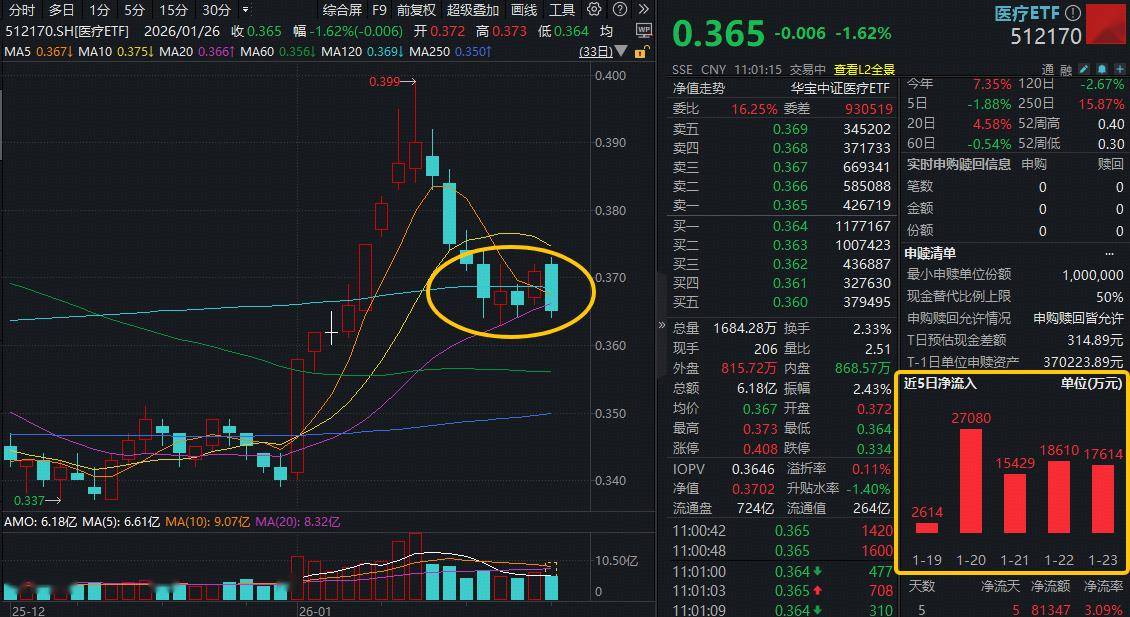
Group 1 - The A-share medical sector weakened on January 26, with AI medical and brain-computer interface concepts leading the decline, as Meien Health dropped by 6% and Weining Health and Sanbo Brain Science fell over 5% [1] - The largest medical ETF in the market (512170) declined by more than 1.6%, losing its half-year line, with real-time transactions exceeding 600 million yuan [1] - Despite the overall decline, the medical ETF (512170) showed high-frequency premiums in the market, indicating active buying interest, with a weekly increase in positions exceeding 813 million yuan [1] Group 2 - CITIC Securities recently published a weekly review of the pharmaceutical industry, indicating that policy impacts will eventually clear, and companies will gradually recover after strategic adjustments, with the medical device sector undergoing dual recovery in valuation and performance [3] - The report suggests increasing allocation to the medical device sector by 2026, with major investment opportunities arising from performance recovery, overseas expansion, brain-computer interfaces, and AI medical technologies, potentially leading to multi-bagger stocks in a tech bull market [3] - The CXO sector is experiencing rapid growth due to advancements in ADC and peptide drugs, with increasing demand for related CXO services, and segments like small nucleic acids and CGT are expected to develop quickly [3] Group 3 - The largest medical ETF (512170) has a fund size of 26.8 billion yuan, making it the largest in the market among medical ETFs [3] - The medical ETF and its linked fund (012323) cover 12 AI medical and brain-computer interface concept stocks, with over 50% weight in medical devices and nearly 25% in CXO [3] - For those interested in Hong Kong stock medical opportunities, the Hong Kong Stock Connect Medical ETF (159137) focuses on medical innovation, gathering core leaders in various pharmaceutical fields, including medical devices, AI medical, CXO, and innovative drugs [3]

刚刚,全市场规模最大医疗ETF(512170)再失半年线,场内频现溢价,“抄底”资金单周爆买逾8亿元
Xin Lang Cai Jing· 2026-01-26 03:25
Group 1 - The A-share medical sector weakened on January 26, with AI medical and brain-computer interface concepts leading the decline, as Meien Health dropped by 6% and Weining Health and Sanbo Brain Science fell over 5% [1][6] - The largest medical ETF in the market (512170) fell by more than 1.6%, losing its half-year line, with real-time transactions exceeding 600 million yuan [1][6] - Notably, the medical ETF (512170) showed high-frequency premiums in the market, indicating active low-buying funds, with a weekly increase of over 813 million yuan [1][6] Group 2 - CITIC Securities recently published a weekly review of the pharmaceutical industry, indicating that policy impacts will eventually clear, and corporate strategic adjustments will lead to gradual recovery, particularly in the medical device sector, which is undergoing dual recovery in valuation and performance [3][8] - The report suggests increasing allocation to the medical device sector by 2026, with main investment opportunities arising from performance recovery, overseas expansion, brain-computer interfaces, and AI medical technologies, potentially leading to multi-fold stock growth in a tech bull market [3][8] - The CXO sector is experiencing rapid growth due to advancements in ADC and peptide drugs, with increasing demand in related fields such as small nucleic acids and CGT, indicating long-term growth potential [3][8] Group 3 - The medical ETF (512170) has a fund size of 26.8 billion yuan, making it the largest among medical ETFs in the market [3][8] - The ETF covers over 50% weight in medical devices and nearly 25% in CXO, including 12 AI medical and brain-computer interface concept stocks [3][8] - For those interested in Hong Kong stock medical opportunities, the Hong Kong Stock Connect Medical ETF (159137) is highlighted as a high-elasticity T+0 tool, focusing on medical innovation and gathering core leaders in various medical fields [3][8]
银河通用成为2026春晚指定具身大模型机器人,医疗创新ETF(516820)连续6天净流入
Xin Lang Cai Jing· 2026-01-26 02:17
Group 1 - The core viewpoint of the news highlights the performance of the medical innovation sector, with the China Securities Medical and Medical Device Innovation Index showing mixed results among its constituent stocks, led by Hualan Biological at a 0.90% increase [1] - The Medical Innovation ETF has seen continuous net inflows over the past six days, with a peak single-day net inflow of 40.54 million yuan, totaling 84.99 million yuan and an average daily net inflow of 14.17 million yuan [1] - Central China Television announced that Galaxy General Robotics will be the designated humanoid robot for the 2026 Spring Festival Gala, marking a significant milestone for the company established in May 2023, which focuses on a wide range of applications including retail, industrial, medical, and cultural tourism [1] Group 2 - The China Securities Medical and Medical Device Innovation Index consists of 30 publicly listed companies with strong profitability, growth potential, and research innovation capabilities, reflecting the overall performance of the medical and medical device sector [2] - As of December 31, 2025, the top ten weighted stocks in the index include WuXi AppTec, Hengrui Medicine, Mindray Medical, and others, collectively accounting for 63.75% of the index [2] Group 3 - The current medical device sector is at a turning point, with performance recovery expected in 2026, driven by new technologies such as AI in healthcare, brain-machine interfaces, and surgical robots, leading to a continuous revaluation of innovative products with global competitiveness [1]

医药行业周报(26/1/19-26/1/23):服务价格立项指南出台,手术机器人行业有望加速发展-20260126
Hua Yuan Zheng Quan· 2026-01-26 02:03
Investment Rating - The investment rating for the pharmaceutical industry is "Positive" (maintained) [4] Core Insights - The report highlights the potential acceleration of the surgical robot industry following the release of the service pricing guidelines by the National Medical Insurance Administration, which clarifies the pricing structure for surgical robot services and consumables [3][18] - The report emphasizes the importance of innovation in the pharmaceutical sector, noting that the industry has completed a transition from old to new growth drivers, particularly in innovative drugs, which are expected to continue to perform well in 2026 [46][47] - The report suggests a focus on sectors such as innovative drugs, AI medical technology, and brain-computer interfaces, which are anticipated to see significant advancements in 2026 [46][48] Summary by Sections Market Performance - From January 19 to January 23, the pharmaceutical index decreased by 0.39%, with an excess return of 0.23% relative to the CSI 300 index. The market was relatively stable, with a notable increase of 1.26% on Friday, driven by themes like brain-computer interfaces and AI medical technology [5][27] - A total of 330 stocks rose while 137 fell during the week, with notable gainers including *ST Changyao (+70.37%) and Hualan Biological (+32.21%) [27][28] Surgical Robot Industry - The surgical robot market is expected to benefit from the new pricing guidelines, which will enhance the clinical application of surgical robots and promote a sustainable business model [3][18] - The domestic laparoscopic robot market is projected to grow significantly, with a compound annual growth rate (CAGR) of 29.3% from 2024 to 2030 [9][15] Investment Recommendations - The report recommends focusing on strong fundamentals and well-adjusted innovative drug stocks, including companies like Xinlitai, Zexing Pharmaceutical, and Hengrui Medicine, as well as medical technology firms like Yuyue Medical and Alibaba Health [5][49] - It also suggests monitoring companies involved in the export of CXO services and those with stable operations and low valuations that are expected to see fundamental changes in 2026 [5][46] Future Outlook - The report anticipates that the pharmaceutical industry will continue to improve marginally in 2026, driven by technological innovation and performance recovery in traditional sectors [46][47] - Key areas of focus include innovative drugs, AI medical technology, and the aging population's healthcare needs, which are expected to drive demand [46][48]


2025年中国授权发明专利97.2万件 每万人口高价值发明专利拥有量达16件
Chang Jiang Shang Bao· 2026-01-26 00:22
Core Insights - By the end of 2025, the number of valid invention patents in China is expected to reach 5.32 million, with a high-value invention patent ownership rate of 16 per 10,000 people, indicating a significant increase in innovation quality and patent structure [1][3] - The value of Chinese brands among the top 5000 global brands is projected to reach $1.81 trillion, ranking second globally, reflecting the growing importance of intellectual property in enhancing brand value [1][4] Group 1: Patent Statistics - In 2025, a total of 972,000 invention patents and 1.461 million utility model patents are expected to be granted, with 96,000 cases of patent reexamination and invalidation concluded [1][3] - The proportion of high-value invention patents has increased to 43.1% of the total valid invention patents, up by 2.9 percentage points compared to the end of the 13th Five-Year Plan [2] - The total number of valid high-value invention patents is projected to reach 2.292 million by the end of 2025, with a year-on-year growth rate higher than the overall patent growth rate by 2.2 percentage points [2] Group 2: Regional Innovation - The eastern region of China continues to lead in innovation, with the Yangtze River Delta, Beijing-Tianjin-Hebei, and Guangdong-Hong Kong-Macau Greater Bay Area being key innovation hubs, collectively accounting for about two-thirds of the total valid invention patents [3] - The Yangtze River Delta, Beijing-Tianjin-Hebei, and Guangdong Province are expected to have valid invention patents of 1.734 million, 916,000, and 899,000 respectively by the end of 2025 [3] - The Shenzhen-Hong Kong-Guangzhou, Beijing, and Shanghai-Suzhou clusters are ranked 1st, 4th, and 6th in the 2025 Global Top 100 Innovation Clusters by the World Intellectual Property Organization [3] Group 3: Economic Impact - The value added by patent-intensive industries is projected to account for 13.38% of GDP by 2024, up from 11.97% in 2020, indicating a steady increase in their contribution to economic growth [4] - The total import and export value of intellectual property usage fees reached 382.87 billion yuan in the first 11 months of 2025, with exports growing by 23.1% year-on-year [3] - The annual output value of geographical indication products is nearing 1 trillion yuan, marking five consecutive years of growth and highlighting their role in enhancing income in specialized industries [4]
专利密集型产业增加值突破18万亿元
Xin Lang Cai Jing· 2026-01-25 19:17
Core Insights - By the end of 2025, the number of valid invention patents in China (excluding Hong Kong, Macau, and Taiwan) is expected to reach 5.32 million, with a high-value invention patent ownership rate of 16 per 10,000 people [1] - The added value of patent-intensive industries in China is projected to exceed 18 trillion yuan [1] - In 2025, a total of 972,000 invention patents, 1.461 million utility model patents, and 666,000 design patents are expected to be granted [1] - The examination cycle for invention patents has been reduced to 15 months, with a case closure accuracy rate of 95.6% [1] - The number of registered trademarks in 2025 is anticipated to reach 4.206 million, with an average examination cycle of 4 months and an approval rate exceeding 97% [1] Industry Performance - The contribution of patent-intensive industries to GDP has increased from 11.97% in 2020 to 13.38% in 2024, indicating a steady improvement in economic contribution [2] - The value of Chinese brands among the world's top 5,000 brands is estimated at 1.81 trillion USD, ranking second globally [2] - The direct annual output value of geographical indication products is close to 1 trillion yuan, marking five consecutive years of growth and significantly contributing to regional economic development [2] Innovation Quality - The growth rate of high-value invention patents in China has outpaced the overall growth rate by 2.2 percentage points, reaching 2.292 million [1] - The fastest-growing fields for valid invention patents include information technology management methods, computer technology, and medical technology [1] - China holds a leading position globally in artificial intelligence patents and has established key core technology patents in future industries such as quantum technology, biomanufacturing, brain-computer interfaces, and sixth-generation communication [1]
热门主题集结:机器人、eVTOL、商业航天、轻量化功能化、固态电池、热管理、先进半导体
DT新材料· 2026-01-25 16:05
Core Viewpoint - The 2026 Future Industries New Materials Expo (FINE 2026) aims to lead global innovation in new materials, emphasizing their critical role in the transformation of high-tech industries and the future economy [1][2]. Group 1: Event Overview - FINE 2026 will take place from June 10 to June 12, 2026, at the Shanghai New International Expo Center, featuring a total exhibition area of 50,000 square meters and over 800 exhibitors [12][34]. - The expo will include more than 300 strategic and cutting-edge technology reports, showcasing innovations applicable to various industries such as AI, aerospace, smart vehicles, and renewable energy [2][20]. Group 2: Focus Areas - The event will focus on five common demands of future industries: advanced semiconductors, advanced batteries, lightweight functional materials, low-carbon sustainability, and thermal management [2][10]. - Six thematic exhibition areas will be established, including advanced semiconductors, advanced batteries and energy materials, thermal management, lightweight and sustainable materials, new materials technology innovation, and future smart terminals [12][15]. Group 3: Participation and Audience - FINE 2026 is expected to attract over 100,000 professional visitors, including industry leaders and investors, facilitating precise connections between enterprises and industry resources [34][35]. - The event will invite over 5,000 industry investors to support quality startups and enhance collaboration opportunities [10][35]. Group 4: Supporting Organizations - The expo is organized by DT New Materials, in collaboration with various associations and institutions, including the China Productivity Promotion Center and the Ningbo New Materials Industry Association [4][5]. - The event will leverage the extensive network of DT New Materials, which has established connections with over 200,000 professionals across various sectors [10]. Group 5: Historical Context - FINE 2026 builds on the success of previous events, including the 2025 International Carbon Materials Expo and the 2025 Thermal Management Expo, which collectively attracted over 35,000 professional visitors from 27 countries [7][34]. - The previous events set a historical high with a total exhibition area of nearly 40,000 square meters and over 500 exhibitors [7].

博拓生物:2026年营收有望重回增长,战略布局脑机接口未来可期
Zheng Quan Shi Bao Wang· 2026-01-25 15:03
Core Viewpoint - The company, Hangzhou Botao Biotechnology Co., Ltd., anticipates a decline in revenue and net profit for 2025 due to the impact of U.S. tariff policies and cyclical fluctuations in the infectious disease market, but expects steady growth in 2026 with new product registrations and strategic investments in the brain-computer interface (BCI) industry [1][2]. Financial Performance - The company forecasts a significant drop in net profit for 2025, primarily due to revenue declines from U.S. tariffs and cyclical market demand fluctuations, alongside increased R&D and stock incentive costs [2]. - Despite short-term performance pressures, the company is optimistic about 2026 being a turning point for revenue and profit growth, supported by new product registrations and stable tariff conditions [2]. Product Development and Innovation - The company is accelerating the development of its microfluidic technology platform, focusing on cardiac markers, thyroid function, and nutrition-related projects, with breakthroughs in multi-project detection on a single chip [2]. - The company has received FDA510(k) approval for fentanyl testing and is progressing with various microfluidic product registrations in China, the EU, and Southeast Asia [2]. Strategic Expansion in Brain-Computer Interface - The company is actively investing in the BCI sector, aiming to establish it as a second core business through direct investments and partnerships [3]. - A strategic investment in Hangzhou Qingshi Yongjun has been made, focusing on invasive BCI treatments for treatment-resistant depression, with clinical trials already underway [3][4]. - The company has also invested in Hangzhou Haoshi Tianhui, which focuses on non-invasive BCI technologies for mental health assessments, with plans for product promotion and sales in 2026 [5][6]. Industry Ecosystem Development - The company plans to establish a specialized industry fund for the BCI sector, with a total scale of 200 million yuan, to enhance collaboration and development within the medical device ecosystem [6]. - The company is committed to building a synergistic medical device ecosystem in the BCI industry, recognizing it as a long-term investment opportunity in the healthcare sector [6].

银河基金权益投资团队详解五大产业发展
Shang Hai Zheng Quan Bao· 2026-01-25 14:24
Group 1: Medical Industry - The brain-computer interface (BCI) has emerged as a significant theme in 2026, with potential for growth in the medical device sector [2] - The domestic payment system for non-invasive and invasive BCI technologies is becoming clearer, with quantifiable prices and quantities [2] - The valuation of innovative drugs has seen some recovery, and there is anticipation for other pharmaceutical sub-sectors to gradually increase in valuation due to predictable catalytic events [2] Group 2: Cyclical Industry - The precious and non-ferrous metals market remains strong, supported by three main factors: global de-dollarization, de-globalization, and AI industry trends [3] - The core logic behind the current gold market is the continuous purchasing of gold by multiple central banks, indicating that bullish sentiment may persist despite high prices [3] - The chemical sector is currently at historical low price indices, and any confirmation of an upward trend in chemical prices could attract market attention [3] Group 3: Energy Sector - The energy sector is a focal point for capital markets, with space-based solar power identified as a potential breakthrough in the renewable energy sector [4] - The lithium battery and energy storage industry is at a turning point, primarily driven by increased storage demand [4] Group 4: Media Industry - The application of AI is expected to see significant advancements this year, driven by improvements in large model capabilities and the commercial pressures faced by major internet companies [5] - The market is focusing on the commercialization of AI applications, particularly in advertising and content generation, such as short dramas and realistic dramas [5] Group 5: AI Industry - The robotics sector is experiencing growth, with a major electric vehicle and energy company planning to deploy thousands of robots this year [6] - The AI industry is viewed as a long-term growth direction, with expectations for rapid monetization from hardware to software, although there may be interim waiting periods for breakthroughs [6] - The application and robotics sectors are anticipated to present broader development opportunities as the market seeks tangible returns from AI investments [6]