A股市场

Search documents
量价齐升 A股多个指数创阶段新高
Zheng Quan Shi Bao· 2025-07-23 22:24
Core Viewpoint - The A-share market continues to show a strong trend, with major indices reaching new highs, while structural differentiation remains evident in the market [1][2][4]. Market Indices Performance - Major A-share indices have been on the rise, with the Shanghai Composite Index surpassing 3600 points, reaching a nearly 9-month high; the Shenzhen Component Index and the ChiNext Index also achieved new highs [2]. - The CSI 2000 Index and CSI 1000 Index reached new highs since their respective launches, while the CSI 500 Index hit its highest level in 8 months [2]. Market Activity and Trading Volume - Market trading volume has significantly increased, with total trading volume in the Shanghai, Shenzhen, and Beijing markets exceeding 1.9 trillion yuan on July 22, marking a 4-month high and an increase of several hundred billion yuan since early July [2]. - Margin trading has become more active, with daily margin purchases reaching 200.9 billion yuan on July 22, the highest in over 4 months, compared to less than 100 billion yuan a month prior [3]. Structural Differentiation in the Market - Despite the overall rise in indices, there is notable structural differentiation, with some sectors and stocks underperforming relative to the indices [4]. - From a longer-term perspective, while major sectors have seen varying degrees of increase since 2024, the banking sector has outperformed with over 60% growth, while sectors like food and beverage, coal, and real estate have seen less than 10% growth [4]. Market Sentiment and Future Outlook - Analysts indicate that the A-share market has exhibited intense volatility and convergence of trends, driven by aggressive capital speculation and market sentiment influencing short-term pricing [5][6]. - The outlook remains optimistic, supported by a 5.3% economic growth rate in the first half of the year, ongoing capital market reforms, and favorable monetary policies, which enhance the attractiveness of A-share investments [6].
沪指3600点拉锯战,上攻动能几何?
21世纪经济报道· 2025-07-23 15:23
Market Performance - The A-share market has shown strong momentum, with the Shanghai Composite Index rising from a low of 3040.69 points on April 7 to over 3600 points within approximately 70 trading days, indicating robust market dynamics [3] - As of July 23, the Shanghai Composite Index closed at 3582.30 points, with a slight increase of 0.01% for the day, despite a significant drop during the afternoon session [1] - The trading volume in the Shanghai and Shenzhen markets reached 1.86 trillion yuan, a decrease of 28.4 billion yuan compared to the previous trading day, with over 4000 stocks declining and more than 1200 stocks rising [1] Sector Performance - Among the 31 first-level sectors, 18 sectors have seen an increase of over 10% in the past 120 trading days, with steel, non-ferrous metals, and pharmaceutical sectors leading with gains of 21.79%, 21.65%, and 20.55% respectively [3] - The average stock price increase in the A-share market has exceeded 30% since last October, with over 4000 stocks surpassing their previous highs, and 405 stocks doubling in value [3] Funding and Policy Support - The financing balance in the A-share market has been on the rise, reaching 1.93 trillion yuan as of July 22, the highest level in nearly four months [4] - Regulatory bodies are actively promoting long-term capital inflows into the market, with recent guidelines aimed at enhancing the investment of commercial insurance funds and various pension funds [5] - The market sentiment remains optimistic due to abundant liquidity and favorable policy expectations, with a notable shift towards technology sectors benefiting from industry and policy support [5] Economic Indicators - Recent economic data has exceeded expectations, with consumption contributing 52% to economic growth, reinforcing confidence in the capital market [8] - Analysts suggest that the current market conditions may lead to a stronger-than-expected performance in the A-share market in the second half of the year [7][8] Risk and Valuation Concerns - There are concerns regarding the accumulation of risks in the financing market, particularly for companies with valuations exceeding 15 PE without matching growth [7] - The presence of historical trapped positions around the 3600-point mark may lead to volatility if the market cannot maintain its upward momentum [7]


A股,积极信号
Zheng Quan Shi Bao· 2025-07-23 12:49
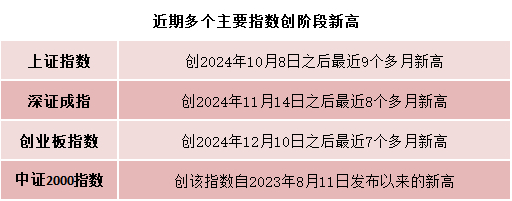
Market Overview - A-share market indices have recently reached new highs, with the Shanghai Composite Index surpassing 3600 points, marking a nine-month high since October 8, 2024 [2][4] - The Shenzhen Component Index and the ChiNext Index also achieved significant milestones, with the former reaching an eight-month high since November 14, 2024, and the latter a seven-month high since December 10, 2024 [2][4] Trading Activity - Market trading volume has increased significantly, with total trading volume in the Shanghai, Shenzhen, and Beijing markets exceeding 1.9 trillion yuan on July 22, a four-month high, reflecting a rise of several hundred billion yuan since early July [4][5] - Margin trading has become more active, with daily financing purchases reaching 200.9 billion yuan on July 22, the highest since March 6, 2024, and a notable increase from under 100 billion yuan a month prior [5] Market Structure - Despite the overall upward trend, there is a noticeable structural differentiation within the A-share market, with some sectors and stocks underperforming relative to the indices [6][7] - From a longer-term perspective, various sectors have shown different performance levels, with the banking sector leading with over 60% cumulative gains since the beginning of 2024, while sectors like food and beverage, coal, and real estate have seen gains of less than 10% [7][8] Market Dynamics - The A-share market has exhibited significant volatility and convergence in trends, indicating intense capital competition and emotional trading influencing short-term pricing [8] - The effectiveness of market pricing is gradually improving, as evidenced by the narrowing of cumulative price fluctuations and the survival of quality companies supported by fundamentals [8][9] Future Outlook - The market is expected to maintain an optimistic trend, supported by a GDP growth rate of 5.3% in the first half of the year, which lays a foundation for achieving annual targets [9] - Ongoing capital market reforms and a favorable monetary policy environment are anticipated to enhance the attractiveness of A-share investments, particularly in value sectors [9]
A股,积极信号!
证券时报· 2025-07-23 12:29
Core Viewpoint - The A-share market is showing strong upward momentum, with multiple indices reaching new highs and increasing trading volumes, indicating a positive market sentiment and potential investment opportunities [1][5][9]. Group 1: Market Performance - On July 23, major indices such as the Shanghai Composite Index, Shenzhen Component Index, and ChiNext Index reached new highs, with the Shanghai Composite Index surpassing the 3600-point mark for the first time in over nine months [5][7]. - The total trading volume in the Shanghai, Shenzhen, and Beijing markets has been rising, with a record of over 1.9 trillion yuan on July 22, marking a significant increase compared to early July [7][9]. Group 2: Margin Trading Activity - Margin trading has become increasingly active, with daily financing purchases reaching 200.9 billion yuan on July 22, the highest level since March 6 [9][8]. - The total margin balance exceeded 1.9 trillion yuan on July 17, indicating a growing interest in leveraged trading [9]. Group 3: Market Structure and Trends - Despite the overall market uptrend, there is notable structural differentiation, with some sectors and stocks underperforming relative to the indices [10][11]. - Since the beginning of 2024, the banking sector has seen a significant increase of over 60%, while sectors like food and beverage, coal, and real estate have shown minimal growth of less than 10% [11][12]. - Over 3,000 stocks have doubled from their lowest points in 2024, while more than 100 stocks have seen their prices drop by over 50% from their peaks, indicating high volatility and selective performance among individual stocks [12][13]. Group 4: Future Outlook - Analysts predict that the optimistic trend in the market is likely to continue, supported by a GDP growth rate of 5.3% in the first half of the year and ongoing reforms in the capital market [13]. - The current global monetary order is undergoing changes, which may benefit Chinese assets, further attracting overseas capital to the A-share market [13].

【机构策略】A股市场有望延续震荡上行走势
Zheng Quan Shi Bao Wang· 2025-07-23 01:19
Group 1 - The A-share market experienced a slight upward trend after initial declines, with sectors such as coal, photovoltaic equipment, batteries, and liquor performing well, while banking, gaming, communication services, and internet services lagged behind [1] - Long-term capital inflow into the market is accelerating, with steady growth in ETF sizes and continuous inflow of insurance funds, providing significant support [1] - The Federal Reserve maintained interest rates in June, but uncertainty remains regarding the path of potential rate cuts, which could significantly boost global risk appetite if clear signals are released [1] Group 2 - The A-share market's three major indices continued to show upward momentum, with the Shanghai Composite Index stabilizing above 3500 points and approaching 3600 points [2] - The current core pricing logic in the equity market is increasingly reflected in policies such as "domestic circulation" and "anti-involution," alongside active thematic investment opportunities, suggesting a continuation of the upward trend [2] - Despite external uncertainties, the overall market is expected to maintain a strong upward trajectory [2]
二季报点评:摩根MSCI中国A股ETF基金季度涨幅1.78%
Zheng Quan Zhi Xing· 2025-07-22 18:28
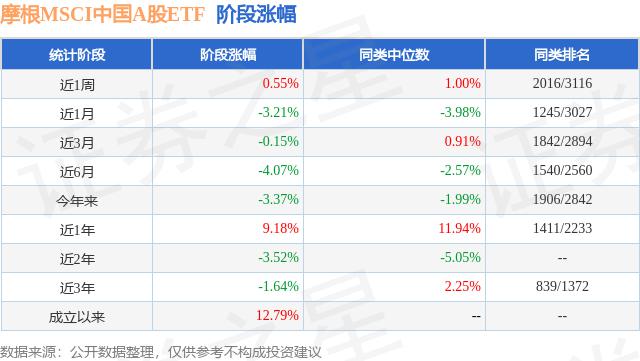
Core Viewpoint - Morgan MSCI China A-Share ETF reported a net asset value increase of 1.78% for Q2 2025, with a total fund size of 0.82 billion yuan, reflecting a year-on-year net value growth of 19.05% [1][2]. Fund Performance - The fund's performance over the past year ranks 1639 out of 2395 similar funds, with a median net value growth of 25.63% among peers [1]. - The maximum drawdown for the past year was -15.31%, while the maximum drawdown since inception reached -37.82% [1]. Fund Size and Asset Allocation - The fund size decreased by 202.46 million yuan from the previous period, representing a 2.41% decline [2]. - The current asset allocation shows 98.63% in equities, 1.55% in cash, and no bond assets [2]. Top Holdings - The top ten stock holdings account for 19.66% of the fund, with Kweichow Moutai (600519) being the largest holding at 4.55% [2][3]. Fund Manager Insights - The current fund manager, He Zhihao, has been in charge since February 19, 2021, with a cumulative return of -17.71% during his tenure [4]. - The fund manager noted that the A-share market is at the beginning of a new expansion cycle, with small-cap stocks performing better than large-cap stocks [7]. Market Outlook - The A-share non-financial companies ended a streak of eight consecutive quarters of profit decline, with a 4.2% year-on-year net profit growth in Q1 2025 [7]. - If the fundamentals continue to improve, coupled with a weaker dollar, there is potential for foreign capital to flow back into Chinese core assets, which are still relatively undervalued globally [7].
冲击4连涨!中证A500ETF南方(159352)最新单日净流入1.79亿元,全球资金积极增配中国资产,A股运行中枢有望迈上新台阶
Xin Lang Cai Jing· 2025-07-22 03:51
Group 1 - The core viewpoint of the news highlights the positive performance of the China A500 ETF and the increasing interest from sovereign wealth funds in Chinese assets, particularly in sectors like digital technology and renewable energy [1][2]. - The China A500 ETF Southern (159352) has shown a 0.10% increase, marking its fourth consecutive rise, with the underlying index, the China A500 Index, up by 0.14% [1]. - Sovereign wealth funds, especially from the Middle East, are planning to increase their allocation to Chinese assets over the next five years, with around 60% of them expressing this intention [1]. Group 2 - The market is exhibiting positive signals, with the Shanghai Composite Index remaining above 3500 points, indicating a potential upward trend in the A-share market [2]. - The upcoming Central Political Bureau meeting is expected to focus on key policy areas, which could influence market dynamics [2]. - The China A500 Index is designed to reflect the performance of the top 500 leading securities across various industries, selected based on market capitalization and liquidity [2][3]. Group 3 - The China A500 Index employs an adjusted market capitalization weighting method and covers a wide range of industries, including both emerging and traditional sectors [3]. - The top ten weighted stocks in the index include major companies such as Kweichow Moutai, CATL, and Ping An Insurance [3]. - The management and custody fees for the China A500 ETF Southern are among the lowest in the ETF market, with a management fee of 0.15% and a custody fee of 0.05% [3].





创业板50ETF华夏(159367)二级市场价格创上市以来新高
Mei Ri Jing Ji Xin Wen· 2025-07-22 02:39
Group 1 - A-shares showed mixed performance on July 22, 2025, with sectors like building materials, beauty care, and communications leading the gains, while banking, non-bank financials, and environmental protection sectors faced declines [1] - Since April, the A-share market has been on a rising trend, with the Shanghai Composite Index surpassing 3500 points, indicating a new phase of growth [1] - Foreign investment interest in Chinese assets is increasing, with approximately 60% of Middle Eastern sovereign wealth funds planning to increase allocations to China over the next five years, particularly in the technology sector [1] Group 2 - Current market conditions are characterized by "asymmetrical risk and reward," with "downside risks" being contained due to central bank support and insurance companies committing to invest 30% of new premiums in A-shares starting in 2025 [2] - The potential for "upside rewards" is significant, especially if upcoming political meetings and planning initiatives positively influence long-term market expectations [2] - The ChiNext 50 Index focuses on the top 100 stocks by market capitalization in the ChiNext market, selecting the 50 with the best liquidity, representing high-growth potential in sectors like batteries, securities, and communication equipment [2] Group 3 - The Huaxia ChiNext 50 ETF (159367) stands out due to its 20% price fluctuation limit, enhancing trading flexibility compared to traditional broad-based ETFs, allowing better capture of market opportunities [3] - The fund features competitive fee structures, with a management fee of only 0.15% and a custody fee of 0.05%, positioning it among the lowest in its category, thereby reducing long-term investment costs and increasing potential returns for investors [3]

一周市场回顾(2025.07.14—2025.07.18)
Hongxin Security· 2025-07-21 09:07
Market Performance - The Shanghai Composite Index rose by 0.69%, closing at 3534.48 points[1] - The Shenzhen Component Index increased by 2.04%, closing at 10913.84 points[1] - The ChiNext Index saw a growth of 3.17%, ending at 2277.15 points[1] Sector Performance - The top-performing sectors included Communication (7.56%), Pharmaceuticals (4.00%), and Automotive (3.28%) for the week[4] - The sectors with the largest declines were Media (-2.24%), Real Estate (-2.17%), and Utilities (-1.37%) for the week[4] Margin Trading - The total margin trading balance reached 19023.36 billion CNY, an increase of 1.41% from the previous week[5] - Margin trading accounted for 2.25% of the A-share market's circulating market value, up by 0.36%[5] - The weekly margin trading volume was 7465.05 billion CNY, increasing by 6.21% from the previous week[19] Industry Insights - The top five industries for net margin purchases were Electronics (29.37 billion CNY), Non-ferrous Metals (26.51 billion CNY), and Computers (26.22 billion CNY)[28] - The industries with the highest net margin sales included Food and Beverage (-5.50 billion CNY) and Textiles and Apparel (-2.09 billion CNY)[28]
【申万宏源策略 | 一周回顾展望】经济预期谨慎,A股缘何延续强势
申万宏源证券上海北京西路营业部· 2025-07-21 02:02
Core Viewpoint - The article discusses the cautious economic outlook and analyzes the reasons behind the sustained strength of the A-share market [1] Group 1: Economic Outlook - The economic expectations remain cautious, influenced by various domestic and international factors [1] - Recent economic indicators suggest a mixed performance, with some sectors showing resilience while others face challenges [1] Group 2: A-share Market Performance - The A-share market has shown strong performance despite the cautious economic outlook, driven by investor sentiment and sector rotations [1] - Key sectors contributing to the market strength include technology and consumer goods, which have outperformed others [1]