
创新药出海

Search documents
9部门:鼓励创新药等药品进零售药店销售渠道,创新药ETF(159992)涨超1%,昨日“吸金”2.4亿元
2 1 Shi Ji Jing Ji Bao Dao· 2026-01-23 02:57
Group 1 - The A-share market saw all three major indices rise collectively, with the CSI Innovation Drug Industry Index increasing by 1.37%, driven by significant gains in stocks such as Zhaoyan New Drug, which rose over 5% [1] - The Innovation Drug ETF (159992) also experienced a rise of 1.17%, with a trading volume exceeding 150 million yuan, indicating active trading [1] - The ETF has recorded a net inflow of 240 million yuan on the previous trading day (January 22), marking five consecutive days of net inflows totaling 860 million yuan, with a latest circulation size of 14.87 billion yuan [1] Group 2 - The Ministry of Commerce and eight other departments released opinions to promote high-quality development in the pharmaceutical retail industry, advocating for deep cooperation between pharmaceutical manufacturers and large distribution companies [2] - The new policies encourage the sale of innovative drugs and reference preparations through retail pharmacies and promote the use of data interfaces by e-commerce platforms to enhance price monitoring [2] - Jianghai Securities noted that the global biopharmaceutical investment environment is gradually improving, with Chinese innovative drug companies increasingly pursuing international collaborations, evidenced by five new licensing agreements in the first week of the new year [2]
金鹰基金欧阳娟:创新药迎来业绩窗口期 脑机和AI医疗焕发产业新生
Xin Lang Cai Jing· 2026-01-22 07:09
Core Insights - The innovative drug sector is entering a critical performance realization phase in 2026, driven by multiple catalysts and advancements in brain-computer interfaces and AI medical technologies [1][6][7] - Fund managers, including Ouyang Juan from Jinying Fund, express optimism about the innovative drug sector's upward trend, supported by domestic healthcare policies and China's competitive edge in global markets [1][6][7] - The potential of AI in healthcare is significantly underestimated, with expectations for new business models to emerge as AI applications in drug development, cancer screening, and personalized treatment evolve [2][7] Group 1: Industry Outlook - The innovative drug sector is expected to maintain a positive outlook, benefiting from ongoing support from domestic healthcare policies and the global competitiveness of Chinese innovative drugs [1][6] - The year 2026 is anticipated to be pivotal for the brain-computer interface industry, with significant changes expected in both domestic and international markets [3][8] - The AI healthcare sector is entering a phase of commercial exploration, with vast amounts of medical data and a growing demand for AI applications [2][8] Group 2: Investment Strategies - Focus areas for investment include innovative drugs with strong global competitiveness, which can benefit from both domestic and Western markets [3][8] - The innovative drug supply chain, including CXO and life sciences services, is projected to see a recovery in order growth as global financing accelerates [3][8] - The brain-computer interface and AI medical sectors are highlighted as emerging areas of interest, with potential for substantial growth and innovation [2][3][8]
创新药ETF国泰(517110)盘中涨超1%,市场关注行业出海与业绩亮点
Mei Ri Jing Ji Xin Wen· 2026-01-21 06:30
Group 1 - The core viewpoint of the article highlights the significant growth and potential of China's innovative pharmaceuticals sector, particularly in the context of international expansion and record-breaking performance in business development (BD) transactions [1] - In 2025, the total amount of BD transactions for Chinese innovative drugs reaching overseas is projected to hit $135.655 billion, with upfront payments of $7 billion and a total of 157 transactions, all marking historical highs [1] - The ongoing BD transactions validate the global competitiveness of Chinese innovative drugs, which is expected to bolster long-term investor confidence [1] Group 2 - The small nucleic acid drug sector is experiencing accelerated development, with leading companies making significant strides in new target development and treatment convenience, supported by continuously validated clinical data [1] - The increasing focus on this sector is likely to drive more licensing and merger collaborations, which could further stimulate the growth of the upstream supply chain [1] - The ETF Guotai (517110) tracks the SHS Innovative Drug Index (931409), which selects innovative pharmaceutical companies from the Shanghai, Shenzhen, and Hong Kong markets, emphasizing strong R&D capabilities and growth potential [1]
20cm速递|科创创新药ETF国泰(589720)盘中涨超1%,连续5日净流入近2亿元,关注AI医疗与出海进展
Mei Ri Jing Ji Xin Wen· 2026-01-21 05:56
Core Insights - 2025 is a landmark year for Chinese innovative drugs going global, with total BD (business development) outbound licensing transaction value reaching $135.655 billion and transaction count hitting 157, both setting historical highs [1] - The continuous execution of BD transactions in 2026 validates the global competitiveness of Chinese innovative drugs, with innovation remaining the main investment theme in the pharmaceutical industry [1] Group 1: Market Trends - The small nucleic acid drug sector is attracting more attention from leading companies due to advancements in new target development and treatment convenience, alongside continuously validated clinical data, accelerating outbound licensing and merger collaborations [1] - In the GLP-1 sector, a new pricing system is forming in the domestic market, but the long-term market potential remains promising due to the large patient population for weight loss and diabetes [1] - The development of oral autoimmune drugs is gaining focus, with domestic companies exploring related new targets [1] Group 2: Investment Products - The Guotai Innovation Drug ETF (589720) tracks the Innovation Drug Index (950161), which has a daily price fluctuation limit of 20%, selecting listed companies focused on new drug research and development in the biotech and chemical pharmaceutical sectors to reflect the overall trend and market performance of China's pharmaceutical industry innovation [1]
中国创新药2025年出海交易超1300亿美元,港股医药ETF(159718)备受关注
Xin Lang Cai Jing· 2026-01-20 02:24
Core Viewpoint - The Chinese innovative drug business development (BD) for overseas licensing reached a record high of $135.655 billion in total transaction value for 2025, with a significant increase in upfront payments and transaction numbers compared to previous years [1][2]. Group 1: Market Performance - The China Securities Hong Kong Stock Connect Pharmaceutical and Health Comprehensive Index (930965) showed mixed performance among its constituent stocks, with Times Angel leading at a 4.83% increase [1]. - The Hong Kong pharmaceutical ETF (159718) was quoted at 0.96 yuan [1]. Group 2: Industry Developments - The innovative drug BD overseas licensing transactions in China for 2025 totaled $135.655 billion, with upfront payments of $7 billion and 157 transactions, all marking historical highs [2]. - Notable collaborations include Rongchang Biopharma's PD-1/VEGF dual antibody RC148 receiving a $650 million upfront payment from AbbVie, and Yilian Biopharma's partnership with Roche on B7H3-targeted ADC [2]. - GSK's Bepirovirsen for chronic hepatitis B showed positive results in Phase III trials, and Arrowhead announced advancements in RNAi therapies for weight loss, validating the clinical value of small nucleic acid drugs [2]. Group 3: Investment Outlook - The 44th Annual J.P. Morgan Healthcare Conference revealed positive updates from leading global pharmaceutical companies, with significant BD transactions and improved forecasts from CXO companies like WuXi AppTec [2]. - The global pharmaceutical industry remains robust, with innovation in drugs and medical devices continuing to be the main investment theme [2].


“出海”与并购并举 创新药产业跑出加速度
Zheng Quan Ri Bao· 2026-01-19 16:12
Core Insights - The Chinese innovative pharmaceutical industry is experiencing a surge in overseas orders and mergers, indicating a vibrant market as companies engage in international collaborations and acquisitions [1][2] Group 1: International Collaborations - Since January, local companies like West Bioman and Rongchang Biopharmaceutical have completed at least five overseas licensing agreements with multinational pharmaceutical firms, showcasing active global transaction capabilities [1] - China's drug pipeline accounts for approximately 30% of the global total, ranking second worldwide, which signifies a shift from following to leading in the biopharmaceutical sector [2] - It is projected that by 2025, the total value of innovative drug licensing transactions from China will exceed $130 billion, with over 150 deals, significantly surpassing the previous year's figures [2] Group 2: Mergers and Acquisitions - China National Pharmaceutical announced a full acquisition of Hegia Biopharmaceutical for RMB 1.2 billion, aiming to enter the small interfering RNA (siRNA) innovative drug sector and expand its pipeline in cardiovascular and metabolic diseases [3] - WuXi AppTec plans to acquire Easton Pharmaceuticals at HKD 4.00 per share to enhance its capabilities in the commercial production of antibody-drug conjugates [3] - Aopu Mai has completed the acquisition of Pengli Biopharmaceutical, integrating it as a wholly-owned subsidiary to strengthen industry chain collaboration and achieve business integration [4] Group 3: Future Outlook - Companies like Fuhong Hanlin expect to launch over 20 products globally by 2030, with more than 15 anticipated to be approved in the US and Europe [5] - Jiangsu Hengrui Medicine has over 100 innovative products in clinical development and expects multiple milestone advancements in 2026, including approvals for over 10 innovative drugs or indications [5]


科望医药“长期主义”价值兑现正当时,打造中国创新药出海标杆
Cai Fu Zai Xian· 2026-01-19 06:13
Core Insights - The article highlights the significant valuation reassessment window for the innovative drug industry, with Kewang Pharmaceutical emerging as a rare focus for capital due to its differentiated technology platform and robust pipeline [1] - Kewang Pharmaceutical has secured over $250 million from top-tier institutions, achieving a post-Series C valuation of nearly $600 million, and is set to update its Hong Kong IPO prospectus in 2025, aiming to become the "first MCE stock" [1] - The dual resonance of capital empowerment and clinical breakthroughs lays a solid foundation for Kewang Pharmaceutical's long-term R&D investments and global expansion, gradually realizing the value of "long-termism" [1] Capital and Investment - Kewang Pharmaceutical's investor team includes prominent institutions such as Eli Lilly Asia Fund, Hillhouse Capital, Greater Bay Area Fund, and Tencent Investment, reflecting strong recognition of its innovative R&D capabilities in immunotherapy [1][2] - The company achieved positive operating cash flow in 2024, indicating robust cash flow management while continuing to increase R&D investments, providing a solid foundation for pipeline advancement and R&D activities [2] - The update of the Hong Kong IPO prospectus accelerates the capital process, potentially offering broader capital platforms for global technical cooperation, clinical advancement, and market expansion [2] Strategic Collaborations - Kewang Pharmaceutical established a global strategic partnership with AstraZeneca worth over $1.7 billion, focusing on joint R&D of candidate drug molecules from the BiME® platform, setting a record for BD transactions in the domestic immuno-oncology field [2] - This collaboration demonstrates international giants' high recognition of Kewang Pharmaceutical's MCE technology and accumulates valuable global cooperation experience [2] - The company has built a unique light-asset development model through "independent R&D + global cooperation + BD," enhancing pipeline value and global market expansion [2] Clinical Progress and Future Outlook - With capital support, Kewang Pharmaceutical's core pipeline is advancing rapidly, including promising Phase I data for the globally first CD39/TGF-β dual antibody ES014 and accelerated clinical development of multiple projects from the BiME® platform [3] - The successful development of products like ES104 and ES102 into mid-to-late clinical stages validates the foresight of Kewang Pharmaceutical's differentiated target layout and lays a solid asset foundation for future commercialization and global BD cooperation [3] - As the capital process progresses, Kewang Pharmaceutical aims to further connect the "R&D - clinical - commercialization" value chain, continuously releasing long-term potential in the next generation of immunotherapy [3]
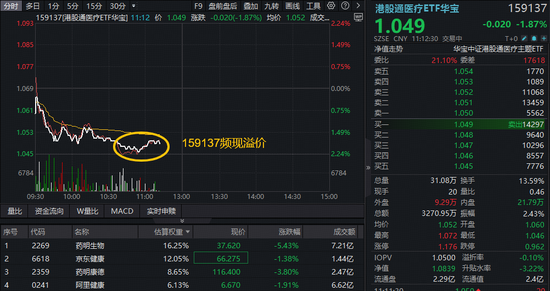
港股医药再调整,港股通医疗ETF(159137)、港股通创新药ETF(520880)跌2%!低吸时机到了?场内持续溢价!
Xin Lang Cai Jing· 2026-01-19 03:25
Core Viewpoint - The Hong Kong stock market is experiencing a broad adjustment, with the Hang Seng Index down nearly 1%, particularly affecting the healthcare sector, which is seeing declines in major pharmaceutical stocks and ETFs [1][10]. Group 1: Market Performance - The Hong Kong healthcare sector opened lower and continued to decline, with the Hong Kong Stock Connect Medical ETF (Huabao, 159137) dropping by 2%, and major stocks like WuXi Biologics falling over 5% [1][10]. - The Hong Kong Stock Connect Innovative Drug ETF (520880), which exclusively tracks innovative drugs, fell by over 2%, with leading stocks such as BeiGene and CanSino Biologics also declining by more than 2% [3][10]. - The trading volume for the Hong Kong Stock Connect Innovative Drug ETF exceeded 200 million yuan, indicating strong buying interest despite the price drop [12]. Group 2: Regulatory and Market Insights - The National Medical Products Administration of China announced that 76 innovative drugs are expected to be approved by 2025, positioning China as a global leader in this area, with the total transaction value for overseas licensing of innovative drugs expected to exceed 130 billion USD [14]. - Analysts believe that the Chinese innovative drug sector is entering a phase of simultaneous benefits from "going global, technology, and policy," leading to a revaluation of innovative drug stocks [15]. Group 3: ETF Characteristics - The Hong Kong Stock Connect Innovative Drug ETF (520880) and its associated funds passively track the Hang Seng Stock Connect Innovative Drug Select Index, which has three unique advantages: it is purely focused on innovative drugs, has a high concentration of leading companies, and effectively manages risks associated with less liquid stocks [5][6][16]. - The top ten stocks in the ETF account for over 73% of its weight, highlighting the dominance of leading companies in the innovative drug sector [17].

蓄势、崛起:从三生国健看中国创新药企的下一站
Ge Long Hui· 2026-01-19 02:00
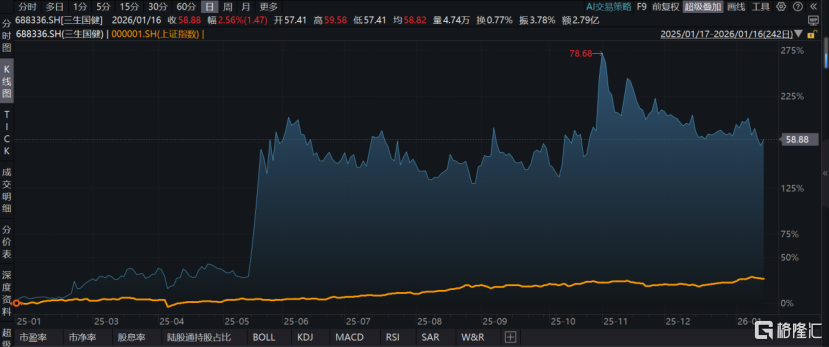
Core Insights - In 2025, China's innovative pharmaceuticals are emerging as a central narrative in the capital market, with companies like Sangfor Biopharma leading the charge due to their solid fundamentals and innovative achievements [1][16] - The market is responding positively, as evidenced by Sangfor Biopharma's stock price increase of 319.41% over the past year, indicating strong investor confidence in companies with genuine innovation capabilities [1][15] - Despite potential external policy changes, the growth logic and resilience of the industry remain intact, with a consensus among multiple institutions that the outlook for the innovative drug sector is still bright [1][16] Company Performance - Sangfor Biopharma's R&D investment reached 368 million yuan in the first three quarters of 2025, a year-on-year increase of 3.87%, with R&D expenses accounting for 32.97% of revenue [3][15] - The company has 22 projects in its pipeline, ensuring a steady stream of new drug applications from 2025 to 2028, which will drive long-term growth and open up opportunities for international expansion [3][11] Product Pipeline - The company is advancing several key products, including: - **608 (anti-IL-17A monoclonal antibody)**: Shows significant therapeutic potential for psoriasis, with a market size exceeding 10 billion yuan in China [6][10] - **613 (anti-IL-1β monoclonal antibody)**: Targets acute and intercritical gouty arthritis, with a large patient population of over 14.66 million in China [7][10] - **610 (anti-IL-5 monoclonal antibody)**: Leading in domestic development for severe eosinophilic asthma, with promising clinical results [8] - **611 (anti-IL-4Rα monoclonal antibody)**: Covers multiple indications, including atopic dermatitis and chronic rhinosinusitis with nasal polyps, with a significant patient base [9][10] Market Trends - The autoimmune disease drug market is one of the fastest-growing therapeutic areas, projected to reach 4.6 billion USD by 2024, with a compound annual growth rate of 15.9% from 2020 to 2024 [16] - The penetration rate of domestic biological agents in autoimmune diseases is still below 10%, indicating substantial room for growth compared to over 30% in Western markets [16] Strategic Development - Sangfor Biopharma has established a three-pronged development model focusing on autoimmune diseases, collaborative licensing, and R&D innovation, positioning itself for a positive cycle of performance and valuation recovery [18] - The company has built a global sales network, with nearly 300 sales professionals covering over 4,900 medical institutions in China and gaining market approvals in 15 countries for its core product [18] Valuation Outlook - Several brokerages have raised their valuation expectations for Sangfor Biopharma, indicating strong growth potential, with a current PE ratio of 41.72, suggesting room for upward adjustment [19][22]

蓄势、崛起:从三生国健(688336.SH)看中国创新药企的下一站
Ge Long Hui· 2026-01-19 01:56
Core Viewpoint - In 2025, China's innovative pharmaceuticals are emerging as a central narrative in the capital market, with companies like Sangamo Health demonstrating strong fundamentals and innovation capabilities, leading to significant stock price increases [1][4]. Group 1: Company Performance - Sangamo Health's stock price has seen a maximum increase of 319.41% over the past year, reflecting market confidence in companies with genuine innovation capabilities [1]. - For the first three quarters of 2025, the company reported revenue of 1.116 billion yuan, a year-on-year increase of 18.80%, and a net profit of 399 million yuan, up 71.15%, indicating enhanced profitability [17]. - The company has a robust pipeline with 22 ongoing projects, ensuring a steady stream of new drug applications from 2025 to 2028 [4]. Group 2: Research and Development - The company's R&D investment reached 36.8 million yuan in the first three quarters of 2025, a 3.87% increase year-on-year, with R&D expenses accounting for 32.97% of revenue [4]. - Key projects in the pipeline include 608 (for psoriasis) and 613 (for acute gout), both of which have received regulatory acceptance for market application [8][9]. - The early-stage pipeline includes 626 and 627, which show potential for being "best-in-class" (BIC) products, further enriching the company's innovation landscape [13][14]. Group 3: Market Trends and Opportunities - The autoimmune disease drug market in China is projected to grow significantly, reaching 4.6 billion USD by 2024, with a compound annual growth rate of 15.9% from 2020 to 2024 [19]. - The company is positioned to benefit from the increasing global recognition of Chinese innovative drugs, with a focus on self-immune diseases and international collaborations [20][21]. - The company has established a global sales network, with nearly 300 sales professionals covering over 4,900 medical institutions, including more than 2,100 tertiary hospitals [21]. Group 4: Valuation and Market Perception - Multiple brokerages have raised the company's valuation expectations, indicating a positive outlook for growth potential [25]. - As of January 17, the company's PE (TTM) was 41.72, positioned in the lower range of its historical valuation, suggesting upward potential [22].