
利差损

Search documents
4月人身险保费强势复苏,同比增超10%
Guo Ji Jin Rong Bao· 2025-06-03 14:01
Group 1 - The life insurance sector experienced a significant recovery in premium income in April, with total original insurance premium income reaching 2.10 trillion yuan in the first four months of the year, a year-on-year increase of 1.8% [1] - In April alone, life insurance companies achieved original insurance premium income of 287.9 billion yuan, reflecting a year-on-year growth rate of 11.6% [1] - The premium income for different types of insurance from January to April showed that life insurance, accident insurance, and health insurance generated 1.61 trillion yuan, 15.3 billion yuan, and 325.5 billion yuan respectively, with growth rates of 1.2%, -5.0%, and 2.4% [1] Group 2 - Analysts suggest that the life insurance sector is expected to gradually emerge from the adjustment cycle and move towards high-quality development in a low-interest-rate environment by the second half of 2025 [2] - The demand for savings and pension products is anticipated to grow rapidly due to the aging population, while the supply of commercial health insurance is expected to increase [2] - The transition to floating income products has become a common choice among life insurance companies in the current low-interest-rate environment, although challenges remain for dividend insurance to regain mainstream market status [2][3] Group 3 - The acceptance of dividend insurance is gradually improving, and as commercial banks lower deposit rates, the relative attractiveness of insurance products is expected to increase, leading to sustained improvement in new premium growth for insurance companies [3] - The optimization of liability costs for insurance companies is anticipated as they transition to dividend insurance, alongside stabilization of long-term interest rates alleviating pressure from interest rate spreads [3]
险资举牌热浪涌动,银行股成热门投资标的
Huan Qiu Wang· 2025-06-03 05:57
Group 1 - The insurance capital has seen a resurgence in shareholding activities, with 15 instances of shareholding by 7 insurance companies by the end of May, surpassing the total for the entire year of 2023 and exceeding the first nine months of 2024 [1] - The current wave of shareholding is the third in nearly a decade, following previous waves in 2015 and 2020, driven by different factors in each period [3] - The shareholding activities this year include major banks such as Postal Savings Bank, China Merchants Bank, and Agricultural Bank, as well as companies in various sectors like public utilities, energy, and transportation [3] Group 2 - The driving factors for the current shareholding trend include the need for insurance companies to enhance investment returns in a low-interest-rate environment, optimize financial statements under new accounting standards, and the introduction of policies supporting long-term capital market entry [3] - The pilot reform for long-term investment of insurance funds is accelerating, with the total scale of pilot funds expected to reach 222 billion yuan after the approval of the third batch of 60 billion yuan [4] - This pilot reform aims to address the barriers faced by insurance capital in entering the market for investments [4]


中国机构配置手册(2025版)之保险资管篇:产品结构破局,资产配置渐变
Guoxin Securities· 2025-06-03 02:25
Investment Rating - The report maintains an "Outperform" rating for the insurance asset management sector [2]. Core Insights - The core focus of the report is on the evolving asset allocation strategies of insurance funds in response to a low interest rate environment and the need for asset-liability matching [3][82]. - The report highlights the increasing importance of diversified investment strategies, including equities and alternative assets, to enhance returns and mitigate risks associated with traditional fixed-income investments [3][82]. Summary by Sections 1. Liability Structure Optimization - The insurance sector is optimizing its liability structure to better align with asset allocation strategies, focusing on matching cash flows and durations [3]. 2. Asset-Liability Linkage - Insurance funds are required to achieve a balance between returns, duration, and cash flow to meet their liabilities effectively [3]. 3. Insurance Asset Allocation Strategies - The report discusses strategies such as extending duration and locking in yields through long-term bonds and high-quality non-standard assets to counteract the challenges posed by a low interest rate environment [3]. - It emphasizes increasing the allocation to dividend-paying equities and alternative investments like private equity and real estate to enhance overall portfolio returns [3]. 4. Innovation Directions - The report suggests that insurance companies should develop products with stronger investment attributes, such as participating insurance, to support long-term asset allocation [3]. - It also encourages the use of diversified strategies to seek yield enhancement in a low interest rate environment [3]. 5. Insurance Product Classification and Premium Income Share - The report notes that life insurance accounts for over 70% of total premium income, with life insurance premium income reaching 42,632.51 billion yuan in 2024, representing 74.8% of total premium income [8][18]. - The growth in premium income is attributed to rising disposable income, enhanced social security, and improved consumer confidence [18]. 6. Health Insurance Market Overview - The health insurance sector is experiencing growth, with total health insurance premium income reaching 9,773 billion yuan in 2024, a year-on-year increase of 8.2% [32]. 7. Property Insurance Market Overview - The property insurance sector reported a premium income of 16,906.89 billion yuan in 2024, with a growth rate of over 6% [47]. - The report highlights that auto insurance constitutes 54.04% of property insurance premium income, driven by the growth of new energy vehicles and supportive government policies [47].
中邮人寿保费收入反超泰康人寿!一季度人身险公司净利润逆势回暖
2 1 Shi Ji Jing Ji Bao Dao· 2025-05-26 11:30
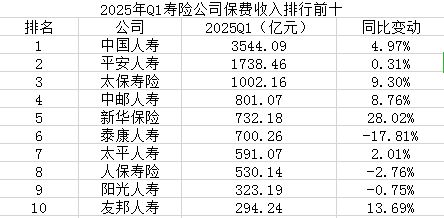
Core Insights - The overall life insurance industry is showing a complex picture of "stability in total volume, differentiation in structure" as the solvency reports for Q1 2025 are released [1] - The total insurance business revenue for 73 comparable life insurance companies reached 1.37 trillion yuan, a year-on-year increase of 3.16%, but over half of the companies experienced a decline in premium income [1] - Net profit for 74 comparable life insurance companies totaled approximately 866 billion yuan, a year-on-year increase of over 40%, with "turning losses into profits" being a key theme [1] Company Performance - China Life Insurance led the market with a premium income of 354.41 billion yuan, a year-on-year increase of 4.97% [2] - Zhongyi Life Insurance surpassed Taikang Life Insurance for the first time with a premium income of 80.11 billion yuan, growing by 8.76% year-on-year [3] - Taikang Life Insurance's premium income fell by 17.81% to 70.03 billion yuan, but its net profit surged by 214.45% to 55.91 billion yuan, ranking first among non-listed life insurance companies [4] Investment Performance - Investment performance is mixed, with over 40% of companies reporting negative comprehensive investment returns [1][8] - Zhongyi Life Insurance's net profit declined by 43% due to high commission costs and a drop in total investment return rate from 1.01% to 0.61% [4] - The highest comprehensive investment returns were reported by Ping An Life and Xinhua Life at 11% and 7.15%, respectively [8] Market Trends - The life insurance industry is experiencing a significant divergence, with 39 out of 73 companies reporting negative premium growth, particularly among small and medium-sized insurers [6][7] - The low interest rate environment is impacting the attractiveness of savings-type products, exacerbating the challenges faced by smaller companies [7] - The implementation of new accounting standards has increased the volatility of profits and net assets, particularly affecting smaller insurers [9]



招商信诺:超越规模追求 踏上新增长曲线
Xin Lang Zheng Quan· 2025-05-18 08:38
Core Insights - The insurance industry is transitioning from a focus on scale and speed to one centered on value and efficiency, as highlighted by the new "National Ten Articles" [1] - The low interest rate environment poses significant challenges for life insurance companies, leading to a shift in product offerings and business strategies [2][3] - Companies like China Merchants Life Insurance are actively transforming their product structures, moving away from fixed income products to floating rate products, which helps mitigate interest spread loss risks [3][4] Industry Trends - The life insurance sector has historically relied on savings-type products, leading to interest spread dependency, which is now being challenged by declining interest rates and market volatility [5] - The focus is shifting towards pure protection products, with health insurance becoming a key area of growth due to demographic changes and government policies [5][6] - The health insurance market is approaching a scale of nearly one trillion, with expectations for rapid growth driven by aging populations and health initiatives [5] Company Strategy - China Merchants Life Insurance has set a target for health insurance products to account for 61% of its offerings by 2024, with a significant increase in health insurance premium income [5][10] - The company is prioritizing high-end medical insurance, leveraging its strong distribution channels and expertise to capture market demand [7][8] - A comprehensive health management service system is being developed to differentiate the company in the competitive landscape, with a focus on integrating health services with insurance products [9][10] Financial Performance - In 2024, China Merchants Life Insurance reported a 19.74% increase in insurance business revenue, reaching 41.483 billion, with new business value growing by 38% [11] - The company achieved a net profit of 559 million, marking a 31.52% year-on-year increase, while maintaining strong solvency ratios [11]
险资举牌又来了!平安人寿增持两家银行H股股份
2 1 Shi Ji Jing Ji Bao Dao· 2025-05-16 11:30
Group 1 - Ping An Life increased its holdings in Agricultural Bank of China H-shares by 147 million shares, raising its stake from 3.044 billion shares to 3.191 billion shares, which is an increase from 9.90% to 10.38% of the bank's H-share capital [1] - On May 9, Ping An Life also increased its holdings in Postal Savings Bank of China H-shares by 23.29 million shares, increasing its stake from 1.974 billion shares to 1.997 billion shares, which is an increase from 9.93% to 10.05% of the bank's H-share capital [1] - This marks the second time in the year that Ping An Life has made significant investments in both Agricultural Bank and Postal Savings Bank H-shares, having previously made similar moves in January and February [1] Group 2 - Insurance capital has shown strong enthusiasm for equity markets, with 13 listed companies being targeted for significant investments this year [2] - Among the targeted companies, 10 are H-shares and 3 are A-shares, with the banking sector being the most favored, accounting for over 40% of the investments [2] - The entry of insurance capital is expected to stabilize both A-share and H-share markets, enhancing liquidity and trading activity of individual stocks [2] Group 3 - Three core motivations for insurance capital's increased investments include the need to enhance returns amid low interest rates, the accounting changes that stabilize profit reporting, and policy support for increasing insurance investments in A-shares [3] - Bank stocks are particularly attractive to insurance capital due to their low valuation, stable high dividend characteristics, and alignment with the long-term stable return investment philosophy of insurance companies [3]
中国人身险行业展望,2025年4月
Zhong Cheng Xin Guo Ji· 2025-04-30 12:23
Investment Rating - The report maintains a stable outlook for the life insurance industry, indicating that the overall credit quality will not undergo significant changes in the next 12-18 months [5][48]. Core Insights - The life insurance industry is expected to see premium growth in 2024, driven by renewal business despite challenges in new policy sales due to regulatory changes and declining interest rates [4][5]. - The regulatory environment is evolving towards stricter oversight and risk prevention, with new policies aimed at enhancing product pricing mechanisms and improving the quality of liabilities [6][7]. - The investment strategies of life insurance companies are diversifying, with a continued focus on fixed-income assets while increasing allocations to equities as market conditions improve [11][30]. - Financial performance is projected to improve significantly in 2024, with rising investment returns offsetting increased claims and reserve requirements due to lower interest rates [31][35]. Summary by Sections Regulatory Environment - The new "National Ten Articles" emphasizes strict regulation and risk prevention, aiming for high-quality development in the insurance sector [6][7]. - The introduction of a comprehensive insurance company regulatory rating system will enhance risk assessment and management across the industry [7]. Business Operations - The life insurance sector is experiencing pressure on new policy sales due to regulatory impacts, but renewal business is supporting overall premium growth [13][14]. - The shift in product design towards lower guaranteed rates is becoming a trend to mitigate risks associated with interest rate declines [17][19]. Financial Condition - The life insurance industry reported a premium income of CNY 4.01 trillion in 2024, reflecting a growth rate of 5.7% compared to the previous year, although the growth rate has slowed [31][32]. - The overall profitability of the industry is expected to improve, driven by favorable market conditions in both the bond and equity markets, leading to a significant increase in investment returns [35][36]. - The solvency levels of life insurance companies remain robust, with a comprehensive solvency adequacy ratio of 190.5% as of the end of 2024, indicating a stable capital position [42][43].
中国人身险行业展望,2025 年 4 月
Zhong Cheng Xin Guo Ji· 2025-04-30 11:16
Investment Rating - The report maintains a stable outlook for the life insurance industry, indicating that the overall credit quality will not undergo significant changes in the next 12-18 months [5][48]. Core Insights - The life insurance industry is expected to see premium growth in 2024, driven by renewal business despite challenges in new policy sales due to regulatory changes and declining interest rates [4][5]. - The regulatory environment is evolving with a focus on risk prevention and high-quality development, emphasizing the need for improved product pricing mechanisms and enhanced solvency supervision [6][7]. - The investment strategies of life insurance companies are diversifying, with a continued emphasis on fixed-income assets while increasing allocations to equities as market conditions improve [11][30]. - Financial performance is expected to improve significantly in 2024, with rising investment returns due to a recovering capital market, although sustainability of profits remains a concern [31][35]. Summary by Sections Regulatory Environment - The new "National Ten Articles" emphasizes strict regulation and risk prevention, aiming for high-quality development in the insurance sector [6][7]. - The introduction of a comprehensive insurance company regulatory rating system will enhance risk assessment and management [7]. Business Operations - The life insurance sector is experiencing pressure on new policy sales due to regulatory impacts, but renewal business is supporting overall premium growth [13][14]. - The shift in product design towards lower guaranteed rates and the transformation of distribution channels are key trends [17][22]. Financial Condition - The life insurance industry achieved a premium income of CNY 4.01 trillion in 2024, reflecting a growth rate of 5.7% compared to the previous year, although the growth rate has slowed [31][32]. - The overall profitability of the industry is improving, with a significant increase in investment income driven by favorable market conditions [35][36]. - The solvency levels of life insurance companies remain robust, with a solvency adequacy ratio of 190.5% as of the end of 2024, indicating a stable capital position [42][43].
分红险不好卖?保险业“开门红”承压,一季度保费增速不足1%
Bei Jing Shang Bao· 2025-04-27 14:59
Core Insights - The insurance industry consensus of a strong start to the year is being challenged, with the first quarter of 2025 showing a significant slowdown in premium growth [1][3]. Industry Performance - In the first three months of 2025, the insurance industry reported original insurance premium income of 2.17 trillion yuan, with a year-on-year growth of only 0.93%, a notable decline from the previous year's 5.1% growth [3][4]. - The life insurance sector specifically saw original insurance premium income of 1.79 trillion yuan, with a mere growth rate of 0.24% [4]. Factors Affecting Growth - The slowdown in premium growth is attributed to several factors, including a reduction in the guaranteed interest rates of insurance products, which has led to a premature release of consumer demand [5]. - The shift towards promoting dividend insurance products has also contributed to the slowdown, as market acceptance of these products has been lower than expected [5]. - The ongoing decline in interest rates is increasing the pressure on life insurance companies regarding interest margin losses, prompting a shift in product structure towards more variable income products [5][6]. Future Outlook - The first quarter's weak performance may indicate a challenging year ahead, with industry experts predicting that the overall premium growth for 2025 may align with the first quarter's modest increase [6][7]. - The potential for further reductions in the maximum guaranteed interest rate for life insurance products could exacerbate sales difficulties, as the current upper limit is set at 2.5% [7]. - The latest research value for the guaranteed interest rate was published at 2.13%, and if it remains below 2.25% in the next quarter, it could trigger a downward adjustment in rates as early as the third quarter [7].

保险行业周报(20250421-20250425):万能险新规落地,监管持续推动负债成本管控-20250427
Huachuang Securities· 2025-04-27 13:19
Investment Rating - The industry investment rating is "Recommended," indicating an expected increase in the industry index by more than 5% over the next 3-6 months compared to the benchmark index [20]. Core Insights - The new regulations on universal insurance are expected to stabilize the industry by tightening both liability and asset requirements, which will help mitigate risks associated with the asset allocation pressure faced by insurance companies [3][4]. - The total premium for the insurance industry in the first quarter of 2025 was 21,745 billion yuan, showing a year-on-year growth of 0.9%, with property insurance premiums increasing by 5.1% and life insurance premiums decreasing by 0.3% [2][4]. - The average investment return assumption for listed insurance companies has been lowered in 2024, which may help alleviate the pressure on net investment returns and lead to a valuation recovery in the insurance sector [4]. Summary by Sections Market Performance - The insurance index rose by 1.31% this week, outperforming the market by 0.93 percentage points, with notable increases in individual stocks such as Sunshine (+2.64%) and ZhongAn (+2.57%) [1]. Regulatory Developments - The Financial Regulatory Authority issued a notification on April 25, 2025, to strengthen the regulation of universal life insurance, which includes provisions for adjusting minimum guaranteed interest rates and investment limits in various asset classes [2][3]. Company Performance - China Ping An reported a net profit of 27.016 billion yuan for Q1 2025, a decrease of 26% year-on-year, while its operating profit increased by 2.4% [2]. - China Pacific Insurance achieved a net profit of 9.627 billion yuan in Q1 2025, down 18% year-on-year [2]. Investment Recommendations - The recommended order for investment is: Property Insurance H, Ping An, Pacific Insurance, Xinhua, and China Life, with specific price-to-earnings (PE) and price-to-book (PB) ratios provided for each company [5][9].