
去杠杆

Search documents
1011加密货币市场闪崩事件调查报道
Sou Hu Cai Jing· 2025-10-25 05:15
Core Insights - The cryptocurrency market experienced one of the largest flash crashes in history on October 10-11, 2025, with Bitcoin dropping from approximately $115,000 to around $86,000, a decline of over 25%, while Ethereum and other major assets fell by 40-50% [1][2] - The total liquidation amount across the network reached $19.141 billion, affecting 1.62 million accounts, setting a new historical record [1][2] Event Overview and Timeline - The crash was triggered by U.S. President Trump's announcement of a 100% tariff on China, leading to a global sell-off of risk assets [2] - Key timestamps include Bitcoin reaching an all-time high of $126,000 on October 6, followed by the rapid decline starting shortly after the tariff announcement [2] Causes of the Flash Crash Macro-Level Analysis - The sudden escalation of geopolitical risks led to a broad sell-off in risk assets, with traditional markets also experiencing significant declines [2][3] - Over 90% of Bitcoin holdings were in profit prior to the crash, indicating that the decline was driven more by profit-taking than a collapse in fundamental confidence [3] Micro-Level Structure - The cryptocurrency market had seen a rapid influx of leveraged funds, with Bitcoin perpetual contract open interest reaching a historical peak of approximately $70 billion [4] - The crash triggered a chain reaction of forced liquidations, with Bitcoin futures open interest dropping from $70 billion to $58 billion in a single day, marking the largest single-day decline in history [5] Liquidity Crisis - Extreme volatility led to a sudden disappearance of market depth, with major exchanges experiencing significant order book depletion [6] - Market makers withdrew orders due to uncertainty, and transaction delays on some exchanges exacerbated the liquidity crisis [6] Exchange-Level Pressure Testing - Several exchanges triggered automatic deleveraging mechanisms as liquidation amounts exceeded their insurance fund capacities [7] - Binance faced unique challenges, with certain assets experiencing 80-90% instantaneous drops, while other platforms remained stable [8] Controversies Surrounding Binance - The narrative that Binance caused the crash is overly simplistic, as the initial decline began with the tariff announcement, well before Binance's issues arose [11] - Binance's system flaws were acknowledged, including pricing mechanism defects and internal transfer delays [12] Industry Impact and Lessons Market Structure Reflection - The event highlighted systemic risks associated with excessive leverage and the need for more prudent margin and leverage management [17] - The withdrawal behavior of market makers during extreme conditions underscored the fragility of liquidity [17] Regulatory Considerations - The incident provides important insights for regulators, emphasizing the need for transparency, stress testing, and cross-border coordination in the cryptocurrency market [18] Implications for Different Participants - Exchanges should optimize risk management models and improve system redundancy [18] - Investors are advised to use leverage cautiously and diversify platform risk [18] Future Outlook - Short-term impacts include a return to healthier leverage levels and a need for time to rebuild investor confidence [19] - Long-term trends suggest that while the event was severe, it does not alter the market's fundamental trajectory, with institutional interest potentially providing new support [19]


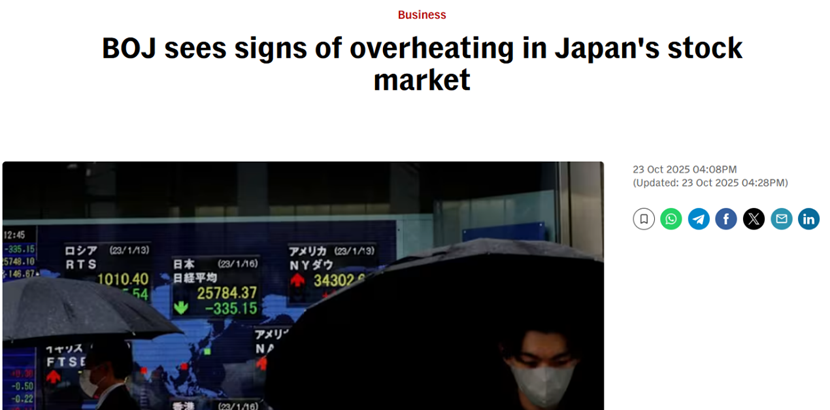
日本央行警告股市出现过热的早期迹象
Huan Qiu Wang· 2025-10-24 01:05
Group 1 - The Bank of Japan's financial system report indicates early signs of overheating in the Japanese stock market and warns that uncertainties in U.S. trade policy could lead to significant market corrections, impacting financial institutions [1] - The report highlights that rapid position adjustments and deleveraging by hedge funds during unexpected market changes could amplify asset price volatility, particularly if these adjustments occur in the global bond market, potentially affecting various financial instruments in Japan [1] Group 2 - Critics argue that the Bank of Japan's prolonged ultra-low interest rates and a weak yen have made investments in Japan cheaper for foreign investors, consequently driving up asset and property prices [4] - In April and May of this year, rumors regarding large-scale fiscal spending and potential increases in debt issuance led hedge funds to sell bonds, resulting in a significant spike in long-term Japanese government bond yields [4]
开云集团(PPRUY.US)作价40亿欧元向欧莱雅出售美妆业务 旨在削减债务重振时尚主业
智通财经网· 2025-10-20 01:49
Core Viewpoint - Kering Group has agreed to sell its beauty business to L'Oréal for €4 billion (approximately $4.66 billion) as part of a strategic move by new CEO Luca de Meo to address high debt levels and refocus on core fashion operations [1][2] Group 1: Transaction Details - The agreement allows L'Oréal to acquire Kering's perfume brand Creed and grants a 50-year exclusive license to develop beauty products based on Kering's fashion brands, including Gucci, Balenciaga, and Saint Laurent [1] - The sale is a significant step for Kering to reduce its net debt, which stood at €9.5 billion as of June 30, alongside €6 billion in long-term lease liabilities [1] Group 2: Business Performance - Kering's beauty business, established in 2023, recorded an operating loss of €60 million in the first half of the year, highlighting the challenges faced in diversifying away from Gucci [2] - Gucci's revenue fell by 25% year-on-year in the last fiscal quarter, increasing Kering's pressure to deleverage and avoid further credit rating downgrades [2] Group 3: Strategic Implications - The transaction marks a shift in strategy under CEO de Meo, who took over in September and has committed to rationalizing the business and restructuring if necessary to lower debt levels [2] - L'Oréal's acquisition is its largest to date, surpassing the $2.5 billion purchase of Australian brand Aesop in 2023, indicating L'Oréal's aggressive expansion strategy [2]

职场现形系列之:如何聪明地不承担责任
Hu Xiu· 2025-10-11 04:25
Core Insights - The company faced a mandatory task to deleverage and reduce risk exposure due to changes in shareholder structure and national policy [2][3] - The management team proposed selling part of the equity to introduce new investors while retaining core assets, aiming for a win-win situation [4][5] - Initial enthusiasm turned into a dilemma as upper management questioned the implications of bringing in new investors and the potential impact on existing shareholders [8][10] Group 1: Responsibility Deployment - Six years ago, the company underwent a change in shareholder structure, leading to a directive to deleverage and reduce risk exposure [2] - The task was communicated through multiple levels of management, emphasizing the importance of compliance with the policy [2] Group 2: Execution of the Plan - The management team developed a plan to sell equity and attract new investors, which would help recover funds and support future development [4] - They engaged multiple investment banks to find suitable investors, with one top-tier firm showing interest [6][5] Group 3: Decision-Making Challenges - Upper management expressed surprise at the interest from investors, leading to concerns about potential favoritism towards new shareholders [8] - The decision-making process became complicated as management feared repercussions from both approving or rejecting the investment [10][11] Group 4: Institutional Development - A need for compliance arose when concerns were raised about the lack of a bidding process for selecting investment banks [12] - The company had no established bidding management system, leading to a lengthy process of creating one [12][14] Group 5: Implementation of the System - After ten months of developing a bidding process, the original investment bank was ultimately selected again [17] - The structured process provided a sense of relief to management, allowing them to avoid immediate decision-making dilemmas [18] Group 6: Conclusion - The market conditions deteriorated, leading to the withdrawal of interested investors and a significant drop in asset valuations, making the transaction terms unbridgeable [21]
债务周期专题之二:去杠杆的国际经验与资产表现
China Post Securities· 2025-10-09 08:32
1. Report Industry Investment Rating No information provided in the content. 2. Core Viewpoints of the Report - China's de - leveraging is a proactive risk mitigation under high leverage, aiming for a gradual reduction of the corporate sector's leverage at a high level [2][85]. - Policy paths should draw on US and Japanese experiences, with a low probability of a large - scale "flood - irrigation" fiscal environment in China. Monetary policy has room but must prevent capital idling and avoid further increasing leverage and asset bubbles [2]. - China's de - leveraging pace may be between that of the US and Japan, aiming for a "harmonious de - leveraging" by balancing risk disposal and employment maintenance and resolving risks over time [2][89]. - Asset allocation can refer to US and Japanese experiences. Interest rates may rebound during de - leveraging, and low - interest rates are conducive to debt clearance. Asset price increases should interact positively with the de - leveraging process [2][90]. 3. Summary by Relevant Catalogs 3.1 Debt Cycle: The Clearing Phase Continues 3.1.1 Changes in Leverage Ratios of Each Sector Since the New Round of Debt Resolution - Since 1992, China has experienced two complete large - scale debt cycles and is currently in a continuous and fluctuating de - leveraging large - scale cycle since 2008, with four complete small - scale cycles from 2008 - 2021. In 2024, it was in the de - leveraging phase of the small - scale debt cycle after 2021Q4. In the first half of 2025, debt continued to clear, and in the second half, it was expected to restart the leveraging process, with the restart of the corporate debt cycle being the key [11]. - The household sector's de - leveraging process is relatively advanced and may continue to bottom out. The leverage ratio fluctuation item continued to decline in the first half of 2025, and the 9 - month consumer loan subsidy policy may only ease the decline but cannot reverse the trend. In the long run, the household sector may start a new small - scale debt cycle after reaching the bottom, but the time may be postponed [13][14]. - The corporate sector's leverage ratio fluctuation item is oscillating at a high level, and no de - leveraging trend has been formed. Affected by policy support, the leverage ratio fluctuation item has not shown a trend of de - leveraging. Forecasts indicate a further decline with a gentle slope, and credit financing demand remains weak [16]. - The government sector's leverage ratio fluctuation item is expected to continue to oscillate upward. In 2025, the government bond issuance was concentrated in the early stage. Without new policies in the fourth quarter, the leverage ratio fluctuation item may decline. In 2026, the fiscal policy's debt - issuing scale may expand further, driving the government sector's leverage ratio to rise [19]. 3.1.2 Has the Debt Pressure of the Three Sectors Eased? - The household sector's overall de - leveraging has led to a decrease in mortgage - centered debt costs. Policy - driven interest rate cuts and relaxed mortgage conditions have alleviated the debt pressure, but income growth remains under pressure, and de - leveraging continues [24]. - The corporate sector's interest - payment pressure has decreased, but the increase in the leverage ratio has affected the safety margin of corporate operations. Although financial expenses have decreased, the debt ratio has risen again, and the pressure to reduce leverage remains high [26]. - The government sector's cost - control measures have a greater impact than leveraging, and the interest - payment pressure has stabilized. Interest rate cuts have reduced the weighted average cost of national and local debts, but the debt scale is still expanding. Overall, the interest - payment pressure is controllable [30]. 3.2 International Experience: Two "De - leveraging" Paths in Japan and the US 3.2.1 Japan: After the Economic Bubble Burst in the 1990s, De - leveraging Was Long and Passive - The household sector's debt de - leveraging process was slow due to asset shrinkage and high - cost debts. Asset - side housing and financial asset values declined significantly and were not repaired for a long time, and income growth was weak. On the liability side, high - cost debts and deflation pressure made it difficult to de - leverage [39][42]. - The corporate sector's de - leveraging was difficult. The "convoy system" led to the formation of many zombie enterprises, and the slow disposal of non - performing assets made the de - leveraging process long. Enterprises mainly reduced investment and capital expenditure to repay debts, lacking structural adjustments [50][55]. - The government's policy response was ineffective. Monetary policy fell into a liquidity trap, and fiscal policy was inconsistent. Early large - scale stimulus led to a sharp increase in government debt, and later fiscal tightening and policy mistakes weakened the economic recovery momentum [59][60]. 3.2.2 US: Fast - paced, Market - oriented De - leveraging with Policy Coordination for Rapid Clearing - The household sector quickly de - leveraged through default clearance, active debt reduction, and refinancing restructuring. The Fed's low - interest rate policy and government - led mortgage restructuring programs helped reduce debt pressure, and the release of consumption potential promoted economic recovery [68]. - The corporate sector completed de - leveraging through bankruptcy liquidation, restructuring, investment reduction, asset sales, and equity capital supplementation. The leverage ratio decreased significantly and then stabilized [70]. - The government sector increased leverage significantly during the private sector's de - leveraging period, providing support for the economy. Fiscal stimulus and the Fed's balance - sheet expansion helped transfer private - sector risks to the public sector. As the economy recovered, the fiscal deficit narrowed, and government debt stabilized [73]. 3.3 Asset Allocation: Asset Performance During the "De - leveraging" Phase 3.3.1 Japanese Experience: Reasons and Magnitudes of Interest Rate Rebounds During De - leveraging - Interest rates of 10 - year Japanese government bonds rebounded significantly during de - leveraging, mainly due to recovery and re - inflation expectations and fiscal supply - demand mismatches. There were also some 50 - BP rebounds during the in - depth de - leveraging period in the 2010s [75][76]. 3.3.2 US Experience: Asset Price Repair and Wealth Effect During De - leveraging - The rapid repair of asset prices during the household sector's de - leveraging process had a wealth effect, reducing the leverage ratio, improving consumer confidence, and promoting consumption. The Fed's policies also controlled the government's bond - issuing costs [80][82]. 3.3.3 China's Reference: Balancing Economic Stability and De - leveraging - China's de - leveraging is a proactive adjustment under high leverage, different from the passive de - leveraging in the US and Japan. It aims to gradually reduce the corporate sector's leverage and maintain a reasonable household leverage level [85]. - Policy tools should draw on US and Japanese experiences, combining prudent loosening and targeted support to balance economic stability and de - leveraging [87][88]. - China's de - leveraging pace may be between that of the US and Japan, achieving a "harmonious de - leveraging" by actively resolving risks and maintaining employment [89].
美国政府扛120%债务,中国居民背38.6万亿房贷,谁能笑到最后?
Sou Hu Cai Jing· 2025-10-07 06:30
Core Insights - The article discusses the historical context and implications of leverage in the U.S. and China, highlighting the differences in their economic strategies and outcomes during financial crises and recovery periods. Group 1: U.S. Leverage Dynamics - In 2008, U.S. household leverage reached a historical peak of 99.8%, signaling the onset of the financial crisis, driven by policy shifts following the dot-com bubble burst [1] - The Federal Reserve initiated a rate-cutting cycle starting in 2000, reducing the federal funds rate from 6.5% to 1% by 2003, which, along with relaxed credit standards, fueled a housing market boom [2] - Post-2008, the Federal Reserve's quantitative easing (QE) involved purchasing over $1.7 trillion in mortgage-backed securities (MBS) and more than $2.5 trillion in government bonds, effectively transferring leverage from households and businesses to the government [7] Group 2: Comparison with China - From 2012 to 2023, China's household leverage increased from 20% to 62% in just 11 years, contrasting with the U.S. which took 40 years to achieve a similar increase [5] - China's leverage strategy post-2015 focused on increasing household debt to stimulate domestic demand, with policies like lowering down payments and interest rates [8][10] - By 2023, China's household leverage reached 62%, while U.S. household leverage stabilized around 75%, indicating different economic foundations and debt burdens [10] Group 3: Current Leverage Trends - As of 2024, U.S. government leverage is projected to exceed 120%, relying on dollar hegemony and asset appreciation to manage debt [13] - In contrast, China's leverage structure shows high corporate leverage at 151.3%, with government leverage at 44.7% and household leverage at 62%, indicating a need for balance in managing risks [16] - The article warns of potential risks in China's reliance on government bonds for social financing, suggesting that if government leverage does not stimulate private investment, it could lead to inefficiencies [16] Group 4: Future Implications for China - The core of China's future leverage management should focus on controlling household leverage, enhancing the business environment, and restructuring local government debt to improve efficiency [18] - Achieving a balance between leverage and economic fundamentals is crucial for China's long-term economic transformation and potential [18]

伯克希尔“王储”的第一笔大交易:“巴菲特”式的精明,西方石油的止损
Hua Er Jie Jian Wen· 2025-10-03 07:45
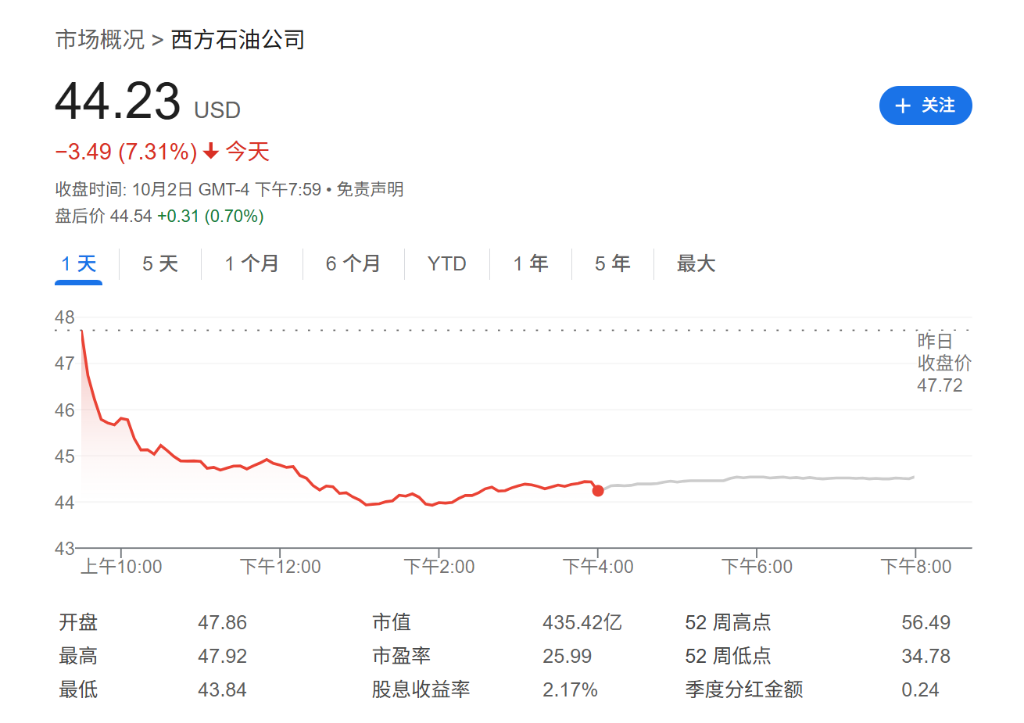
Core Viewpoint - Berkshire Hathaway has agreed to acquire Occidental Petroleum's chemical subsidiary OxyChem for $9.7 billion in cash, marking the first major deal orchestrated by Greg Abel, Buffett's designated successor [1][8] Group 1: Transaction Details - The acquisition is a cash transaction aimed at helping Occidental reduce its significant debt load, which is part of a broader plan to cut $24 billion in debt [1][4] - Occidental plans to use $6.5 billion of the proceeds from the sale to pay down debt, with a goal of reducing its debt to below $15 billion [1][4] - Following the announcement, Occidental's stock price fell by 7.3%, reflecting market concerns about the deal's implications [1] Group 2: Implications for Occidental Petroleum - The sale of OxyChem is seen as a necessary step for Occidental's CEO Vicki Hollub to stabilize the company's financial situation, which has been strained by previous acquisitions [4][5] - Occidental's heavy debt burden primarily stems from the $55 billion acquisition of Anadarko Petroleum in 2019 and a $12 billion acquisition of CrownRock in 2023 [4] - Analysts believe this transaction will help Occidental meet its debt reduction targets and potentially allow for increased shareholder returns, such as stock buybacks [5] Group 3: Strategic Benefits for Berkshire Hathaway - For Berkshire, this acquisition serves a dual purpose: it aids in stabilizing its investment in Occidental, where it holds a 29.6% stake, while also expanding its portfolio by controlling one of the largest independent chemical producers globally [3][6] - The deal is characterized as a "win-win" for Berkshire, as it allows the company to acquire a quality asset at a favorable price while ensuring that the proceeds are used to strengthen its investment in Occidental [9] - The transaction is the largest for Berkshire since its $11.6 billion acquisition of Alleghany in 2022, showcasing Abel's capital allocation strategy [8]

全线大跌!近14万人爆仓
Sou Hu Cai Jing· 2025-09-26 00:46
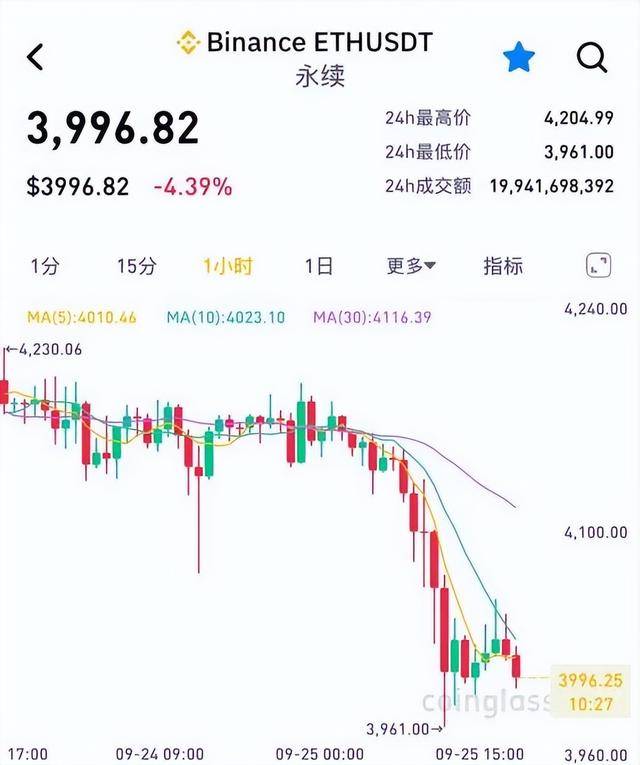
Core Viewpoint - The cryptocurrency market experienced a significant downturn on September 25, with Ethereum dropping over 4% and briefly falling below $4000, marking its fourth consecutive day of decline [1][3][4]. Market Performance - Ethereum's price reached a low of $3961 per coin, reflecting a decline of over 4% [2]. - As of the latest report, Ethereum was priced at $3996.82, with a total drop of 4.39% [4]. - The overall cryptocurrency market saw a collective decline, with Bitcoin, Binance Coin, Dogecoin, SOL, Ripple, Cardano, and SUI all experiencing significant drops, with some coins like SOL and Dogecoin falling over 4% [9]. Trading Volume and Liquidation Risks - The trading volume in the cryptocurrency market has significantly decreased, increasing the risk of forced liquidations. Approximately 140,000 traders faced liquidation in the last 24 hours, with a total liquidation amount reaching $441 million [12]. - The majority of liquidations were long positions, amounting to $380 million, while short positions accounted for $6.47 million [12]. Historical Context and Trends - In September, Ethereum has seen a decline of 10.75%, with historical data indicating an average return of -5.75% for Ethereum in September since 2016, with only four years out of the past nine showing positive returns [7]. - Market analysts suggest that while the macro environment is favorable for crypto assets, the significant drop in trading volume is increasing the risk of forced liquidations, especially if prices breach critical technical support levels [14]. ETF Flow and Market Sentiment - Recent data indicates a net outflow of $141 million from Ethereum spot ETFs, with Fidelity's ETF experiencing the largest single-day outflow of $63.4 million [14]. - The total net asset value of Ethereum spot ETFs is reported at $27.477 billion, with a historical cumulative net inflow of $13.703 billion [14].
佳明集团控股拟52.5亿港元出售四个数据中心项目的整个组合
Zhi Tong Cai Jing· 2025-09-22 14:30
Group 1 - The company announced that Wellford Properties has not yet entered into any final agreements with potential buyers, and the exclusivity period will end on September 15, 2025 [1] - On September 22, 2025, the company signed a non-binding indicative term sheet with a potential buyer for the sale of a portfolio of four data center projects, including the acquisition of all shares of Wellford Properties Holdings Limited and Wei Feng Properties Limited, with a total potential consideration of HKD 5.25 billion [1][2] - The potential sale is subject to the signing of a final sale agreement and negotiation of terms [1] Group 2 - As part of the transaction, Wellford Properties Holdings Limited will undergo an internal restructuring to hold all shares of the target group companies, which include various data center entities registered in Hong Kong [2] - Wei Feng, a wholly-owned subsidiary of Wellford, will be divested from Wellford Properties Holdings Limited [2] - The board believes that the comprehensive offer for the entire data center asset portfolio aims to provide strategic advantages and greater certainty for the company's deleveraging goals [3] Group 3 - If the potential sale is realized, most of the net proceeds are expected to be used to repay the company's bank borrowings, thereby reducing debt and financial costs [3] - The board considers that entering into the term sheet and the potential sale aligns with the overall interests of the company and its shareholders [3]
2024年阿尔及利亚对外债务创六年新低
Shang Wu Bu Wang Zhan· 2025-09-21 16:21
Core Insights - Algeria's external debt is projected to decrease to $2.87 billion by the end of 2024, the lowest level since 2019, reflecting a reduction of approximately $0.962 billion from $3.832 billion in 2019 [1] - The Algerian government is committed to a cautious financial policy and proactive debt management to reduce reliance on international financing and strengthen financial sovereignty [1] Debt Structure - Both long-term and short-term debts have decreased, with long-term debt falling from $1.568 billion in 2019 to $1.114 billion in 2024, representing a decrease in its share from 40.9% to 38.8% of total debt [1] - Short-term debt has decreased from $2.264 billion to $1.756 billion, with its share increasing to 61.2%, indicating that Algeria's external debt remains primarily composed of short-term commercial financing [1] Loan Sources - Multilateral loans from institutions like the IMF and World Bank have decreased from $1.009 billion in 2019 to $0.718 billion in 2024, with their share dropping from 26.3% to 25.0% [2] - Bilateral loans have seen a more significant decline, falling from $0.385 billion to $0.130 billion, with their share decreasing from 10.1% to 4.5% [2] - Support from parent companies to subsidiaries in Algeria has increased from $0.130 billion in 2019 to $0.254 billion in 2024, indicating that multinational companies continue to support their operations in Algeria through direct investment [2] Strategic Implications - Algeria has been pursuing a "de-leveraging" strategy since 2019, leading to a continuous decline in external debt and a significant adjustment in debt structure, particularly with a reduced proportion of multilateral and bilateral loans [2] - This debt reduction strategy enhances financial autonomy and mitigates external risks, while the increase in foreign companies' support for their subsidiaries suggests that Algeria still maintains a certain level of attractiveness for foreign investment [2]