
多元化布局

Search documents
江苏雷利拟投4.4亿海外建厂 多元布局显效营收增20.71%
Chang Jiang Shang Bao· 2025-09-03 00:06
Core Viewpoint - Jiangsu Leili is actively advancing its globalization strategy by investing in overseas production bases in Malaysia, Vietnam, and Mexico, with a total investment of 439.6 million RMB [1][2]. Group 1: Overseas Expansion - The company plans to invest 216 million RMB in Malaysia, 139 million RMB in Vietnam, and 84.94 million RMB in Mexico as part of its overseas production base construction [2]. - Since 2025, Jiangsu Leili has been increasing its overseas production capacity, with a recent plan to raise 1.286 billion RMB through convertible bonds for overseas and domestic projects [2]. - By 2024, overseas revenue is expected to account for 47% of Jiangsu Leili's total revenue, supported by established R&D and manufacturing bases in North America, Europe, and Southeast Asia [2]. Group 2: Domestic Investments - On the same day as the overseas investment announcement, Jiangsu Leili revealed plans to invest 500 million RMB in a production base and laboratory for automotive micro-motors and components in Changzhou [4]. - The company’s subsidiary plans to invest at least 150 million RMB in projects related to intelligent sensing lidar and vehicle thermal management micro-motors [4]. Group 3: Business Performance - In the first half of 2025, Jiangsu Leili achieved a revenue of 1.958 billion RMB, representing a year-on-year growth of 20.71%, and a net profit of 186 million RMB, up 8.45% [5]. - The automotive components sector saw significant growth, with revenue reaching 379 million RMB, a 63.72% increase compared to the previous year [4][5]. - The company has successfully launched multiple new products in the automotive sector, including lidar motor products, which generated 44.65 million RMB in revenue, a 35% increase year-on-year [4].

“多元化+全球化”支撑家电三巨头业绩显韧性
Zheng Quan Ri Bao Zhi Sheng· 2025-08-31 17:08
Core Viewpoint - The home appliance industry in China demonstrates strong resilience and vitality amid a complex global economic environment, with the performance of the three major players serving as a key indicator of industry development [1] Group 1: Financial Performance - Midea Group achieved revenue of 252.3 billion yuan and a net profit of 26 billion yuan in the first half of the year, representing year-on-year growth of 15.7% and 25% respectively [1] - Haier Smart Home reported revenue of 156.49 billion yuan and a net profit of 12.03 billion yuan, with year-on-year growth of 10.22% and 15.59%, both reaching historical highs [1] - Gree Electric's revenue decreased by 2.46% to 97.33 billion yuan, but net profit increased by 1.95% to 14.41 billion yuan [1] Group 2: Business Diversification - Midea Group's smart home business revenue grew by 13.31% to 167.2 billion yuan, accounting for 66.58% of total revenue; its new energy and industrial technology businesses generated 64.5 billion yuan, up nearly 21%, making up 25.7% of total revenue [2] - Gree Electric's diversified business expansion led to industrial products and green energy revenue of 9.59 billion yuan and smart equipment revenue of 314 million yuan, with year-on-year growth of 17.13% and 20.9%, respectively, accounting for about 10.17% of total revenue [2] - Haier Smart Home's equipment and channel service revenue reached 18.72 billion yuan, growing nearly 35% and representing about 12% of total revenue [3] Group 3: International Expansion - Midea Group's overseas revenue was 107.19 billion yuan, Haier Smart Home's overseas revenue was 79.08 billion yuan, and Gree Electric's overseas revenue was 16.34 billion yuan, with year-on-year growth of 17.70%, 11.70%, and 10.19% respectively [3] Group 4: R&D Investment - Midea Group invested 8.76 billion yuan in R&D, an increase of 14.41% year-on-year; Haier Smart Home's R&D investment was 5.79 billion yuan, up 11.73%; Gree Electric's R&D investment reached 3.89 billion yuan, growing by 7.05% [3] Group 5: Strategic Focus - The home appliance giants are initiating a "value war" centered on technological innovation, scenario experience, and global layout, expanding their scale advantages while solidifying profit foundations and advancing channel transformation [4]



旗滨集团(601636):多元化布局完善 光伏玻璃产销增长
Xin Lang Cai Jing· 2025-08-31 10:37
Core Viewpoint - The company reported a mixed performance for the first half of 2025, with revenue declining by 6.6% year-on-year, while net profit attributable to shareholders increased by 9.8% [1] Financial Performance - For H1 2025, the company achieved revenue of 7.39 billion yuan and net profit of 0.89 billion yuan, with Q2 revenue and net profit at 3.99 billion yuan and 0.42 billion yuan respectively, showing a year-on-year decline of 3.6% in revenue but a growth of 13.8% in net profit [1] - The significant improvement in Q2 performance was attributed to a notable decrease in expense ratios and a substantial increase in photovoltaic glass sales [1] - The company’s float glass and photovoltaic glass sales reached 0.5 billion weight cases and 2.7 billion square meters respectively, marking increases of 6.9% and 44.2% year-on-year [1] Cost and Margin Analysis - The gross margin for float glass and photovoltaic glass was under pressure due to price declines, with margins at 17.8% and 8.1% respectively, reflecting year-on-year decreases of 10.6 and 13.2 percentage points [1] - The management expense ratio significantly decreased to 7.7%, down by 4.3 percentage points year-on-year, primarily due to the failure of the partner shareholding plan to meet long-term targets [2] - Operating cash flow improved significantly to 0.32 billion yuan, an increase of 0.37 billion yuan year-on-year, driven by the stabilization of photovoltaic glass production capacity [2] Production Capacity and Strategic Positioning - As of H1 2025, the company’s float glass capacity stood at 16,600 tons per day and photovoltaic glass capacity at 13,000 tons per day, ranking among the top three in the industry [2] - The company has established production bases in Malaysia, with overseas capacity accounting for 20%, which is expected to mitigate domestic policy and price cycle impacts [2] Profit Forecast and Valuation - The company maintains its profit forecast, projecting net profits of 1.01 billion, 0.95 billion, and 1.36 billion yuan for 2025-2027 [3] - The target price is set at 8.48 yuan, based on a price-to-book ratio of 1.6x for 2025, reflecting a slight reduction in valuation discount due to improved photovoltaic glass capacity and sales [3]

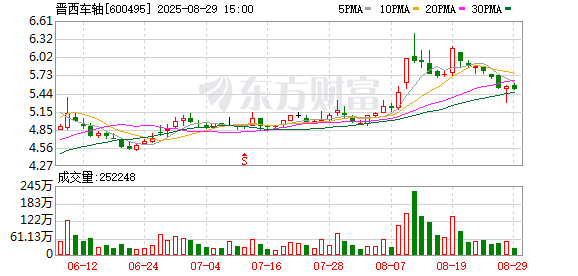
营收利润双改善 晋西车轴多元布局寻增量
Zhong Guo Jing Ying Bao· 2025-08-29 14:46
Group 1 - The core viewpoint of the article highlights that Jinxi Axle Co., Ltd. has shown significant growth in revenue and a reduction in net loss in its recent half-year report, indicating a positive trend in its financial performance [2] - In the first half of 2025, the company achieved an operating income of 608 million yuan, representing a year-on-year increase of 41.73%, while the net profit after deducting non-recurring items was a loss of 808,000 yuan, which is a reduction in loss by 50.04 million yuan compared to the same period last year [2] - Jinxi Axle is the largest railway axle manufacturer in China, holding the highest market share, and has consistently secured the largest share in the procurement of freight car axles by China National Railway Group [2] Group 2 - The company is actively accelerating its diversification strategy, focusing on enhancing its core business in railway transportation equipment manufacturing while exploring new business areas such as defense equipment and smart firefighting [3] - The company plans to strengthen market research and analysis to adapt to the competitive landscape, aiming for breakthroughs in high value-added products and international markets while maintaining its market share in core products [3] - Jinxi Industrial Group, the controlling shareholder of Jinxi Axle, plans to increase its stake in the company by investing between 50 million and 100 million yuan over the next 12 months, reflecting confidence in the company's future development [3] Group 3 - Established in December 2000 and listed on the Shanghai Stock Exchange in 2004, Jinxi Axle's products cover various types of railway freight cars, passenger cars, subways, light rail, locomotives, and high-speed trains [4] - Axles are critical components for railway and urban rail transit vehicles, essential for the assembly and production of various types of vehicles [4]


恺英网络半年报:产品矩阵扩张,多元布局与全球化进程加速
Mei Ri Jing Ji Xin Wen· 2025-08-29 12:54
Core Viewpoint - The company reported steady revenue growth and significant profit increase in the first half of 2025, driven by both classic and innovative game offerings [1][2]. Group 1: Financial Performance - In the first half of 2025, the company achieved revenue of 2.578 billion yuan, a year-on-year increase of 0.89% [1] - The net profit attributable to shareholders reached 950 million yuan, reflecting a year-on-year growth of 17.41% [1] Group 2: Product Development and Innovation - The company focused on the classic "Legend" category and launched several new products, including "Dragon Valley World" and "Digital Monster: Source Code," which performed well in app store rankings [1] - The company has multiple new titles approved for release, expected to launch in the second half of this year and early next year [1] Group 3: Market Position and Strategy - Industry experts believe that the launch of new products by leading companies will significantly impact the competitive landscape as the industry recovers [2] - The company is diversifying its product portfolio to mitigate risks associated with single-category reliance and enhance its resilience against market cycles [2] Group 4: Global Expansion - The company reported overseas revenue of 202 million yuan in the first half of 2025, marking a year-on-year increase of 59.57% [2] - The RPG title "MU Immortal" topped the iOS RPG free charts in multiple countries, indicating strong international performance [2] Group 5: IP Strategy - The company is diversifying its IP strategy by developing original IPs and incorporating well-known IPs like "King of Fighters" and "Ultraman" into its offerings [3] - The focus is on creating a multi-channel distribution strategy to reach a broader audience across different age groups [3]

漱玉平民(301017) - 301017漱玉平民投资者关系管理信息20250829
2025-08-29 08:58
Financial Performance - In the first half of 2025, the company achieved a total revenue of 1.30 billion yuan, representing a year-on-year increase of 48.81% [3] - The net profit attributable to shareholders was 36.25 million yuan, with a year-on-year growth of 49.83% [3] - The gross profit margin decreased by 1.56% compared to the previous year [3] - The expense-to-revenue ratio improved by 1.16% during the reporting period [3] Store Network and Market Strategy - As of June 30, 2025, the company operated a total of 9,042 stores across several provinces, including Shandong, Liaoning, Heilongjiang, Fujian, Henan, and Gansu [3] - The company has 5,072 directly operated stores and 3,970 franchise stores [3] - Three core strategies to increase market share in Shandong include: 1. Mergers and acquisitions, with 754 stores acquired in the first half of 2025 [5] 2. Upgrading franchise operations to improve management efficiency [5] 3. Optimizing existing stores and introducing new service models [5] Diversification and Product Development - The company has diversified its product offerings, including health foods, medical devices, and traditional Chinese herbal teas, with a notable increase in sales from non-traditional categories [6] - Self-owned product sales accounted for approximately 14% of total sales, with a year-on-year growth of around 4% [8] Online Business Strategy - The online business strategy focuses on B2C, O2O, and private domain operations, with a strong emphasis on private domain operations as a key growth area [9] - The company has established an innovation business development department to support the expansion of private domain operations [9] Industry Outlook - The retail pharmacy industry is expected to undergo a consolidation phase, with a gradual reduction in the number of stores as the market evolves [10] - The trend indicates that resources will increasingly concentrate on leading chain brands with scale effects and professional service capabilities [11]

格力电器半年报:上半年营收同比下滑2.46%,净利润同比增长1.95%
Bei Jing Shang Bao· 2025-08-29 03:29
Core Viewpoint - Gree Electric Appliances reported a slight decline in revenue for the first half of 2025, but showed growth in net profit and significant improvement in cash flow from operating activities [1] Financial Performance - For the first half of 2025, Gree Electric achieved operating revenue of 97.325 billion yuan, a decrease of 2.46% compared to 99.783 billion yuan in the same period last year [1] - The net profit attributable to shareholders reached 14.412 billion yuan, an increase of 1.95% year-on-year [1] - The net profit after deducting non-recurring gains and losses was 13.946 billion yuan, reflecting a year-on-year growth of 0.59% [1] - The net cash flow from operating activities was notably strong at 28.329 billion yuan, representing a substantial increase of 453.06% year-on-year [1] Business Diversification - The company enhanced market attention on smart home appliances through the "Dong Mingzhu Health Home" offline stores and online platforms [1] - The market recognition of home appliances such as refrigerators and washing machines has been continuously improving [1] - In the industrial sector, the smart equipment segment saw a revenue increase of 20.90% year-on-year, while the industrial products and green energy segment experienced a revenue growth of 17.13% year-on-year [1] - The quality of "Gree Intelligent Manufacturing" has gained market recognition [1]
江苏雷利上半年收入同比增长20.71% 多元化布局见成效
Zheng Quan Shi Bao Wang· 2025-08-28 13:08
Core Insights - Jiangsu Leili reported a revenue of 1.958 billion yuan for the first half of 2025, representing a year-on-year growth of 20.71%, and a net profit attributable to shareholders of 186 million yuan, up 8.45% year-on-year [1] - The company is the largest provider of micro-motor modular solutions in China, focusing on various applications including home appliances, new energy vehicles, medical instruments, and industrial control motors [1] - Jiangsu Leili's strategy emphasizes multi-application solutions, continuously launching new products in componentization and mechatronics integration [1] Business Segments Performance - Revenue from the home appliance segment grew by 5.09%, automotive parts by 63.72%, industrial control by 34.49%, and medical health by 30.91% compared to the same period last year [1] - In the automotive parts segment, revenue reached 379 million yuan, a significant increase of 63.72%, driven by the electronic and lightweight trends in automotive components [1] - The company's lidar motor products generated 44.65 million yuan in revenue, marking a 35% increase, with clients including Hesai, BYD, and SUTENG [1] Diversification and New Applications - Jiangsu Leili is expanding into emerging application areas such as dexterous hands and core components for robotics, high-efficiency industrial motors, and medical devices [2] - The subsidiary, Zhongke Lingxi, launched two types of dexterous hands and control systems, with a focus on providing integrated solutions for robotics [2] - The company has entered the supply chains of major medical device firms like Mindray and Siemens, and is collaborating with Dingzhi Technology in the dental treatment equipment sector [2] Investment and Expansion Plans - Jiangsu Leili plans to issue convertible bonds to raise 1.286 billion yuan for the construction of overseas production bases and the R&D of automotive parts and robotic control components [3] - The company is in the process of establishing a factory in Mexico, which has begun small-scale production, and is also setting up production bases in Malaysia and Thailand, expected to be operational by the end of the year [3]
不懂外语但公司出口超2000万!小微外贸人“巧”闯市场
Di Yi Cai Jing· 2025-08-28 12:47
Core Viewpoint - Small and micro foreign trade operators in China are successfully navigating challenging international conditions using unconventional methods and local strategies, demonstrating resilience and adaptability in the face of market changes [1][2]. Group 1: Market Adaptation Strategies - Liu Chao, a foreign trader from Jiangxi, has achieved over 20 million yuan in export scale by employing simple methods and adapting to market needs without formal education or foreign language skills [1]. - Liu Min from Fujian has shifted from traditional lighting to the ceramic tile sector, utilizing unconventional strategies to maintain double-digit growth despite tariff fluctuations [1][2]. - Both traders exemplify the flexibility and resilience of small foreign trade businesses in adjusting to the evolving landscape of international trade [1]. Group 2: Localization and Technology Utilization - Liu Chao uses translation software and local resources to communicate effectively with clients, addressing specific needs through tailored product modifications [2][3]. - Liu Min emphasizes the importance of local social media for customer engagement and small-batch customization to build trust in emerging markets [2][3]. - The use of AI tools and digital platforms has enabled these traders to overcome language barriers and streamline operations, enhancing their market reach [3][6]. Group 3: Diversification and New Market Opportunities - Liu Chao has shifted his strategy from a reliance on the U.S. market to a localized approach, establishing local companies in various regions to adapt to changing market dynamics [4][5]. - The emergence of new markets has allowed for rapid growth, with localized stores yielding higher profits and stronger competitive advantages [4][5]. - The diversification into new product categories and markets is becoming essential for sustaining growth amid increasing competition and changing trade conditions [7][8]. Group 4: Emerging Market Trends - The demand for "new three items" (lithium batteries, new energy vehicles, solar cells) is rising, with significant export opportunities in Southeast Asia and other developing regions [9]. - The ongoing global shift towards green and low-carbon technologies presents new avenues for growth in the export sector, particularly in infrastructure development in Latin America and Africa [9].
东山精密(002384):2025年半年报点评:内外并举,多元化布局顺利推进
Yin He Zheng Quan· 2025-08-27 14:47
Investment Rating - The report maintains a "Recommended" rating for the company [4]. Core Views - The company achieved a revenue of 16.955 billion yuan in H1 2025, a year-on-year increase of 1.96%, with a net profit attributable to shareholders of 758 million yuan, up 35.21% year-on-year [4]. - The electronic circuit segment remains the primary revenue source, while the new energy business shows rapid growth, achieving a revenue of 4.940 billion yuan, a year-on-year increase of 29.66% [4]. - The company plans to invest up to 1 billion USD to expand PCB capacity, focusing on high-end PCB products to meet increasing customer demand [4]. - The company is actively pursuing acquisitions to diversify its business, including the acquisition of GMD Group and Solstice Optoelectronics, with total investments not exceeding 5.935 billion yuan [4]. Financial Performance Summary - H1 2025 financial highlights include: - Revenue: 16.955 billion yuan, up 1.96% year-on-year - Net profit: 758 million yuan, up 35.21% year-on-year - Gross margin: 13.59%, up 0.52 percentage points year-on-year - Net margin: 4.47%, up 1.11 percentage points year-on-year [4]. - The company forecasts revenues of 42.118 billion yuan, 52.404 billion yuan, and 60.264 billion yuan for 2025, 2026, and 2027, respectively, with corresponding net profits of 2.524 billion yuan, 3.425 billion yuan, and 4.565 billion yuan [5][6]. Future Projections - Expected revenue growth rates are 15% for 2025, 24% for 2026, and 15% for 2027 [5]. - The projected earnings per share (EPS) are 1.38 yuan for 2025, 1.87 yuan for 2026, and 2.49 yuan for 2027, with corresponding price-to-earnings (PE) ratios of 40, 30, and 22 times [5][6].
