
套利交易

Search documents
银河期货甲醇日报-20250813
Yin He Qi Huo· 2025-08-13 01:15
Group 1: Report Information - Report title: Methanol Daily Report, August 13, 2025 [3] - Research area: Commodity research - Energy and chemical industry [1][2] - Researcher: Zhang Mengchao [8] Group 2: Market Review - Futures market: The futures price closed at 2391, up 6 or 0.25% [4] - Spot market: Various regions had different methanol prices, with production areas ranging from 2090 - 2230 yuan/ton, consumption areas from 2230 - 2320 yuan/ton, and ports from 2360 - 2380 yuan/ton [4] Group 3: Important News - Zhejiang Xingxing New Energy Technology Co., Ltd.'s 690,000 - ton/year methanol - to - olefins plant stopped on July 30, and the restart time is to be tracked [5] Group 4: Logic Analysis - Supply side: Coal mine开工率 in the northwest decreased, coal prices rebounded, methanol开工率 was high and stable, and domestic supply was loose [6] - Import side: The US dollar price fell slightly last week, import profit increased, foreign开工率 was high, and Iranian shipments to China increased [6] - Demand side: Traditional downstream entered the off - season, MTO开工率 increased, but some MTO plants had reduced loads or stopped [6] - Inventory: Port inventory increased, and inland enterprise inventory fluctuated slightly [6] - Overall: International装置开工率 was stable, imports recovered, demand was stable, and ports accelerated inventory accumulation. Methanol supply increased, and it was advisable to short at high prices [6] Group 5: Trading Strategies - Single - side: Short at high prices, do not chase short [7] - Arbitrage: Wait and see [7] - Options: Sell call options [10]
“套利交易”再度升温,墨西哥比索成贸易战大赢家
Hua Er Jie Jian Wen· 2025-08-12 07:50
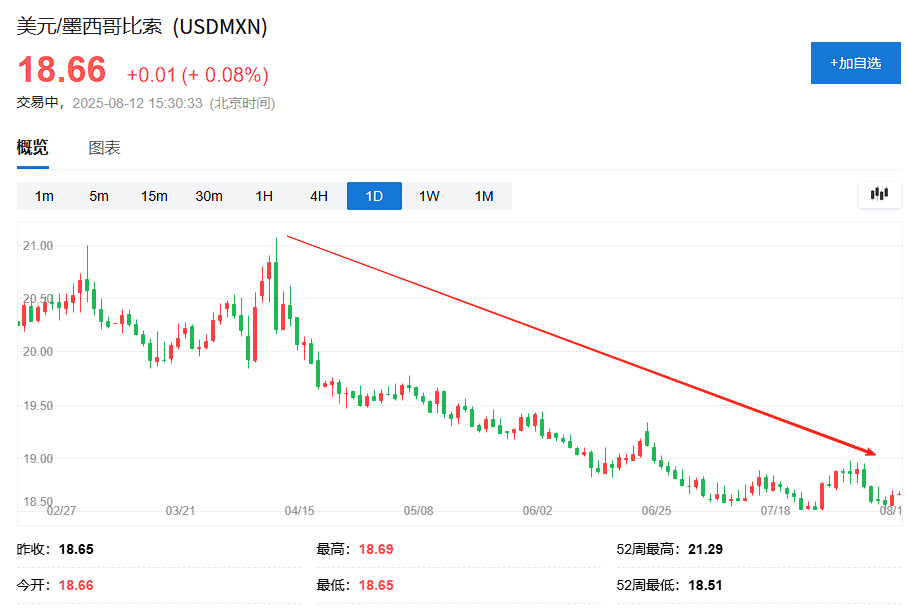
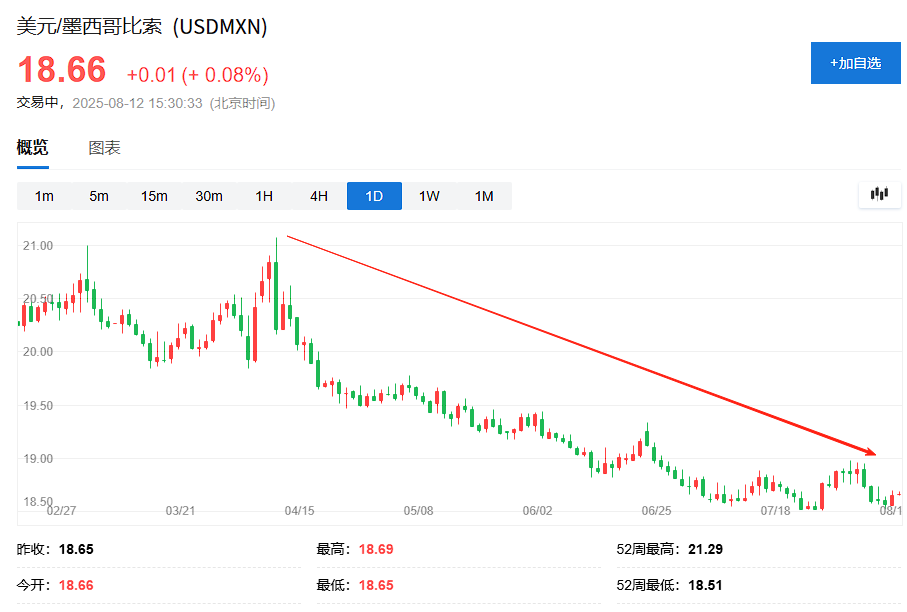
Core Viewpoint - The Mexican peso has emerged as a significant beneficiary of global carry trade, driven by expectations of Federal Reserve rate cuts and a weakening dollar, recovering from previous lows due to trade tensions with the U.S. [1][3] Group 1: Currency Performance - Over the past three months, the peso has appreciated by 4% against the dollar, outperforming other major currencies and becoming the best-performing emerging market asset [1] - The peso rebounded from a low of 21 pesos per dollar in February to around 18.5 pesos, erasing losses since Trump's election [1] Group 2: Trade Relations and Agreements - Mexico's relative success in U.S. trade negotiations, particularly through the USMCA agreement, has allowed it to secure tariff exemptions on most goods [3] - The extension of Trump's "reciprocal tariffs" policy for 90 days has further supported the peso's strength [3] Group 3: Factors Driving Carry Trade Revival - Three key changes have made carry trades attractive again: 1. Weak U.S. employment data has increased expectations for a Fed rate cut, lowering the cost of borrowing dollars [6] 2. The interest rate differential between emerging markets and developed countries is significant, with Mexico's central bank rate at 7.75% compared to a 4.3% yield on U.S. Treasuries [7] 3. A notable decrease in market volatility has made carry trades more appealing [7] Group 4: Investment Trends - Global asset management firms are reallocating investments towards high-yield markets like Mexico, with emerging market bond funds seeing consistent inflows over the past four months, peaking at $1.7 billion in a single week [8] - Leveraged funds have increased bullish bets on the peso to the highest level in nearly a year, reflecting confidence in maintaining a high-interest environment [8] Group 5: Market Sentiment - The overall strength of the peso and Mexican assets is attributed to a weak dollar environment and high carry yields [9] - Despite concerns over U.S. trade policies, recent fluctuations in Trump's more destructive policies have somewhat alleviated investor worries [9]

“套利交易”再度升温,墨西哥比索成贸易战大赢家!
Hua Er Jie Jian Wen· 2025-08-12 07:37
Core Viewpoint - The Mexican peso has emerged as a significant beneficiary of the recent global carry trade revival, driven by expectations of Federal Reserve rate cuts and a weakening dollar, making it the top-performing emerging market asset in the past three months [1][4]. Group 1: Currency Performance - The peso appreciated by 4% against the dollar over the past three months, recovering from a low of 21 pesos per dollar after the announcement of a 25% tariff on Mexico by the U.S. in February, now trading around 18.5 pesos [1][4]. - The peso's recovery has erased losses since Trump's election and positioned it as a core beneficiary of the resurgence in carry trades [1]. Group 2: Trade Relations and Agreements - Mexico's relative success in U.S. trade negotiations, particularly through the USMCA agreement, has allowed it to secure tariff exemptions on most goods and a 90-day extension on Trump's "reciprocal tariffs" policy [4][5]. - Analysts note that Mexico has managed its relationship with the U.S. more effectively than other countries, contributing to the peso's strength [4]. Group 3: Factors Driving Carry Trade Revival - Three key factors have contributed to the renewed interest in carry trades: 1. Weak U.S. employment data has heightened expectations for a Fed rate cut in September, lowering the cost of borrowing in dollars [5]. 2. The interest rate differential between emerging markets and developed countries is significant, with Mexico's central bank rate at 7.75% compared to a lower U.S. Treasury yield [6]. 3. A notable decrease in market volatility has made carry trades more appealing, as indicated by the decline in the dollar-peso exchange rate volatility index [6]. Group 4: Institutional Investment Trends - Global asset management firms are reallocating investments towards high-yield markets like Mexico, with emerging market bond funds seeing consistent inflows over the past four months, peaking at $1.7 billion in a single week [7]. - Leveraged funds have increased their bullish bets on the peso to the highest level in nearly a year, reflecting confidence in the currency's high-interest environment [7]. - Latin American currencies, including the peso, have shown strong performance in carry trade yields, significantly outperforming those in Europe, Africa, and Asia [7]. Group 5: Market Sentiment and Risks - The overall strength of the peso and Mexican assets is primarily driven by a weak dollar environment and high carry yields [8]. - Despite positive trends, U.S. trade policies remain a potential risk factor, although recent fluctuations in Trump's policies have somewhat alleviated concerns [8].
美联储降息预期升温,套利交易员加大对新兴市场的押注
Sou Hu Cai Jing· 2025-08-10 14:49
Core Viewpoint - The resurgence of carry trades among emerging market investors is driven by expectations of an interest rate cut by the Federal Reserve next month, leading to a weaker dollar and increased interest in high-yield currencies [1] Group 1: Market Dynamics - Asset management firms such as Neuberger Berman and Aberdeen Group are increasing their positions in currencies from countries like Brazil, South Africa, and Egypt [1] - The weakening dollar and reduced volatility have created a favorable environment for carry trade strategies [1] - Earlier this year, these trades recorded double-digit returns, but a rebound in the dollar in July caused a temporary halt [1] Group 2: Economic Indicators - Recent poor U.S. employment data has strengthened market expectations that policymakers will have to cut rates next month to avoid an economic recession, reviving interest in arbitrage trading [1] - Institutions like DoubleLine and UBS have recently joined the bearish dollar camp, indicating a renewed narrative of dollar weakness [1] Group 3: Investment Preferences - Neuberger Berman's co-head of emerging market debt, Urquieta, expressed a limited likelihood of a significant dollar rebound, while noting that global economic growth remains relatively stable [1] - Urquieta favors carry trades in South Africa, Turkey, Brazil, Colombia, Indonesia, and South Korea [1]
金价,大涨
Sou Hu Cai Jing· 2025-08-08 00:40
◆来源:21世纪经济报道、智通财经 Wind数据显示,7日下午现货黄金短线上扬,逼近3400美元关口,日内一度涨超0.8%,COMEX黄金也 上涨超0.9%。截至17时,现货黄金报36378.56美元/盎司。 最新数据显示,中国7月末黄金储备报7396万盎司(约2300.41吨),环比增加6万盎司(约1.86吨),为 连续第9个月增持黄金。 消息面上,美联储降息预期持续升温,叠加美国非农数据疲弱及地缘政治风险,为黄金提供支撑。与此 同时,上海期货交易所黄金库存已跃升至历史新高的36吨,较上月几乎翻倍,反映出期货市场交投活 跃,套利交易需求旺盛。 近日,素有"黄金空头"之称的花旗转向看涨黄金,将未来三个月的黄金价格预测从3300美元/盎司上调 至3500美元/盎司,并将预期交易区间从每盎司3100至3500美元调整为3300至3600美元。 终审:臧立 编辑:孙懿辞 初审:梁爽 复审:曹光宇 ...

套利交易激增,上海黄金库存创历史新高
Hua Er Jie Jian Wen· 2025-08-06 05:54
期货与现货市场的价格脱节为套利交易创造了有利条件。 世界黄金协会高级市场策略师John Reade称,大量投资者涌入期货市场,推动期货价格大幅超越实物黄 金价格,为其他市场参与者提供了套利机会。 交易商通过在现货市场采购黄金并向交易所仓库交割的方式,有效利用了这一价差。这种交割后对冲期 货头寸的操作模式,使得36吨以上的黄金条块完成注册,创下历史新高纪录。 据介绍,交易商的套利策略相对简单:在现货市场购买价格相对较低的黄金,将其交割到交易所仓库, 然后利用这些实物黄金来对冲期货合约的空头头寸,从而在期现价差中获利。 上海黄金库存创下历史新高,期现货价差带来的套利机会正在吸引大量资金涌入。 8月6日,据报道,上海期货交易所相关仓库的黄金库存已跃升至历史新高,超过36吨金条/块已注册用 于期货合约交割,这一数量在过去一个月内几乎翻倍。 报道指出,库存激增主要源于期货需求强劲推动的套利交易热潮,期货价格相对实物黄金出现大幅溢 价。 眼下,交易商和银行抓住这一价差机会,在现货市场购买相对便宜的黄金并交割至交易所仓库,用于对 冲期货空头头寸并获利平仓。 套利机制推动库存暴增 值得注意的是,今年早些时候,市场对美国关税的 ...
深夜突发!香港金管局一周内第三次出手护盘,港元汇率咋了?
智通财经网· 2025-08-05 14:39
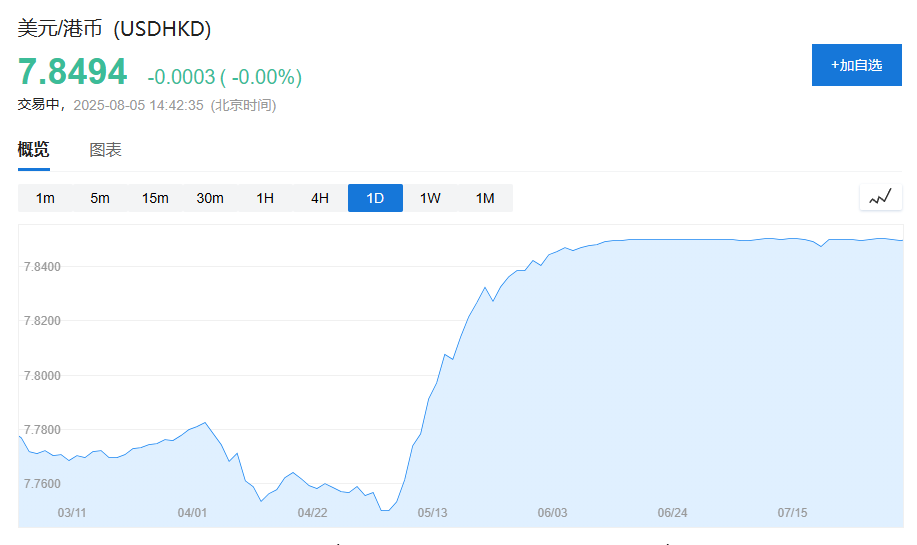
Group 1 - The Hong Kong Monetary Authority (HKMA) intervened in the market for the third time in a week due to the Hong Kong dollar (HKD) hitting the weak end of its peg at 7.85 against the US dollar, buying HKD 64.29 billion and selling USD [1] - The HKMA's actions are aimed at maintaining the HKD within the 7.75-7.85 range, with the banking system's liquidity expected to drop to HKD 72.461 billion following the intervention [1][7] - The continuous pressure on the HKD is attributed to a combination of low interest rates and capital outflows from the Hong Kong stock market [2][4] Group 2 - The interest rate differential between Hong Kong and the US has created an environment where investors are shorting the HKD to capitalize on the interest rate spread, leading to further depreciation of the currency [2] - Recent data indicates significant capital outflows from the Hong Kong stock market, with a notable increase in selling activity, particularly in healthcare, consumer, and real estate sectors [3][4] - The ongoing capital outflows exacerbate the demand for HKD, contributing to the depreciation pressure [4] Group 3 - Experts suggest that the duration of the HKMA's intervention will depend on the Federal Reserve's actions and the performance of the Hong Kong stock market [6] - If the US Federal Reserve initiates interest rate cuts due to weak employment data, the pressure on the HKD may ease as the interest rate differential narrows [6] - The situation reflects broader trends in emerging markets, with other currencies like the Indian Rupee also facing depreciation pressures due to external factors [6] Group 4 - The HKMA's interventions aim to stabilize HKD assets for ordinary citizens, but long-term attention is needed on interest rate differentials and capital flows [7] - While interventions may tighten liquidity and theoretically increase interest rates, the fragile state of the Hong Kong economy suggests that rates will remain low for the time being [8] - Investors in HKD assets should closely monitor the Federal Reserve's policies and capital flows in the Hong Kong stock market, as ongoing high interest rate differentials and capital outflows may lead to continued volatility [9]

南向流出与套利夹击,香港金管局一周三次出手稳汇市
Hua Er Jie Jian Wen· 2025-08-05 06:48
Core Viewpoint - The Hong Kong Monetary Authority (HKMA) has intervened in the currency market by purchasing HKD 64.29 billion (approximately USD 8.19 billion) to maintain the stability of the Hong Kong dollar against the US dollar, following previous interventions in late July and early August [1][4]. Group 1: Currency Intervention - The HKMA's recent market intervention is part of a series of actions since June aimed at curbing the depreciation of the Hong Kong dollar, which has been pressured by significant interest rate differentials between Hong Kong and the US [4][5]. - In total, the HKMA has withdrawn HKD 138.9 billion from the market through currency purchases over the past week to keep the exchange rate within the 7.75-7.85 range [1]. Group 2: Market Dynamics - Southbound capital outflows reached approximately HKD 181 billion on Monday, marking the largest single-day net outflow since May 12, which has intensified downward pressure on the Hong Kong dollar [1][4]. - Seasonal demand reduction and the outflow of southbound funds are contributing to the prevailing selling pressure on the Hong Kong dollar, as noted by DBS Bank's strategist Carie Li [4]. Group 3: Interest Rate Expectations - Recent US employment data has led to expectations of potential interest rate cuts by the Federal Reserve, which could alleviate some pressure on the HKMA if the interest rate differential narrows [5]. - The ongoing arbitrage trading driven by the interest rate gap is expected to remain active, with further interventions from the HKMA likely in the future [4][5].
央行沟通机制助日股逆袭:套利交易平仓阴霾渐散,外资加速布局
Zhi Tong Cai Jing· 2025-08-05 01:41
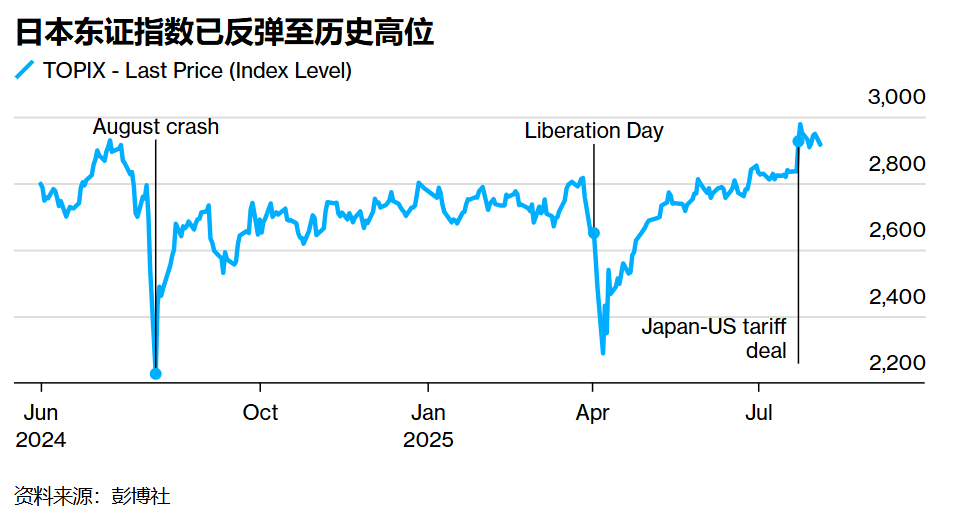
Core Viewpoint - The Japanese stock market has stabilized after significant volatility caused by the yen's appreciation last year, with current market conditions suggesting a lower likelihood of a repeat collapse in 2024 [1][4]. Group 1: Market Stability and Investor Sentiment - Analysts highlight that improved communication from the Bank of Japan, ongoing corporate governance reforms, and favorable US-China tariff agreements have contributed to a more stable market environment [4]. - The market has formed expectations for continued interest rate hikes from the Bank of Japan, indicating a shift in investor sentiment towards a more optimistic outlook [4][7]. - The volatility of the yen has decreased significantly compared to the previous year, with the exchange rate around 146.95 against the dollar, contrasting with a 10% increase in the same period last year [4][7]. Group 2: Corporate Governance and Foreign Investment - Foreign capital is flowing into the Japanese stock market, driven by corporate buybacks and governance reforms that enhance long-term value for investors [10]. - The ongoing reforms aimed at increasing shareholder returns are seen as attractive for global investors seeking diversified portfolios [10]. - The potential for fiscal expansion policies post-elections is expected to boost domestic demand sectors, further enhancing market attractiveness [10]. Group 3: Economic Indicators and Future Outlook - Goldman Sachs and Bank of America have raised their target prices for the Nikkei 225 and Topix indices, citing that US-China tariff agreements remaining below 15% will alleviate export pressures on Japan [12]. - The yen's trajectory remains a critical variable, with potential implications for market resilience if the Federal Reserve lowers rates while the Bank of Japan continues tightening [12][13]. - Current exchange rates are becoming a new indicator for observing global capital flows, reflecting the interconnectedness of international markets [13].
贸易逆差背后,瑞士黄金贸易成为特朗普关税政策焦点
Hua Er Jie Jian Wen· 2025-08-04 13:46
Group 1 - Switzerland's unique position in global gold trade is causing a trade deficit with the U.S. to become a focal point of Trump's tariff policy, with tariffs on Switzerland reaching as high as 39% [1] - In the first quarter of this year, Switzerland exported over $36 billion worth of gold to the U.S., accounting for more than two-thirds of its trade surplus with the country [1] - The Swiss National Bank and IMD Business School emphasize that gold exports should not be included in trade relationship analyses, as they reflect financial market activities rather than actual economic output [2] Group 2 - Recent surges in Swiss gold exports to the U.S. are driven by an arbitrage opportunity due to concerns over potential tariffs, leading to a price premium in New York [3] - The arbitrage process involves transporting gold bars from London to Switzerland for re-minting into Comex specifications before delivery to New York, highlighting the importance of Swiss refineries in this trade [3] - Despite the high volume of gold trade, the refining business itself has relatively low added value, with Swiss refiners earning only a few dollars per ounce from re-minting [4]