开源生态

Search documents
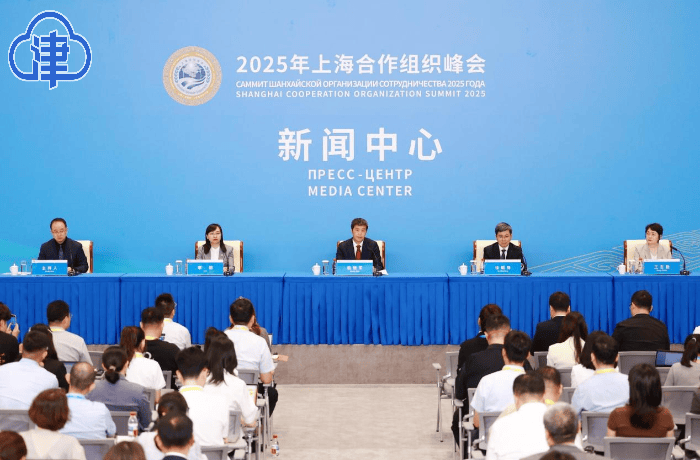
工业和信息化部:推动构建上合组织工业和信息通信业合作发展新格局
Sou Hu Cai Jing· 2025-08-28 13:50
Group 1 - In the first half of the year, China's industrial and information economy demonstrated strong resilience, with industrial added value above designated size growing by 6.4% year-on-year, and manufacturing investment increasing by 7.5% [3] - The telecommunications sector reported a revenue of 905.5 billion yuan, with a year-on-year growth of 9.3%, and the number of 5G base stations reached 4.55 million, with 1.118 billion 5G mobile phone users [3] - The software business also showed robust growth, with total revenue reaching 7.0585 trillion yuan, a profit increase of 12%, and exports growing by 5.3% [3] Group 2 - The Shanghai Cooperation Organization (SCO) has become a significant regional cooperation organization, with a trade volume exceeding 8 trillion dollars in 2024, accounting for one-fourth of global trade [4] - The SCO aims to promote sustainable development and modernization, with 2025 designated as the "Year of Sustainable Development" [4] Group 3 - The Ministry of Industry and Information Technology (MIIT) has actively engaged in international cooperation with SCO countries, focusing on building an open and inclusive global digital industry ecosystem [9] - MIIT has conducted training for over 830 digital technology talents through the China-SCO Big Data Cooperation Center, facilitating digital transformation [7][9] - The MIIT has also initiated pilot projects to expand foreign investment in value-added telecommunications services, with over 40 foreign enterprises receiving pilot approvals [9][10] Group 4 - The MIIT emphasizes high-level opening up in the industrial sector, removing foreign investment restrictions in manufacturing, and promoting trade liberalization through bilateral cooperation [10] - The MIIT plans to enhance cooperation in energy industries, promote industrial transformation, and build innovative cooperation platforms with SCO countries [10]

推理、智能体、资本:2025年AI行业都认同啥趋势?
Sou Hu Cai Jing· 2025-08-22 10:17
Core Insights - The AI industry is experiencing rapid development, with significant changes in technology, product forms, and capital logic since the emergence of large models like ChatGPT in late 2022 [1] Group 1: Technology Consensus - The evolution of AI technology is centered around three main directions: the maturity of reasoning models, the rise of intelligent agents, and the strong development of the open-source ecosystem [2] - Reasoning models have become standard, with leading models from companies like OpenAI and Alibaba demonstrating strong reasoning capabilities, including multi-step logical analysis and complex task resolution [2][3] - Intelligent agents are defined as the key term for 2025, capable of autonomous planning and task execution, marking a significant leap from traditional chatbots [3] Group 2: Product Consensus - AI products are evolving with a focus on user experience, emphasizing interaction design, operational strategies, and result delivery [8] - Browsers are becoming the primary platform for intelligent agents, providing a stable environment for memory storage and task execution [9] - The operational strategy includes the widespread use of invitation codes to control user growth and early product releases for rapid iteration based on user feedback [10] Group 3: Capital Consensus - The AI industry is witnessing accelerated revenue growth, with leading companies like OpenAI projected to increase revenue from $1 billion in 2023 to $13 billion in 2025 [12] - Mergers and acquisitions are becoming prevalent, with large tech companies acquiring AI capabilities and private companies engaging in strategic acquisitions to enhance their ecosystems [13] - Investment in AI infrastructure is gaining attention, as the deployment of intelligent agents requires supporting capabilities like environment setup and tool invocation protocols [14]

第二十七届中国国际软件博览会10月郑州见
Zheng Zhou Ri Bao· 2025-08-21 00:45
Group 1 - The 27th China International Software Expo will be held from October 15 to 17 in Zhengzhou, showcasing the innovation and development of China's software industry [1] - The expo is the largest and longest-running professional event in China's software and information technology service sector, having successfully hosted 26 editions [1] - This year's theme is "Open Source Builds New Ecology, Software Manufacturing New Future," featuring a comprehensive activity system including a main opening ceremony, parallel activities, and a software achievement exhibition [1] Group 2 - The opening ceremony will include discussions among industry experts, leading software companies, and representatives from outstanding national parks on cutting-edge technology trends and industry cooperation [2] - A highlight of the expo will be the "Star River Co-code: Central Plains Appointment" themed series of activities for programmers, along with several major events focused on software innovation and AI technology [2] - National think tanks and authoritative industry associations will release the latest achievements in the software industry and conduct key project signing ceremonies [2]
构建更具活力开源生态
Jing Ji Ri Bao· 2025-08-12 03:01
Core Insights - China's open-source ecosystem has rapidly developed, with over 2.2 million active open-source developers in 2024, leading globally [1] - The open-source model is reshaping the AI competitive landscape, providing cost-effective access to top AI capabilities for SMEs and benefiting cloud service providers and domestic chip manufacturers [3] Group 1: Open-source Development in China - The Ministry of Industry and Information Technology (MIIT) highlights that open-source has significantly driven technological breakthroughs and high-quality development [1] - Major cities like Beijing and Shanghai lead in active open-source projects and developers, while cities like Guangzhou and Chengdu are emerging as new forces in the ecosystem [1] - The open-source ecosystem in China is characterized by a stable top tier, an ascending mid-tier, and a catching-up lower tier, indicating a broadening of innovation resources across more cities [1] Group 2: Impact of Large Models on Software Development - The rise of large models has sparked a new wave of AI innovation, enhancing intelligent capabilities and broadening application scenarios [2] - The UBML community is transitioning from low-code to intelligent development, focusing on semantic modeling, multi-agent collaboration tools, and open datasets [2] - This transformation aims to improve software development models and enhance the core competitiveness of China's software industry [2] Group 3: Government Initiatives and Support - Beijing's information software industry achieved a revenue of 3.3 trillion yuan in 2024, accounting for a quarter of the national total [4] - The government plans to optimize open-source public services, cultivate talent, and establish evaluation and incentive mechanisms based on open-source contributions [4] - MIIT will accelerate the construction of the open-source system, encouraging deep integration of government, industry, academia, research, and finance [5]
覆盖多行业多场景—— 构建更具活力开源生态
Jing Ji Ri Bao· 2025-08-11 22:03
Core Insights - China's open-source ecosystem has rapidly developed, with over 2.2 million active open-source developers in 2024, leading globally [1] - Open-source is driving technological breakthroughs and high-quality development, becoming a significant force in cultivating new productive forces [1] - Major cities like Beijing, Shanghai, Shenzhen, and Hangzhou are leading in active open-source projects and developer numbers, while other cities like Guangzhou and Chengdu are emerging as new forces [1] Group 1: Open-source Development - The open-source ecosystem in China is characterized by a stable top tier, an ascending mid-tier, and a catching-up lower tier, with a growing number of cities participating [1] - The open-source community is expanding from a few regions to more cities, enhancing resource flow and regional collaboration [1] Group 2: AI and Software Transformation - The rise of large models has sparked a new wave of AI innovation, significantly increasing enterprises' willingness to deploy these models [2] - The shift towards intelligent software development is being driven by the UBML community, focusing on semantic modeling and collaborative tools [2] Group 3: Economic Impact and Collaboration - Open-source technology is penetrating various industries, with over 100 organizations leading the trend and more than 150 application cases published across critical sectors [3] - Beijing's software industry generated 3.3 trillion yuan in revenue in 2024, accounting for a quarter of the national total, with plans to enhance open-source public services and talent cultivation [4] Group 4: Government Initiatives - The Ministry of Industry and Information Technology aims to accelerate open-source system construction and promote deep integration of government, industry, academia, and research [4] - There is a focus on quantifying the value of open-source products and fully releasing their commercial potential, particularly in foundational software and AI [4]
华为出其不意,给英伟达的CUDA补了致命一刀!
Xin Lang Cai Jing· 2025-08-11 09:24
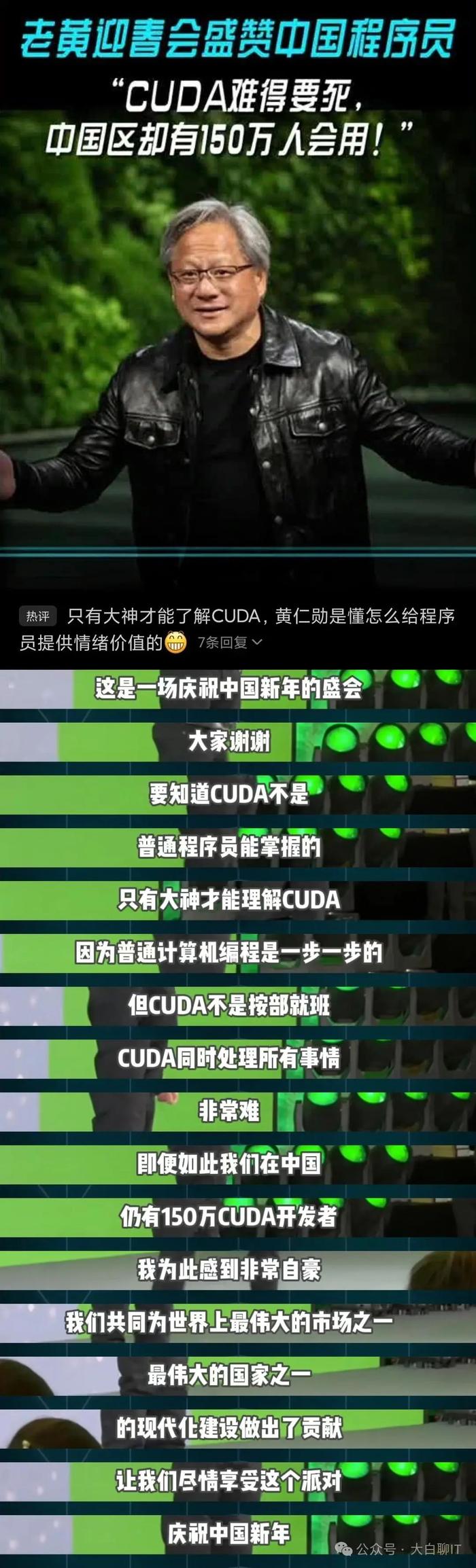
Core Insights - NVIDIA's dominance in AI computing is attributed to its 18-year development of the CUDA ecosystem, which has created a vast network of 4 million developers and 4,000 companies, making it an essential infrastructure for the global AI industry [1][10] - The significant reliance on the Chinese market is highlighted, with over 1.5 million CUDA developers in China, indicating that a mass shift to other platforms could jeopardize NVIDIA's competitive edge [1][3] Group 1: CUDA Ecosystem - CUDA, established in 2007, has taken nearly two decades to develop into a critical platform for AI, with a large developer base [1] - Huang Renxun's comments emphasize the importance of the Chinese developer community to NVIDIA's strategy and market position [1][3] Group 2: Huawei's CANN Open Source Initiative - Huawei's announcement to fully open source its CANN platform marks a significant challenge to NVIDIA's AI development monopoly, aiming to establish a self-sufficient computing foundation for China [7][10] - The open sourcing of CANN includes critical components like the hardware task scheduler (HWTS) and heterogeneous computing compiler (HCC), allowing developers direct access to the underlying computing power of Ascend AI processors [8][10] Group 3: Industry Impact and Future Outlook - Huawei's strategy of open sourcing technology contrasts with NVIDIA's "limited openness," potentially providing a new technological pathway for the global AI industry [8][10] - The collaborative effort in the CANN ecosystem, with over 20 leading companies participating, aims to complete over 1,000 community-built operators by the end of the year, indicating a shift in industry dynamics [10] - Concerns over NVIDIA's H20 chip vulnerabilities signal a growing preference for domestically controlled hardware and software ecosystems, as reliance on foreign chips may pose security risks [10]

华为版CUDA,全面开源了
3 6 Ke· 2025-08-06 08:29
Core Insights - Huawei has announced the open-sourcing of its CANN software toolkit for Ascend AI GPUs, emphasizing its AI strategy centered around computing power and monetization of Ascend hardware [3][6][11] - The CANN architecture, akin to NVIDIA's CUDA, provides a multi-layer programming interface to help users build AI applications specifically for Huawei's Ascend GPUs [4][6] Group 1: Huawei's CANN Open-Sourcing - The CANN toolkit has been upgraded to version 8.0, offering both a community version for early feature access and a commercial version tailored for enterprise users [6] - CANN now supports various deep learning frameworks, including PyTorch, MindSpore, TensorFlow, and others, enhancing its compatibility and usability for developers [9] - Huawei has initiated the "CANN Open Source Ecosystem Co-Building Initiative," indicating a strong commitment to developing an open ecosystem around Ascend technology [11] Group 2: Competitive Landscape - A new startup, Oxmiq Labs, founded by a legendary GPU architect, aims to create a software ecosystem similar to CUDA, focusing on GPU hardware and software IP [12][14] - Oxmiq's software stack includes OXCapsule for workload management and OXPython, which allows CUDA-based applications to run on non-NVIDIA hardware without modification [21][23] - The competitive environment is intensifying, with multiple players challenging NVIDIA's dominance in the GPU market, ultimately benefiting developers through increased options and innovation [7][23]
华为版CUDA,全面开源了
量子位· 2025-08-06 08:14
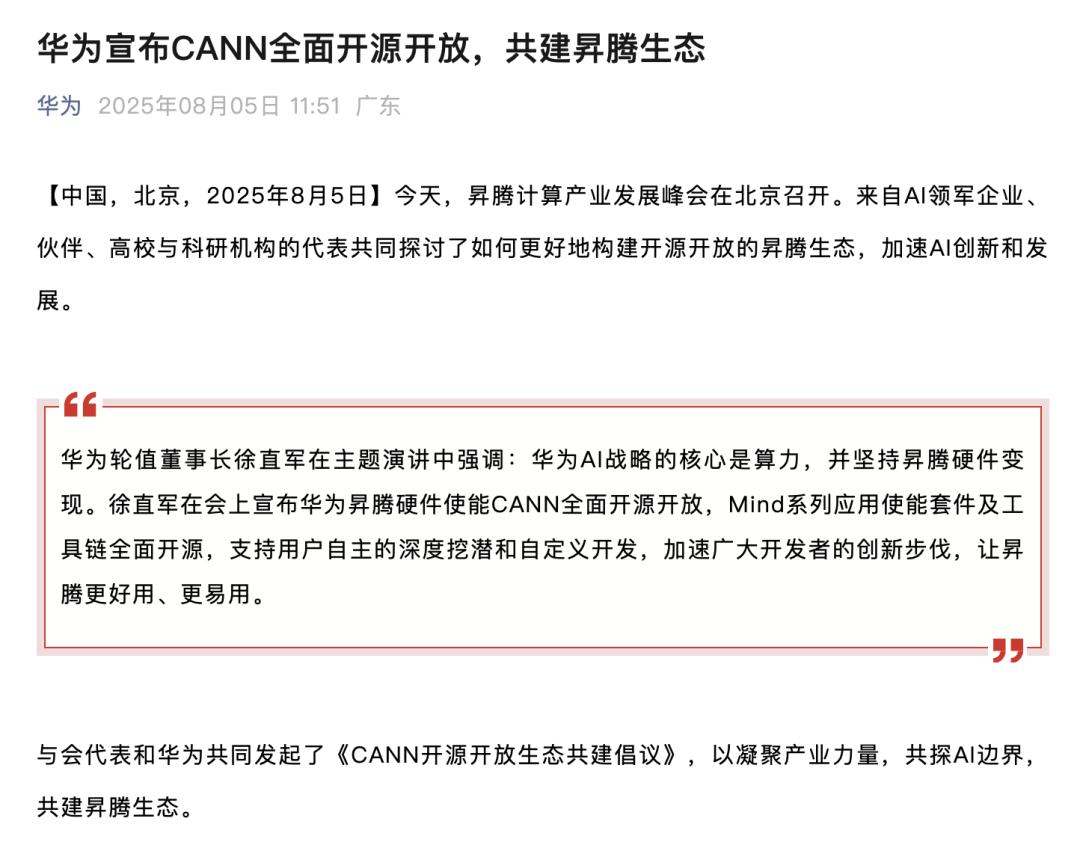
Core Viewpoint - Huawei has announced the open-source release of its CANN software toolkit for Ascend AI GPUs, aiming to enhance its competitiveness against NVIDIA's CUDA ecosystem [1][3][7]. Group 1: Huawei's AI Strategy - Huawei's rotating chairman Xu Zhijun emphasized that the core of Huawei's AI strategy is computing power, with a commitment to monetizing Ascend hardware [3]. - The open-source CANN architecture and Mind series application enablement toolkit will allow developers to explore the potential of Ascend GPUs independently [7][12]. Group 2: CANN Software Toolkit - CANN, a neural network computing architecture, provides multiple programming interfaces to help users build AI applications for Huawei's Ascend [4]. - The CANN toolkit is likened to a Huawei version of CUDA, offering similar interfaces for GPU support [5]. - CANN has been upgraded to version 8.0, with both community and commercial versions available, supporting 12 operating systems [7]. Group 3: Competitive Landscape - On the same day, a new startup led by legendary GPU architect Raja Koduri emerged, focusing on developing a software ecosystem similar to CUDA, but not targeting consumer-grade GPUs [6][13]. - Oxmiq Labs, founded by Koduri, aims to provide a vertically integrated platform combining GPU hardware IP with a comprehensive software stack for AI and graphics workloads [20][22]. Group 4: Oxmiq's Software Strategy - Oxmiq's software stack includes OXCapsule, a unified runtime for workload management, and OXPython, which allows CUDA-based applications to run on non-NVIDIA hardware without modification [29][31]. - The software is designed to be independent of Oxmiq's hardware, which is a core part of its strategy [31]. Group 5: Industry Implications - The competition against NVIDIA's CUDA ecosystem is intensifying, with multiple players entering the field, ultimately benefiting developers [32].

凝聚开源共识 第三届杭州产投融生态大会召开
Zheng Quan Ri Bao Zhi Sheng· 2025-08-01 14:17
Core Viewpoint - The third Hangzhou Industrial Investment and Financing Ecological Conference was successfully held, focusing on building an open and win-win open-source ecosystem in the context of technological innovation and industrial integration [1][3][7]. Group 1: Conference Overview - The conference was organized by Hangzhou Jin Investment, Hangzhou Capital, and Hangzhou Bank, with support from various municipal departments, gathering over 300 representatives from digital enterprises, investment institutions, and industrial parks [3][4]. - The theme of the conference was "Thickening the Open Source Ecology, Together Embarking on a New Journey of Digital Intelligence," highlighting the launch of the "Hangzhou Innovation E-Station," a comprehensive service platform for technology innovation enterprises [3][4]. Group 2: Key Initiatives and Platforms - The "Hangzhou Innovation E-Station" was officially launched, providing a full lifecycle and comprehensive service system for technology innovation enterprises, integrating five major funding elements: investment, loans, subsidies, guarantees, and insurance [4]. - The establishment of the Hangzhou Market Scene Innovation Center aims to facilitate the application of new technologies and products, promoting the integration of technological and industrial innovation [4]. Group 3: Financial Ecosystem Development - Hangzhou is striving to become a globally influential financial city, accelerating the construction of the Qiantang River Financial Port and actively engaging in national AI strategic layouts [5]. - Hangzhou Jin Investment, Hangzhou Capital, and Hangzhou Bank are collaborating to build an AI open-source industrial investment ecosystem, emphasizing shared benefits and mutual success [5]. Group 4: Insights on Open Source Ecology - Industry leaders discussed the trends and opportunities in technology, industry, and investment within the open-source ecosystem, emphasizing the importance of open-source in the development of the digital economy [6]. - The conference highlighted that small investments in AI could lead to significant returns, with the potential for super winners emerging from these investments [6]. Group 5: Future Directions - The conference established a green channel for deep communication in industrial investment and financing, aiming to continuously gather patient capital and stimulate innovation [7].

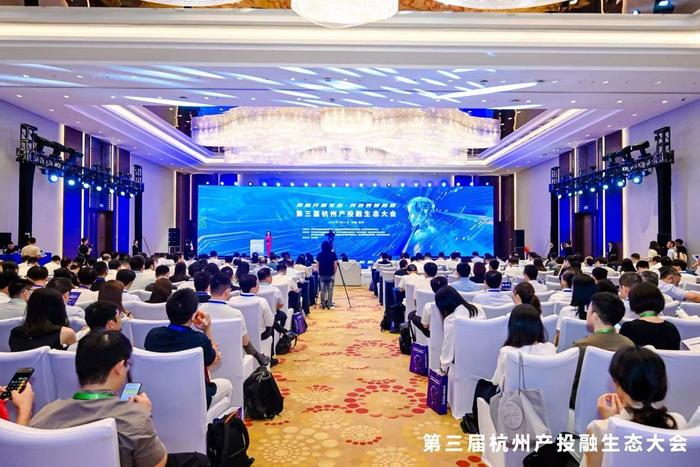
李家庆、郑伟鹤,最新发声!
中国基金报· 2025-08-01 10:34
Core Viewpoint - The discussions at the Hangzhou Investment and Financing Ecological Conference highlighted the significant breakthroughs in China's open-source field, particularly in AI large models and RISC-V chips, indicating a globalization trend for Chinese technology [2][4]. Group 1: AI and Open Source Development - The emergence of nine out of the top ten open-source models globally from Chinese companies signifies China's leading position in both AI and open-source dimensions [4]. - Open-source is becoming the infrastructure for digital economic development, reshaping production relationships and the competitive landscape in technology innovation [4][6]. - Chinese entrepreneurs are transitioning from being "users" of technology to "contributors" and "leaders," with RISC-V chip shipments expected to exceed 50% of the global market share by 2024 [5]. Group 2: Investment Opportunities and Market Revaluation - The current phase of asset revaluation in China is highlighted, with significant growth in companies related to AI, such as the rapid increase in valuation for companies like Cambricon [8]. - The A-share market has shown positive performance, and the revaluation of Chinese assets is expected to continue over the next two to three years, driven by industry upgrades [8]. - Private equity firms are encouraged to adopt a diversified investment strategy, accepting some failures while actively seeking out potential "super winners" in the AI sector [9].