成本优化

Search documents
小牛电动20251119
2025-11-20 02:16
Summary of Niu Technologies Conference Call Company Overview - **Company**: Niu Technologies - **Industry**: Electric Vehicles (specifically electric scooters and motorcycles) Key Points Sales Performance - In the first nine months of 2025, Niu Technologies sold over 1 million vehicles, a year-on-year increase of 46% [2][3] - Sales in China reached 950,000 units, up 65% year-on-year, while overseas sales were 66,000 units [2][3] - In Q3 2025, total revenue was 1.694 billion RMB, a 65% increase year-on-year [2][3] Revenue Breakdown - Revenue from the Chinese market was 1.617 billion RMB, accounting for 96% of total revenue [3] - Chinese vehicle revenue grew 86% to 1.482 billion RMB, driven by increased sales volume and average selling price (ASP) [2][3] - ASP for domestic vehicles was 3,283 RMB, a 6.7% increase year-on-year [2][3] - Overseas vehicle revenue decreased by 48% to 67 million RMB, primarily due to a decline in scooter sales and ASP [2][5] Profitability - Gross profit for Q3 was 370 million RMB, with a gross margin of 21.8%, an increase of 8 percentage points year-on-year [2][5] - Operating expenses were 297 million RMB, with a ratio of 17.5%, lower than the previous year [5] - Net profit was 82 million RMB, with a net margin of 7.8% [5] Market Dynamics - The transition to new national standards affected September's shipment growth, but the domestic market remains strong [2][6] - Strategic adjustments in the scooter business led to a decline in overseas sales but improved performance in the electric motorcycle segment [2][9] Future Outlook - Q4 revenue is expected to be between 3.7 billion and 3.9 billion RMB [4] - The company plans to increase the proportion of electric motorcycles and expand into lower-tier cities [4][14] - The proportion of lead-acid batteries is expected to rise, with net margins projected to stabilize between 2% to 4% in 2025 and 4% to 6% in 2026 [4][30] Product Strategy - Niu is focusing on high-end products in response to competitive pressures in the low-end market [11] - The company is also expanding its presence in the European market while addressing challenges in the U.S. due to potential tariff increases [12][29] Inventory and Sales Projections - Sales in Q4 are expected to be flat compared to the previous year, with inventory needing to be cleared by November 30 [13] - The company aims to increase the proportion of electric motorcycles from the current 15% to a higher percentage in the future [14] Cost Structure and Pricing - The introduction of new national standards has led to increased costs due to the use of magnesium alloy components, raising vehicle prices by approximately 200 RMB [16][21] - ASP in the Chinese market is expected to stabilize between 3,300 and 3,500 RMB, while overseas ASP is projected to be between 13,000 and 15,000 RMB [22] Strategic Focus - The company’s strategy includes expanding its product line to include both lead-acid and lithium battery vehicles, while also enhancing its presence in lower-tier cities [33] - Niu aims to improve profitability through product line optimization and strategic market positioning [33] Conclusion - Niu Technologies is experiencing strong growth in the domestic market, with a focus on high-end products and strategic adjustments in overseas markets. The company is optimistic about future revenue growth and profitability improvements as it navigates regulatory changes and market dynamics.

吉利汽车Q3利润增长59%,极氪交付量同比增长13% | 财报见闻
Hua Er Jie Jian Wen· 2025-11-17 06:31
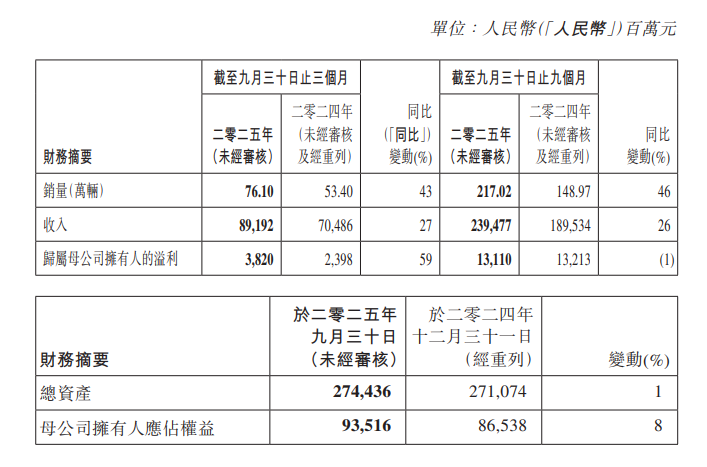
Core Viewpoint - Geely Automobile reported significant growth in both sales and profits for Q3 2025, with total sales increasing by 43% to 761,000 units and revenue rising by 27% to RMB 89.192 billion, indicating strong performance in both fuel and new energy vehicles [1][3][5]. Financial Performance - In Q3 2025, Geely's revenue reached RMB 89.2 billion, marking a historical high and a 15% increase from the previous quarter [5]. - The net profit attributable to the parent company was RMB 3.8 billion, reflecting a 59% year-on-year increase [5]. - The total gross profit for Q3 was RMB 14.8 billion, with an 11% quarter-on-quarter growth [5]. Sales and Delivery - Zeekr, Geely's premium electric vehicle brand, delivered approximately 140,000 units in Q3 2025, a 13% increase year-on-year, generating revenue of about RMB 31.6 billion [6]. - As of the end of October, Geely has achieved a cumulative sales volume of 2.477 million units for the year, reaching 82.6% of its annual target of 3 million units [1]. Cost Management and Profitability - The company attributed its profit growth to scale effects, cost control, and brand integration synergies, with net profit growth outpacing revenue growth [3]. - Adjusted net profit for the first nine months of the year was RMB 10.62 billion, a 59% increase year-on-year when excluding one-time items from the previous year [3]. Accounting Changes - Geely has changed its accounting policy effective January 1, 2025, from the "purchase method" to the "equity method" for joint control entities, impacting the way acquisitions are recorded and necessitating restatement of prior financial results [8]. - This change aims to enhance financial reporting transparency and align with international practices, affecting the financial data comparison for 2024 [8].


赫伯罗特确认投资22艘小型集装箱船
Sou Hu Cai Jing· 2025-11-14 10:21
Core Viewpoint - Hapag-Lloyd is proceeding with an investment plan for 22 small container ships despite a significant decline in profits this year, aiming to modernize its fleet and support its transition to net-zero emissions [1][2]. Investment and Fleet Modernization - The company plans to acquire medium-sized vessels with a capacity of less than 5000 TEU through a combination of long-term leasing and owned ships, with preliminary contracts signed with two Chinese shipyards valued at approximately $1.58 billion [1]. - The new vessels will have capacities ranging from 3500 TEU to 4500 TEU, built by Yantai Raffles CIMC Offshore and Taizhou Sanfu Ship Engineering [1]. Financial Performance - In Q3, Hapag-Lloyd's profit dropped to €138 million (approximately $160 million), a decline of over 85% compared to €955 million in the same period last year, with revenue decreasing from €5.2 billion to €4.6 billion [1]. - For the first nine months, overall profit fell to €846 million, nearly halving from €1.6 billion in the previous year [1]. Market Environment and Strategic Response - CEO Rolf Habben Jansen noted that the market environment has been highly volatile due to geopolitical developments and trade policy uncertainties, but strong customer demand has led to significant volume growth [2]. - The company has narrowed its profit expectations for FY2025, with EBITDA projected between €2.8 billion and €3.2 billion, and EBIT between €500 million and €1 billion [2]. Pricing and Competitive Position - Average freight rates remain under pressure, with the price per TEU at $1397, a decrease of 4.8% year-on-year [3]. - The Gemini network, a collaboration with AP Moller-Maersk, has improved schedule reliability and is expected to yield cost advantages by 2026 [3]. Long-term Outlook - Hapag-Lloyd's investment decision reflects strategic foresight, enhancing the flexibility of its feeder network and contributing to decarbonization efforts, which is crucial for maintaining competitiveness during low freight rate periods [3]. - The company remains cautiously optimistic about a recovery in global trade, signaling a commitment to sustainable development in the shipping industry [3].
金达威:前三季度辅酶Q10原料毛利率同比上升得益于成本优化
2 1 Shi Ji Jing Ji Bao Dao· 2025-11-14 09:24
南财智讯11月14日电,金达威在投资者关系活动中表示,公司前三季度辅酶Q10原料毛利率同比上升主 要由于去年部分原料依赖外部采购导致成本较高,而今年通过规模效应和技术升级,前三季度单位成本 有所下降,推动毛利率提升。 ...

日本方便面回暖,日清食品内地2025前三季度增长5.4%,华西、华北带头复苏
3 6 Ke· 2025-11-11 03:56
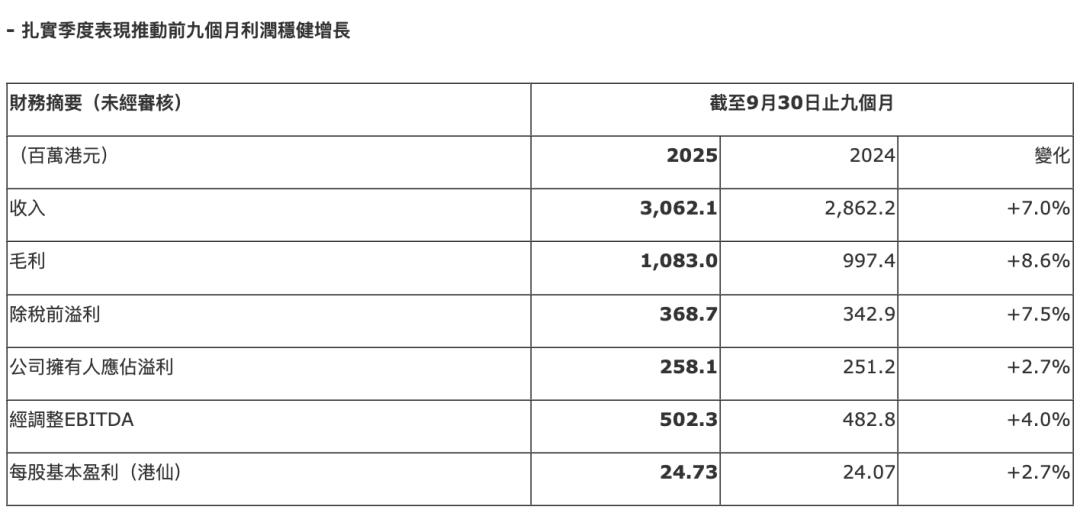
Core Insights - Nissin Foods reported a revenue of HKD 30.62 billion (approximately RMB 28.04 billion) for the first three quarters ending September 30, 2025, representing a year-on-year growth of 7.0% [1][2] - The net profit for the same period was HKD 2.58 billion (approximately RMB 2.36 billion), showing a year-on-year increase of about 2.7% [1][2] - The gross profit margin improved from 34.8% to 35.4%, attributed to the strong sales of high-margin cup noodles and enhanced production efficiency [2] Financial Performance - Revenue for the nine months ending September 30, 2025, was HKD 3,062.1 million, up from HKD 2,862.2 million, a 7.0% increase [2] - Gross profit rose to HKD 1,083.0 million, an 8.6% increase from HKD 997.4 million [2] - Profit before tax increased by 7.5% to HKD 368.7 million from HKD 342.9 million [2] - Adjusted EBITDA grew by 4.0% to HKD 502.3 million from HKD 482.8 million [2] - Basic earnings per share rose to 24.73 cents from 24.07 cents, reflecting a 2.7% increase [2] Regional Performance - Revenue from Hong Kong and other regions grew by 9.5% to HKD 1.20 billion, driven by stable sales of instant noodles and rising demand in overseas markets [2] - Revenue from mainland China was HKD 18.60 billion (approximately RMB 17.03 billion), with a modest year-on-year growth of 5.4%, accounting for about 60% of total revenue [2][3] Strategic Adjustments - The company is shifting its sales strategy from an over-reliance on e-commerce to strengthening offline channels, particularly in core markets like South China [5] - Nissin aims to maintain profit margins by controlling promotional expenses and avoiding price hikes despite rising raw material costs [5][6] - The company is focusing on product upgrades and cost optimization, with recent investments in new product lines targeting health-conscious consumers [6] Market Challenges - The demand for instant noodles in China is slowly recovering, with management noting a resurgence in sales in previously struggling regions [3][6] - The competitive landscape has intensified, with Nissin facing challenges from both external competitors and changing consumer preferences [10][11] - The company's market share in China has declined significantly, dropping to around 4% in 2023 from a peak of 14.5% in 2018 [11] Future Outlook - Nissin is investing approximately RMB 240 million in new facilities in Zhuhai, Guangdong, to enhance production efficiency and meet growing demand for high-end products [6][7] - The management remains optimistic about the recovery of the mainland market, projecting a 9.4% revenue growth in the first half of 2025 [6][7]
新东方-S(09901.HK)动态研究:FY2026Q2预计K12业务加速增长 回购+分红回报股东
Ge Long Hui· 2025-11-11 03:39
Core Insights - The company reported a revenue of $1.52 billion for FY2026 Q1, representing a year-over-year increase of 6.1%, exceeding the previous guidance by 1% [1] - The company plans to return $490 million to shareholders through dividends and share buybacks, with a dividend of $0.12 per share and a total dividend payout of approximately $190 million [2] - The company expects revenue growth in FY2026 Q2 to be higher than Q1, with projected net revenue between $1.13 billion and $1.16 billion, reflecting a year-over-year increase of 9% to 12% [2] Financial Performance - In FY2026 Q1, the company achieved a Non-GAAP operating profit of $340 million, a year-over-year increase of 11.8%, with an operating profit margin of 22%, up 1.1 percentage points [1] - The company reported a net profit attributable to shareholders of $240 million for FY2026 Q1, a decrease of 1.9% year-over-year, while the Non-GAAP net profit was $260 million, down 2.4% year-over-year [1] - As of the end of FY2026 Q1, the company had cash and cash equivalents of $1.28 billion, time deposits of $1.57 billion, and short-term investments of $2.18 billion [1] Business Segments - The company’s revenue growth was driven by domestic exam services for adults and university students, which grew by 14.4% year-over-year, and new education businesses, which grew by 15.3% year-over-year [1] - The overseas business faced pressure, with the revenue growth for study abroad exam preparation and consulting services at only 1% and 2% year-over-year, respectively [1] Future Outlook - The company maintains its previous revenue growth expectations for the full year, despite adjusting forecasts due to international economic conditions affecting traditional study abroad and new cultural tourism businesses [2] - The company anticipates an increase in profit margins in FY2026 Q2, driven by improvements in core education business and enhanced profitability from its subsidiary, Dongfang Zhenxuan [2] - Revenue projections for FY2026-2028 are estimated at $5.36 billion, $5.98 billion, and $6.5 billion, with net profits of $460 million, $540 million, and $620 million, respectively, maintaining a "buy" rating [2]
新能源车交付前夜,大众每天都在“算账”
3 6 Ke· 2025-11-11 01:11
Core Insights - Volkswagen Group is facing challenges in its financial performance, particularly in China, where it has invested heavily in transformation efforts [1][3] - The company aims to increase its electric vehicle (EV) sales significantly by 2026, with a target of over 20 new EV models and a sales share rising from 5% to double digits [2] - Volkswagen's CFO for China, Patrick Heinecke, emphasizes the importance of local innovation and efficient operations to ensure sustainable profitability in the Chinese market [1][2] Financial Performance - Volkswagen Group's third-quarter results indicate ongoing financial decline, with a warning of continued losses in the next two years [3] - The company reported a drop in investment returns from joint ventures in China, forecasting profits to decrease from €2.6 billion in 2023 to €1.7 billion in 2024, and further to €0.5-1 billion in 2025 [4] - The profitability of EVs is a critical concern, as the company anticipates that the transition phase will not yield parity in profit margins between traditional fuel vehicles and EVs until the later stages of its planning cycle, likely around 2030 [2][4] Cost Optimization Efforts - Volkswagen is actively engaged in cost optimization, with a goal to reduce costs by 40% compared to previous global platforms, aiming for a 50% reduction in the long term [7][8] - The company is focusing on detailed cost analysis and price forecasting through intensive product workshops, involving all team members in the process [2][6] - The management team is prioritizing the prediction of market price trends and optimizing costs across all vehicle segments to enhance profitability [6][7] Strategic Investments - Recent investments include a partnership with Horizon Robotics to develop system-level chips, with an investment of approximately $200 million, and the opening of a new Porsche R&D center in Shanghai [9] - Volkswagen is committed to maintaining control over core technologies in the Chinese market, despite speculation about shifting to external collaborations for software development [8][9] Market Position and Future Outlook - Volkswagen anticipates that its joint venture profits will rebound to €2 billion by 2027 and reach €3 billion by 2030, supported by new ventures like Volkswagen Anhui [5] - The company acknowledges the competitive landscape in the A-segment market, which is more challenging than the B and C segments, impacting overall profitability [5][6] - The focus on enhancing capital efficiency in the fuel vehicle segment is crucial as the market share for fuel vehicles continues to decline, currently standing at 22% in China [8]
新能源车交付前夜 大众每天都在“算账”
经济观察报· 2025-11-10 14:41
Core Viewpoint - Volkswagen Group is undergoing a significant transformation in China, focusing on cost optimization and the transition to electric vehicles, while facing challenges in profitability and market competition [2][4][10]. Investment and Financial Performance - Volkswagen Group's third-quarter financial report indicates ongoing performance decline, with a notable investment of €50 billion in transformation efforts in China [2][3]. - The CFO of Volkswagen China, Patrick Heinecke, emphasizes the importance of establishing a sustainable profit model in the Chinese market, which is crucial for the global transformation success [2][3]. - Investment returns from joint ventures in China are projected to decrease from €2.6 billion in 2023 to €1.7 billion in 2024, with further declines expected in 2025 [7]. Sales and Market Strategy - Volkswagen aims to increase the share of electric vehicle sales from 5% to double digits by 2026, with over 20 new electric models planned [3][4]. - The profitability of electric vehicles is expected to remain lower than that of traditional fuel vehicles during the transition phase from 2025 to 2026, with a target to achieve parity by the end of the planning cycle, likely around 2030 [3][4]. Cost Optimization Efforts - The current focus for Volkswagen China is on meticulous cost analysis and optimization, with a significant reduction in costs by 40% compared to previous global platforms, aiming for a 50% reduction in the long term [3][11]. - The management team is actively engaged in product workshops to analyze cost details and predict pricing, indicating a shift towards a more cost-conscious operational approach [4][10][12]. Challenges and Future Outlook - Despite the anticipated growth in electric vehicle sales, Volkswagen acknowledges that the scale of electric vehicle production is still insufficient to match the profitability of fuel vehicles, necessitating careful management of R&D and investment expenditures [7][10]. - The competitive landscape in the A-segment market is particularly fierce, impacting profit margins, while Volkswagen expects joint venture profits to rebound to €2 billion by 2027 and reach €3 billion by 2030 [7][8]. Technological Investments - Volkswagen is committed to maintaining core technology in software development and has announced new investments, including a $200 million collaboration with Horizon for system-level chip design [13]. - The establishment of a new Porsche R&D center in Shanghai signifies Volkswagen's dedication to enhancing its local value chain and technological capabilities in China [13].

新能源车交付前夜 大众每天都在“算账”
Jing Ji Guan Cha Wang· 2025-11-10 03:24
Core Insights - Volkswagen Group's third-quarter financial report indicates that the company has not yet emerged from a downward trend, particularly in the Chinese market where it is increasing investment [2][4] - The CFO of Volkswagen China, Patrick Heinecke, emphasized the importance of local innovation and efficient operations as the company aims to build a sustainable profit model in China [2][3] Investment and Financial Goals - Volkswagen China has committed 50 billion euros towards its transformation, with strategic goals including increasing the share of new energy vehicle (NEV) sales from 5% to double digits by 2026 [3][5] - The company anticipates that profits from joint ventures will rebound to 2 billion euros by 2027 and reach 3 billion euros by 2030, aided by new joint ventures [5][9] Cost Management and Operational Efficiency - Volkswagen China is focused on optimizing costs, having reduced costs by 40% compared to previous global platforms, with a target of achieving a 50% reduction in the long term [8][9] - The management team is conducting frequent product workshops to analyze cost details and predict pricing, indicating a shift towards a more cost-conscious operational approach [7][8] Market Challenges and Strategic Adjustments - The company faces significant challenges in achieving profitability in the NEV sector, as the transition phase is expected to see lower profit margins compared to traditional fuel vehicles [4][5] - Volkswagen anticipates ongoing price competition in the Chinese market, which will require rapid cost optimization and market share enhancement to maintain profitability [7][10] Recent Developments - On November 15, Volkswagen China announced two new investments, including a partnership with Horizon to design and develop system-on-chip (SoC) technology, with an investment of approximately 200 million euros [10]
Greif(GEF) - 2025 Q4 - Earnings Call Transcript
2025-11-06 14:30
Financial Data and Key Metrics Changes - Adjusted EBITDA for Q4 was $99 million, a 7.4% increase year-over-year, with EBITDA margins expanding by 140 basis points due to better price-cost dynamics across all segments and cost optimization efforts [15][17] - Adjusted free cash flow improved by over 24.3% year-over-year, driven by increased EBITDA and strong working capital management [15] - Adjusted EPS for the quarter was $0.01 compared to $0.59 in the prior year quarter, impacted by non-recurring tax items and the nature of continuing operations after removing discontinued operations [16] Business Line Data and Key Metrics Changes - In the polymers segment, small containers showed positive volume momentum, while IBC and large polymer drums experienced mid-single-digit declines due to softness in industrial markets [11][12] - Durable metals volumes declined by 6.6%, reflecting weakness in industrial end markets [12] - Sustainable fiber volumes decreased by 7.7%, impacted by URB economic downtime and soft fiber drum demand [12] - Integrated solutions saw volume improvements driven by closures, with these products generating over 30% gross margin [12] Market Data and Key Metrics Changes - The company reported a Net Promoter Score of 72, an improvement of 3 points from the previous year, indicating enhanced customer service performance [5] - The macro environment remains challenging, with demand softness in construction and manufacturing affecting customer volumes [27] Company Strategy and Development Direction - The company is focused on a "Build to Last" strategy, emphasizing cost optimization, portfolio reshaping, and sustainable growth [6][24] - The divestiture of the containerboard and land management businesses has allowed the company to concentrate on areas with the greatest opportunity for EBITDA growth and margin expansion [5][24] - The cost optimization program has exceeded initial commitments, with anticipated cumulative savings raised from $50 million-$60 million to $80 million-$90 million for fiscal 2026 [9][10] Management's Comments on Operating Environment and Future Outlook - Management acknowledged the ongoing challenges in the macro environment but expressed confidence in the company's ability to generate cash and manage costs effectively [36] - The company anticipates a low-end guidance for fiscal 2026, assuming flat to low single-digit volume declines in metals and fiber, with low single-digit improvements in polymers and closures [18][19] - Management remains optimistic about capturing value as demand returns, supported by a strong balance sheet and cash flow generation [24][70] Other Important Information - The company plans to execute a $150 million open market repurchase plan and seeks board approval for a new stock repurchase authorization [22][23] - The anticipated capital expenditures for the year are approximately $155 million, with maintenance CapEx needs reduced by about $25 million [20] Q&A Session Summary Question: Can you provide more details on the growth in polymers and target markets? - Management noted that the agrochemicals market has been a significant growth area, particularly for small containers, despite overall demand softness in other sectors [27] Question: How should we think about EBITDA guidance for fiscal 2026? - Management indicated that the first quarter is expected to be the weakest, with subsequent quarters showing improvement [29] Question: If volumes come in weaker, can cost optimization offset that? - Management confirmed that cost optimization remains a lever to pull in response to volume weakness, with ongoing improvements in the program [33] Question: What are the expectations for the durable metals business in Europe? - Management highlighted that North American steel business has been down similarly to EMEA, but EMEA steel has shown consistent performance [66] Question: What is the outlook for M&A activity? - Management stated that while there is a solid pipeline for M&A, the focus remains on organic growth, with no transformational M&A expected [41][68]