结构升级

Search documents
华润啤酒(00291.HK):2025年降本提效对冲吨价压力 利润表现稳健
Ge Long Hui· 2026-03-26 05:16
Core Viewpoint - The company achieved a core net profit of 5.72 billion yuan in 2025, slightly exceeding expectations, despite a decline in overall revenue and net profit due to various one-time costs and market conditions [1][2]. Performance Review - In 2025, the company reported revenue of 37.99 billion yuan, a year-on-year decrease of 1.7%, and a net profit attributable to shareholders of 3.37 billion yuan, down 28.9%. After excluding goodwill impairment, after-tax land sale gains, and factory closure losses, the core net profit was 5.72 billion yuan, reflecting a year-on-year increase of 19.6% [1]. Development Trends - The beer segment continues to upgrade its product structure, with stable growth in premium and above products. In the second half of 2025, the company faced price pressure primarily due to increased one-time expenses. Despite a weak dining environment, the company remains committed to high-end product strategies, with volume and price changes of +0.4% and -4.5% respectively in the second half of 2025 [1][2]. Cost and Efficiency - The company experienced a year-on-year decrease in beer cost per ton of 2.9% in the second half of 2025 and 3.7% for the entire year, mainly due to lower raw material costs. Although there may be upward pressure on costs due to fluctuations in commodity prices, the company is expected to maintain a strong cost reduction and efficiency improvement trend [2]. White Spirit Business - The white spirit business continues to adjust due to industry cycles, with revenue for 2025 and the second half of 2025 at 1.496 billion yuan and 720 million yuan, respectively, reflecting year-on-year declines of 30.4% and 26.4%. The EBITDA for the same periods was 264 million yuan and 46 million yuan, down 69% and 89% respectively. The goodwill impairment of 2.877 billion yuan was in line with expectations [2]. Profit Forecast and Valuation - Due to better-than-expected cost reduction and efficiency improvements, the core net profit forecast for 2026 has been raised by 4.3% to 5.997 billion yuan, with a new forecast for 2027 at 6.342 billion yuan. The current stock price corresponds to a core P/E of 12.4 and 11.7 for 2026 and 2027, respectively. The target price is maintained at 32.4 HKD, indicating a 25% upside potential from the current price, with an outperform rating relative to the industry [2].

美容护理行业双周报(2026/3/6-2026/3/19):需求稳增与盈利承压并存,行业分化加剧-20260320
Dongguan Securities· 2026-03-20 08:56
Investment Rating - The report maintains an "Overweight" rating for the beauty care industry, indicating an expectation that the industry index will outperform the market index by more than 10% over the next six months [29]. Core Insights - The beauty care industry is experiencing a simultaneous increase in demand and pressure on profitability, leading to intensified industry differentiation. Companies are shifting focus from scale expansion to profit orientation, with a structural divergence expected in the short term. However, there is potential for recovery in the medium to long term due to increased concentration among leading companies and product strength [29]. - The retail sales of cosmetics reached 75.3 billion yuan in January-February 2026, marking a year-on-year growth of 4.5%, which outperformed the overall market and reflects a steady growth trend [21][23]. - The overall price-to-earnings ratio (PE) of the beauty care industry is approximately 32.46 times, which is below the valuation mean since 2015, indicating a potential undervaluation [20]. Summary by Sections Market Review - The SW beauty care industry underperformed the CSI 300 index, declining by 1.52% from March 6 to March 19, 2026, and ranked fifteenth among SW primary industries [13]. - All secondary segments within the beauty care industry recorded negative returns during the same period, with personal care products, cosmetics, and medical beauty declining by 1.56%, 2.27%, and 2.30%, respectively [14]. - Approximately 29.03% of stocks in the industry recorded positive returns, with Keshihua leading with a 5.62% increase, while Shuiyang shares saw the largest drop at 10.32% [15]. Industry News - The growth of the skincare and beauty business by Ryohin Keikaku (Muji) has doubled its revenue to approximately 100 billion yen, accounting for about 13% of total sales, becoming a significant growth driver [24]. - Intercos, a leading global beauty OEM, reported a 1.7% decline in revenue for 2025, marking its first annual revenue drop since its IPO in 2021, although its adjusted EBITDA increased by 8.8% [25]. Company Announcements - Aimeike reported a revenue of 2.453 billion yuan for 2025, down 18.94% year-on-year, with a net profit of 1.291 billion yuan, a decrease of 34.05% [26]. - Juzi Biotechnology achieved a revenue of 5.519 billion yuan for 2025, a slight decline of 0.4%, with a net profit of 1.915 billion yuan, down 7.1% [27]. - Shuiyang shares are nearing conditions for redeeming convertible bonds, reflecting marginal improvements in operations and market expectations [28]. Weekly Industry Perspective - The report emphasizes the ongoing structural optimization in the beauty care industry, with a shift from scale expansion to profit quality enhancement. It suggests focusing on leading companies with strong brand and cash flow advantages, such as Huaxi Biological, Wanmei Biological, Beijia Clean, and Shanghai Jahwa, to capture structural opportunities [29][30].
东北证券:宠物食品多品类百花齐放 功能化和精细化品类崛起
Zhi Tong Cai Jing· 2026-02-04 01:48
Core Insights - The pet food industry has become the most certain core track within the pet economy, showing significant changes in penetration and structure, transitioning to a new development stage characterized by steady growth and structural upgrades [1][2] Industry Overview - The Chinese pet food market has grown from 24 billion yuan in 2014 to 166.8 billion yuan in 2024, nearly a sixfold increase, with a compound annual growth rate (CAGR) of 21.4% [1] - Despite a temporary setback in 2020, the market quickly recovered, demonstrating strong demand resilience driven by an increasing number of urban pet owners and rising average annual spending per pet [1] Product Structure - The pet food category is characterized by a stable core of staple food, with the market for staple pet food expected to reach 107.2 billion yuan in 2024, growing by 8.72% year-on-year [2] - While traditional puffed food remains dominant, high-end segments like baked, air-dried, and freeze-dried foods are rapidly penetrating the market, with baked food growing from approximately 2 billion yuan in 2020 to over 8 billion yuan in 2023, a growth rate exceeding 55% [2] Innovations in Product Types - Emerging categories such as dual-protein food, prescription food, and fresh food are expanding the boundaries of staple food [2] - The dual-protein food market is projected to reach about 2 billion yuan in 2024, combining puffed staple food with freeze-dried or air-dried particles to enhance palatability and nutritional balance [2] - The prescription food market is expected to reach 5.8 billion yuan in 2024, growing by 19.2% year-on-year, driven by increased demand for chronic disease management and specialized feeding [2] Trends in Snacks and Nutritional Products - The industry is shifting from "optional consumption" to "functional and health-oriented" upgrades, with functional snacks gaining a larger share [3] - The pet nutritional products market is projected to grow from 2.03 billion yuan in 2020 to 10.807 billion yuan in 2024, with a CAGR of 51.9% [3] - The cat nutritional products segment is expected to reach 5.98 billion yuan in 2024, growing by 64.8%, significantly outpacing dog nutritional products [3]

全球布局加码-再论黑电成长空间
2026-01-22 02:43
Summary of Key Points from Conference Call Industry Overview - The global black electronics market is currently dominated by Samsung, with an annual shipment volume of approximately 35-36 million units, accounting for about 17%-18% of the global market share. TCL and Hisense follow closely, each with around 30 million units shipped. LG ranks fourth among the top ten brands, six of which have Chinese backgrounds, indicating a significant scale advantage for Chinese brands in the global market [5][6][15]. Company Developments - TCL Electronics plans to establish a joint venture with Sony, where TCL will hold 51% and Sony 49%. This new company will focus on Sony's home entertainment business, including televisions and audio products, and is expected to begin operations in April 2027 [2][4]. - The collaboration aims to optimize Sony's television business in response to declining market share and profitability pressures, while providing TCL with an opportunity to enhance its high-end brand presence [1][4]. Market Dynamics - The global black electronics market maintains a stable total shipment volume of around 200 million units annually, with domestic shipments exceeding 30 million and overseas shipments over 160 million [6]. - The penetration rate of Mini LED technology has surpassed 30%, offering significant opportunities for high-end product categories in overseas markets [1][7]. Strategic Opportunities - Chinese manufacturers are accelerating their brand expansion overseas by enhancing product structures and promoting new technologies like Mini LED. Collaborations with established brands like Sony are crucial for improving brand image and market positioning [1][8][9]. - The upcoming 2026 FIFA World Cup is expected to boost overseas demand for black electronics, with domestic manufacturers planning to leverage this event for marketing and local channel partnerships [11]. Financial Implications - The expansion of domestic television hardware overseas is driving growth in internet content businesses, which have a much higher profitability than hardware sales. This is seen as a key driver for increasing overseas revenue and profits [3][10]. - The ongoing support from national subsidy policies and the rising penetration of Mini LED technology are expected to enhance profitability in the domestic black electronics industry [14]. Long-term Outlook - Long-term projections indicate that Chinese black electronics companies are likely to achieve higher valuation premiums through scale growth and profit improvement. As leading Chinese firms increase their shipment volumes, traditional leaders like LG and Sony face declining market shares [15].

2026年食品饮料行业投资策略报告:筑底修复为主线,结构分化藏良机-20260119
Wanlian Securities· 2026-01-19 11:02
Group 1 - The core viewpoint of the report indicates that the food and beverage industry experienced a downturn in performance and stock prices in 2025, with revenue growth slowing and net profit declining for the first time [2][16][23] - The food and beverage sector's revenue for the first three quarters of 2025 was 831.395 billion yuan, a year-on-year increase of only 0.14%, while net profit decreased by 4.57%, ranking 20th and 21st among 31 industries respectively [16][20] - The stock prices of the food and beverage sector fell by 4.72% from January to November 2025, placing it at the bottom of the performance rankings among the 31 industries [23][27] Group 2 - In the liquor industry, the report notes that channel destocking and low valuations combined with high dividend yields provide support for stock prices, despite a challenging environment due to policy impacts [3][36] - The report predicts that the white liquor industry will enter a "volume-price double kill" phase, characterized by intensified competition and market consolidation [3][36] - The report highlights that the beer sector is expected to see marginal improvements in 2026 due to cost advantages and a recovery in on-premise consumption [4][36] Group 3 - The dairy sector is experiencing a recovery in demand, with low-temperature and deep-processed dairy products showing positive growth, while the overall profitability of dairy companies varies significantly [4][9] - The condiment industry is evolving towards customization driven by the rise of chain restaurants and strong retail channels, with a focus on companies that can meet tailored demands [4][9] - The frozen food sector is expected to return to positive growth as price wars ease, with companies like Anji actively exploring new sales channels [4][9] Group 4 - The soft drink market is primarily driven by functional beverages, which are seen as a high-growth segment, while the overall market growth is expected to rely on structural upgrades [4][9] - The snack industry is facing challenges with "revenue without profit," and companies with health-oriented products and strong channel advantages are recommended for attention [4][9]






格隆汇2026下注中国十大核心资产之万华化学
格隆汇APP· 2026-01-05 10:08
Core Viewpoint - Wanhua Chemical has been selected as a core asset in the "Global Vision" category for 2026, representing the chemical industry, due to its strong performance and growth potential amid industry recovery and structural upgrades [2][3]. Industry Background - The global chemical industry is expected to emerge from a downturn in 2025, with MDI supply-demand optimization and a recovery in domestic demand driving steady price increases [3][5]. - The industry is projected to see a net profit growth rate of 15%-20% in 2026, with leading companies like Wanhua Chemical benefiting from this recovery [5]. Wanhua Chemical's Competitive Advantages - Wanhua Chemical has a complete industrial chain from raw materials to finished products, with over 30% global market share in MDI, creating significant barriers to entry [7][11]. - The company is positioned to capture market share from smaller competitors during the recovery phase due to its scale, technology, and global presence [7][11]. Business Segments and Financial Performance - The polyurethane segment is a key growth driver, with revenue of 551.43 billion yuan in the first three quarters of 2025, maintaining a high gross margin of 26% [9]. - The petrochemical segment has become the largest business unit, generating 593.19 billion yuan in revenue, benefiting from cost reductions through raw material switching [9]. - The emerging materials segment is expected to grow significantly, with revenue of 238.11 billion yuan in the first three quarters of 2025, focusing on high-value areas like battery materials and semiconductors [10]. Financial Outlook - Wanhua Chemical's net profit for 2026 is projected to reach 180-200 billion yuan, driven by growth across its business segments, with significant increases expected in both the petrochemical and emerging materials sectors [13]. - The company's current price-to-earnings ratio is 19.29, below the average for domestic and international peers, indicating potential for valuation recovery [13]. Conclusion - Wanhua Chemical represents a dual opportunity of cyclical recovery and growth, making it a compelling choice for investment in 2026 as it combines strong fundamentals with a favorable market outlook [15][16].



中信证券:2026年春节白酒实际动销有望维持平稳 看好白酒行业底部配置机会
智通财经网· 2025-12-29 01:49
Group 1: Core Insights - Leading liquor companies are holding important meetings to convey their commitment to adjustments, reforms, and channel rebalancing, which is beneficial for the long-term healthy development of the industry [2] - The white liquor sector has seen major companies implementing measures to control shipments, reduce burdens on distributors, and promote sales, aimed at lowering channel inventory [2][3] - The company anticipates that the actual sales of white liquor during the 2026 Spring Festival will remain stable, supported by various factors including a longer holiday and improved consumption scenarios [3] Group 2: White Liquor Sector Analysis - The current price-to-earnings ratio (TTM) for the white liquor sector is approximately 20x, indicating it is at a mid-to-long-term bottom range, reflecting significant pessimistic expectations [3] - Shareholder returns for leading white liquor companies have been steadily increasing since 2024, with dividend rates generally above 65%, enhancing investment safety margins [3] Group 3: Beer Sector Analysis - The beer industry is experiencing a slight decline in production, with a total output of 33.18 million kiloliters from January to November 2025, down 0.3% year-on-year [4] - The industry remains highly concentrated, with competition shifting towards value chains and product quality, driven by consumer demand for high-quality products [4] - The beer sector is expected to see a mild recovery from a bottom position in 2026, with an overall trend of stable volume and price increases [4]

中金2026年展望 | 基础材料:供给优化持续,结构升级为王
中金点睛· 2025-12-22 23:38
Core Viewpoint - The article forecasts the industry landscape and corporate competition strategies for 2026, emphasizing demand as the starting point for analysis, with recommendations for sectors including fiberglass, consumer building materials, glass, and cement [2] Group 1: Fiberglass - The fiberglass sector is expected to maintain a favorable supply-demand balance, with a projected net increase in production of 400,000 to 500,000 tons by 2026, driven by high-end products like wind power yarn [6][10] - The high-end special fabric market is anticipated to continue its growth, with significant price increases expected for wind power yarn and potential price adjustments for ordinary yarn and electronic fabrics [5][7] - The industry is likely to see rational expansion with limited new capacity, as new entrants face challenges in achieving excess returns due to high initial costs [6][10] Group 2: Consumer Building Materials - The consumer building materials sector is under pressure, with new construction expected to decline by 16% year-on-year in 2026, and completions down by 7% [3][12] - Positive signals are emerging, including price increases for waterproofing materials and gypsum boards, alongside a reduction in cost rates and easing of impairment risks [3][11] - The market is witnessing a consolidation phase where leading companies are expected to recover profitability, benefiting from improved demand and supply optimization [11][15] Group 3: Glass and Cement - The glass sector is undergoing a "de-involution" process, with supply reductions anticipated as companies respond to ongoing losses, particularly in the float glass segment [3][24] - Cement demand is projected to decline by 7% in 2026, with supply-side policies aimed at curbing overproduction expected to play a crucial role in market dynamics [27][28] - The industry is expected to see a gradual recovery in pricing as supply and demand begin to balance, aided by a decrease in coal prices which may alleviate profit pressures [28][25]

纸张再迎来涨价潮!这些纸企预计全年净利润向好
Zheng Quan Shi Bao Wang· 2025-11-27 01:20
Core Viewpoint - The packaging paper industry is experiencing a price increase for raw materials, with significant implications for companies involved in this sector [1][3]. Group 1: Company News - *ST Dongtong is facing delisting due to financial fraud, with the Shenzhen Stock Exchange planning to terminate its stock listing after discovering false disclosures in annual reports from 2019 to 2022 [2]. - The company has been fined 229 million yuan for fraudulent issuance based on false financial data [2]. Group 2: Industry Trends - Since the third quarter of this year, the price of raw paper used in the packaging paper industry has been rising, with a reported increase of 20% to 30% for upstream raw paper [3]. - As of November 24, the average daily price of corrugated paper was 3,213 yuan per ton, up 17.65% year-on-year, while boxboard paper averaged 3,889 yuan per ton, up 6.86% year-on-year [3]. - Major paper companies have announced price increases for various paper products, with adjustments ranging from 50 to 200 yuan per ton, aimed at alleviating operational pressures and maintaining market order [3]. Group 3: Market Outlook - The paper industry is benefiting from a combination of price increases, improved demand, and structural upgrades, with leading companies driving price hikes and inefficient capacity being phased out [4]. - Analysts predict that the overall profitability of the packaging paper industry will improve in the fourth quarter due to rising waste paper prices and government policies against excessive competition [4]. Group 4: Profit Forecasts - Companies such as Sun Paper, Annie Co., Huatai Co., and Bohui Paper have seen significant net buying in financing, indicating positive market sentiment [5]. - Forecasts suggest that Hengfeng Paper, Qifeng New Materials, and Bohui Paper will experience substantial net profit growth in 2025, with increases of 70.67%, 35.33%, and 20.2% respectively [6]. - Shanying International is expected to turn profitable, supported by investments aimed at enhancing production capabilities and competitiveness [6].


伊利股份三季报:核心盈利能力持续提升,扣非净利润首破百亿大关!积极响应监管号召,首次实施年中分红方案
Zheng Quan Shi Bao Wang· 2025-10-31 03:13
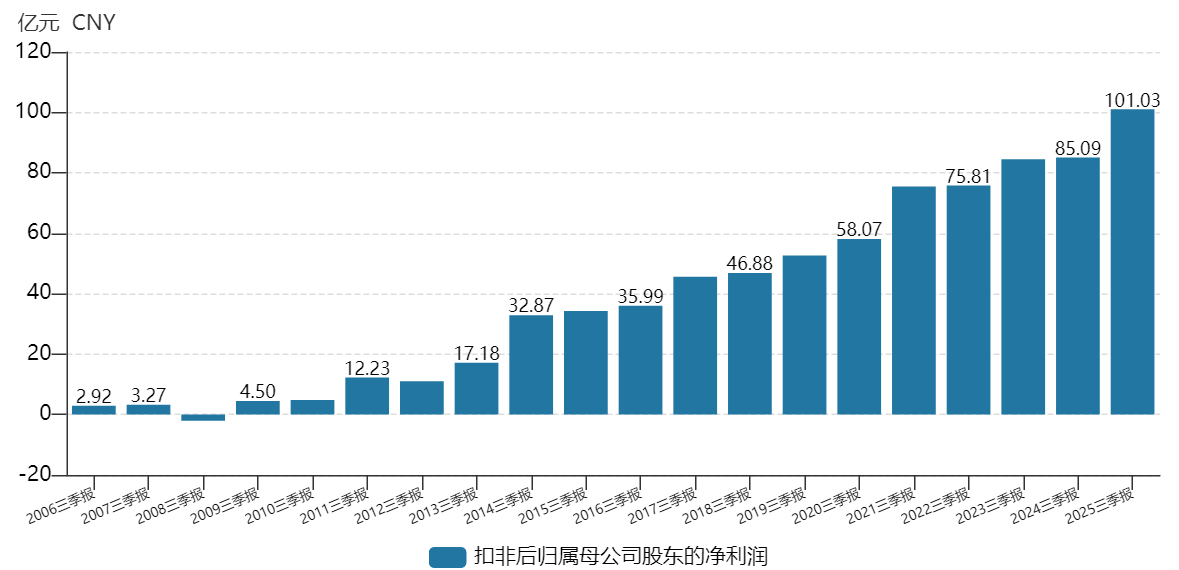
Core Insights - The core viewpoint of the article highlights the resilience of Yili Group in the dairy industry, showcasing revenue growth and a significant increase in non-recurring net profit despite a challenging market environment [1][2]. Financial Performance - In the first three quarters of 2025, Yili achieved total revenue of 90.564 billion yuan, a year-on-year increase of 1.71% [2] - The net profit attributable to shareholders was 10.426 billion yuan, a decline of 4.07% year-on-year, while the non-recurring net profit reached 10.103 billion yuan, marking an 18.73% increase [2] - This is the first time Yili's non-recurring net profit has surpassed 10 billion yuan in the first three quarters, indicating improved core profitability and high-quality development of its main business [2]. Profitability and Cost Management - The strong growth in non-recurring net profit is attributed to product structure optimization, an increase in the proportion of high-margin products, and refined cost control [4] - The gross margin improved by 0.52 percentage points to 35.32%, reflecting the company's pricing power and cost control advantages in high-end and functional products [4] - The sales expense ratio decreased by 0.98 percentage points to 18.28%, while the management expense ratio was 3.84% and the R&D expense ratio was 0.69%, indicating stable overall expense ratios [4]. Business Segments Performance - Yili's liquid milk segment remains the industry leader, generating revenue of 54.939 billion yuan in the first three quarters [5] - The milk powder segment achieved revenue of 24.261 billion yuan, a historical high with a year-on-year increase of 13.74%, maintaining the top market share in China [5] - The ice cream business also performed well, with revenue of 9.428 billion yuan, a 13% increase, continuing its leadership in the industry for thirty consecutive years [5]. Global Expansion - Yili is accelerating its global expansion, with brands like Jinlingguan and Cremo entering markets in Hong Kong and Saudi Arabia, and the JinDian brand launching in Singapore [6] - The overseas business showed strong performance, particularly in core categories like ice cream and infant goat milk powder, becoming a key driver for global business expansion [6]. Dividend Policy - Yili announced a mid-year dividend plan, marking the first time in its history to implement such a distribution, responding to regulatory encouragement for companies to reward investors [7] - The company plans to distribute a cash dividend of 0.48 yuan per share, totaling approximately 3.036 billion yuan, which accounts for 29.12% of its net profit for the first three quarters [7] - With a projected dividend yield exceeding 6%, Yili ranks among the top dividend-paying companies in the A-share market [7][8].