
数字消费

Search documents
中国消费向新而行·扩大优质服务供给丨新型消费,新形态带来新活力
Ren Min Ri Bao· 2026-01-26 03:07
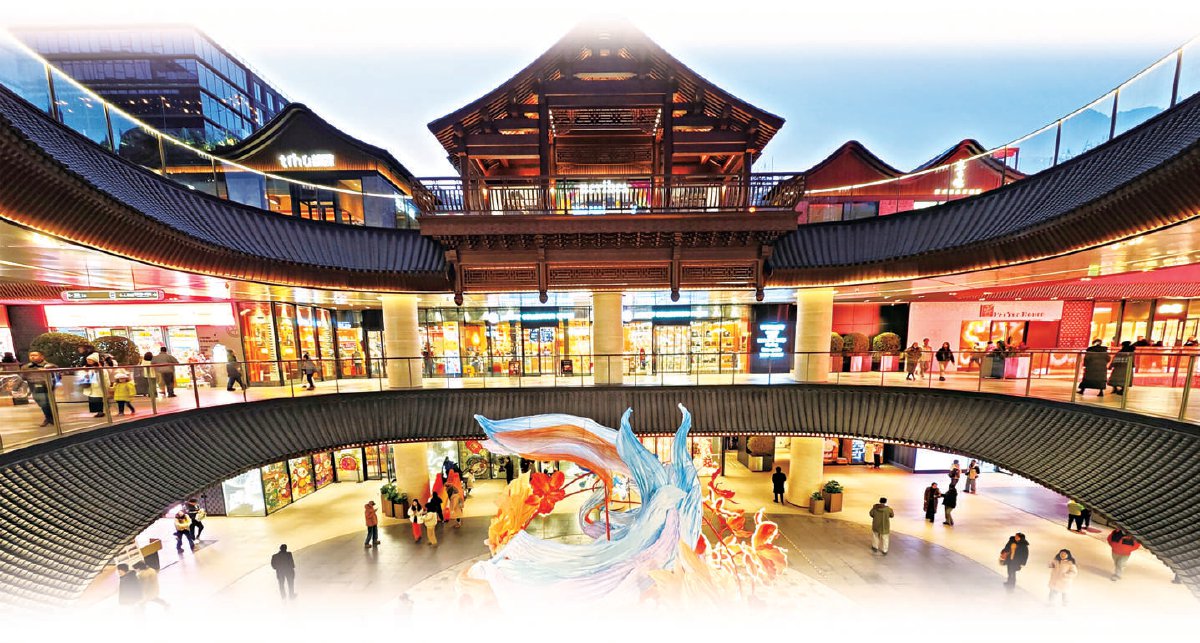
江西资溪,低碳旅游将生态优势转化为发展动能,让绿色消费成为旅游新风尚;山东潍坊,中医药 从诊室走向市集、餐桌,以新形态"圈粉"年轻人;四川成都,春熙路商圈以科技赋能,打造沉浸式数字 消费新场景……近年来,绿色消费、健康消费、数字消费等新型消费不断壮大,更好满足居民多元化、 个性化、品质化的消费需求,孕育新的经济增长点。 ——编者 江西资溪—— 低碳旅游,绿色消费成新风尚 人民日报记者 杨颜菲 江西抚州资溪县大觉山景区,山高林密,空气清新。悬崖动车缓缓离站,开阔的群山在游客眼前铺 展开来。"上午坐悬崖动车在山间看景,下午开着悬崖飞车下山,沉浸式欣赏美景绿意。"来自江西景德 镇的游客吴玟润说。 大觉山的"绿",不仅是游客眼中的美景,更是当地发展低碳旅游的缩影。 "悬崖动车线路总长13.14公里,运行在海拔800至1100米的悬崖峭壁上,是集旅游观光与交通功能 于一体的空中游览系统。"大觉山景区董事长李启明介绍,车辆采用低能耗电驱系统,最大日运载能力 达2.5万人次,有效减少燃油车穿行带来的污染与碳排放。 悬崖动车缓缓驶入总站,吴玟润和朋友一起下车,欣赏完山顶美景,短暂休息后,开始体验景区新 上线的项目——悬崖飞车 ...
新型消费,新形态带来新活力
Ren Min Ri Bao· 2026-01-26 03:05
江西资溪—— 江西资溪,低碳旅游将生态优势转化为发展动能,让绿色消费成为旅游新风尚;山东潍坊,中医药从诊 室走向市集、餐桌,以新形态"圈粉"年轻人;四川成都,春熙路商圈以科技赋能,打造沉浸式数字消费 新场景……近年来,绿色消费、健康消费、数字消费等新型消费不断壮大,更好满足居民多元化、个性 化、品质化的消费需求,孕育新的经济增长点。 ——编 者 低碳旅游,绿色消费成新风尚 江西抚州资溪县大觉山景区,山高林密,空气清新。悬崖动车缓缓离站,开阔的群山在游客眼前铺展开 来。"上午坐悬崖动车在山间看景,下午开着悬崖飞车下山,沉浸式欣赏美景绿意。"来自江西景德镇的 游客吴玟润说。 大觉山的"绿",不仅是游客眼中的美景,更是当地发展低碳旅游的缩影。 "悬崖动车线路总长13.14公里,运行在海拔800至1100米的悬崖峭壁上,是集旅游观光与交通功能于一 体的空中游览系统。"大觉山景区董事长李启明介绍,车辆采用低能耗电驱系统,最大日运载能力达2.5 万人次,有效减少燃油车穿行带来的污染与碳排放。 悬崖动车缓缓驶入总站,吴玟润和朋友一起下车,欣赏完山顶美景,短暂休息后,开始体验景区新上线 的项目——悬崖飞车。 "依托大觉山生态 ...
每日市场观察-20260126
Caida Securities· 2026-01-26 02:58
Market Overview - The Shanghai Composite Index rose by 0.33%, the Shenzhen Component Index increased by 0.79%, and the ChiNext Index gained 0.63% on January 23, 2026, with over 3,700 stocks rising in total [4][5] - The trading volume in the Shanghai and Shenzhen markets exceeded 3.1 trillion yuan, indicating a recovery in market confidence [4] Industry Focus - The commercial aerospace sector is entering a golden era driven by both demand and supply, with significant investment opportunities in satellite manufacturing and launching [1] - The "15th Five-Year Plan" emphasizes the goal of building a strong aerospace nation, marking a strategic focus for the upcoming years [1] Fund Dynamics - Public fund management scale increased by over 1.3 trillion yuan in Q4 2025, with money market funds, bond funds, commodity funds, and index funds being the main growth drivers [13] - Headline private equity firms are increasing their positions, with stock private equity positions exceeding 81% as of January 9, 2026, indicating a bullish outlook for structural opportunities in 2026 [14] Industry Developments - The "Jiuquan Commercial Aerospace Industry Development Plan (2026-2035)" has been officially released, aiming to establish a national commercial aerospace launch base [10] - China has successfully completed its first space metal 3D printing experiment, showcasing advancements in additive manufacturing technology in microgravity environments [11] - The launch of six major platforms in Beijing's commercial aerospace sector aims to accelerate the development of a comprehensive "thousand stars production and launch" capability [12]
中国批发和零售业增加值14.6万亿 连续13年稳居全球最大网络零售市场
Chang Jiang Shang Bao· 2026-01-26 00:22
Group 1: E-commerce Development - In 2025, China's e-commerce continues to develop steadily, maintaining its position as the world's largest online retail market for 13 consecutive years, contributing to consumption, industrial transformation, international cooperation, and social benefits [1][2] - The online retail of physical goods is projected to grow by 5.2% in 2025, contributing 36.2% to the total retail sales of consumer goods, with significant growth in digital products such as mobile phones and smart robots, which saw increases of 20.5% and 18% respectively [1] - The number of partner countries in the "Silk Road E-commerce" initiative has expanded to 36, with new collaborations established with Kenya, Bangladesh, and Egypt, and an upgraded cooperation mechanism with Kazakhstan [2] Group 2: Wholesale and Retail Industry - The value added of China's wholesale and retail industry reached 14.6 trillion yuan in 2025, growing by 5.0% year-on-year, accounting for 10.4% of GDP, marking a historical high [3] - The retail sales of consumer goods in China are expected to reach 44.3 trillion yuan in 2025, with a year-on-year growth of 3.8%, an increase of 0.6 percentage points compared to 2024 [3] - In the wholesale sector, the transaction volume of key commodity markets is projected to grow by 3.6% year-on-year, with profits increasing by 9.7%, particularly in the industrial consumer goods market, which is expected to grow by 9.1% [3]
2026浙江新春消费季启动
Mei Ri Shang Bao· 2026-01-25 22:32
Group 1 - The 2026 Zhejiang Spring Consumption Season has been officially launched in Hangzhou, focusing on enhancing consumer spending through various activities and subsidies [1] - The initiative aims to distribute over 300 million yuan in consumption subsidies and organize more than 1,700 promotional events across the province in the first quarter [1] - Hangzhou will issue over 1 billion yuan in consumer vouchers and promote various sports and cultural events to attract consumers [1] Group 2 - The event showcases innovative products from Hangzhou's Shangcheng District, emphasizing its status as a digital consumption hub [2] - The main venue features eight thematic sections, highlighting a blend of cultural heritage and modern consumer experiences with nearly 300 brands participating [2] - The activities will run until January 27, inviting citizens to engage in a rich cultural and shopping experience [2]
六大机构A股最新研判来了!春节前或维持这一格局
Zhong Guo Zheng Quan Bao· 2026-01-25 12:05
Market Overview - The A-share market is experiencing a high-level fluctuation, with increasing attention on corporate fundamentals as more companies disclose their 2025 performance forecasts [1] - Market analysts predict that from late January to before the Spring Festival, the overall market may maintain a strong oscillation pattern, with a continuation of differentiated trends [1] Investment Opportunities - Institutions suggest focusing on short-term rotation and rebound opportunities in the technology innovation sector, particularly in the "AI+" downstream applications and upstream materials and infrastructure [1][9] - The manufacturing and resource sectors show clear paths for profit recovery, with a focus on industries like non-ferrous metals and basic chemicals that have performance support under price increase logic [1][5] Regulatory Developments - The China Securities Regulatory Commission (CSRC) has released guidelines for public fund performance benchmarks, marking a significant step in promoting high-quality development in the public fund industry [2] IPO Developments - The CSRC has approved the IPO registration of Shenzhen Dapu Microelectronics Co., marking the first approval for an unprofitable company on the ChiNext board, which focuses on enterprise-level storage and serves key applications in AI and cloud computing [3] Consumer Market Initiatives - The Ministry of Commerce has proposed initiatives to enhance consumption, including a "trade-in" program for consumer goods, aiming to stimulate demand in sectors like automotive and home goods [4] Sector-Specific Insights - China Galaxy emphasizes the importance of performance indicators in guiding structural market trends, with a focus on high-growth sectors and profit recovery in specific segments [5] - Dongwu Securities highlights that companies with better-than-expected performance are likely to yield excess returns, particularly in sectors like computing, communication, lithium batteries, and energy storage [6] - Zhongtai Securities recommends a segmented and dynamic investment strategy, focusing on high-elasticity sectors such as robotics within the technology sector [7][8] Investment Strategies - Jiashi Fund suggests a cautious approach, focusing on two main investment opportunities: "AI+" applications and low-position domestic demand sectors benefiting from policies aimed at expanding domestic consumption [9] - Lobo Mai Fund maintains a positive outlook on copper demand, noting a strengthening growth logic amid supply contraction trends [10] - Caitong Fund asserts that the current AI sector is not in a bubble phase, with significant growth potential as more companies launch AI applications [11]
全市地区生产总值5.2万亿元
Xin Lang Cai Jing· 2026-01-25 06:55
回顾2025 首都功能持续优化提升 绿色电力占比达36%,优良天数比例首次突破80% 回顾2025 织密扎牢社会保障网 2025年,全市地区生产总值5.2万亿元、增长5.4%、高于全国0.4个百分点,一般公共预算收入增长4.8%,城镇调查失业率4.1%,居民人均可支配收入实际增 长4.4%,居民消费价格总体平稳,人均地区生产总值、全员劳动生产率和万元地区生产总值能耗、水耗、碳排放等多项指标保持全国省级地区最优水平。 首都功能持续优化提升。圆满完成中国人民抗日战争暨世界反法西斯战争胜利80周年纪念活动服务保障,建立高效协同指挥体系,精心组织多次综合演练和 专项演练,纪念活动高效顺畅,城市运行平稳有序,以零误差交上服务国家重大活动的北京答卷。持续打好"疏整促"组合拳,疏解提质一般制造业企业104 家,治理违法建设2049万平方米,核心区平房申请式退租2006户。深化京津冀重点领域协同发展,扎实推进通州区与北三县一体化高质量发展示范区建设, 白庙南北检查站完成改造。 科技创新加快引领新质生产力发展。强化原创性引领性科技攻关,210项关键核心技术获得突破,北京连续9年稳居自然指数—科研城市全球榜首,新增两院 院士占全 ...

市长殷勇作政府工作报告:2025年北京市入境游客增长近四成
Xin Lang Cai Jing· 2026-01-25 01:47
来源:北京日报客户端 1月25日上午,北京市第十六届人民代表大会第四次会议在北京会议中心开幕。市长殷勇作政府工作报 告。 在回顾2025年工作时,报告提出,北京着力优化新供给扩大新需求,因地制宜用好"两重""两新"政策, 积极争取超长期特别国债等各类资金,推进地方政府专项债"自审自发"试点;优化投融资体制机制,面 向民间资本推介重大项目总投资约2350亿元;深入推进国际消费中心城市建设,深化境外人员服务便利 化改革,入境游客增长39%,全市旅游人次和收入再创历史新高,数字消费、绿色消费、健康消费蓬勃 发展,服务消费增长5%。 ...
2025年北京市入境游客增长近四成
Xin Lang Cai Jing· 2026-01-25 01:47
格隆汇1月25日|据北京商报,今日上午,北京市第十六届人民代表大会第四次会议在北京会议中心开 幕。市长殷勇作政府工作报告。报告提出,北京着力优化新供给扩大新需求,因地制宜用好"两重""两 新"政策,积极争取超长期特别国债等各类资金,推进地方政府专项债"自审自发"试点;优化投融资体 制机制,面向民间资本推介重大项目总投资约2350亿元;深入推进国际消费中心城市建设,深化境外人 员服务便利化改革,入境游客增长39%,全市旅游人次和收入再创历史新高,数字消费、绿色消费、健 康消费蓬勃发展,服务消费增长5%。 ...
北京商品消费持续焕新 全国百强MCN机构数量位居首位
Bei Jing Shang Bao· 2026-01-24 09:56
Core Insights - The core viewpoint of the article highlights the continuous upgrade and renewal of consumer goods in Beijing, showcasing the city's efforts to enhance its economic potential through the introduction of new retail formats and digital consumption ecosystems [1] Group 1: Economic Development - Beijing has attracted over 4,600 new retail stores since 2021, indicating a strong growth in the first-store economy [1] - The city has established 22 first-store vitality centers and first-store aggregation centers to further promote retail innovation [1] Group 2: Digital Consumption - Beijing has recognized 35 city-level characteristic live e-commerce bases and 30 exemplary cases of live e-commerce, reflecting the city's commitment to enhancing its digital consumption ecosystem [1] - The city is home to 24 of the top 100 MCN (Multi-Channel Network) organizations in the country, leading in quantity nationwide [1] Group 3: Smart Retail Initiatives - The Sanlitun business district and the southern area of Taikoo Li have been selected as the first batch of national demonstration smart business districts and stores [1] - The Zhongguancun Dazhongcheng is developing a city-level commercial humanoid robot demonstration project named "Galaxy Space Capsule" [1] Group 4: Tax Refund Innovations - Beijing has nearly 1,600 stores offering tax refunds for outbound travelers, with 37 instant refund stores [1] - The city has pioneered a "city-wide tax refund, multi-point handling" model, establishing seven centralized refund points in areas like the China World Mall [1]