量子信息

Search documents
创新活力持续迸发
Ren Min Wang· 2025-12-29 22:24
Core Insights - China has made significant advancements in various fields of technology and innovation, achieving notable breakthroughs in artificial intelligence, quantum information, life sciences, and clean energy, contributing to high-quality development and improved living standards [8][11][15]. Group 1: Fundamental Research - The Jiangmen Underground Neutrino Observatory (JUNO) has commenced operations, achieving a measurement precision of key neutrino oscillation parameters that is 1.5 to 1.8 times better than previous international standards, aiding in understanding the origins of neutrino mass [9]. - A team from the Chinese Academy of Sciences has successfully created five types of two-dimensional metals with single-atom thickness, filling a 20-year gap in the field and paving the way for low-power electronic devices and new quantum phenomena [9]. - As of August 2025, China has produced 2,342 hot papers, accounting for 53.2% of the global total, and ranks first in international citations across nine disciplines, indicating a significant increase in the quality of foundational research [10]. Group 2: Cutting-edge Technologies - The "Zuchongzhi 3" superconducting quantum computing prototype has been released, featuring 105 readable qubits and 182 coupled qubits, outperforming the fastest supercomputers in quantum random circuit sampling [11]. - The AI model DeepSeek-R1 has been launched, achieving performance comparable to top global models with fewer computational resources, marking a shift in AI development strategies [11]. - The humanoid robot industry is rapidly developing, with significant achievements in mass production and performance, showcasing China's capabilities in this field [12]. Group 3: Energy and Communication - The EAST nuclear fusion experiment has achieved a world record of 1 million degrees Celsius for 1,066 seconds, validating the feasibility of steady-state operation for fusion reactors [13]. - A team from Peking University has developed a compact optical-electronic integrated adaptive high-speed communication chip, capable of handling full-band resources with data transmission rates exceeding 120 Gbps, laying the groundwork for 6G technology [14]. Group 4: Technological Breakthroughs for Quality of Life - Research on locust pheromones has led to the development of specific small-molecule inhibitors, transitioning pest control from chemical reliance to a greener, more precise approach [15]. - The South-to-North Water Diversion Project has delivered over 80 billion cubic meters of water, benefiting 185 million people and addressing groundwater over-extraction issues in North China [16]. - China's high-speed rail technology has set new records, achieving a single-column speed of 453 km/h, enhancing travel convenience and comfort for the public [16]. Group 5: Open Cooperation and Global Contribution - China has led the global renewable energy sector, with solar and wind energy surpassing fossil fuels in new electricity generation, contributing significantly to climate change mitigation efforts [17]. - The DeepSeek model has been made available globally in an open-source format, gaining widespread adoption and recognition [17]. - China's advancements in high-speed rail and water management technologies are being shared internationally, providing solutions for global transportation and resource allocation challenges [17].

新兴产业“未来已来”,中国科技创新如何“惊艳”世界
2 1 Shi Ji Jing Ji Bao Dao· 2025-12-27 02:16
Core Viewpoint - The article emphasizes the rapid growth and transformation of China's economy driven by innovation, particularly through strategic emerging industries and future industries, which are reshaping the industrial landscape and enhancing global competitiveness [6][11]. Group 1: Economic Transformation - The "14th Five-Year Plan" prioritizes the construction of a modern industrial system and the strengthening of the real economy, focusing on nurturing emerging and future industries as a strategic task [5]. - Continuous increases in R&D investment and the rising contribution of strategic emerging industries to GDP highlight a clear shift towards an innovation-driven economy [8][9]. Group 2: Industry Growth - Strategic emerging industries are becoming the main force in China's economic transformation, with significant growth in sectors such as low-altitude economy, commercial aerospace, and renewable energy [11][12]. - The market size of the low-altitude economy has doubled over four years, while the commercial aerospace sector has seen a substantial increase in launch frequency and satellite numbers [12][13]. Group 3: R&D Investment - R&D expenditure has steadily increased for four consecutive years, with the intensity of R&D investment rising significantly [9]. - The value added by strategic emerging industries is projected to continue expanding, with a notable increase in their share of GDP [9][10]. Group 4: Future Industries - Future industries, including quantum technology and brain-computer interfaces, are experiencing rapid advancements and commercialization, positioning China as a leader in global technology competition [15][17]. - The artificial intelligence sector is expected to exceed 700 billion yuan in 2024, maintaining a growth rate of over 20% annually, with China leading in AI patent applications [17][18].

湖南省自然科学基金立项数创新高 青年人才担纲基础研究主力
Xin Lang Cai Jing· 2025-12-26 15:55
Core Insights - Hunan Province is significantly increasing its investment in basic research, with the total number of projects and funding for the 2026 Natural Science Fund reaching a historical high of 4,556 projects [1] - The ability of young scientific talents in Hunan to undertake major national tasks has notably improved, with a record of 10 approved A-class projects and 20 B-class projects in 2025, marking a continuous growth over three years [1] - The funding system has been optimized to support various disciplines, with a focus on cutting-edge fields such as artificial intelligence, biomedicine, and quantum information [1] Funding and Support Mechanisms - Since the 14th Five-Year Plan, the average funding rate for youth talent projects has remained above 60%, with innovative measures to create a comprehensive training pathway for young scholars [2] - The annual number of provincial youth A and B class projects has been stabilized at 100, with age limits for applications being adjusted to broaden support [2] - A "Youth Student Basic Research Project" was piloted in 2024, expanding its coverage to 14 full-time undergraduate institutions by 2025, establishing an early research training system from undergraduate to doctoral levels [2] Collaborative Funding Initiatives - Hunan has established 53 joint funds to broaden the funding pool and nurture talent, successfully leveraging over 200 million yuan in social funds alongside a provincial financial input of over 50 million yuan for the 2026 projects [3] - The government aims to enhance the basic research funding system, focusing on the collaborative configuration of projects, platforms, and talent to stimulate innovation and achieve original research outcomes [3]
中美贸易降温!美联储降息,国内经济在转型,普通人抓这2条线
Sou Hu Cai Jing· 2025-12-25 16:21
Global Economic Environment - The relationship between the US and China has improved, reducing trade tensions and the risk of tariff increases, which enhances market stability for businesses [3] - The Federal Reserve has cut interest rates by 100 basis points in 2025, with expectations of further cuts in 2026, potentially lowering rates to around 3%, making borrowing cheaper and increasing liquidity in the market [3] Domestic Economic Policies - The Chinese government is focusing on consumption as the core engine for economic growth, with policies to promote trade-in programs for appliances and vehicles, encouraging consumer spending [5] - The shift in China's economic development model emphasizes consumption and technology, with increased investment in R&D and a growing competitive edge in AI applications [7] Support for Emerging Industries - The government is implementing policies to support emerging industries while addressing issues in traditional sectors, promoting initiatives like "Artificial Intelligence +" and enhancing regulations for the digital economy [9] - 2026 marks the beginning of the "14th Five-Year Plan," with significant policy support expected for cutting-edge fields such as AI, quantum information, and deep space exploration [9] Capital Market Outlook - The domestic capital market is expected to continue its recovery, supported by government policies and ample liquidity, with significant investments from central financial institutions and long-term funds [11] - Actions such as stock buybacks by state-owned enterprises and increased allocations to equities by social security and insurance funds are stabilizing market expectations [11]

科创中心扩围意义深远
Jing Ji Ri Bao· 2025-12-20 22:09
Core Viewpoint - The 2025 Central Economic Work Conference has proposed the establishment of international technology innovation centers in Beijing (Jing-Jin-Ji), Shanghai (Yangtze River Delta), and the Guangdong-Hong Kong-Macao Greater Bay Area, marking the first expansion of the scope of Beijing and Shanghai's innovation centers to include these regions [1] Group 1: Necessity of Expansion - The expansion of innovation centers is a necessary choice to address development bottlenecks and align with innovation trends, as global technological competition intensifies and resource demands grow [2] - The three regions have established a solid foundation for innovation, with Shenzhen-Hong Kong-Guangzhou, Beijing, and Shanghai-Suzhou ranking 1st, 4th, and 6th respectively in the 2025 Global Innovation Index [2] - The "siphon effect" of core cities needs to be transformed into regional "radiation dynamics," requiring collaboration between cities to create a complete innovation chain from basic research to industrial application [2] Group 2: Key Components for Effective Expansion - Strategic Technology Community: Establish a cross-regional coordination mechanism for national laboratories and major technological infrastructure to avoid resource dispersion [3] - Industrial Innovation Community: Foster world-class advanced manufacturing clusters and create cross-regional innovation unions to integrate resources from universities and research institutions [3] - Talent Development Community: Implement cross-regional talent exchange and qualification recognition mechanisms to facilitate the free movement of high-level talent [3] - Reform Community: Strengthen institutional guarantees and deepen reforms in the use of research funds and distribution of technology transfer benefits [3] Group 3: Future Outlook - The expansion is seen as a new starting point, transitioning from "single-point breakthroughs" in core cities to "collaborative efforts" among city clusters, which is a significant evolution in China's innovation development philosophy [4] - This strategic deployment is expected to activate greater innovation potential, positioning the three international technology innovation centers as sources of original innovation and leaders in high-end industries [4] - As initiatives are implemented, these centers are anticipated to become key engines driving Chinese-style modernization and enhancing China's presence in the global innovation landscape [4]
紧扣关键领域推动湾区标准建设
Jing Ji Ri Bao· 2025-12-20 22:09
Core Viewpoint - The article emphasizes the importance of establishing a robust standard system in the Guangdong-Hong Kong-Macao Greater Bay Area to support high-quality development and enhance global competitiveness through regional collaboration and international standardization efforts [1][4]. Group 1: Standard System Development - The Greater Bay Area has jointly announced 262 "Bay Area Standards" covering 36 fields, including transportation, water conservancy, traditional Chinese medicine, green ecology, and elderly care, creating a positive ecosystem driven by government guidance, market leadership, and collaboration among the three regions [1]. - A focus on emerging industries and future sectors is essential to build a forward-looking standard system that guides industrial upgrades and provides regulatory support, particularly in artificial intelligence and digital economy sectors [2][3]. Group 2: Internationalization and Regional Collaboration - The article discusses the need for a dual empowerment mechanism of "standard internationalization + regional collaboration" to enhance global rule-making power, advocating for the integration of Bay Area standards with international standards [4][5]. - Strengthening regional collaboration and establishing a multi-level international cooperation network is crucial, including standard mutual recognition mechanisms with countries along the Belt and Road Initiative [5]. Group 3: Implementation and Governance - A "technology empowerment + governance innovation" framework is proposed to ensure effective implementation of standards, utilizing advanced technologies like big data and artificial intelligence for real-time monitoring and evaluation [6][7]. - The establishment of incentive mechanisms for enterprises adopting Bay Area standards is recommended, including tax benefits and funding support, to encourage compliance and participation in standard formulation [7].
国盾量子董事长吕品逝世 公司董事会推举应勇代行董事长职责
Zheng Quan Shi Bao Wang· 2025-12-19 13:08
Core Viewpoint - The sudden passing of the chairman of GuoDun Quantum, Lv Pin, has led to the appointment of Ying Yong as the interim chairman and legal representative until a new chairman is elected [1][2]. Group 1: Company Leadership Changes - Lv Pin, born in 1979, joined the board of GuoDun Quantum on May 30, 2025, and was elected as chairman [1][2]. - Ying Yong has been appointed as the interim chairman and has been with GuoDun Quantum since May 2017, currently serving as the president [1][2]. Group 2: Background of Lv Pin - Prior to his role at GuoDun Quantum, Lv Pin held various positions at China Telecom Group, including deputy general manager of the marketing department [2]. - In January 2025, China Telecom Quantum Group became the controlling shareholder of GuoDun Quantum, with the actual controller changing to the State-owned Assets Supervision and Administration Commission [2]. Group 3: Recent Company Transactions - GuoDun Quantum plans to sign a procurement service contract with its affiliate Ququan (Wuhan) Technology Co., Ltd. for the development of "GuoDun Quantum EDA software," with an estimated amount of 8.7 million yuan [3]. - The wholly-owned subsidiary Shanghai GuoDun Quantum Information Technology Co., Ltd. intends to sign a sales contract with a subsidiary of the Chinese Academy of Sciences to sell a dilution refrigerator, with an estimated amount of 4.28 million yuan [3].

突发,一上市公司董事长意外去世!警方深夜通报
Sou Hu Cai Jing· 2025-12-19 10:05
Group 1 - The incident involved the death of a company executive, Lv Ping, who was found unresponsive in an office on December 18, 2025, and the police have ruled out foul play [1] - Lv Ping held several key positions within China Telecom and was the current chairman of China Telecom Quantum Information Technology Group Co., Ltd. [4] - The company specializes in quantum communication, quantum computing, and quantum precision measurement products, and is recognized as a pioneer in the commercialization of quantum information in China [4] Group 2 - As of December 18, 2025, the stock price of GuoDun Quantum was reported at 494 yuan per share, reflecting an increase of over 65% for the year, with a total market capitalization of 50.813 billion yuan [4] - The company is a wholly-owned subsidiary of China Telecom Group and was listed on the Sci-Tech Innovation Board in 2020 [4] - GuoDun Quantum is recognized as a national-level specialized and innovative "little giant" enterprise and a national intellectual property advantage enterprise [4]

国盾量子董事长吕品去世,警方通报:已排除案件
Guan Cha Zhe Wang· 2025-12-18 15:04
截至本公告披露日,吕品先生不持有公司股票,亦不存在应当履行而未履行的股份锁定承诺。 吕品先生的逝世不会导致公司董事会成员人数低于法定人数,不会影响公司董事会的正常运作。公司经营管理团队正常履职,公司将根据有关法律法规和 《公司章程》的规定,尽快完成董事补选及董事长选举的相关工作,并及时履行信息披露义务。 18日,国盾量子发布公告称,公司董事长吕品先生不幸逝世。 吕品先生于2025年5月起担任公司董事长,并担任战略与投资委员会主任委员、薪酬与考核委员会委员。公司及公司董事会对吕品先生的逝世表示沉痛哀悼 并向其家属表达深切慰问。 18日早些时候,合肥市公安局高新技术开发区分局发布警情通报: 2025年12月18日13时许,我局接报警称,吕某(男,46岁)在望江西路与孔雀台路交叉口某公司一办公室内失去意识。接警后,民警立即到场处置。经120 现场确认,吕某已无生命体征。经公安机关勘查调查,已排除案件。 警方提示:请广大网民不造谣、不传谣、不信谣,共同营造清朗网络空间。 新黄河大鱼财经从数个权威信源处获悉,上述通报中提到的吕某即为国盾量子董事长吕品。该媒体多次联系国盾量子公司董秘,截至发稿无回应。 Wind显示,吕品 ...
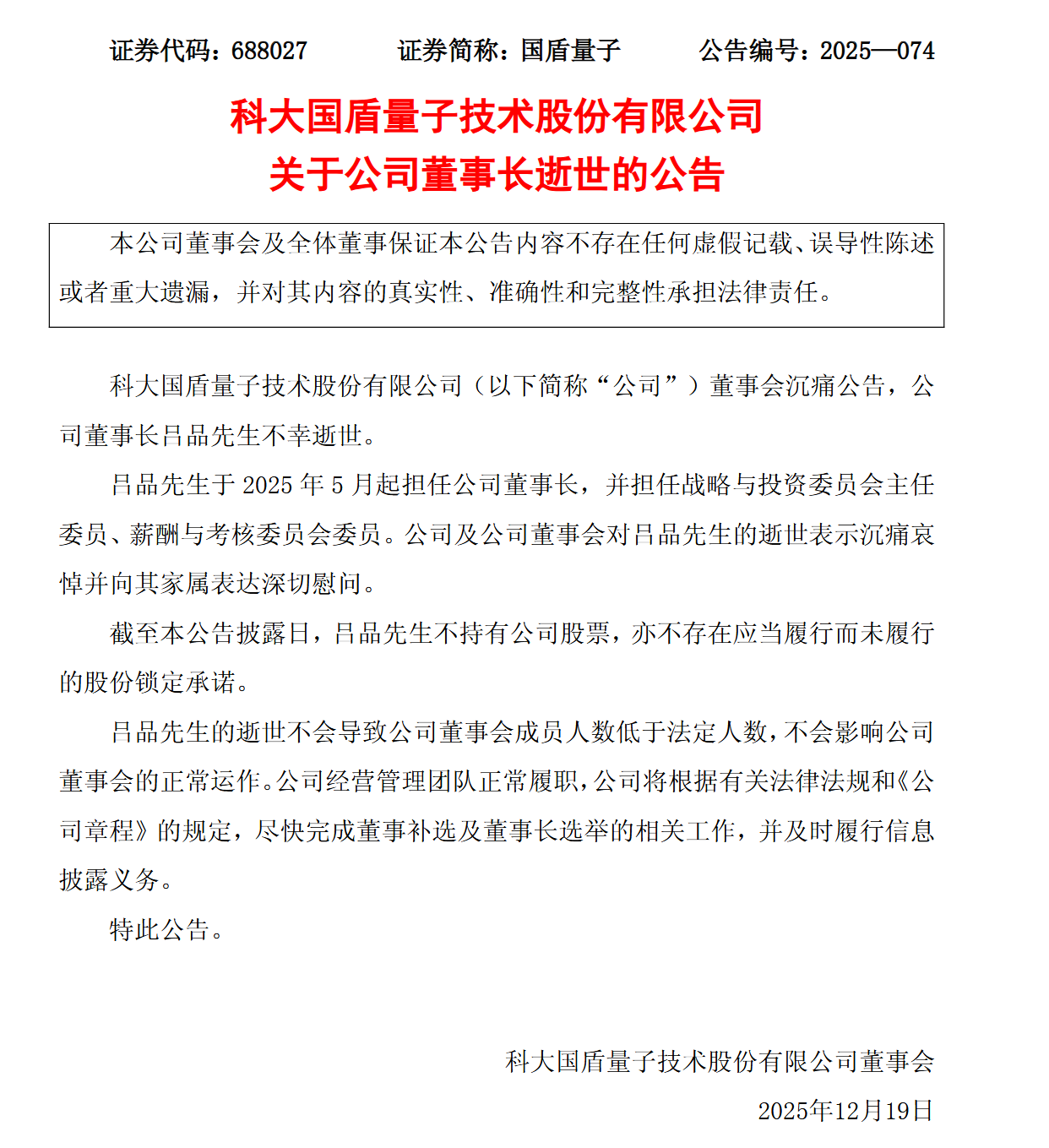
清华五道口陆毅:构建内需主导经济发展模式,是“十五五”时期的战略抉择
Sou Hu Cai Jing· 2025-12-18 10:01
Core Viewpoint - The conference highlighted the transition of China's economy from high-speed growth to high-quality development, emphasizing the need for a new development model that focuses on domestic circulation and consumption-driven growth [3]. Group 1: Economic Transition - China's economy has shifted from a phase of high-speed growth to one of high-quality development, undergoing a profound transformation in its development model [3]. - The period before 2002 was characterized as an exploratory phase, establishing the foundation for a market economy [3]. - From 2002 to 2010, the economy was driven by external demand and investment, leading to rapid urbanization and infrastructure development, but also creating supply-demand mismatches [3]. - Since 2010, the focus has shifted to consumption-led growth, with decreasing reliance on external demand and increasing importance of domestic circulation [3]. Group 2: Challenges and Opportunities - During the "14th Five-Year Plan" period, China is still in a significant strategic opportunity phase, but faces new challenges such as external uncertainties and domestic imbalances [3]. - The "14th Five-Year Plan" emphasizes the need for coordinated development and security, promoting a new development pattern that prioritizes domestic circulation while facilitating international circulation [3]. Group 3: Demand-Side Strategies - To address insufficient domestic demand, the strategy should focus on expanding internal demand and creating a favorable policy environment for consumption [4]. - Key measures include increasing labor compensation in initial distribution, expanding the middle-income group, and enhancing public investment in education, healthcare, and childcare [4]. - The plan also calls for increasing the share of quality consumer goods and services while removing unreasonable consumption restrictions [4]. Group 4: Supply-Side Strategies - The "14th Five-Year Plan" prioritizes the establishment of a modern industrial system, emphasizing an entity economy approach and the modernization of industrial chains [4]. - In the field of technological innovation, it is crucial to strengthen national strategic technological capabilities and focus on key core technology breakthroughs in areas like artificial intelligence and quantum information [4]. - The plan advocates for deep integration of industry, academia, and research to foster strategic emerging industries and accelerate the rise of new productive forces [4]. Group 5: Strategic Choices - The construction of an economy driven by domestic demand and consumption is a strategic choice for the "14th Five-Year Plan" period [4]. - This requires deepening fiscal and tax reforms, optimizing tax structures, and balancing direct and indirect tax ratios [4]. - Investment should be coordinated between physical capital and human capital, enhancing infrastructure while increasing investments in education, health, and skills training to address social welfare gaps [4].