高股息资产

Search documents
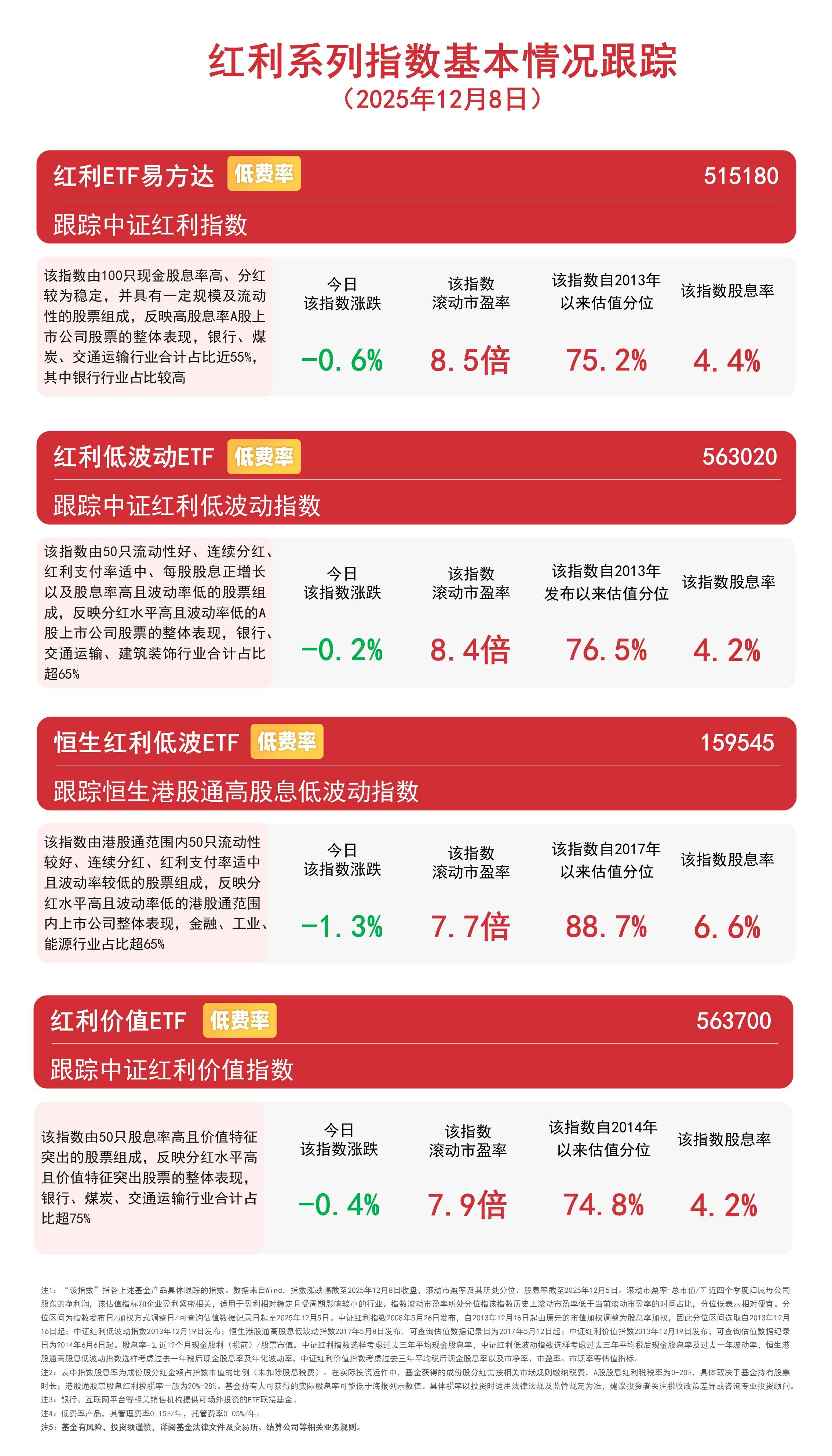
红利板块震荡回调,关注恒生红利低波ETF(159545)、红利ETF易方达(515180)等布局机会
Sou Hu Cai Jing· 2025-12-08 11:05
Group 1 - The market experienced fluctuations today, with energy stocks such as coal and petrochemicals undergoing corrections, while the banking sector showed mixed performance [1] - The CSI Dividend Low Volatility Index decreased by 0.2%, the CSI Dividend Value Index fell by 0.4%, and the CSI Dividend Index dropped by 0.6% [1] - The Hang Seng High Dividend Low Volatility Index declined by 1.3%, despite capital inflows, with the Hang Seng Dividend Low Volatility ETF (159545) seeing a net subscription of nearly 100 million units throughout the day [1] Group 2 - E Fund is currently the only fund company that implements low fee rates for all dividend ETFs, with management fees set at 0.15% per year for its products, including the Hang Seng Dividend Low Volatility ETF (159545) and others [1] - The CSI Dividend Low Volatility Index consists of 50 stocks with good liquidity, continuous dividends, moderate dividend payout ratios, positive growth in earnings per share, and low volatility, reflecting the overall performance of A-share listed companies with high dividend levels and low volatility [4] - The Hang Seng Dividend Low Volatility Index is composed of 50 stocks within the Hong Kong stock range that have good liquidity, continuous dividends, moderate dividend payout ratios, and low volatility, representing the overall performance of listed companies in the Hong Kong stock market with high dividend levels and low volatility [8]

港股速报|大市低迷新股疯狂 卓越睿新上市首日猛涨
Mei Ri Jing Ji Xin Wen· 2025-12-08 08:57
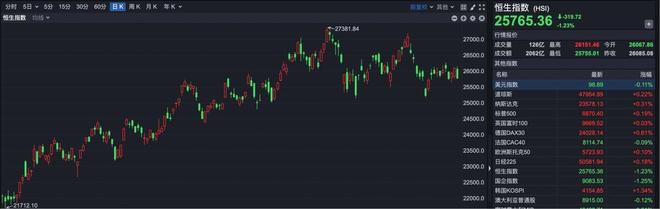
Market Overview - The Hong Kong stock market experienced a weak adjustment, with the Hang Seng Index closing at 25,765.36 points, down 319.72 points, a decline of 1.23% [1] - The Hang Seng Technology Index closed at 5,662.55 points, with a slight increase of 0.09 points [2] New Stock Performance - Two new stocks were listed today, showing significant performance differences.卓越睿新 (HK02687) initially had a moderate performance with a rise of less than 30%, but surged after 3 PM, ultimately closing with a gain of over 87% [4] - In contrast, 纳芯微 (HK02676) opened flat but remained in a state of decline throughout the day, closing with a drop of 4.31% [7] Company Insights - 卓越睿新 is a well-known Chinese higher education institution providing digital solutions for teaching, focusing on digital educational content and environments. It ranks second in the Chinese higher education digital market with a market share of 4.0% and first in the digital content production market with a share of 7.3% according to Frost & Sullivan [6] Stock Movements - Among the constituents of the Hang Seng Index, Baidu Group rose over 3%, Hua Hong Semiconductor increased over 4%, and SMIC gained over 2%. Conversely, Pop Mart fell over 8%, while Lao Pu Gold and Xinda Biopharmaceutical dropped over 6%. Banking stocks collectively declined, with China Construction Bank down over 4% and both China Merchants Bank and Industrial and Commercial Bank down over 3%. Chinese brokerage stocks saw gains, with Huatai Securities up over 4% [9] Market Outlook - Multiple institutions believe that the Hong Kong stock market is currently at a low valuation or in a positioning phase, with a positive outlook for 2026. Technology innovation, particularly in AI, and high-dividend assets are identified as two promising investment themes [11] - There are differing opinions among institutions; Huatai Securities suggests an early "spring rally" for the Hong Kong market, while Hua'an Fund indicates a preference for defensive dividend sectors as the year ends. Factors driving the market include corporate earnings, liquidity, and foreign investment [12]
港股速报 | 大市低迷新股疯狂 卓越睿新上市首日猛涨
Mei Ri Jing Ji Xin Wen· 2025-12-08 08:45
Market Overview - The Hong Kong stock market experienced a weak adjustment, with the Hang Seng Index closing at 25,765.36 points, down 319.72 points, a decline of 1.23% [2] - The Hang Seng Tech Index closed at 5,662.55 points, with a slight increase of 0.09 points [4] Company Performance - Excellence Education (HK02687) showed moderate performance in the morning, with gains kept within 30%, but surged after 3 PM, reaching a maximum increase of over 111%, ultimately closing up over 87% [5] - In contrast, the newly listed stock Naxin Micro (HK02676) opened flat but remained in a state of decline throughout the day, closing down 4.31% [7][8] Sector Insights - According to Frost & Sullivan, the top five companies in the Chinese higher education digitalization market hold a total market share of 12.9% as of 2024. Excellence Education ranks second in revenue with a market share of 4.0% in the overall digitalization market and first with a 7.3% market share in digital content production [7] - In the broader market, Baidu Group rose over 3%, Huahong Semiconductor increased over 4%, and SMIC gained over 2%. Conversely, Pop Mart fell over 8%, while Lao Pu Gold and Innovent Biologics dropped over 6%. Bank stocks collectively declined, with China Construction Bank down over 4% [10] Investment Outlook - Multiple institutions believe that the Hong Kong stock market is currently at a low valuation or in a positioning phase, with a positive outlook for 2026. Technology innovation, particularly in AI, and high-dividend assets are seen as promising investment themes [12] - There are differing opinions among institutions regarding market trends, with Huatai Securities suggesting an early "spring rally" for Hong Kong stocks, while Huaan Fund indicates a potential shift towards defensive dividend sectors as the year ends [13]

量化掘基系列之四十:重估央企红利:高股息、强防御与政策共振下的新主线
SINOLINK SECURITIES· 2025-12-05 13:25
- The "CSI Central State-owned Enterprises Dividend 50 Index" (931231.CSI) is constructed based on a dual-dimension screening method combining "central enterprise attributes" and "high dividend yield factors" [38][39][43] - The index selects 50 listed companies with high cash dividend yields from central enterprises under the State-owned Assets Supervision and Administration Commission (SASAC) and includes companies with stable cash flows, continuous dividends, and clear dividend payout ratios [38][39][43] - The index's sample space includes A-shares and depositary receipts issued by red-chip enterprises, meeting criteria such as being controlled by SASAC, ranking in the top 80% in terms of average daily market value and trading volume over the past year, and maintaining a dividend payout ratio between 0 and 1 over the past three years [38][39][43] - The index is rebalanced annually, with adjustments implemented on the trading day following the second Friday of December each year [38][39][43] Index Backtesting Results - The CSI Central State-owned Enterprises Dividend 50 Index achieved a cumulative return of 7.65% and an annualized return of 5.70% from January 1, 2025, to December 1, 2025 [45][49][51] - The index's annualized volatility was 11.86%, with a Sharpe ratio of 0.31 and a maximum drawdown of 10.82% during the same period [45][49][51] - The weighted dividend yield of the index was 4.46%, ranking among the top in similar indices [49][51][60] Factor Exposure Analysis - Based on the Barra model, the index exhibits significant positive exposure to value factors such as high earnings yield and high book-to-price ratio, while showing negative exposure to risk factors like low beta and low residual volatility [68][70][72] - The index avoids momentum and growth factors, indicating a focus on stable, low-volatility assets rather than chasing market trends [68][70][72]



年末再现性价比!可月月分红的港股红利低波ETF(520550)连续11日吸金,份额突破10亿新高!
Ge Long Hui· 2025-12-05 03:47
【突出的股息率优势,是吸引资金的核心逻辑】 该基金的核心配置价值,与其标的指数 恒生港股通高股息低波动指数的"高股息"特性 紧密相关。目 前,该指数近12个月股息率已攀升至5.88%,与同期1.85%的10年期国债收益率形成显著利差,其吸引 力也超越了部分主流红利类指数。突出的股息率优势,使港股红利类资产在当前波动加剧的市场中,彰 显出十足的配置韧性。 【低费率+月月评估分红,提升长期持有体验】 据了解,港股红利低波ETF(520550)以全市场最低费率(综合费率0.2%)降低持有成本,其月度分红机 制和T+0交易特性进一步提升了资金效率;持仓结构上,金融、能源等成熟行业构筑安全垫,同时通过 单一个股5%的权重上限实现风险分散,剔除阶段跌幅过大的股票规避"股息率陷阱"。场外投资者可借 助联接基金(A类:024029/C类:024030)进行布局。 随着年末市场波动加剧,资金正加速流向具备防御属性的资产。截至12月4日,港股红利低波 ETF(520550)已获资金连续11日净流入,累计金额约9900万元。在资金的持续推动下,该基金份额规模 大幅增长,年内份额扩容达420.57%,最新份额突破10亿份,创下历史新 ...
红利国企ETF(510720)近10日净流入超3.4亿元,市场关注高股息资产防御价值
Mei Ri Jing Ji Xin Wen· 2025-12-04 06:36
Group 1 - The coal industry fundamentals are driven by winter storage replenishment and a decline in raw coal supply, with coal companies generally exhibiting strong cash flow [1] - Leading coal enterprises maintain high dividend yields, making them resilient dividend allocation choices [1] - The banking sector's net interest margin is stabilizing, with declining liability costs helping to alleviate pressure on asset-side yields, attracting allocation funds into high-dividend stocks [1] Group 2 - The Red Chip ETF (510720) tracks the Red Chip Dividend Index (000151), which selects stocks with high dividend characteristics and stable dividend performance, primarily covering traditional sectors such as finance, energy, and industry [1] - The index reflects the characteristics of value investment strategies, focusing on stable returns and long-term dividends [1] - There is an increasing market focus on high-dividend, low-volatility assets, with dividend assets demonstrating good stability, and a positive outlook for dividend market resilience towards year-end [1]
红利板块震荡调整,恒生红利低波ETF(159545)逆势获超1.5亿份净申购
Sou Hu Cai Jing· 2025-12-03 09:15
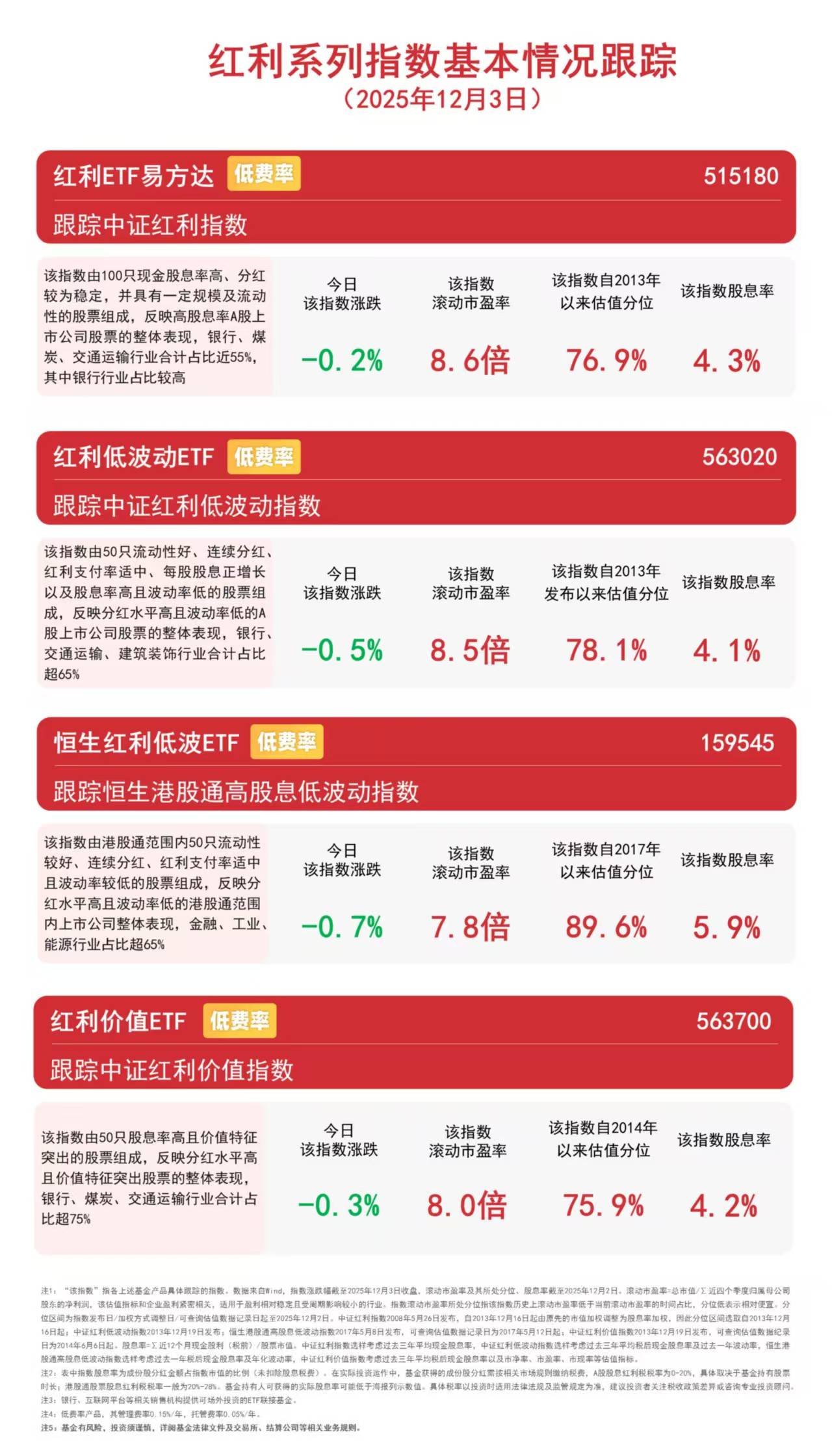
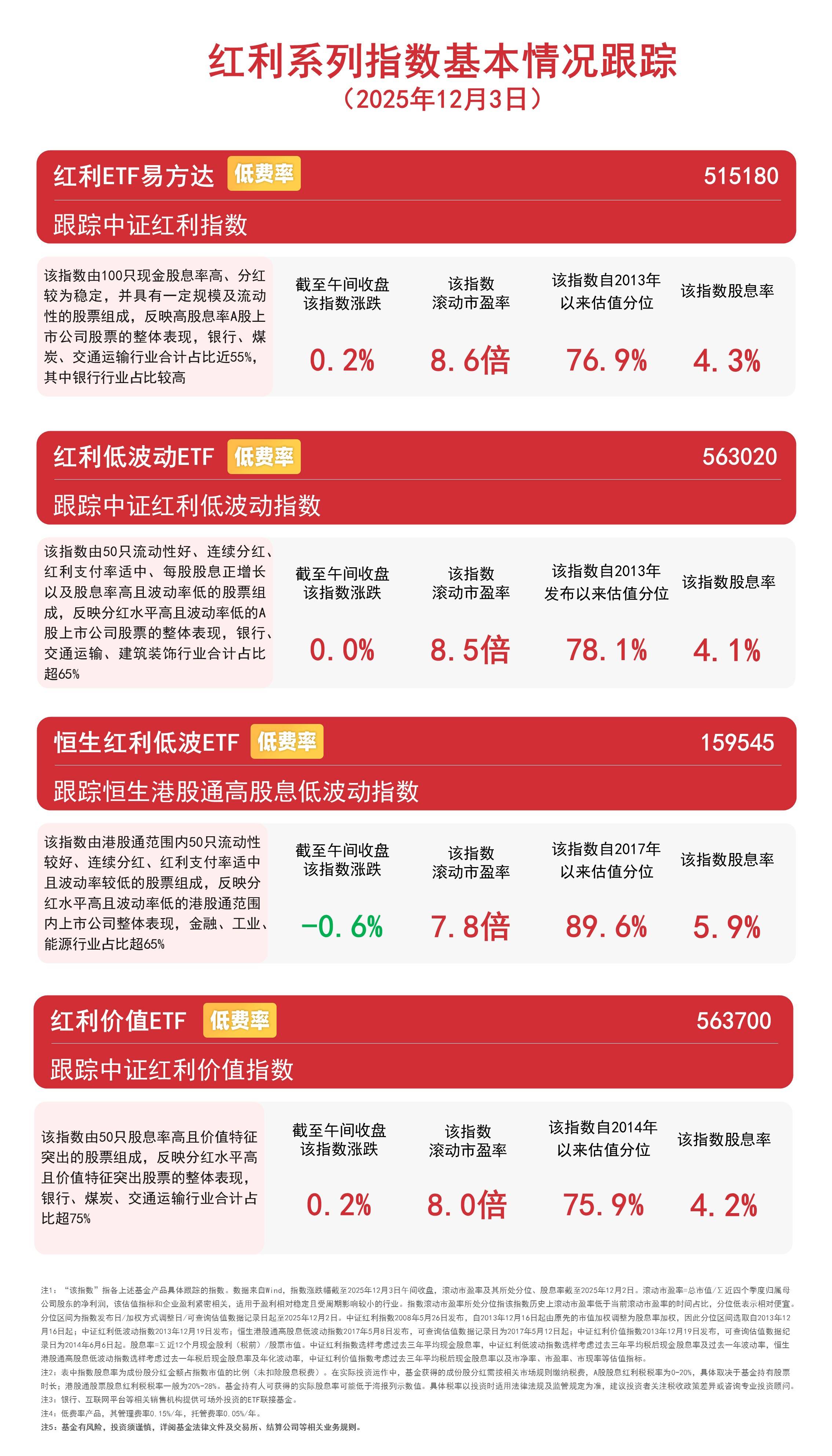
今日,A股午后集体回落,早盘强势的银行板块翻绿,带动红利板块下行;港股红利板块则全天低位震荡。指数层面,中证红利指数下跌0.2%,中证红利价 值指数下跌0.3%,中证红利低波动指数均下跌0.5%,恒生港股通高股息低波动指数下跌0.7%。资金逆势布局,恒生红利低波ETF(159545)全天净申购超 1.5亿份。 | 直特征 | 今日 | 该指数 | 该指数目2014年 | | --- | --- | --- | --- | | 水平高 | 该指数涨跌 | 滚动市盈率 | 以来估值分位 | | 表现, | | | | | 合计占 | -0. 3% | 8.0倍 | 75.9% | 据悉,易方达基金是目前唯一一家红利类ETF全部实行低费率的基金公司,旗下恒生红利低波ETF(159545)、红利ETF易方达(515180)、红利低波动 ETF(563020)、红利价值ETF(563700)、A500红利低波ETF(563510)等产品的管理费率均为0.15%/年,可助力投资者低成本布局高股息资产。 | 红利ETF易方达 低费率 | | | | | | --- | --- | --- | --- | --- | | 跟 ...
红利板块震荡分化,资金持续加仓,恒生红利低波ETF(159545)半日净申购超1亿份
Sou Hu Cai Jing· 2025-12-03 05:15
Group 1 - The core viewpoint of the news highlights the performance of dividend-related indices, with the CSI Dividend Value Index and CSI Dividend Index both rising by 0.2%, while the Hang Seng High Dividend Low Volatility Index decreased by 0.6% [1][6] - E Fund is noted as the only fund company offering low fee rates for all dividend ETFs, with management fees set at 0.15% per year for various products, facilitating low-cost investment in high-dividend assets [1][5] - The CSI Dividend Index comprises 50 stocks characterized by good liquidity, continuous dividends, moderate payout ratios, positive growth in dividends per share, and low volatility, with banking, transportation, and construction industries accounting for over 65% of the index [4] Group 2 - The Hang Seng High Dividend Low Volatility Index consists of 50 stocks within the Hong Kong stock market that exhibit good liquidity, continuous dividends, moderate payout ratios, and low volatility, with financial, industrial, and energy sectors making up over 65% of the index [6] - The Hang Seng Low Dividend ETF (159545) has seen a net subscription exceeding 100 million units in the first half of the day [1]
10倍牛股 历史新高!从跌停到涨超8%
Zhong Guo Zheng Quan Bao· 2025-12-03 04:54
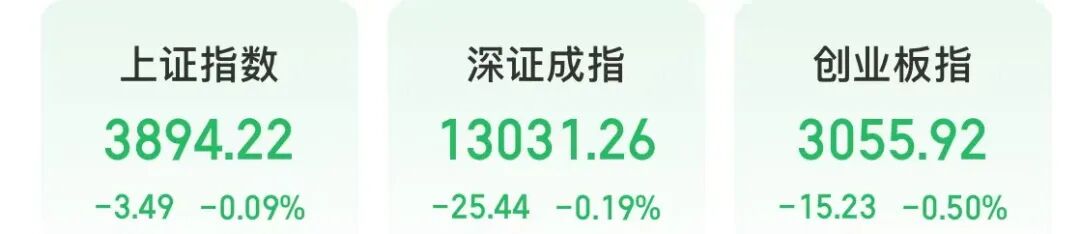
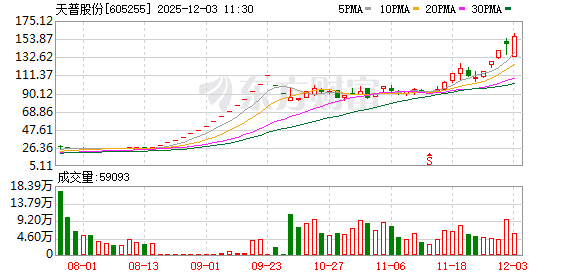
Market Overview - High dividend assets strengthened, with the coal sector leading the gains, while banking, electricity, and transportation sectors also performed actively [2] - As of the morning close, the Shanghai Composite Index fell by 0.09%, the Shenzhen Component Index decreased by 0.19%, and the ChiNext Index dropped by 0.5% [2] Individual Stock Performance - Hai Xin Food reached a trading limit, marking its sixth consecutive rise, with the company confirming no major changes in its fundamentals [3] - Tianpu Co., a notable stock, resumed trading and saw a morning increase of 7.12%, despite a previous trading halt due to significant price fluctuations [3] - Tianpu Co. stock price surged by 451.8% from August 22 to November 27, indicating substantial trading risks [3] - Xinke Materials experienced a drop of over 1% initially but then surged to a trading limit, with over 740,000 shares still on the limit order at midday [5] Industry Highlights - The cultivated diamond sector saw significant gains, with companies like Sifangda and Huifeng Diamond experiencing substantial increases [8] - The 2025 Cultivated Diamond Industry Conference is set to take place on December 5-6 in Zhengzhou, aiming to unveil key projects and investments totaling no less than 15 billion yuan [8] - The cultivated diamond industry is characterized by technological breakthroughs that create new application scenarios, particularly in high-function materials essential for various strategic industries [8][9] - The demand for traditional superhard products is under pressure, but advancements in functional diamond technology are opening new growth opportunities, especially in high-end chip cooling applications [9]
10倍牛股,历史新高!从跌停到涨超8%
Zhong Guo Zheng Quan Bao· 2025-12-03 04:38
Market Overview - High dividend assets strengthened, with the coal sector leading the gains, while banking, electricity, and transportation sectors also performed actively [1] - As of the morning close, the Shanghai Composite Index fell by 0.09%, the Shenzhen Component Index decreased by 0.19%, and the ChiNext Index dropped by 0.5% [1] Individual Stock Performance - Hai Xin Food (002702) hit the daily limit, marking its sixth consecutive rise, with the company confirming no major changes in its fundamentals [2] - Tianpu Co. (605255) resumed trading and saw a morning increase of 7.12%, after a significant rise of 451.8% from August 22 to November 27, indicating potential trading risks [4] - Xin Ke Materials (600255) initially dropped over 1% but then surged to hit the daily limit, with over 740,000 shares still on the limit order at midday [4] Cultivated Diamond Sector - The cultivated diamond sector saw significant gains, with stocks like Sifangda (300179) and Huifeng Diamond rising sharply [7] - The cultivated diamond industry conference is set to take place on December 5-6, 2025, in Zhengzhou, aiming to establish a comprehensive service ecosystem and sign key projects with a total investment of no less than 15 billion [11] - The cultivated diamond sector has been active this year, driven by technological breakthroughs and new application scenarios, particularly in high-function materials for strategic industries [11] Industry Insights - Traditional superhard product demand is under pressure, but ongoing technological advancements in functional diamond materials are opening new growth opportunities [12] - Diamond/copper composite materials for high-end chip cooling are seen as a key development direction, with increasing recognition from downstream customers [12]