大模型

Search documents
发力AI社交,腾讯内测“元宝派”
Xin Jing Bao· 2026-01-26 09:32
新京报贝壳财经讯(记者韦英姿)1月26日,在腾讯2026年员工大会上,腾讯董事会主席兼首席执行官 马化腾透露,元宝即将推出命名为"元宝派"AI社交新玩法。他表示自己也在内测,还表示"元宝会引入 一个新的和腾讯特点结合的社交功能。元宝派未来可能还会再设计一些通信的功能"。 据马化腾介绍,这一玩法脱胎于腾讯会议里的AI探索和尝试,致力于打造一个能让AI与用户群体共同 娱乐、协作的"社交空间"。同时,腾讯将向元宝用户开放QQ音乐、腾讯视频等内容,用户可以在元宝 建立自己的"派",实现和好友一起看、一起听,还可以和元宝实时互动聊天。 去年,腾讯在AI战场上的表现被解读为"相对克制",直到下半年引入前 OpenAI 高级研究员姚顺雨后, 又开始密集释放AI战略加速的信号。马化腾在腾讯2026年员工大会上透露,腾讯混元去年在人才吸 引、组织结构等方面"做了很大的改变",吸引了更多的原生AI人才。 2025 年12月17日,腾讯宣布升级大模型研发架构,新成立AI Infra 部、AI Data部、数据计算平台部,任 命前OpenAI 高级研究员姚顺雨为"CEO / 总裁办公室"首席 AI 科学家,并向刘炽平汇报;同时兼任A ...

智谱港股飙升13%,冲刺A股IPO
Hua Er Jie Jian Wen· 2026-01-26 09:24
1月26日港股智谱股价再度走强,截至收盘报217港元/股,股价飙升13%。继H股上市后,智谱还将继续 在A股"吸金"。近日,中国证监会官网更新了智谱公司的IPO辅导进展信息。根据公告,其辅导机构中 金公司已递交了智谱的第三期IPO辅导工作进展情况报告,落款日期为2026年1月15日。这意味着,"大 模型第一股"智谱在2026年1月8日完成港股上市后,仍在继续推进其A股上市计划。(21财经) 市场有风险,投资需谨慎。本文不构成个人投资建议,也未考虑到个别用户特殊的投资目标、财务状况或需要。用户应考虑本文中的任何 意见、观点或结论是否符合其特定状况。据此投资,责任自负。 风险提示及免责条款 ...
三大指数表现不一 传统板块逆袭科技热点成新主线
Xin Lang Cai Jing· 2026-01-26 08:37
Market Performance - The Hong Kong stock market showed mixed performance with the Hang Seng Index up by 0.06% closing at 26,765.52 points, while the Tech Index fell by 1.24% to 5,725.99 points, and the National Enterprises Index decreased by 0.15% to 9,147.21 points [1][2]. Sector Performance - Traditional cyclical stocks such as oil, coal, and non-ferrous metals performed strongly, indicating a shift in market focus towards value assets. In contrast, previously popular sectors like commercial aerospace and brain-computer interface technologies experienced a pullback [2][11]. Oil Sector - Oil stocks saw significant gains, with China National Offshore Oil Corporation (CNOOC) rising by 4.01%, China Petroleum & Chemical Corporation (Sinopec) increasing by 3.68%, and China Oilfield Services Limited up by 3.23%. This strength is attributed to a recent extreme cold wave in North America, which caused a 63% spike in U.S. natural gas prices from January 20 to 22, subsequently boosting prices of light hydrocarbons and supporting domestic petrochemical prices [4][5]. Coal Sector - Coal stocks also showed robust performance, with Mongolian Energy up by 5.80%, China Shenhua Energy rising by 4.42%, and China Qinfa up by 3.74%. The increase in coal prices is linked to heightened demand due to cold weather, with daily coal output from the Bohai Rim ports averaging 1.682 million tons, a week-on-week increase of 14.2 tons or 9.19% [6][7]. Non-Ferrous Metals Sector - Non-ferrous metal stocks were active, with Rusal rising by 12.31%, China Nonferrous Mining increasing by 9.87%, and Chifeng Jilong Gold Mining up by 7.44%. Citigroup's report indicates a structural bull market in aluminum, predicting a 61,000-ton structural deficit by early 2026 and raising the price target for aluminum from $2,950 to $3,400 per ton [8][9]. Gold Market - Morgan Stanley's research indicates that gold prices have surpassed their forecast of $4,750 per ounce for the second half of the year, with expectations of further increases due to geopolitical risks, central bank purchases, and ETF inflows. A bullish scenario suggests a target price of $5,700 per ounce for the second half [10]. Weakness in Tech Sectors - Commercial aerospace stocks faced collective declines, with Asia Pacific Satellite down by 11.53%, Goldwind Technology down by 7.14%, and JunDa Co. down by 6.56%. This adjustment is attributed to short-term profit-taking pressures [11]. Brain-computer interface stocks also showed weakness, with Nanjing Panda Electronics down by 6.15% and Brainstorming Technology down by 5.35%, partly due to a recent share placement announcement [13][14]. Individual Stock Movements - Zhizhuo (02513.HK) surged by 13.02% following a significant increase in subscription service users after the launch of its flagship model GLM-4.7, indicating strong market interest in its AI capabilities [15]. Lao Pu Gold (06181.HK) rose by 7.80% due to increased customer traffic during a promotional event, with expectations of substantial revenue growth during the upcoming Spring Festival [16].






刷新纪录!阶跃星辰完成超50亿元人民币B+轮融资
Zhong Guo Jing Ying Bao· 2026-01-26 07:41
Group 1 - StepFun, a Shanghai-based AI startup, announced the completion of over 5 billion RMB in Series B+ financing, setting a record for the largest single financing in China's large model sector in the past 12 months [1] - The financing round included participation from various investors such as State Investment Fund, China Life Equity, and Tencent, with funds primarily allocated for foundational model research and the commercialization of the "AI + terminal" strategy [1] - The company appointed Yin Qi as chairman to oversee strategic direction and technology development, focusing on foundational models and AI + terminal, achieving world-leading levels in language models and multi-modal models [1] Group 2 - StepFun has established deep collaborations with smartphone brands like OPPO, Honor, and ZTE, with model installations exceeding 42 million units [1] - In the automotive sector, partnerships with Qianli Technology and Geely have led to the launch of intelligent cockpit solutions, with the Geely Galaxy M9 model selling nearly 40,000 units within three months of its release [1] - The competitive landscape of large models has shifted from a "hundred models battle" to a head-to-head competition, with this financing and management upgrade providing critical acceleration for StepFun in technology development and market expansion [1]
深度|印奇与阶跃的全景:一支战队,一条窄路,一个物理世界
Z Potentials· 2026-01-26 07:11
Core Viewpoint - The article highlights the significant financing achievement of Jumpshare Star, which has raised over 5 billion RMB in a B+ round, surpassing the IPO fundraising targets of competitors like Zhipu AI and MiniMax, indicating strong market confidence in its unique strategy and team [2][3][4]. Group 1: Financing and Capital - Jumpshare Star's recent financing sets a record for single financing in the Chinese large model sector, reflecting a shift in investor focus towards technology barriers, clear commercialization paths, and resilient teams [3][4]. - The diverse shareholder composition, including state-owned enterprises, industrial capital, long-term insurance capital, and market-oriented VC, signals strong confidence in Jumpshare Star's long-term value and stability [4]. - Many investors view Jumpshare Star as their primary or sole investment in the large model field, indicating a concentrated bet on its potential [4]. Group 2: Team and Leadership - The article emphasizes the importance of team composition in Jumpshare Star's success, highlighting a well-rounded team capable of addressing the multifaceted challenges of the large model industry [5][6]. - The appointment of Yin Qi as chairman brings extensive experience in commercializing AI technologies, positioning Jumpshare Star for strategic success [7][8]. - Key team members include Jiang Daxin, who has a strong background in transforming technology into competitive products; Zhang Xiangyu, a leading algorithm scientist; and Zhu Yibo, an expert in AI infrastructure, all contributing to a comprehensive operational strategy [8][9]. Group 3: Strategic Direction - Jumpshare Star's choice of the "AI + terminal" strategy is seen as a unique path amidst the challenges faced by other large model companies, aiming to integrate AI into physical devices [10][11]. - The company focuses on developing a multi-modal AI capability and deep integration with terminal devices, which is essential for creating a comprehensive intelligent assistant [11][12]. - The revenue model is designed to be sustainable, with income linked to the sales of partner manufacturers, indicating a clear and viable business strategy [12][13]. Group 4: Market Performance and Future Outlook - Jumpshare Star has demonstrated strong market demand, with a 170% increase in API call volume over three consecutive quarters and partnerships with major smartphone brands, indicating robust commercial traction [13]. - The company is set to equip over one million new vehicles with its large model technology, showcasing its expansion into the automotive sector [13]. - The article concludes that Jumpshare Star's strategic choices, technological foundations, and business validations position it well for future growth, suggesting a promising trajectory in the AI landscape [14][15].

干春晖:汽车行业抓住三大潜能实现三个转变
Zhong Guo Qi Che Bao Wang· 2026-01-26 06:48
Group 1 - The core viewpoint is that the automotive industry in China is at a critical juncture, transitioning from scale expansion to quality enhancement, driven by technological innovation, ecological reconstruction, and global competitiveness [11][12] - The three major potentials identified for 2026 are consumption and investment, technology and industry, and urban-rural and regional coordination, which will synergistically promote economic growth and provide key opportunities for the automotive sector [3][6] - The expansion of domestic demand strategy and the adjustment of the "two new" policies are expected to shift the automotive industry from a focus on scale to a focus on quality, enhancing market vitality and promoting a virtuous cycle of supply and demand [7][8][10] Group 2 - The automotive industry is expected to leverage new technologies such as solid-state batteries and L4-level autonomous driving, transforming vehicles into mobile smart terminals and energy carriers [4][5][12] - The integration of technology and industry is reshaping the competitive landscape of the automotive sector, allowing companies to explore new business models and enhance their ecological systems [5][6] - The policy adjustments are designed to address structural contradictions in the industry, such as excess low-end capacity and insufficient high-end supply, by promoting technological upgrades and encouraging consumer confidence [9][10][12] Group 3 - The automotive industry is increasingly focusing on creating a comprehensive ecosystem rather than just manufacturing vehicles, with an emphasis on smart energy and low-altitude economy [2][6] - The development of regional innovation clusters is facilitating the flow of resources and enhancing the industry's resilience to global supply chain changes [5][6] - The shift towards a value-driven market is evident, as policies encourage technological advancements and high-efficiency models, moving away from price wars to value competition [10][12]
手握最强AI大脑,千里科技打响智能汽车“含模量”战役
Jing Ji Guan Cha Bao· 2026-01-26 06:38
Core Insights - The appointment of Yin Qi as chairman of Jiyue Xingchen marks a significant step in the integration of AI and hardware, indicating the launch of a Chinese "AI + terminal" strategy [1] - Jiyue Xingchen has successfully completed nearly 5 billion RMB in B+ round financing, which will be invested in the development of leading foundational models [1] - The combination of Jiyue Xingchen and Qianli Technology aims to create a comprehensive "Physical AI" system that connects underlying algorithms to large-scale applications [1][2] Group 1: Strategic Vision and Leadership - Yin Qi's entrepreneurial journey emphasizes the long-term vision of "Physical AI," focusing on the transformation of the physical world through AI [2] - His leadership combines deep algorithmic knowledge with extensive manufacturing experience, positioning him as a rare composite leader in the industry [2] - The strategic focus on smart vehicles as a primary application area reflects a commitment to engineering excellence and technological advancement [2] Group 2: Technological Evolution and Market Positioning - The emergence of Physical AI is recognized as the ultimate consensus for closing the commercial loop in the AI 2.0 era, with a focus on integrated hardware and software strategies [3] - Next-generation terminals are evolving from passive "App containers" to proactive intelligent agents capable of understanding user habits and context [3] - The shift in interaction points from application layers to operating system-level smart hubs signifies a reorganization of traditional distribution logic [3] Group 3: Differentiation and Competitive Advantage - The strategic partnership between Qianli Technology and Jiyue Xingchen grants Qianli absolute autonomy in defining core algorithms for the "AI-defined automotive" era [4] - The concept of "containing modulus" has become a critical metric for assessing intelligent driving capabilities, with Qianli focusing on end-to-end intelligent driving solutions [4] - The collaboration with Geely has led to the launch of the Qianli Haohan G-ASD, currently deployed in over 30,000 vehicles across 16 models [4] Group 4: User Experience and Future Prospects - The integration of multi-modal capabilities is transforming smart cabins from mere tools into "intelligent partners" [5] - The next-generation smart cabin Agent OS, developed in collaboration with Jiyue Xingchen, offers revolutionary experiences such as super-natural interaction and human-machine co-driving [5] - This partnership represents a rare practice in the Chinese AI industry under the Physical AI wave, reflecting a long-term strategic logic [5]

AI生态加速融合,高人气港股科技类产品吸金显著:恒生科技ETF(513130)获资金13个交易日连增,合计超36亿元
Mei Ri Jing Ji Xin Wen· 2026-01-26 06:18
Group 1 - The core viewpoint highlights the acceleration of AI integration within the leading tech companies in the Hong Kong stock market, focusing on the commercialization and application of AI models in various sectors such as e-commerce and transportation [1] - Qianwen APP is advancing productization in key scenarios, while Yuanbao APP's new Spring Red Packet activity is expected to boost downloads and daily active users, indicating a competitive landscape for AI entry points among major model vendors [1] - Open-source securities note that domestic large model vendors are enhancing user and revenue scale through frequent model upgrades and overseas expansion, leveraging social effects from "Spring Festival" activities to capture C-end AI entry points, which may accelerate user growth and commercialization [1] Group 2 - Despite recent fluctuations, the Hong Kong tech sector is seeing active investment in high liquidity products, with the Hang Seng Tech ETF (513130) experiencing a net inflow of 3.609 billion yuan over 13 trading days since January 7, 2026, boosting its scale to 47.586 billion yuan [2] - The Hang Seng Tech ETF (513130) has a daily average trading volume of 5.139 billion yuan, making it the only product tracking the Hang Seng Tech Index with an average daily turnover exceeding 5 billion yuan, showcasing its liquidity advantage [2] - The ETF closely tracks the Hang Seng Tech Index, which includes key competitive tech companies such as SMIC, Alibaba-W, Meituan-W, BYD, and Tencent, all of which are leaders in AI application and development, poised to benefit from the current AI application opportunities [2] Group 3 - The fund manager of the Hang Seng Tech ETF (513130), Huatai-PB Fund, is among the first ETF managers in China, with a strong track record in broad-based and dividend-themed indices [3] - The "Dividend Family" series includes various ETFs that may serve as good defensive options within a "barbell strategy," indicating a diversified approach to investment [3]
与郭毅可深聊:AI 逼近“全知”,人类会走向精神荒芜吗?
3 6 Ke· 2026-01-26 05:45
1944年,阿根廷作家豪尔赫·路易斯·博尔赫斯曾在《巴别图书馆》中,为人类构筑了一个由无限六角形回廊组成的"全书图书馆"。 起初,它是神谕的代名词。人们沉浸在"万物皆已写就"的狂喜中,穷极一生去追寻那本能解释宇宙真相、甚至是个体命运的"辩护状"。 然而,当狂欢落幕,真相显露:在近乎无限的、由乱码组成的废纸堆里,寻找一行有意义的叙述,概率微弱到近乎虚无。 信息的极度冗余,非但没有点亮智慧,反而以噪声淹没了意义。 博尔赫斯笔下的旅行者穿梭于周而复始的卷册间,看透了那令人绝望的循环。他预言人类终将灭绝,而图书馆永存——"青灯孤照,无限不动,藏有珍 本,默默无闻。" 八十余年后的今天,这个隐喻跨越时空,精准地击中了生成式AI时代的神经。 我们正站在知识饱和的奇点:当算法可以在瞬间穷尽文字的所有组合,我们是在挖掘通往真理的沃土,还是在加速步入一片精神的荒原?当一切皆可生 成,是否意味着一切皆无意义?人类智慧的护城河在何方?我们应该如何与AI共存,并利用它创造出真正有价值的内容?那些记录着人类"不完美灵 魂"的文学与艺术,是否会成为我们最后的精神庇护所? 图片由AI生成 带着这些关于创造、教育与存在的追问,在高山书院十周 ...

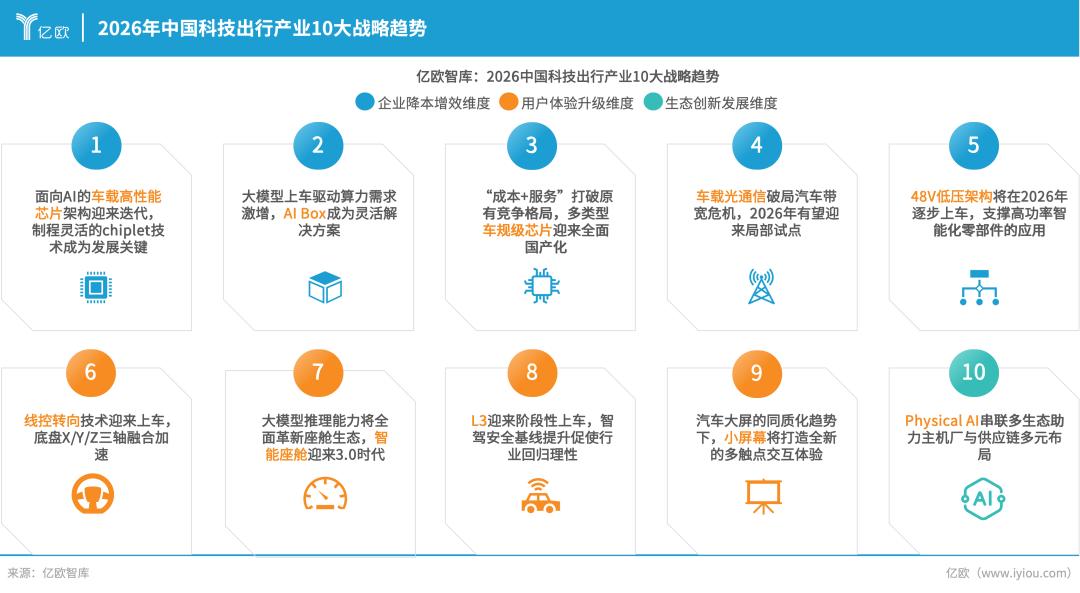
决胜2026:科技出行十大战略技术趋势
3 6 Ke· 2026-01-26 05:09
Core Insights - The report "2026 China Technology Mobility Industry 10 Strategic Technology Trends Outlook" aims to provide a key action guide for decision-makers in the industry chain, focusing on cost reduction, enhanced user experience, and ecological collaborative innovation [1][1] - The Chinese technology mobility industry is undergoing a profound systemic transformation driven by the accelerated integration of intelligence, electrification, and artificial intelligence technologies [1][1] - The industry is transitioning from a phase of incremental expansion to a high-quality development stage centered on efficiency, scale, and systemic capabilities amid intensified global automotive competition and evolving profit models [1][1] Trend Summaries - **Trend 1: Chiplet Restructuring Vehicle Chip Architecture** The traditional single-chip SoC is inadequate for L3+ autonomous driving and advanced cockpit requirements. Chiplet architecture is emerging as a mainstream solution for high-performance intelligent driving chips, enabling cost optimization and demand-driven scalability [4] - **Trend 2: AI Box Decoupling Computing Power Deployment** AI Box is becoming a key transitional solution for OEMs to achieve flexible computing power expansion, supporting local AI capabilities without major changes to vehicle electronic architectures [6] - **Trend 3: Accelerated Localization of Automotive Chips** Driven by supply chain security and cost optimization, communication chips and power semiconductors are leading the way in domestic chip localization, transitioning from technical feasibility to large-scale implementation [10] - **Trend 4: Optical Communication in Vehicles** Optical communication is moving from technology validation to mass production, addressing bandwidth limitations and electromagnetic interference in traditional vehicle networks, with significant advancements expected by 2026-2027 [13] - **Trend 5: 48V Low-Voltage Architecture** The 48V architecture is becoming essential for high-power intelligent components in electric vehicles, with initial applications in high-end models expected to scale by 2026 [15] - **Trend 6: Nearing the Inflection Point for Steer-by-Wire** With the maturation of technology and regulatory frameworks, steer-by-wire systems are transitioning from small-scale validation to mass production, becoming critical for advanced driving capabilities [19] - **Trend 7: Large Models Driving Intelligent Cockpits** The evolution of large models is transforming intelligent cockpits into system-level intelligent entities, enhancing user interaction and service optimization [22] - **Trend 8: Phased Implementation of L3 Autonomous Driving** L3 autonomous driving will be introduced gradually under regulatory constraints, focusing on safety and responsibility alignment, with commercial applications expected to begin in 2024-2025 [25] - **Trend 9: Redefining Interaction with Small Screens** The shift from centralized large screens to distributed small screens in vehicle interfaces aims to enhance user experience and reduce cognitive load during driving [28] - **Trend 10: Physical AI Driving Second Growth Curve** Physical AI capabilities are evolving into transferable competencies, enabling automotive technologies to extend across various intelligent terminals, fostering ecosystem collaboration [30] Overall Industry Outlook - The trends indicate a systemic restructuring in the Chinese technology mobility industry, focusing on integrated systems engineering and collaborative efficiency, with a shift from isolated performance to comprehensive system capabilities [32][34] - The next phase of competition will favor organizations that can build replicable, scalable, and evolvable system capabilities, marking 2026 as a pivotal year for technological scaling and global competitive landscape reshaping [34]