
失业率

Search documents
国家统计局发布4月份分年龄组失业率数据
news flash· 2025-05-20 07:20
国家统计局发布4月份分年龄组失业率数据 智通财经5月20日电,国家统计局发布4月份分年龄组失业率数据。4月份,全国城镇不包含在校生的16- 24岁劳动力失业率为15.8%,不包含在校生的25-29岁劳动力失业率为7.1%,不包含在校生的30-59岁劳 动力失业率为4.0%。 ...
澳洲联储降息25个基点,就特朗普贸易战发出严厉警告
Jin Shi Shu Ju· 2025-05-20 05:14
Group 1 - The Reserve Bank of Australia (RBA) has lowered the policy interest rate by 25 basis points to 3.85%, the lowest level in two years, in response to declining domestic inflation concerns [1] - Australia's inflation rate has significantly decreased since peaking in 2022, with the latest overall inflation data projected to reach 2.4% by the first quarter of 2025, the lowest in four years [1] - The RBA anticipates that inflation will drop to around 2% by the end of 2026, below its baseline forecast of 2.6%, while GDP levels are expected to be over 3% lower than baseline scenarios by mid-2027 [1] Group 2 - The RBA acknowledges that the recent trade truce between the US and China has alleviated some downside risks to global growth, but warns of potential escalation into a broader trade war that could significantly impact domestic GDP growth and increase unemployment rates [2] - In a trade war scenario, the RBA predicts that Australia's unemployment rate could rise to nearly 6% if the US reinstates higher tariffs in 2026 and other countries retaliate [2] - The RBA believes that higher tariffs could have a counter-inflationary effect on Australia, although a prolonged trade war may exacerbate inflationary pressures due to increased tariffs affecting a larger share of global trade [2]
澳洲联储:全球贸易战对经济构成重大下行风险
news flash· 2025-05-20 04:45
澳洲联储:全球贸易战对经济构成重大下行风险 金十数据5月20日讯,澳洲联储周二表示,由于受全球贸易紧张局势的连带影响,通胀率将下降,而失 业率将上升,即使假设降息幅度达到市场预期。澳洲联储在周二发布的季度货币政策声明中称,核心通 胀的降温速度略快于预期,服务业明显放缓。该央行还警告称,美国总统特朗普关税政策将拖低全球经 济增长率,并且总体上有助降低澳洲通胀率。 ...
澳洲联储:预计失业率截至2025年6月为4.2%,2026年6月和2027年6月均为4.3%。地缘政治不确定性依然突出,在 “贸易战” 情景下,失业率或将攀升至近 6%。
news flash· 2025-05-20 04:42
澳洲联储:预计失业率截至2025年6月为4.2%,2026年6月和2027年6月均为4.3%。地缘政治不确定性依 然突出,在 "贸易战" 情景下,失业率或将攀升至近 6%。 ...
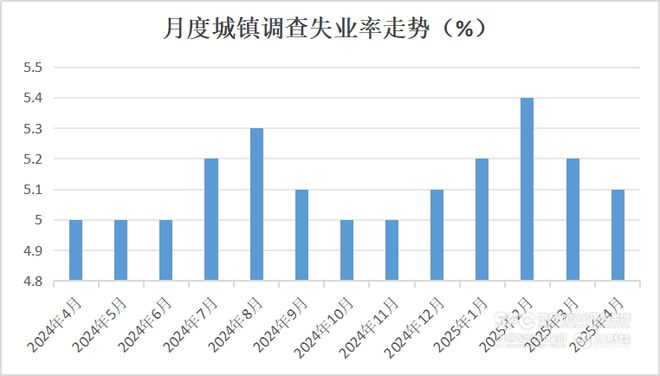
失业率连续两月回落,提前启动就业攻坚|不老经济学
2 1 Shi Ji Jing Ji Bao Dao· 2025-05-19 10:32
Core Viewpoint - The National Bureau of Statistics reported that the urban surveyed unemployment rate in China averaged 5.2% from January to April, remaining stable compared to the same period last year, with a slight decrease to 5.1% in April, indicating a stable employment situation despite external pressures [1][3]. Employment Stability - In April, the urban surveyed unemployment rate was 5.1%, down 0.1 percentage points from the previous month, marking two consecutive months of decline [3]. - The unemployment rates for migrant workers and youth aged 16-24 also showed a decrease, with the rate for migrant workers at 4.7%, down 0.3 percentage points from the previous month [3][4]. - The demand for labor in enterprises increased in April, contributing to the improvement in unemployment rates [3]. External Environment Impact - The external environment has become increasingly complex, with rising uncertainties affecting the labor market, leading to a 0.1 percentage point increase in the unemployment rate for local registered populations and a 0.2 percentage point increase for migrant agricultural workers compared to the same period last year [3][5]. - Analysts suggest that the impact of U.S. tariff policies on employment is significant in certain industries, particularly leather, footwear, and textiles, but overall, the short-term employment market may remain relatively stable [3]. Employment Policies and Initiatives - The government has implemented various policies to support employment, focusing on key sectors and groups, including a plan to develop job positions in seven key areas and six tasks to support employment for priority groups [5][6]. - A series of recruitment events have been organized to address the employment challenges faced by recent graduates, with over 1200 companies offering more than 50,000 positions during a recent job fair [6][7]. Long-term Employment Challenges - Structural employment issues persist, particularly for youth, while some industries face labor shortages, especially for skilled workers [5][6]. - The need for educational reforms to align with industry demands is emphasized, as there is often a four-year lag between education and employment, which can hinder job readiness [7].

法国第一季度ILO失业率 7.4%,预期7.40%,前值7.30%。
news flash· 2025-05-16 05:32
法国第一季度ILO失业率 7.4%,预期7.40%,前值7.30%。 ...
5月16日电,法国第一季度ILO失业率为7.4%,预期7.40%,前值7.30%。
news flash· 2025-05-16 05:31
智通财经5月16日电,法国第一季度ILO失业率为7.4%,预期7.40%,前值7.30%。 ...
申银万国期货早间评论-20250516
Shen Yin Wan Guo Qi Huo· 2025-05-16 03:29
Report Summary 1. Investment Rating - The report does not mention the industry investment rating. 2. Core Viewpoints - Domestically, the government emphasizes strengthening the domestic economic cycle, and the consumer market shows steady growth, indicating a stable economic foundation. Overseas, the global economic recovery is uneven, with the US economy strong but facing inflation, and Europe struggling with energy and supply - chain issues. The IMF has lowered the global economic growth forecast [1]. - For key varieties: - Crude oil prices are falling due to the expected US - Iran nuclear deal and a more relaxed supply - demand balance in the oil market [2][14]. - Shipping, especially the container shipping European line, has seen price rebounds due to the easing of Sino - US tariff frictions, with different trends for different contracts [3][35]. - Gold prices are affected by geopolitical negotiations, tariff wars, and Fed policies, currently in a correction phase [4][5]. 3. Summary by Directory 3.1 Daily Main News - **International News**: The Fed is considering adjusting its monetary policy framework. The US may face more frequent supply shocks and unstable inflation, and long - term interest rates may rise. The predicted April PCE in the US will increase by about 2.2% year - on - year [6]. - **Domestic News**: The State Council emphasizes strengthening the domestic economic cycle to hedge against international uncertainties and promote high - quality development [1][7]. - **Industry News**: The IEA predicts that the global oil demand growth will slow to 650,000 barrels per day for the rest of 2025, and has lowered the US shale oil production forecast [2][8]. 3.2 Foreign Market Daily Returns - The S&P 500 rose 0.41%, the European STOXX50 rose 0.60%, the FTSE China A50 futures fell 0.38%, the US dollar index fell 0.24%, ICE Brent crude oil fell 1.87%, London gold rose 1.98%, London silver rose 1.33%, and various other commodities had different price changes [10]. 3.3 Morning Comments on Major Varieties - **Financial**: - **Stock Index**: Short - term positive factors such as policy support and tariff negotiation results are beneficial to the stock market. The valuation of major domestic indices is low, and stock index futures are expected to be bullish, while stock index options can use the wide - straddle buying strategy [11]. - **Treasury Bonds**: After the Sino - US talks, market risk appetite increased, and treasury bond futures prices fell with potential short - term volatility [12][13]. - **Energy and Chemicals**: - **Crude Oil**: Prices are falling due to the expected US - Iran nuclear deal and a more relaxed supply - demand balance [2][14]. - **Methanol**: Short - term bullish, with changes in domestic device operation rates and inventory levels [15]. - **Rubber**: Expected to be weakly volatile due to factors such as production area conditions and tariff policies [16]. - **Polyolefins**: After a phased rebound, they may oscillate at high levels, affected by macro factors and crude oil prices [17]. - **Glass and Soda Ash**: The market is reacting positively to the Sino - US financial talks. Glass inventory is slowly decreasing, and soda ash supply is relatively abundant, with both facing inventory digestion challenges [18][19]. - **Metals**: - **Precious Metals**: Gold and silver are in a correction phase, affected by geopolitical and tariff factors, and the Fed's wait - and - see attitude [4][5]. - **Copper**: Prices may fluctuate widely, affected by factors such as processing fees, demand, and tariff negotiations [21]. - **Zinc**: Prices may also fluctuate widely, with expectations of improved supply and influenced by tariff negotiations [22]. - **Aluminum**: May be oscillating strongly due to the better - than - expected result of tariff negotiations, despite weakening short - term demand [23][24]. - **Nickel**: Prices may be oscillating strongly, with a mix of positive and negative factors in the market [25]. - **Lithium Carbonate**: Prices are weak, with a supply - demand imbalance. Without large - scale production cuts, the price outlook is pessimistic [26]. - **Black Metals**: - **Coking Coal and Coke**: The black - metal sector is recovering due to macro - level positives, but the fundamentals of coking coal are deteriorating, and coke prices may face downward pressure [27]. - **Iron Ore**: Short - term support exists due to iron - water production and demand, but it may be weakly volatile in the later stage due to expected supply increases [28]. - **Steel**: The market faces a situation of increasing supply and weakening demand, with short - term exports stable but a potential seasonal decline in demand [29][30]. - **Agricultural Products**: - **Oils and Fats**: Prices are falling due to factors such as the weakening of US biodiesel speculation, high palm oil production and inventory in Malaysia, and falling crude oil prices [31]. - **Soybean and Rapeseed Meal**: US soybean prices are rising due to positive factors, but domestic supply is expected to increase, putting pressure on prices [32]. - **Corn and Corn Starch**: The market is in a short - term oscillation. Supply is expected to be tight in July, but high prices may affect downstream acceptance. There is an expectation of imported corn reserve auctions [33]. - **Cotton**: Spot prices are rising with improved macro sentiment. Supply is stable, and the market is bullish in the short - term due to tariff negotiations [34]. - **Shipping Index**: - **Container Shipping European Line**: Prices have rebounded due to the easing of Sino - US tariff frictions. The 06 contract's volatility is expected to be limited, while the 08 contract may remain strong [3][35].