
量子计算

Search documents
2025全球金融科技中心城市报告发布,中国5城跻身TOP10丨直击金融街论坛
Sou Hu Cai Jing· 2025-10-30 08:42
Core Insights - The report titled "Global FinTech Hub Report 2025" reveals that Beijing retains its position as the top global fintech city, with significant advancements in various Chinese cities [1][3]. Trend Summaries Trend 1: Intensifying Global Competition - The competition in the global fintech sector is intensifying, with the top 10 cities showing a reduced gap in rankings over the past six years. The index gap between the first and tenth ranked cities is now 22.8, down from 29.7 in 2020, indicating a narrowing disparity in fintech capabilities [4]. - Notable movements include Hong Kong rising one position and Paris entering the top 10 for the first time, replacing Sydney [4]. Trend 2: Asia's Leading Position - Asia continues to dominate the global fintech landscape, with 60% of the top 10 cities located in the region. China has five cities in the top 10, contributing to a total of 25 Asian cities in the top 50, significantly outpacing other regions [5][6]. Trend 3: Emergence of New Centers - New fintech centers are rapidly emerging, with 14 cities in the top 50 showing consistent upward movement over the past three years. This growth is driven by "industry/technology-driven" and "ecosystem/regulatory-driven" models [7][8]. Trend 4: Breakthroughs in Ecosystem and Industry Rankings - In the ecosystem rankings, China has made significant strides, with four cities in the top 10. Hong Kong's financial institutions saw a market value increase from $216.9 billion to $363.9 billion, a growth rate of 67.8% [9]. - The industry rankings remain led by China and the U.S., with Chinese cities collectively housing 121 fintech listed companies valued at $375.4 billion [10]. Trend 5: Enhanced Index System - The report introduces an upgraded Financial Development Index (FDI) that evaluates fintech development through over 50 indicators, aiming to foster international collaboration and a robust global fintech ecosystem [11][12].



招商证券:量子技术成为未来十年最具潜力的高技术增长引擎
Xin Lang Cai Jing· 2025-10-30 07:29
Core Viewpoint - Quantum technology is accelerating from frontier science to national strategy and industrial practice, becoming the most promising high-tech growth engine for the next decade [1] Summary by Categories Quantum Technology Fields - Quantum technology can be divided into six main areas: quantum computing, quantum communication, quantum sensing, quantum materials, quantum simulation, and quantum optics [1] - Among these, quantum computing, quantum communication, and quantum sensing have emerged as the three areas with the most industrialization potential, characterized by clear technological pathways and defined application demands [1]

见证历史!英伟达市值突破5万亿!超过英法德等国家的股市总市值
Sou Hu Cai Jing· 2025-10-30 04:50
Core Points - Nvidia's stock price increased by 3.2% on October 29, reaching a market capitalization of $5.11 trillion, making it the first company to surpass a $5 trillion market cap [2] - The time taken for Nvidia to grow from a $4 trillion to a $5 trillion market cap was only 113 days, compared to 410 days for the previous $3 trillion to $4 trillion increase [2] - Nvidia's market cap exceeds the total market capitalization of several countries, approaching India's total market cap of $5.3 trillion [2] Company Developments - At the GTC conference, CEO Jensen Huang announced several significant advancements, including the launch of the AI-native wireless 6G technology stack, NVIDIA Arc, and the quantum GPU interconnect technology, NVIDIA NVQLink [2] - Nvidia is collaborating with national laboratories to build a new supercomputer [2] - Sales data for Blackwell indicates visible revenue exceeding $500 billion over the next five quarters, with an order volume of approximately 20 million GPUs [3] - Nvidia announced a $1 billion investment in Nokia [3] Financial Performance - For the second quarter of the fiscal year 2026, Nvidia reported revenue of $46.743 billion, a year-over-year increase of 56% [3] - The net profit for the same quarter was $26.422 billion, reflecting a 59% year-over-year growth [3]

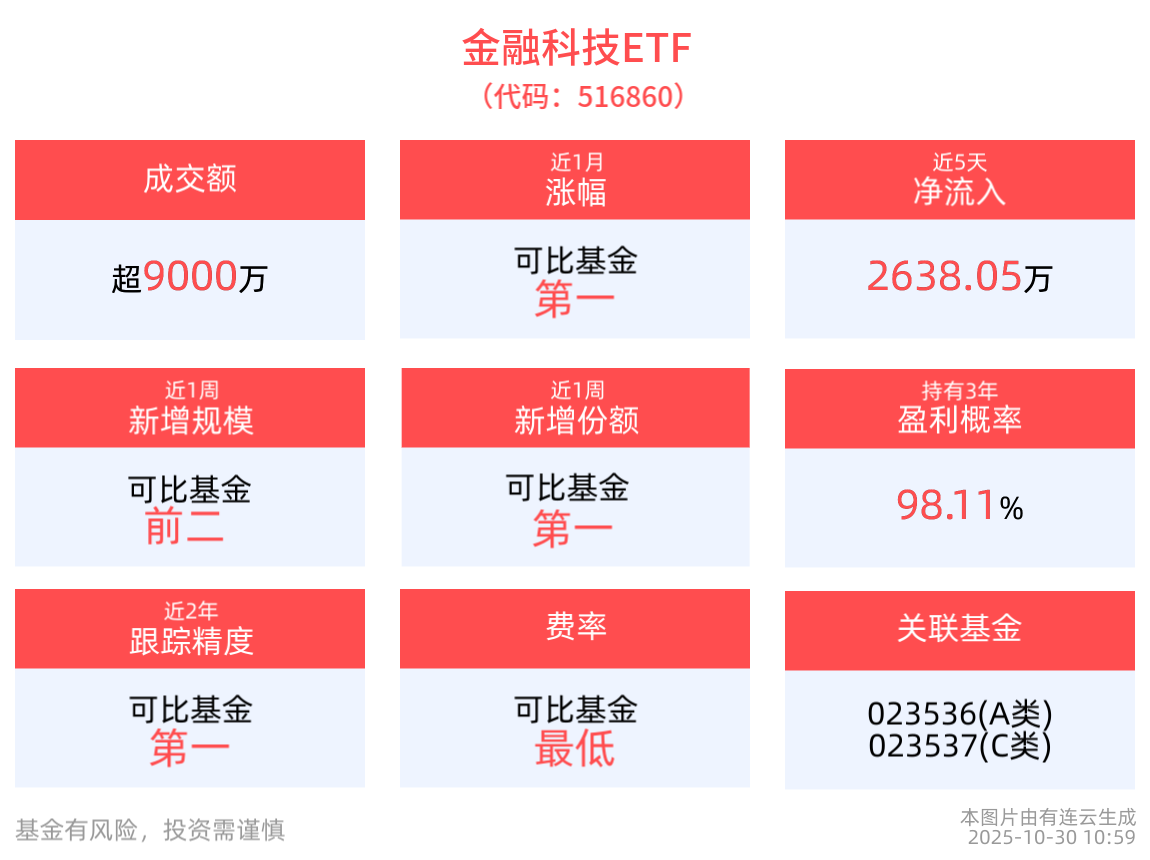
我国量子科技取得重大突破!金融科技ETF(516860)近一周累计上涨超5%,神州信息涨停
Xin Lang Cai Jing· 2025-10-30 03:33
Group 1 - The China Securities Financial Technology Theme Index decreased by 1.26% as of October 30, 2025, with mixed performance among constituent stocks [3] - The Financial Technology ETF (516860) fell by 1.42%, with a latest price of 1.53 yuan, but has seen a 5.50% increase over the past week, ranking 1 out of 7 among comparable funds [3] - The trading volume for the Financial Technology ETF reached 93.84 million yuan, with a turnover rate of 3.78% [3] Group 2 - Quantum technology is becoming a key focus for research and development, with significant breakthroughs transitioning from theoretical research to practical applications [4] - A quantum computing company in Beijing reported that its latest product has a computing capacity of 1000 qubits, enabling the control of 1000 variables in a single calculation [4] - The first domestic optical quantum computer manufacturing plant is set to open in Shenzhen next month, entering small-scale production [4] Group 3 - The Vice Chairman of the China Securities Regulatory Commission emphasized the need to regulate the application of artificial intelligence in capital markets to mitigate risks [4] - Quantum computing is identified as a core driver of next-generation information technology, with its applications expanding from specialized to general computing, impacting sectors like finance, pharmaceuticals, and energy [4] - The quantum computing industry is at a critical turning point, with the period from 2025 to 2030 expected to be a golden window for commercialization, potentially reaching a market size of hundreds of billions [4] Group 4 - The Financial Technology ETF saw a significant increase in scale, growing by 116 million yuan over the past week, ranking 2 out of 7 among comparable funds [4] - The ETF's share count increased by 7 million shares in the past week, also ranking 1 out of 7 among comparable funds [4] - The latest net outflow for the Financial Technology ETF was 6.18 million yuan, but there were net inflows on 3 out of the last 5 trading days, totaling 26.38 million yuan [4] Group 5 - The China Securities Financial Technology Theme Index tracks companies involved in financial technology, reflecting the overall performance of these securities [5] - As of September 30, 2025, the top ten weighted stocks in the index accounted for 55.55% of the total index weight [5]

鼎阳科技20251029
2025-10-30 01:56
Summary of Dingyang Technology Conference Call Company Overview - **Company**: Dingyang Technology - **Industry**: Electronic Measurement Instruments Key Points and Arguments Financial Performance - Dingyang Technology reported a revenue of 431 million yuan for the first three quarters of 2025, representing a year-on-year growth of 21.67% [3] - Net profit attributable to shareholders was 111 million yuan, up 21.49% year-on-year, while the net profit excluding non-recurring items was 109 million yuan, reflecting a growth of 22.62% [3] - The revenue growth is primarily attributed to sustained R&D investment and a high-end product strategy, with high-end products accounting for 30% of total revenue, up 6 percentage points year-on-year [5] Product Development and Innovation - Since 2020, the company has launched 41 new products, with 11 released in 2025, including 7 high-end products [2][6] - The company focuses on the general electronic measurement field and plans to upgrade existing products while expanding into higher bandwidth ranges, including 30GHz and 60GHz [2][9] Market Demand and Trends - There is a rapid increase in demand from sectors such as telecommunications, semiconductors, new energy vehicles, and AI, particularly for AI server-related equipment [2][10] - The company is also monitoring developments in quantum computing, although it is not currently prioritizing this area due to its sensitivity [10] Customer Base and Sales Strategy - Dingyang Technology has expanded its key account (KA) customer base from a few to nearly ten, significantly contributing to revenue growth [7] - The company anticipates a steady increase in direct sales as high-end products are introduced and personnel are optimized [7] High-End Product Performance - High-end product revenue grew by 51.22% year-on-year, with average selling prices increasing by 10.11% [5] - Sales of products priced above 30,000 yuan increased by 46.53%, while those above 50,000 yuan saw a 56.65% increase [5] Future Growth Projections - The SDS 8,000A series is expected to become a significant revenue and profit growth driver in 2026, with potential sales of 50-100 units projected to generate over 50 million yuan in revenue [10] - The company expects to maintain a high growth trend in the coming years, driven by new product launches and market expansion [4][20] Market Conditions and Competitive Landscape - The domestic market is growing significantly faster than the overseas market, with expectations for a recovery in overseas sales as new products are launched [22] - The company faces limited competition in the high-end RF microwave product sector, primarily from a few foreign giants [15] R&D and Profitability - R&D expenses increased by over 40% year-on-year, reflecting the company's commitment to long-term growth despite short-term profit fluctuations [21][23] - The current profit level is moderate, with a focus on long-term potential rather than short-term gains [23] Supply Chain and Production Capacity - The domestic supply chain has matured, particularly in key components like ADCs, which support the development of high-end oscilloscopes [9][16] - The Malaysian factory has ramped up production capacity, addressing supply shortages and enhancing the company's operational efficiency [15] Additional Important Insights - The company is strategically positioned to leverage its technological advancements and market demand, ensuring a robust growth trajectory in the electronic measurement instruments sector [20] - The focus on high-end products and continuous innovation is expected to solidify Dingyang Technology's competitive advantage in the industry [6][10]

再创历史!英伟达市值一夜突破5万亿美元,今年涨幅56%,黄仁勋晋升全球第八富豪
量子位· 2025-10-30 01:06
Core Viewpoint - Nvidia has become the first company in history to surpass a market capitalization of $5 trillion, marking a significant milestone in the tech industry [1][10]. Group 1: Market Performance - On October 29, Nvidia's stock price rose by 5.44%, reaching an intraday high of $212.19 per share, and closing at $207.04 per share, resulting in a market cap of $5.03 trillion [2][10]. - Since the beginning of 2025, Nvidia's stock has surged by 56%, showcasing its rapid growth compared to other major companies [5][39]. - Nvidia's market cap now exceeds the combined total of several major tech companies, including AMD, Intel, and TSMC, as well as entire sectors within the S&P 500 [5][6]. Group 2: Growth Trajectory - Nvidia's market value has skyrocketed from $1 trillion to $5 trillion in just two and a half years, a feat unmatched by other tech giants [9][23]. - The company achieved its first $1 trillion valuation in May 2023, followed by $3 trillion in June 2024, and then $4 trillion in just over a year [22][23]. - The growth from $4 trillion to $5 trillion took only three months, highlighting Nvidia's exceptional market performance [23][24]. Group 3: Key Drivers of Growth - The recent surge in Nvidia's market cap is attributed to announcements made during the GTC developer conference, where CEO Jensen Huang unveiled several technological innovations and partnerships [25][39]. - Key highlights from the conference included plans to collaborate with the U.S. Department of Energy to build new supercomputers and the introduction of the Blackwell chip series, which is expected to significantly increase production [26][27][31]. - Nvidia's anticipated revenue from the new products is projected to reach $500 billion by the end of next year, reflecting a major shift in global computing infrastructure towards Nvidia's accelerated computing model [31][33]. Group 4: Competitive Landscape - Nvidia's rapid ascent has created a substantial gap between it and its closest competitor, Microsoft, which has a market cap of $4.03 trillion, and Apple at $4.00 trillion [13][14]. - The company has positioned itself as a key player in the AI boom, with its GPUs being integral to the infrastructure of leading AI companies like OpenAI and Google DeepMind [39][40]. - Nvidia's strategic investments and partnerships, including a potential $100 billion investment in AI data centers, further solidify its leadership in the AI sector [40][41].

美联储降息25基点,鲍威尔重磅发声!
天天基金网· 2025-10-30 01:05
Market Overview - The U.S. stock indices closed mixed, with the Nasdaq reaching a new high for the fourth consecutive day, up 0.55% to 23958.47 points [5][4] - Nvidia's market capitalization surpassed $5 trillion for the first time, closing at $5.03 trillion after a 2.99% increase in stock price [6][7] Nvidia's Developments - Nvidia's CEO Jensen Huang highlighted the company's advancements in GPU and CUDA-based accelerated computing systems, which have overcome the limitations of Moore's Law [9] - The introduction of the "AI factory" concept aims to support AI's evolution from a tool to an autonomous executor of tasks, driving significant capital expenditure towards AI infrastructure [10] - Nvidia's new architecture, including the Grace Blackwell and Spectrum-X, enables unprecedented performance improvements through extreme collaborative design, marking a significant shift in computing infrastructure [11] Federal Reserve Actions - The Federal Reserve announced a 25 basis point rate cut, bringing the federal funds rate to 3.75% - 4.00%, marking the second rate cut of the year [18] - Fed Chair Jerome Powell indicated that while the labor market is showing signs of cooling, inflation remains above the long-term target of 2% [19][20] - The Fed plans to end its balance sheet reduction on December 1, reflecting a shift in monetary policy to support economic growth amid mixed economic signals [20] Technology Sector Performance - Major tech stocks generally rose, with the Wande American Technology Seven Giants Index increasing by 1.14% [12][13] - Individual stock performances included Nvidia up nearly 3%, Google up over 2%, and Apple up 0.26%, while Microsoft saw a slight decline of 0.1% [14] Chinese Concept Stocks - Chinese concept stocks showed mixed results, with the Nasdaq Golden Dragon China Index down 0.03% and the Wande Chinese Technology Leaders Index up 0.65% [15][16] - Notable individual stock movements included a nearly 16% rise in Canadian Solar and a nearly 9% increase in EHang Intelligent, while some stocks like Luokung Technology and Xiaoma Zhixing saw declines [16]

利好频传机构重估英伟达(NVDA.US):美银喊到235美元!高盛和花旗的目标价刚公布就到了
智通财经网· 2025-10-29 22:26
Core Consensus: $500 Billion Revenue Anchor - The three institutions agree on Nvidia's disclosure of the "Blackwell + Rubin platform" cumulative sales reaching $500 billion, significantly exceeding market consensus [2] - Citigroup estimates this figure implies a potential upside of over $25 billion in data center sales by January 2027, with Nvidia planning to ship 14 million GPUs over the next five quarters, adding to the already shipped 6 million, totaling 20 million GPUs to validate future demand [2] - Goldman Sachs notes this figure is 10% higher than its previous estimate of $453 billion and 12% above the market consensus of $447 billion from Visible Alpha [2] - Bank of America calculates this scale is $50 billion above current industry consensus, equivalent to five times the revenue of the Hopper platform lifecycle (excluding the Chinese market) [2] AI Infrastructure and Quantum Computing Multi-line Expansion - All three institutions highlight Nvidia's deep collaboration with the U.S. Department of Energy in supercomputing, with varying focuses [3] - Citigroup details the collaboration covering seven systems, including the Solstice supercomputer at Argonne Laboratory, which is equipped with 100,000 Blackwell GPUs [3] - Goldman Sachs emphasizes the deployment of specific laboratory platforms, including the Solstice system and the Rubin platform at Los Alamos Laboratory [3] - Bank of America contrasts Nvidia's collaboration with Oracle on the OCI Zettascale10 system against AMD's recent $1 billion investment in two supercomputing projects, showcasing Nvidia's leading position [3] Valuation and Performance Core Differences - Despite all three institutions giving a "buy" rating, there are notable differences in target prices and valuation logic [5] - Citigroup sets a 12-month target price of $210 based on a projected earnings capability of approximately $7 in 2026, using a 30x P/E ratio, aligning with Nvidia's 35-year historical average [6] - Goldman Sachs also sets a target price of $210, but uses a 35x P/E ratio multiplied by a projected $6 earnings per share in 2026 [6] - Bank of America's target price is significantly higher at $235, using a 37x P/E ratio after excluding cash, reflecting a higher recognition of Nvidia's long-term value [6] Performance Forecast Core Divergence - Citigroup's performance forecast focuses on "demand landing rhythm," emphasizing Nvidia's "14 million GPU shipment plan" as a rare clear signal in the industry [7] - Goldman Sachs projects an EPS of $6.75 in 2026, rising to $8.26 in 2028, attributing growth to three main drivers: OpenAI's Blackwell GPU deployment, sustained government orders, and the market advantages from the Rubin platform launch [7] - Bank of America highlights "revenue-EPS transmission efficiency," estimating that an excess revenue of $50 billion could increase 2026 EPS by approximately $1.15, leading to an expected EPS of $8 for the year [7] Vera Rubin Platform Interpretation Differences - The three institutions have different interpretations of Nvidia's Vera Rubin platform [8] - Citigroup does not analyze it separately but considers it within the overall demand framework of the Rubin platform [8] - Goldman Sachs defines it as the core platform for next-generation supercomputing, emphasizing its technological leadership [8] - Bank of America provides specific performance improvement data, noting a 100-fold increase in token generation efficiency compared to the Blackwell platform [8]
不要再看英伟达的热闹了!中国的量子计算正被美国快速甩开
Xin Lang Cai Jing· 2025-10-29 20:29
Core Insights - NVIDIA has launched NVQLink, a new interconnect architecture aimed at enhancing quantum computing capabilities by tightly coupling GPU computing with quantum processors, thereby facilitating accelerated quantum supercomputing [3][12] - The introduction of NVQLink signifies a strategic move towards establishing a robust infrastructure for fault-tolerant quantum computing (FTQC), leveraging NVIDIA's existing GPU technology and CUDA-Q ecosystem [18][20] NVQLink Overview - NVQLink is an open system architecture designed to provide low-latency and high-throughput connections necessary for large-scale quantum computing and quantum error correction (QEC) [3][5] - The architecture has garnered support from 17 quantum processing unit (QPU) manufacturers, 5 control system manufacturers, and 9 U.S. national laboratories, positioning NVIDIA as a central player in the quantum-AI integration market [5][13] Technical Specifications - NVQLink achieves a round-trip latency of less than 4 microseconds, which is critical for effective QEC cycles, ensuring that feedback and measurement processes occur within the coherence time of quantum bits [8][12] - The architecture emphasizes the need for deterministic and reliable feedback times, which are essential for maintaining the integrity of quantum information [6][9] Competitive Landscape - Prior to NVQLink, existing high-performance computing interconnect technologies like traditional NVLink and InfiniBand were inadequate for meeting the stringent real-time requirements of QEC [7][8] - NVQLink's open architecture allows for seamless integration with existing systems, enabling developers to focus on QEC algorithms rather than designing different acceleration interfaces for various QPU technologies [17][19] Strategic Implications - The launch of NVQLink represents a significant advancement in the U.S. quantum computing landscape, establishing a clear divide between U.S. and Chinese technological ecosystems, with the former focusing on a "computational ecosystem" while the latter remains in a "physical ecosystem" [18][20] - The competitive advantage held by U.S. tech giants like NVIDIA, IBM, and Google in defining quantum technology standards is crucial for maintaining global leadership in the quantum computing industry [19][20]
2025全球金融科技中心城市榜单:北京排名第一
Bei Jing Shang Bao· 2025-10-29 16:40
Core Insights - The report released by the Beijing Frontier Financial Regulatory Technology Research Institute highlights five core trends in the development of fintech globally, emphasizing the need for innovation and competitive advantage amidst significant global changes [1][3] Summary by Sections Global Fintech City Rankings - The 2025 Global Fintech Hub Report ranks Beijing as the top city for fintech development, followed by San Francisco, New York, London, Shanghai, Shenzhen, Hangzhou, Singapore, Hong Kong, and Paris [2] - The rankings show minimal changes from 2024, with Hong Kong rising one position and Paris replacing Sydney in the top ten [2] Factors Contributing to Rankings - The report attributes Beijing's top position to strong policy guidance and market vitality, supported by its status as a national financial management and technology innovation center [3][4] - China's large economy and active digital economy, which accounts for over 40% of GDP, provide a rich landscape for fintech, particularly in the consumer sector [3] Regional Analysis - Asia leads the global fintech competition with 25 cities in the top 50, while the Americas and Europe account for 28% and 20% respectively [4] - Among the top 50 cities, 70% experienced ranking changes, indicating fierce competition [2][4] Emerging Centers - The report notes that 14 cities in the top 50 have improved their rankings, with a significant presence from emerging markets, highlighting the dual role of industry/technology and ecosystem/rules in driving fintech development [6] - New emerging cities are showing differentiated advantages in the competitive landscape, with a focus on creating a conducive environment for fintech innovation [6] Importance of Fintech Development - The advancement of fintech is crucial for the modernization of financial systems, driving innovation, economic growth, and job creation [7] - To enhance competitiveness, cities need to focus on diverse and inclusive fintech market innovations, maintain high levels of research investment, and foster open ecosystems [7]