
万物智联

Search documents
6G不远了?中国拼命研究6G的原因,任正非早就说透了,要未雨绸缪
Sou Hu Cai Jing· 2025-08-30 23:23
Group 1 - The core idea of the articles revolves around the development and significance of 6G technology, highlighting China's leading position in research and development efforts [1][4][6] - The collaboration between Peking University and City University of Hong Kong has led to the creation of an ultra-broadband optoelectronic integrated system, which is likened to a wide highway for electronic signals, enhancing the flexibility and speed of data transmission [1] - Huawei's strategic foresight in investing in 6G research since 2017 aims to secure patent positions and explore new capabilities beyond traditional communication, emphasizing the integration of communication and sensing [4][10] Group 2 - 6G is expected to enhance performance metrics by 10 to 100 times compared to 5G, integrating various capabilities such as communication, sensing, AI, and big data, which will support new business models and applications [6][10] - The International Telecommunication Union (ITU) has defined the vision for 6G, focusing on enhancing mobile broadband, low-latency communication, and massive connectivity, while also enabling a seamless integration of communication and perception [6][11] - The anticipated applications of 6G include satellite communication, vehicle networking, and remote conferencing, which will significantly expand the scope of the mobile industry [10][11] Group 3 - Huawei's vision of "Connected Intelligence" aims to bridge the gap towards Artificial General Intelligence (AGI), positioning 6G as the neural hub for future AI agents [10] - The company has invested over 1.249 trillion RMB in R&D over the past decade, solidifying its leadership in the global communication network sector [13] - The transition from 5G to 6G is projected to occur around 2030, aligning with national plans for AI to drive high-quality development and widespread adoption of intelligent applications [11][13]

2030万物智联6G商用在望,微美全息以AI赋能6G“领先之路”
Sou Hu Cai Jing· 2025-08-29 07:22
Group 1 - The International Telecommunication Union's Radiocommunication Bureau has established 3GPP non-terrestrial network technology as the sole international solution for 5G satellites, unifying the 5G terrestrial and satellite technology systems [1] - A timeline for 6G satellite technology research has been set to progress in sync with terrestrial 6G, marking a significant step towards the integration of terrestrial and satellite networks [1][4] - The transition from 5G to 6G is expected to take approximately ten years, with 6G anticipated to provide over ten times the speed of 5G and enable deep integration of terrestrial networks, satellites, and low-altitude platforms [4][5] Group 2 - 6G is not merely an upgrade of communication technology but represents a leap from "Internet of Things" to "Intelligent Connectivity," enhancing the network's perception, computational efficiency, and autonomous decision-making capabilities [5] - The global communication industry is at a pivotal point for the integration of terrestrial and satellite networks, with 2025 being viewed as the year for the establishment of international 6G standards [7] - Companies that complete their technological preparations and ecosystem layouts ahead of others will gain a competitive edge in the upcoming global competition, as 6G will reshape business models across various sectors [9] Group 3 - The company Micro美全息 is actively conducting research on 6G technologies, focusing on wireless transmission technology paths and achieving significant advancements in 6G network architecture [8] - Micro美全息 has developed a 6G+AI integration solution that has reached internationally advanced levels, showcasing its strong forward-looking layout and innovative capabilities [8]

中国AI手机与电脑产业驶入发展快车道
Zheng Quan Ri Bao· 2025-08-27 16:12
Core Insights - The "Artificial Intelligence +" initiative has made significant progress with the release of the State Council's "Opinions on Deepening the Implementation of the 'Artificial Intelligence +' Action," which aims to promote intelligent terminals and develop a new generation of smart products [1][2] - The focus on AI smartphones and computers signifies a comprehensive implementation of the "Artificial Intelligence +" strategy at the terminal level, aiming to empower manufacturing through digital technology and foster new economic growth [2][3] - The introduction of AI into smartphones and computers is expected to transform traditional electronic manufacturing, creating new consumption scenarios and unlocking substantial market potential [2][3] Industry Developments - In 2023, over 100 AI terminals, including AI smartphones and PCs, have been launched, becoming a new growth driver for the economy [3] - IDC predicts that by 2025, the shipment volume of new generation AI smartphones in China will reach 118 million units, a year-on-year increase of 59.8%, capturing 40.7% of the overall market share [3] - The AI PC market is also expected to exceed 50 million units by 2025, accounting for 28% of total shipments, indicating a rapid growth trajectory [3] Corporate Strategies - Major companies like Huawei, Lenovo, and Vivo are actively expanding their presence in the AI smartphone and computer sectors, leveraging their strengths to drive industry clustering [5][6] - Lenovo has reported that its AI PC sales in China surpassed 1 million units in the last fiscal year, with the first quarter of the new fiscal year showing continued growth [5] - Other brands such as Xiaomi and OPPO are innovating in areas like multi-modal interaction and AI photography, contributing to a vibrant AI terminal market [6] Market Potential - The AI terminal market in China is projected to exceed 534.79 billion yuan by 2025, with a compound annual growth rate of over 140% [6] - The advancement of AI terminals relies on robust computing power and efficient algorithm models, with companies like Huawei and MediaTek developing AI-optimized processors [6] - The integration of AI into various terminal products is seen as a crucial step towards enhancing the digitalization of society, driven by the "Artificial Intelligence +" national strategy [7]

唯捷创芯20250827
2025-08-27 15:19
Summary of Weijie Chuangxin Conference Call Company Overview - **Company**: Weijie Chuangxin - **Industry**: RF Front-End Chip Market, WiFi Technology, Cellular Communication Key Points Financial Performance - In the first half of 2025, Weijie Chuangxin reported a net profit decline, primarily due to intensified competition in the RF front-end chip market and falling product prices. The net profit attributable to shareholders was negative 9.43 million yuan, a year-on-year decrease of 183.72% [2][3] - Revenue for the first half of 2025 was 987 million yuan, down 7.93% year-on-year. However, the second quarter saw a gross margin increase of 6.75 percentage points to 28.02% [2][3] - The company expects full-year revenue growth of 8%-20% in 2025, with sequential revenue increases in the second half [2][7] Product Performance - **RF Power Amplifier Modules**: Revenue reached 789 million yuan, with 5G PA module revenue at 388 million yuan. The second-generation Face 7 Le Plus module showed significant performance improvements [5] - **WiFi Products**: WiFi 7 revenue surpassed that of WiFi 6, with high-power WiFi modules in mass production. The company achieved 19.81% of its main business revenue from receiving end products, totaling 195 million yuan [6][8] - **Automotive Products**: Achieved tens of millions in revenue with excellent gross margins, becoming a growth point [2][6] Market Trends and Strategy - The company is focusing on high-margin products and customized material development to enhance profitability and customer loyalty. The share of low-margin 4G/2G products has decreased significantly [3][9] - There is a clear trend of domestic manufacturers replacing foreign companies in the video front-end business, with an estimated replacement of 200-300 million USD over the next three years [3][16] - The company is actively seeking partnerships or acquisitions with firms that have resource integration advantages [3][15] Future Outlook - The company is advancing from 5G to 6G technology, with ongoing development in the N104 frequency band and plans for the Face 8L SA to enter mass production within the year [11][12] - New applications in emerging fields such as drones and smart gateways are expected to drive significant revenue growth in the coming years [10][12] - The company anticipates stable pricing in the second half of 2025, with no significant declines expected [17] Competitive Landscape - Weijie Chuangxin is positioned as a leading domestic player in the WiFi FEM market, with significant revenue from high-end mobile devices and plans to expand into new sectors like AI companion products and automotive applications [22][23] - The company has made progress with major clients, including Samsung, focusing on new projects and advanced modules [27] Inventory and Supply Chain Management - The company maintains a healthy inventory level, with effective supply chain management to meet future demand and challenges [24][26] Conclusion Weijie Chuangxin is navigating a competitive landscape with strategic product development and market positioning, focusing on high-margin products and emerging technologies to drive future growth. The company is well-prepared for the anticipated shifts in the market and technology landscape.

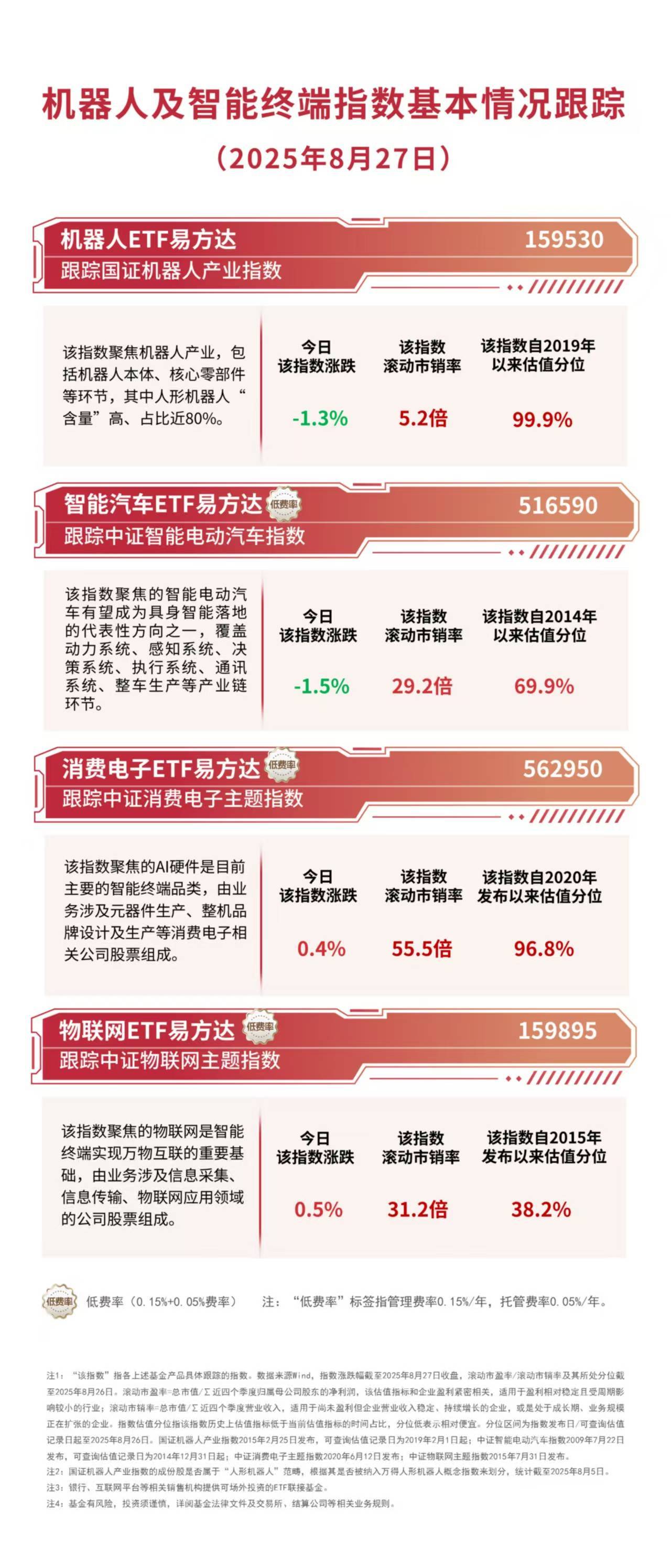
推动智能终端“万物智联”,机器人ETF易方达(159530)今日获超7000万份净申购
Sou Hu Cai Jing· 2025-08-27 11:44
Group 1 - The core viewpoint of the news highlights the performance of various indices related to technology and robotics, with the Zhongzheng Internet of Things Theme Index rising by 0.5% and the Zhongzheng Consumer Electronics Theme Index increasing by 0.4%, while the Guozheng Robotics Industry Index and Zhongzheng Smart Electric Vehicle Index fell by 1.3% and 1.5% respectively [1] - The E Fund Robotics ETF (159530) saw a net subscription of 74 million shares today, marking a continuous inflow of funds for seven consecutive trading days, totaling over 1.3 billion yuan, with the latest scale surpassing 6.3 billion yuan, setting a historical high [1] - The recently issued "Opinions on Deepening the Implementation of 'Artificial Intelligence+' Action" emphasizes the promotion of intelligent terminals and the development of a smart product ecosystem, focusing on smart connected vehicles, AI smartphones, intelligent robots, smart homes, and wearable devices [1]

山东圣阳电源股份有限公司 关于投资设立开源鸿蒙(山东)数字科技有限公司暨关联交易的公告
Zhong Guo Zheng Quan Bao - Zhong Zheng Wang· 2025-08-23 17:56
Summary of Key Points Core Viewpoint - The company plans to establish a joint venture named "OpenHarmony (Shandong) Digital Technology Co., Ltd." to capitalize on opportunities in the digital economy and enhance its growth potential in the energy sector through intelligent upgrades [2][20]. Group 1: Investment Overview - The joint venture will have a registered capital of RMB 50 million, with the company contributing RMB 5 million for a 10% stake [2][21]. - Other investors include Shandong Development Investment Holding Group (30%), Shandong Development Sci-Tech Investment Co., Ltd. (20%), Shandong Expressway Bridge Investment Management Co., Ltd. (20%), and Shenzhen Kaihong Digital Industry Development Co., Ltd. (20%) [2][21]. Group 2: Related Party Transactions - The transaction constitutes a related party transaction as Shandong Development Group is the controlling shareholder of the company [3][9]. - The board of directors approved the investment with unanimous consent, and independent directors confirmed the fairness of the transaction [4][29]. Group 3: Joint Venture Details - The joint venture aims to leverage the OpenHarmony ecosystem, which is positioned as a core digital infrastructure for various industries, including energy, finance, and healthcare [20][23]. - The joint venture's business scope includes computer system services, information technology consulting, and the development of new energy technologies [22][23]. Group 4: Strategic Alignment - The investment aligns with national strategic needs and policies, enhancing the company's sustainable development capabilities and diversifying its growth [30][31]. - The company aims to build an intelligent energy ecosystem based on the OpenHarmony platform, contributing to the digital economy and smart manufacturing [30][31]. Group 5: Financial and Operational Impact - The investment will be funded through the company's own resources, ensuring no significant impact on its financial status [31]. - The company will monitor the joint venture's operations closely to mitigate potential risks associated with market and policy changes [30][31].

从技术自主到生态飞轮:当鸿蒙5跨过「千万大关」
36氪· 2025-08-18 10:13
Core Viewpoint - The launch of HarmonyOS 5, achieving over 10 million device installations, marks a significant milestone in establishing a new operating system ecosystem that can challenge the dominance of iOS and Android [3][4][10]. Group 1: Milestone Achievement - The achievement of 10 million installations signifies a new phase for HarmonyOS, indicating a shift from concept validation to a fully operational ecosystem [7][35]. - HarmonyOS 5's success is attributed to the support of 8 million developers and a growing user base, which has helped it overcome initial challenges [4][10]. - The milestone is seen as a turning point in the competition for technological sovereignty in the operating system market, traditionally dominated by foreign giants [32][35]. Group 2: Technical and Development Challenges - The transition to HarmonyOS 5 involves significant technical challenges, including the need for developers to adapt applications to a completely new system architecture [11][14]. - The development of HarmonyOS has required substantial investment, with over 1.3 billion lines of code and a commitment of thousands of personnel over several years [12][14]. - The ecosystem's growth is contingent upon resolving the "chicken or egg" dilemma of user base versus developer engagement, which HarmonyOS aims to address through strategic device launches [19][20]. Group 3: Ecosystem Development - HarmonyOS is designed to support a wide range of devices, from mobile to IoT, positioning itself as a versatile platform for the interconnected future [15][30]. - The ecosystem is being built collaboratively with major Chinese tech companies, which are actively adapting their applications to HarmonyOS [24][26]. - The focus on supporting small and medium developers is crucial for fostering a diverse application ecosystem, with significant resources allocated to facilitate their integration [27][28]. Group 4: Future Prospects - The growth of HarmonyOS is expected to continue, with projections indicating a robust expansion of its application ecosystem and user base [31][35]. - The operating system's unique features, such as distributed technology and enhanced security, are anticipated to attract more users and developers [15][34]. - As HarmonyOS gains traction, it is poised to become a significant player in the global operating system landscape, potentially leading to increased international collaboration and market presence [26][32].

从技术自主到生态飞轮:当鸿蒙5跨过「千万大关」
3 6 Ke· 2025-08-18 10:07
Core Insights - HarmonyOS 5 has surpassed 10 million device installations, marking a significant milestone in establishing a new operating system ecosystem that breaks the dominance of iOS and Android [4][6][9] - The achievement reflects a shift towards a self-sustaining ecosystem where developers are motivated to invest and users have compelling reasons to choose HarmonyOS [3][6][29] Group 1: Milestone Achievement - The announcement of over 10 million installations of HarmonyOS 5 is a critical turning point, indicating the system's entry into a positive feedback loop of ecosystem development [4][6][9] - This milestone is supported by the collaboration of 8 million developers and a vast user base, showcasing the resilience and growth of the Harmony ecosystem [4][9][15] Group 2: Technical and Development Challenges - Transitioning to HarmonyOS 5 involves significant technical challenges, including the need for developers to adapt applications to a completely new architecture, which includes a self-developed kernel and file system [9][10][12] - The development process has required substantial investment, with hundreds of billions allocated over six years and a workforce of over 10,000 annually [12][19] Group 3: Ecosystem Building - HarmonyOS aims to create a robust ecosystem by addressing the "chicken or egg" dilemma of user and developer engagement, leveraging its growing device base to attract developers [17][29] - The strategy includes providing extensive support and resources for developers, such as migration tools and financial incentives, to facilitate the adaptation of popular applications like WeChat and Taobao [18][21][24] Group 4: Market Position and Future Outlook - With the recent success, HarmonyOS is positioned to challenge the existing operating system market dominated by foreign tech giants, aiming to establish a unique identity in the era of interconnected devices [13][26][28] - The growth of HarmonyOS is expected to continue, with plans for further integration across various device types, enhancing user experience and expanding its market presence [15][26][29]

华为、苹果再“撞档”?eSIM或是重要增量,行业或还是未来端侧AI必然选择
Xuan Gu Bao· 2025-08-12 05:26
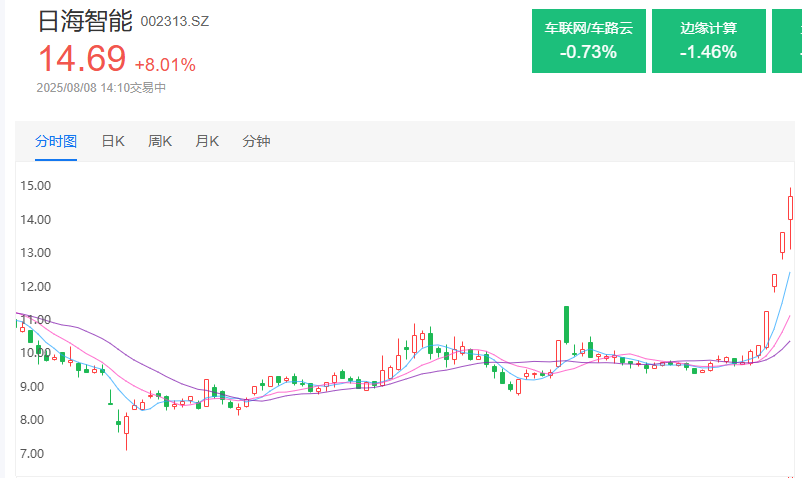
Group 1 - Major smartphone manufacturers like Huawei and Apple are pushing for eSIM technology, with Huawei planning to launch its first eSIM-supported foldable phone, the Mate XTs, potentially on September 10 [1] - OPPO is also expected to release its first batch of eSIM-supported phones by the end of this year, while Apple is set to unveil the iPhone 17 Air, which will eliminate the physical SIM card slot [2] - China's three major telecom operators have resumed eSIM services, with China Unicom leading the charge, having reintroduced eSIM in 25 cities primarily for IoT and wearable devices [2] Group 2 - The demand for real-time online connectivity in the AI era is increasing, making eSIM a preferred choice for devices like smartwatches and future wearable technology due to its space-saving and reliable connectivity features [3] - eSIM is expected to become a standard feature across all smart devices, potentially even non-cellular devices like home robots, as it can serve as a "digital ID" for regulatory purposes [3] - The eSIM market is projected to grow significantly, with GSMA Intelligence forecasting around 1 billion eSIM smartphones by the end of 2025, increasing to 6.9 billion by 2030 [4] Group 3 - The upcoming iPhone 17 series, particularly the iPhone 17 Air, is anticipated to be Apple's thinnest phone at 5.5mm, marking a complete shift to eSIM technology [5] - The eSIM sector has seen a surge in stock prices, with companies like Rihai Intelligent and Dongxin Peace experiencing significant gains [5] - The Ministry of Industry and Information Technology in China is actively researching the application of eSIM technology in various devices, which has positively impacted related stocks [7] Group 4 - The eSIM industry involves a complex ecosystem that includes chip design, platform management, operator services, device integration, and end-user applications [10]

决胜“十四五” 打好收官战|基建先行、技术突破、应用赋能 未来网络产业打造发展新优势
Xin Hua Wang· 2025-08-11 02:27
Group 1 - The future network industry is becoming a crucial support for cultivating new productive forces, driven by technological breakthroughs and application implementation, with a strong digital foundation established through advancements in 5G-A, space-ground networking, and industrial clusters [1][2] - By mid-2025, China's digital infrastructure is expected to achieve significant improvements in both quantity and quality, with over 4.55 million 5G base stations built and over 90% of administrative villages covered by 5G networks [2][3] - Local governments are actively promoting policies to accelerate the development of future networks, with initiatives in cities like Shanghai, Shandong, and Sichuan focusing on 6G, satellite internet, and quantum information technologies [3][4] Group 2 - Companies are accelerating collaborative innovation in the future network industry, with partnerships such as the one between Zhongke Shuguang and Zhongke Xingtai aimed at advancing the entire technology chain from chips to applications [3][4] - The integration of 5G-A and 6G with artificial intelligence is reshaping communication capabilities, emphasizing the importance of collaboration across demand, standards, technology, and ecosystem development [6][7] - The low-altitude economy is emerging as a new growth area for future network applications, with companies like China Telecom and China Mobile developing infrastructure for smart logistics and urban air traffic [7][8] Group 3 - The development of key technologies in 5G-A and 6G is progressing rapidly, with China positioned at the forefront globally, as evidenced by the establishment of the IMT-2030 (6G) promotion group and the release of over 50 research results [5][6] - The future network industry is expected to drive significant transformations across various sectors, with a focus on infrastructure, technological breakthroughs, and application empowerment, contributing to the successful completion of the 14th Five-Year Plan [8]

